
What is molar conductivity, and what is Kohlrausch’s law?
Answer in short
Molar conductivity, Λm = κ/c, is the conductivity of a solution per mole of electrolyte. It rises on dilution while κ falls. Kohlrausch’s law says that at infinite dilution each ion adds its own share: Λ°m = ν₊λ°₊ + ν₋λ°₋. This gives Λ°m of weak electrolytes, and from it their degree of dissociation and Ka.
Stuck on a question? Take a photo and Lagnever AI explains it step by step. Try it for 7 days for ₹2. Get it on Google Play
What are resistance, conductance and conductivity?
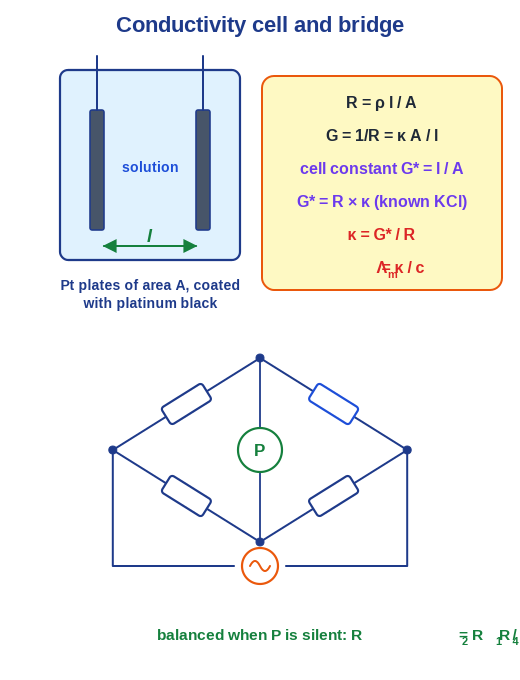
A longer wire resists current more and a thicker one less: R = ρl/A. The constant ρ is the resistivity, the resistance of a piece 1 m long and 1 m² across; its unit is Ω m, and 1 Ω m = 100 Ω cm. The inverse of resistance is conductance, G = 1/R, in siemens (S, the same as Ω⁻¹ or mho). The inverse of resistivity is conductivity, κ, in S m⁻¹; 1 S cm⁻¹ = 100 S m⁻¹. So
G = κA/l
In a metal, electrons carry the current and the metal does not change. In a solution, ions carry it. Ionic conductivity depends on the electrolyte, the size of its ions and how strongly water clings to them (solvation), the solvent and its viscosity, the concentration, and the temperature: unlike a metal, a solution conducts better when warm.
How do we measure the conductivity of a solution?
Two problems arise. Direct current would electrolyse the solution, so an alternating current source is used. And a liquid cannot be clipped into a circuit, so it goes into a conductivity cell: two platinum plates coated with platinum black, of area A, a distance l apart. The ratio l/A is the cell constant, G*. It is found by filling the cell with a KCl solution of known κ and measuring R:
G* = R × κ
After that, any solution’s conductivity is κ = G*/R. The resistance is found on a Wheatstone bridge with an a.c. source and a headphone or electronic detector, or read straight from a conductivity meter.
Our own example. A cell filled with 0.01 M KCl (κ = 0.00141 S cm⁻¹ in the book’s Table 2.3) shows 500 Ω. Then G* = 500 × 0.00141 = 0.705 cm⁻¹. Another solution in the same cell shows 1000 Ω, so its κ = 0.705/1000 = 7.05 × 10⁻⁴ S cm⁻¹.
What is molar conductivity?
Solutions of different strengths cannot be compared by κ alone, so we divide by the concentration:
Λm = κ/c
With κ in S m⁻¹ and c in mol m⁻³, Λm is in S m² mol⁻¹. In the units most problems use,
Λm (S cm² mol⁻¹) = κ (S cm⁻¹) × 1000 (cm³ L⁻¹) ÷ molarity (mol L⁻¹)
Why does κ fall but Λm rise on dilution?
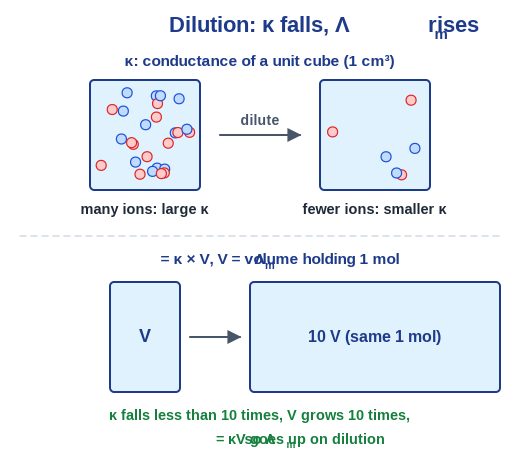
κ is the conductance of a unit cube of solution. Dilute it and each cube holds fewer ions, so κ falls, for every electrolyte. Λm is the conductance of all the solution that holds one mole, placed between electrodes a unit distance apart: Λm = κV. On dilution V grows faster than κ shrinks, so Λm rises.
How do strong and weak electrolytes differ?
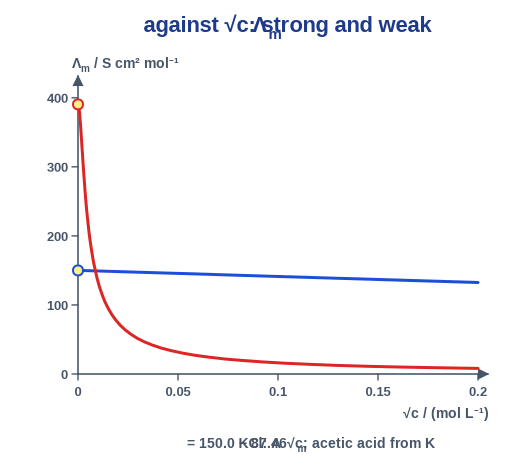
- Strong electrolytes (KCl, NaCl) are fully ionised already, so Λm rises only slowly: Λm = Λ°m − A√c. Plot Λm against √c, extend the straight line to √c = 0, and the intercept is Λ°m. The constant A is the same for all electrolytes of one charge type (1-1 like NaCl, 2-1 like CaCl₂, 2-2 like MgSO₄) in a given solvent at a given temperature.
- Weak electrolytes (acetic acid) are only slightly dissociated. On dilution more molecules split into ions, so Λm climbs steeply near zero concentration. Extending the curve does not work, and very dilute solutions conduct too little to measure well.
What is Kohlrausch’s law?
Kohlrausch compared Λ°m values of many strong electrolytes. Swapping sodium for potassium always changed Λ°m by about the same amount, whatever the anion; swapping chloride for bromide always changed it by about the same amount, whatever the cation. Each ion behaves as if it moves on its own. The law of independent migration of ions says:
Λ°m = ν₊λ°₊ + ν₋λ°₋
where λ°₊ and λ°₋ are the values for the cation and the anion at infinite dilution, and ν₊ and ν₋ how many of each the formula gives. From the book’s Table 2.4 (in S cm² mol⁻¹): Λ°m(NaCl) = 50.1 + 76.3 = 126.4, and Λ°m(NaOH) = 50.1 + 199.1 = 249.2.
How is Kohlrausch’s law used for weak electrolytes?
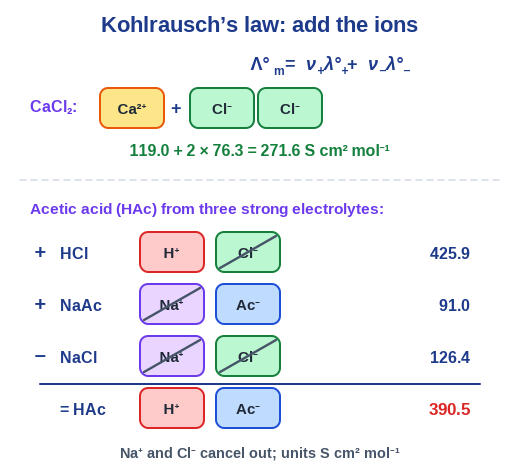
Λ°m of acetic acid (HAc) comes from three strong electrolytes whose values can be measured, because the sodium and chloride parts cancel:
Λ°m(HAc) = Λ°m(HCl) + Λ°m(NaAc) − Λ°m(NaCl)
At a concentration c, the degree of dissociation is about α = Λm/Λ°m, and the dissociation constant is
Ka = cα²/(1 − α)
Our own example. A 0.010 M weak acid HA has Λm = 20.0 S cm² mol⁻¹ and Λ°m = 400 S cm² mol⁻¹.
α = 20.0/400 = 0.05
Ka = 0.010 × (0.05)² ÷ (1 − 0.05) = 2.5 × 10⁻⁵ ÷ 0.95 = 2.6 × 10⁻⁵ mol L⁻¹
Only 5 molecules in 100 are split into ions at this concentration, which is why the acid conducts so poorly.
Next topic: electrolysis and Faraday’s laws. Previous topic: galvanic cells and the Nernst equation. See also the chapter notes and the NCERT solutions.
Practice
-
A conductivity cell has a cell constant of 1.2 cm⁻¹ and a solution in it has a resistance of 240 Ω. κ is:
Show answer
Answer: (a) 0.005 S cm⁻¹
-
From λ°(K⁺) = 73.5 and λ°(SO₄²⁻) = 160.0 S cm² mol⁻¹, Λ°m(K₂SO₄) is:
Show answer
Answer: (b) 307.0
-
Which statement about dilution is correct?
Show answer
Answer: (c) κ falls but Λm rises
-
Why is alternating current used to measure the resistance of a solution?
Show answer
Answer: Direct current would electrolyse the solution and change its composition while it is being measured; alternating current avoids this.
-
A weak acid HA at 0.010 M has Λm = 20.0 and Λ°m = 400 S cm² mol⁻¹. Find α and Ka.
Show answer
Answer: α = 20.0/400 = 0.05; Ka = cα²/(1 − α) = 0.010 × 0.0025/0.95 = 2.6 × 10⁻⁵ mol L⁻¹.
Questions students ask
What is the difference between conductivity and molar conductivity?
Conductivity κ is the conductance of a unit cube of the solution, so it depends on how many ions are packed into that cube. Molar conductivity Λm = κ/c is the conductance of the volume that holds one mole of electrolyte, so it compares electrolytes per mole.
Why does molar conductivity increase on dilution?
Λm = κV, where V is the volume holding one mole. On dilution V grows faster than κ falls. For weak electrolytes the degree of dissociation also rises, so Λm climbs steeply.
What is Kohlrausch’s law of independent migration of ions?
At infinite dilution, the limiting molar conductivity of an electrolyte is the sum of the limiting molar conductivities of its ions, each counted as many times as it appears: Λ°m = ν₊λ°₊ + ν₋λ°₋.
What are the applications of Kohlrausch’s law?
It gives Λ°m of any electrolyte from ion values, including weak electrolytes whose Λ°m cannot be found by extrapolation. With Λm at a known concentration, it then gives the degree of dissociation α = Λm/Λ°m and the dissociation constant.
Stuck on a question?
Take a photo and Lagnever AI explains it step by step. Try it for 7 days for ₹2.
Get it on Google Play Open in browser
For parents: after the trial, the plan renews monthly by UPI or card autopay. You can cancel anytime in the app.