
What is a galvanic cell, and what is the Nernst equation?
Answer in short
A galvanic cell turns the energy of a spontaneous redox reaction into electricity: oxidation at the negative anode, reduction at the positive cathode. Its standard emf is E°cell = E°cathode − E°anode, measured against the hydrogen electrode. The Nernst equation, E = E° − (0.059/n) log Q at 298 K, gives the emf at any concentration.
Stuck on a question? Take a photo and Lagnever AI explains it step by step. Try it for 7 days for ₹2. Get it on Google Play
What is a galvanic cell?
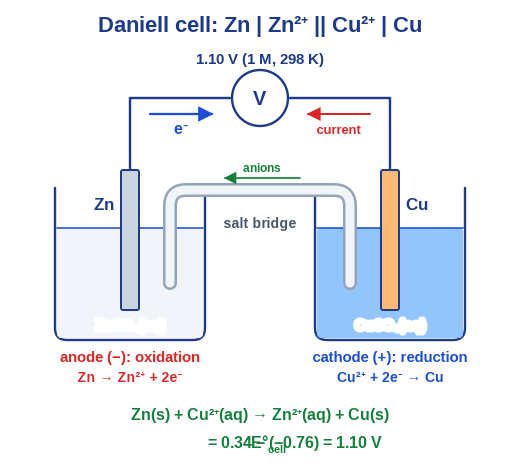
A galvanic (or voltaic) cell turns the energy released by a spontaneous redox reaction into electrical work, enough to run a fan, a heater or a motor. The two halves of the redox reaction are kept apart, so the electrons have to travel through an outside wire. The Daniell cell is the classic example:
- Zinc anode: Zn(s) → Zn²⁺(aq) + 2e⁻ (oxidation)
- Copper cathode: Cu²⁺(aq) + 2e⁻ → Cu(s) (reduction)
- Overall: Zn(s) + Cu²⁺(aq) → Zn²⁺(aq) + Cu(s)
Each half is a half-cell: a metal dipping in a solution of its ions. A salt bridge joins the two solutions so ions can move and charge does not pile up. If both electrodes dip in the same solution, no salt bridge is needed.
Why is the anode negative?
At the zinc surface, zinc atoms leave as Zn²⁺ ions and leave their electrons behind, so the metal becomes negative compared with the solution. At the copper surface, Cu²⁺ ions take electrons from the metal and settle on it, so copper becomes positive. This difference in potential between a metal and its solution is its electrode potential. Once the switch is closed, electrons flow through the wire from the negative anode to the positive cathode; conventional current flows the other way.
How is a cell written down?
Anode on the left, cathode on the right, a single line between a metal and its solution, a double line for the salt bridge:
Zn(s) | Zn²⁺(aq) || Cu²⁺(aq) | Cu(s)
Written this way the emf is positive: Ecell = Eright − Eleft. The emf is the potential difference when no current is drawn.
How do we measure an electrode potential?
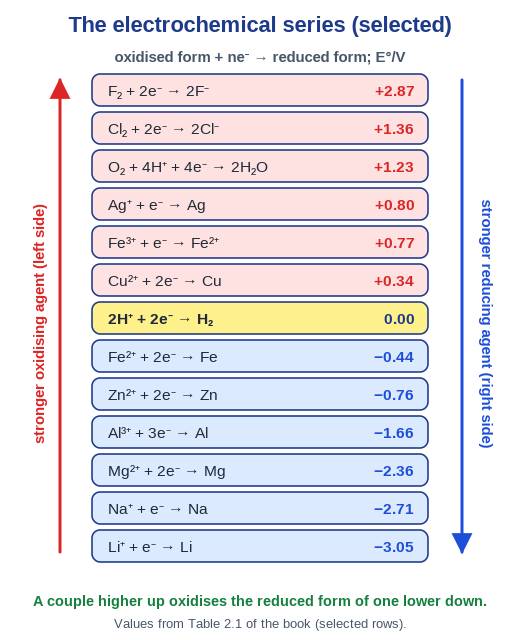
Only differences can be measured, so the standard hydrogen electrode, Pt(s) | H₂(g, 1 bar) | H⁺(aq, 1 M), is set at 0.00 V. Put it on the left, the half-cell under test on the right, with every species at unit concentration; the emf is then that half-cell’s standard electrode potential, E°. For example, E°(Cu²⁺/Cu) = +0.34 V and E°(Zn²⁺/Zn) = −0.76 V, so for the Daniell cell
E°cell = E°cathode − E°anode = 0.34 − (−0.76) = 1.10 V
A higher E° means a stronger oxidising agent; a lower one, a stronger reducing agent. Fluorine (2.87 V) and lithium (−3.05 V) are the two ends of the book’s table.
What does the Nernst equation say?
Real cells rarely have 1 M solutions. For a cell reaction aA + bB → cC + dD in which n electrons move,
Ecell = E°cell − (RT/nF) ln Q, with Q = [C]c[D]d/[A]a[B]b
Here R = 8.314 J K⁻¹ mol⁻¹ and F = 96487 C mol⁻¹. Solids and pure liquids are left out of Q. At 298 K, with base-10 logarithms:
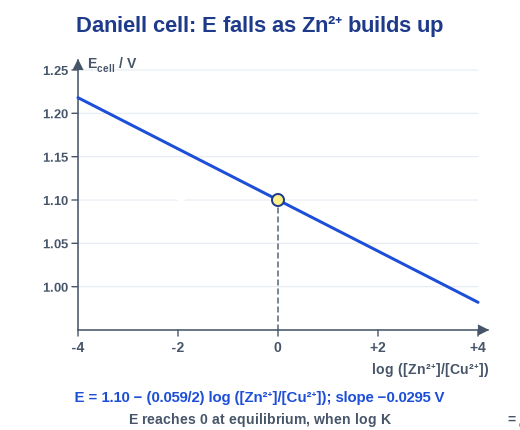
Ecell = E°cell − (0.059/n) log Q
Our own example. A Daniell cell has [Zn²⁺] = 0.01 M and [Cu²⁺] = 1 M at 298 K.
Q = [Zn²⁺]/[Cu²⁺] = 0.01, so log Q = −2
E = 1.10 − (0.059/2)(−2) = 1.10 + 0.059 = 1.159 V
Less zinc ion and more copper ion push the reaction forward, so the emf rises above 1.10 V. Swap the two concentrations and it falls to 1.041 V.
How do E°cell, ΔrG° and K connect?
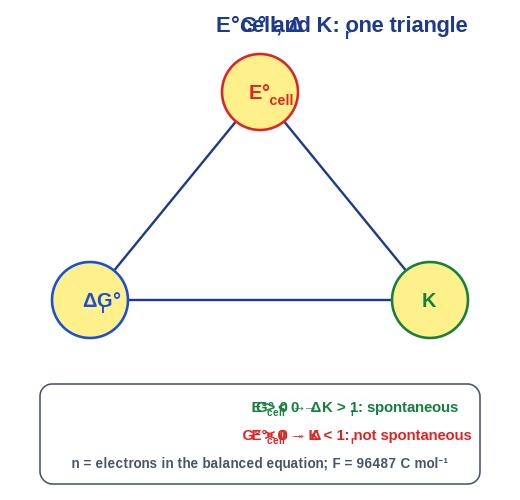
At equilibrium the cell is “flat”: E = 0 and Q = Kc. The Nernst equation then gives
E°cell = (2.303RT/nF) log Kc = (0.059/n) log Kc at 298 K
The largest work a cell can do equals the fall in Gibbs energy, so ΔrG° = −nFE°cell, and also ΔrG° = −RT ln K.
Our own example. Zn(s) + Ni²⁺(aq) → Zn²⁺(aq) + Ni(s), with E°(Ni²⁺/Ni) = −0.25 V and n = 2.
E°cell = −0.25 − (−0.76) = 0.51 V
ΔrG° = −2 × 96487 × 0.51 = −98 417 J mol⁻¹ ≈ −98.4 kJ mol⁻¹
log Kc = 2 × 0.51/0.059 = 17.29, so Kc ≈ 1.9 × 10¹⁷
A positive E° goes with a negative ΔrG° and a large K: zinc reduces nickel ions almost completely.
Next topic: conductance and Kohlrausch’s law. See also the chapter notes and the NCERT solutions.
Practice
-
E°(Zn²⁺/Zn) = −0.76 V and E°(Ni²⁺/Ni) = −0.25 V. E°cell for Zn | Zn²⁺ || Ni²⁺ | Ni is:
Show answer
Answer: (b) 0.51 V
-
In the cell Cu | Cu²⁺ || Ag⁺ | Ag, the electrons in the wire flow:
Show answer
Answer: (b) from Cu to Ag
-
For the Daniell cell at 298 K, if [Zn²⁺] = 1 M and [Cu²⁺] = 0.01 M, E is:
Show answer
Answer: (c) 1.041 V
-
Why is the SHE given a potential of exactly zero?
Show answer
Answer: A single electrode potential cannot be measured; only differences can. Fixing the SHE at 0.00 V gives a reference against which every other half-cell is measured.
-
For a cell reaction with n = 2 and E°cell = 0.059 V at 298 K, find Kc.
Show answer
Answer: log Kc = nE°/0.059 = 2 × 0.059/0.059 = 2, so Kc = 100.
Questions students ask
What is the difference between a galvanic and a Daniell cell?
A galvanic cell is any cell that makes electricity from a spontaneous redox reaction. The Daniell cell is one particular galvanic cell, with zinc in zinc sulphate and copper in copper sulphate, giving 1.1 V when both solutions are 1 M.
Why does a cell’s emf fall as it is used?
As the reaction runs, product ions build up and reactant ions are used up, so Q grows. By the Nernst equation E = E° − (0.059/n) log Q, the emf falls, and it reaches zero when the reaction reaches equilibrium.
What is the Nernst equation used for?
It gives the potential of an electrode or a cell at concentrations other than 1 M. Turned around, it gives equilibrium constants from E° values, and it is the basis for measuring pH and solubility products with cells.
Why does a negative E° mean a strong reducing agent?
A negative E° means the reduced form, such as zinc or lithium, gives up electrons more readily than hydrogen gas does. It is easily oxidised, so it reduces other species readily.
Stuck on a question?
Take a photo and Lagnever AI explains it step by step. Try it for 7 days for ₹2.
Get it on Google Play Open in browser
For parents: after the trial, the plan renews monthly by UPI or card autopay. You can cancel anytime in the app.