
NCERT Solutions Class 12 Chemistry Chapter 3: Chemical Kinetics
Answers to all 30 end-of-unit exercises, all 9 Intext Questions and all 10 worked examples of Unit 3, Chemical Kinetics, of Chemistry Part I, the Class 12 NCERT textbook. Page numbers follow the 2026-27 reprint (pages 61–88). The exercises come first, quoted from the book; the Intext Questions and the examples follow, restated in short. Short notes: Chapter 3 notes.
Constants and logs used. R = 8.314 J K⁻¹ mol⁻¹; ln x = 2.303 log x; log 2 = 0.3010, so ln 2 = 0.693. Temperatures in kelvin are °C + 273, as the book takes them. Logarithms are worked to four figures, which is what the book’s log tables (Appendix IV) give.
Stay safe. Hydrogen peroxide, acids and potassium permanganate irritate skin and eyes, and several gases in these questions are poisonous. Do rate experiments only in the school laboratory with your teacher.
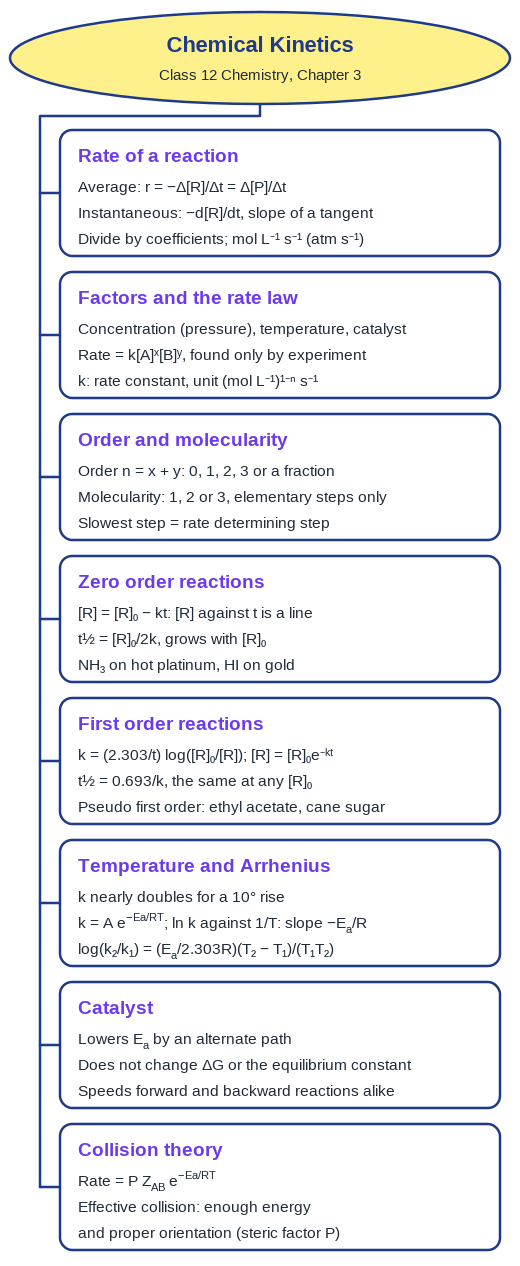
Exercises 3.1 to 3.7: rate laws, order and units
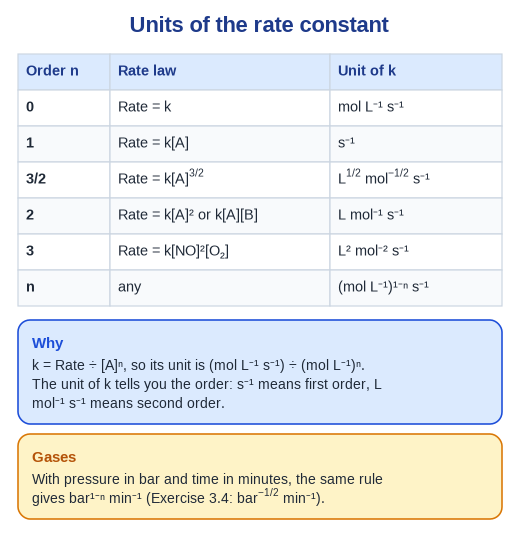
3.1 “From the rate expression for the following reactions, determine their order of reaction and the dimensions of the rate constants. (i) 3NO(g) → N₂O (g) Rate = k[NO]² (ii) H₂O₂ (aq) + 3I⁻ (aq) + 2H⁺ → 2H₂O (l) + I₃⁻ Rate = k[H₂O₂][I⁻] (iii) CH₃CHO (g) → CH₄ (g) + CO(g) Rate = k [CH₃CHO]3/2 (iv) C₂H₅Cl (g) → C₂H₄ (g) + HCl (g) Rate = k [C₂H₅Cl]”
The order is the sum of the powers in the rate law, and k = Rate ÷ (concentration)n, so its unit is (mol L⁻¹)1−n s⁻¹.
(i) Order 2. k = (mol L⁻¹ s⁻¹)/(mol L⁻¹)² = L mol⁻¹ s⁻¹ (dimensions: concentration⁻¹ time⁻¹).
(ii) Order 1 + 1 = 2. k in L mol⁻¹ s⁻¹. (The balanced equation has six species on the left, but the rate law depends only on H₂O₂ and I⁻.)
(iii) Order 3/2. k = (mol L⁻¹ s⁻¹)/(mol L⁻¹)3/2 = (mol L⁻¹)−1/2 s⁻¹ = L1/2 mol−1/2 s⁻¹ (concentration−1/2 time⁻¹).
(iv) Order 1. k in s⁻¹ (time⁻¹).
3.2 “For the reaction: 2A + B → A₂B the rate = k[A][B]² with k = 2.0 × 10⁻⁶ mol⁻² L² s⁻¹. Calculate the initial rate of the reaction when [A] = 0.1 mol L⁻¹, [B] = 0.2 mol L⁻¹. Calculate the rate of reaction after [A] is reduced to 0.06 mol L⁻¹.”
Initial rate = k[A][B]² = 2.0 × 10⁻⁶ × 0.1 × (0.2)² = 2.0 × 10⁻⁶ × 0.1 × 0.04 = 8.0 × 10⁻⁹ mol L⁻¹ s⁻¹
When [A] falls from 0.1 to 0.06 mol L⁻¹, 0.04 mol L⁻¹ of A has reacted. By the equation 2 mol of A react with 1 mol of B, so B used = 0.04/2 = 0.02 mol L⁻¹ and [B] = 0.2 − 0.02 = 0.18 mol L⁻¹.
Rate = 2.0 × 10⁻⁶ × 0.06 × (0.18)² = 2.0 × 10⁻⁶ × 0.06 × 0.0324 = 3.89 × 10⁻⁹ mol L⁻¹ s⁻¹
3.3 “The decomposition of NH₃ on platinum surface is zero order reaction. What are the rates of production of N₂ and H₂ if k = 2.5 × 10⁻⁴ mol⁻¹ L s⁻¹?”
For 2NH₃ → N₂ + 3H₂, the rate of reaction is
Rate = −½ d[NH₃]/dt = d[N₂]/dt = ⅓ d[H₂]/dt
For a zero order reaction, Rate = k[NH₃]⁰ = k = 2.5 × 10⁻⁴ mol L⁻¹ s⁻¹. So
Rate of production of N₂ = 2.5 × 10⁻⁴ mol L⁻¹ s⁻¹
Rate of production of H₂ = 3 × 2.5 × 10⁻⁴ = 7.5 × 10⁻⁴ mol L⁻¹ s⁻¹
(NH₃ is used up at 2 × 2.5 × 10⁻⁴ = 5.0 × 10⁻⁴ mol L⁻¹ s⁻¹.) The question prints the unit of k as “mol⁻¹ L s⁻¹”; for a zero order reaction k has the unit of a rate, mol L⁻¹ s⁻¹, which is used here.
3.4 “The decomposition of dimethyl ether leads to the formation of CH₄, H₂ and CO and the reaction rate is given by Rate = k [CH₃OCH₃]3/2 The rate of reaction is followed by increase in pressure in a closed vessel, so the rate can also be expressed in terms of the partial pressure of dimethyl ether, i.e., Rate = k (pCH₃OCH₃)3/2 If the pressure is measured in bar and time in minutes, then what are the units of rate and rate constants?”
Rate is a change of pressure per unit time: unit bar min⁻¹.
k = Rate/(p)3/2 = (bar min⁻¹)/(bar3/2) = bar−1/2 min⁻¹
(The answer key prints bar−1/2 s⁻¹; with time in minutes, as the question says, it is bar−1/2 min⁻¹.)
3.5 “Mention the factors that affect the rate of a chemical reaction.”
The chapter names three:
- Concentration of the reactants (pressure, for gases): the rate usually rises with concentration, as the rate law shows.
- Temperature: most rates rise with temperature; for a 10° rise k nearly doubles.
- Catalyst: a catalyst gives a path of lower activation energy and raises the rate.
Extra (beyond the unit): the nature of the reactants, the surface area of a solid (powder reacts faster than a lump) and, for some reactions, light also affect the rate.
3.6 “A reaction is second order with respect to a reactant. How is the rate of reaction affected if the concentration of the reactant is (i) doubled (ii) reduced to half ?”
Rate = k[A]².
(i) Rate′ = k(2[A])² = 4k[A]²: the rate becomes 4 times.
(ii) Rate′ = k([A]/2)² = ¼k[A]²: the rate becomes ¼ of the original.
3.7 “What is the effect of temperature on the rate constant of a reaction? How can this effect of temperature on rate constant be represented quantitatively?”
The rate constant of most reactions increases with temperature; for a rise of 10° it nearly doubles. The reason is that more molecules then have energy equal to or greater than the activation energy.
Quantitatively, by the Arrhenius equation:
k = A e−Ea/RT, or ln k = ln A − Ea/RT
where A is the Arrhenius (frequency) factor, Ea the activation energy, R = 8.314 J K⁻¹ mol⁻¹ and T the temperature in kelvin. A plot of ln k against 1/T is a straight line of slope −Ea/R. For two temperatures:
log(k₂/k₁) = (Ea/2.303R) × (T₂ − T₁)/(T₁T₂)
Exercises 3.8 to 3.12: rates and rate laws from data
3.8 “In a pseudo first order reaction in water, the following results were obtained: t/s 0 30 60 90; [A]/ mol L⁻¹ 0.55 0.31 0.17 0.085. Calculate the average rate of reaction between the time interval 30 to 60 seconds.”
rav = −Δ[A]/Δt = −(0.17 − 0.31)/(60 − 30) = 0.14/30 = 4.67 × 10⁻³ mol L⁻¹ s⁻¹
(The answer key also prints “(ii) 1.98 × 10⁻² s⁻¹”, the pseudo first order rate constant, which the older book asked for. It checks: (2.303/t) log(0.55/[A]) gives 1.91 × 10⁻², 1.96 × 10⁻² and 2.08 × 10⁻² s⁻¹ at 30, 60 and 90 s, average 1.98 × 10⁻² s⁻¹.)
3.9 “A reaction is first order in A and second order in B. (i) Write the differential rate equation. (ii) How is the rate affected on increasing the concentration of B three times? (iii) How is the rate affected when the concentrations of both A and B are doubled?”
(i) −d[R]/dt = k[A][B]² (the rate of disappearance of the reactants, per mole of reaction).
(ii) [B] → 3[B]: Rate′ = k[A] × (3[B])² = 9k[A][B]². The rate becomes 9 times.
(iii) Both doubled: Rate′ = k(2[A])(2[B])² = 2 × 4 × k[A][B]² = 8 times the original.
3.10 “In a reaction between A and B, the initial rate of reaction (r₀) was measured for different initial concentrations of A and B as given below: A/ mol L⁻¹ 0.20 0.20 0.40; B/ mol L⁻¹ 0.30 0.10 0.05; r₀/mol L⁻¹s⁻¹ 5.07 × 10⁻⁵ 5.07 × 10⁻⁵ 1.43 × 10⁻⁴. What is the order of the reaction with respect to A and B?”
Let r₀ = k[A]x[B]y.
Experiments 1 and 2: [A] is the same, [B] falls from 0.30 to 0.10, and the rate is unchanged. So (0.30/0.10)y = 1, and y = 0: zero order in B.
Experiments 2 and 3: since the order in B is zero, the change in [B] does not matter. [A] doubles from 0.20 to 0.40 and the rate goes from 5.07 × 10⁻⁵ to 1.43 × 10⁻⁴:
2x = 1.43 × 10⁻⁴ ÷ 5.07 × 10⁻⁵ = 2.82
x = log 2.82 ÷ log 2 = 0.4502 ÷ 0.3010 = 1.496 ≈ 1.5
Order with respect to A = 1.5, with respect to B = 0; Rate = k[A]3/2.
3.11 “The following results have been obtained during the kinetic studies of the reaction: 2A + B → C + D. Experiment [A]/mol L⁻¹ [B]/mol L⁻¹ Initial rate of formation of D/mol L⁻¹ min⁻¹; I 0.1 0.1 6.0 × 10⁻³; II 0.3 0.2 7.2 × 10⁻²; III 0.3 0.4 2.88 × 10⁻¹; IV 0.4 0.1 2.40 × 10⁻². Determine the rate law and the rate constant for the reaction.”
Let Rate = k[A]x[B]y.
I and IV ([B] the same, [A] × 4): 2.40 × 10⁻² ÷ 6.0 × 10⁻³ = 4 = 4x, so x = 1.
II and III ([A] the same, [B] × 2): 2.88 × 10⁻¹ ÷ 7.2 × 10⁻² = 4 = 2y, so y = 2.
Rate = k[A][B]²
From I: k = 6.0 × 10⁻³ ÷ (0.1 × 0.1²) = 6.0 × 10⁻³ ÷ 10⁻³ = 6.0 mol⁻² L² min⁻¹ (that is, 6.0 M⁻² min⁻¹)
Check with II: 6.0 × 0.3 × 0.2² = 0.072 = 7.2 × 10⁻², as measured; III and IV agree too.
3.12 “The reaction between A and B is first order with respect to A and zero order with respect to B. Fill in the blanks in the following table: Experiment [A]/ mol L⁻¹ [B]/ mol L⁻¹ Initial rate/ mol L⁻¹ min⁻¹; I 0.1 0.1 2.0 × 10⁻²; II – 0.2 4.0 × 10⁻²; III 0.4 0.4 –; IV – 0.2 2.0 × 10⁻²”
Rate = k[A][B]⁰ = k[A]. From I: k = 2.0 × 10⁻² ÷ 0.1 = 0.2 min⁻¹.
II: [A] = 4.0 × 10⁻² ÷ 0.2 = 0.2 mol L⁻¹
III: Rate = 0.2 × 0.4 = 8.0 × 10⁻² mol L⁻¹ min⁻¹
IV: [A] = 2.0 × 10⁻² ÷ 0.2 = 0.1 mol L⁻¹
| Exp. | [A] / mol L⁻¹ | Rate / mol L⁻¹ min⁻¹ |
|---|---|---|
| I | 0.1 | 2.0 × 10⁻² |
| II | 0.2 | 4.0 × 10⁻² |
| III | 0.4 | 8.0 × 10⁻² |
| IV | 0.1 | 2.0 × 10⁻² |
([B] does not matter, because the reaction is zero order in B.)
Exercises 3.13 to 3.21: first order reactions and half-life
3.13 “Calculate the half-life of a first order reaction from their rate constants given below: (i) 200 s⁻¹ (ii) 2 min⁻¹ (iii) 4 years⁻¹”
t½ = 0.693/k
(i) 0.693/200 s⁻¹ = 3.47 × 10⁻³ s
(ii) 0.693/2 min⁻¹ = 0.35 min (0.3465 min, about 21 s)
(iii) 0.693/4 years⁻¹ = 0.173 years
3.14 “The half-life for radioactive decay of ¹⁴C is 5730 years. An archaeological artifact containing wood had only 80% of the ¹⁴C found in a living tree. Estimate the age of the sample.”
Radioactive decay is first order. k = 0.693/5730 = 1.209 × 10⁻⁴ year⁻¹.
[R]₀/[R] = 100/80 = 1.25; log 1.25 = 0.0969
t = (2.303/k) log([R]₀/[R]) = (2.303 ÷ 1.209 × 10⁻⁴) × 0.0969 = 1845 years (about 1.8 × 10³ years)
3.15 “The experimental data for decomposition of N₂O₅ [2N₂O₅ → 4NO₂ + O₂] in gas phase at 318K are given below: t/s 0 400 800 1200 1600 2000 2400 2800 3200; 10² × [N₂O₅]/ mol L⁻¹ 1.63 1.36 1.14 0.93 0.78 0.64 0.53 0.43 0.35 (i) Plot [N₂O₅] against t. (ii) Find the half-life period for the reaction. (iii) Draw a graph between log[N₂O₅] and t. (iv) What is the rate law ? (v) Calculate the rate constant. (vi) Calculate the half-life period from k and compare it with (ii).”
(i) The plot falls as a smooth curve, steeply at first and then more slowly.
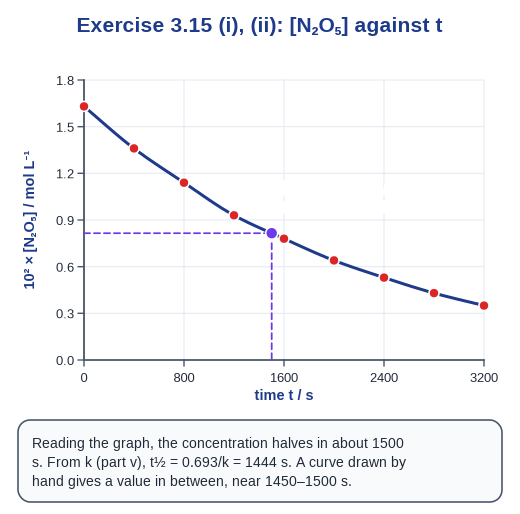
(ii) Half of 1.63 × 10⁻² is 0.815 × 10⁻² mol L⁻¹. The curve reaches it between 1200 s (0.93) and 1600 s (0.78), at about 1500 s. Reading from other starting points (1.36 → 0.68, or 1.14 → 0.57) gives about 1490 s and 1450 s, so t½ ≈ 1450–1500 s.
(iii) The values of log[N₂O₅] (with [N₂O₅] in mol L⁻¹) are:
| t / s | 10² × [N₂O₅] | log[N₂O₅] |
|---|---|---|
| 0 | 1.63 | −1.788 |
| 400 | 1.36 | −1.866 |
| 800 | 1.14 | −1.943 |
| 1200 | 0.93 | −2.032 |
| 1600 | 0.78 | −2.108 |
| 2000 | 0.64 | −2.194 |
| 2400 | 0.53 | −2.276 |
| 2800 | 0.43 | −2.367 |
| 3200 | 0.35 | −2.456 |
They lie on a straight line.
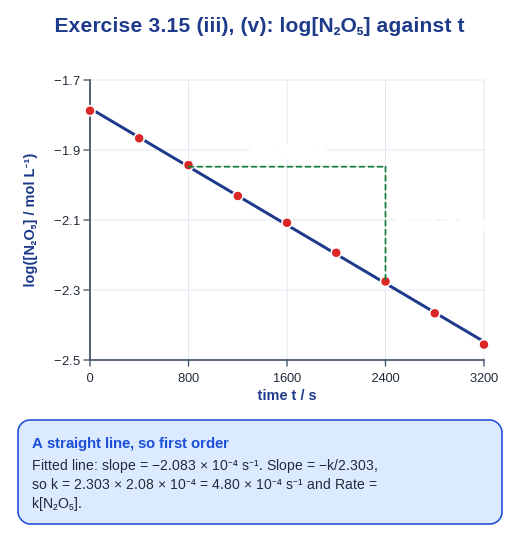
(iv) A straight line for log[N₂O₅] against t means the reaction is first order: Rate = k[N₂O₅].
(v) The least-squares straight line through the points has slope −2.08 × 10⁻⁴ s⁻¹. Since log[R] = log[R]₀ − kt/2.303, the slope is −k/2.303:
k = 2.303 × 2.08 × 10⁻⁴ = 4.80 × 10⁻⁴ s⁻¹
(From the first and last points alone: k = (2.303/3200) log(1.63/0.35) = (2.303/3200) × 0.668 = 4.81 × 10⁻⁴ s⁻¹.)
(vi) t½ = 0.693/k = 0.693 ÷ 4.80 × 10⁻⁴ = 1444 s, about 1440 s. This agrees with the 1450–1500 s read from the graph in (ii) within the accuracy of reading a curve.
3.16 “The rate constant for a first order reaction is 60 s⁻¹. How much time will it take to reduce the initial concentration of the reactant to its 1/16th value?”
t = (2.303/k) log([R]₀/[R]) = (2.303/60) log 16 = 0.03838 × 1.2041 = 4.62 × 10⁻² s
(Check: 1/16 = (½)⁴ is four half-lives, 4 × 0.693/60 = 0.0462 s.)
3.17 “During nuclear explosion, one of the products is ⁹⁰Sr with half-life of 28.1 years. If 1µg of ⁹⁰Sr was absorbed in the bones of a newly born baby instead of calcium, how much of it will remain after 10 years and 60 years if it is not lost metabolically.”
k = 0.693/28.1 = 0.02466 year⁻¹. For first order decay, log([R]₀/[R]) = kt/2.303.
After 10 years: log(1/[R]) = 0.02466 × 10 ÷ 2.303 = 0.1071, so 1/[R] = 1.280 and [R] = 0.781 µg (0.7814 µg)
After 60 years: log(1/[R]) = 0.02466 × 60 ÷ 2.303 = 0.6425, so 1/[R] = 4.390 and [R] = 0.228 µg
(The key prints 0.227 µg for 60 years; the small difference is rounding, and both are 0.23 µg to two figures. Sixty years is a little over two half-lives, so a little under ¼ µg is left.)
3.18 “For a first order reaction, show that time required for 99% completion is twice the time required for the completion of 90% of reaction.”
At 99% completion, [R] = [R]₀/100: t₉₉ = (2.303/k) log 100 = (2.303/k) × 2
At 90% completion, [R] = [R]₀/10: t₉₀ = (2.303/k) log 10 = (2.303/k) × 1
So t₉₉/t₉₀ = 2: the time for 99% completion is twice the time for 90%.
3.19 “A first order reaction takes 40 min for 30% decomposition. Calculate t₁/₂.”
After 30% decomposes, 70% is left: [R]₀/[R] = 100/70.
k = (2.303/40) log(100/70) = (2.303/40) × 0.1549 = 8.918 × 10⁻³ min⁻¹
t½ = 0.693/k = 0.693 ÷ 8.918 × 10⁻³ = 77.7 min
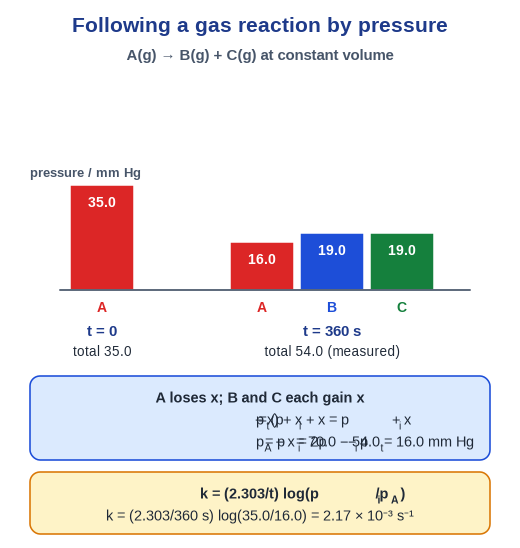
3.20 “For the decomposition of azoisopropane to hexane and nitrogen at 543 K, the following data are obtained. t (sec) P(mm of Hg); 0 35.0; 360 54.0; 720 63.0. Calculate the rate constant.”
The reaction is (CH₃)₂CHN=NCH(CH₃)₂(g) → C₆H₁₄(g) + N₂(g): one gas molecule gives two, so it is of the form A → B + C. With pᵢ = 35.0 mm Hg, if A falls by x, the total pressure is pₜ = pᵢ + x, and the pressure of A is pA = 2pᵢ − pₜ.
k = (2.303/t) log[pᵢ/(2pᵢ − pₜ)]
At t = 360 s: pA = 70.0 − 54.0 = 16.0 mm Hg; k = (2.303/360) log(35.0/16.0) = (2.303/360) × 0.3400 = 2.175 × 10⁻³ s⁻¹
At t = 720 s: pA = 70.0 − 63.0 = 7.0 mm Hg; k = (2.303/720) log(35.0/7.0) = (2.303/720) × 0.6990 = 2.236 × 10⁻³ s⁻¹
Average: k = 2.205 × 10⁻³, so k ≈ 2.2 × 10⁻³ s⁻¹ (the key gives 2.20 × 10⁻³ s⁻¹)
3.21 “The following data were obtained during the first order thermal decomposition of SO₂Cl₂ at a constant volume. SO₂Cl₂ (g) → SO₂ (g) + Cl₂ (g) Experiment Time/s⁻¹ Total pressure/atm; 1 0 0.5; 2 100 0.6. Calculate the rate of the reaction when total pressure is 0.65 atm.”
(The column heading “Time/s⁻¹” means time in seconds.) SO₂Cl₂ → SO₂ + Cl₂ is of the form A → B + C, so pSO₂Cl₂ = 2pᵢ − pₜ, with pᵢ = 0.5 atm.
At 100 s: pSO₂Cl₂ = 1.0 − 0.6 = 0.4 atm
k = (2.303/100) log(0.5/0.4) = (2.303/100) × 0.0969 = 2.23 × 10⁻³ s⁻¹
When pₜ = 0.65 atm: pSO₂Cl₂ = 1.0 − 0.65 = 0.35 atm
Rate = k × pSO₂Cl₂ = 2.23 × 10⁻³ × 0.35 = 7.8 × 10⁻⁴ atm s⁻¹
Exercises 3.22 to 3.30: temperature and the Arrhenius equation
3.22 “The rate constant for the decomposition of N₂O₅ at various temperatures is given below: T/°C 0 20 40 60 80; 10⁵ × k/s⁻¹ 0.0787 1.70 25.7 178 2140. Draw a graph between ln k and 1/T and calculate the values of A and Ea. Predict the rate constant at 30° and 50°C.”
| T / K | 10³/T (K⁻¹) | ln (k/s⁻¹) |
|---|---|---|
| 273 | 3.663 | −14.06 |
| 293 | 3.413 | −10.98 |
| 313 | 3.195 | −8.27 |
| 333 | 3.003 | −6.33 |
| 353 | 2.833 | −3.84 |
The points lie close to a straight line (the 60 °C point sits a little below it). The least-squares line through them is
ln k = 30.29 − 12 100 K/T
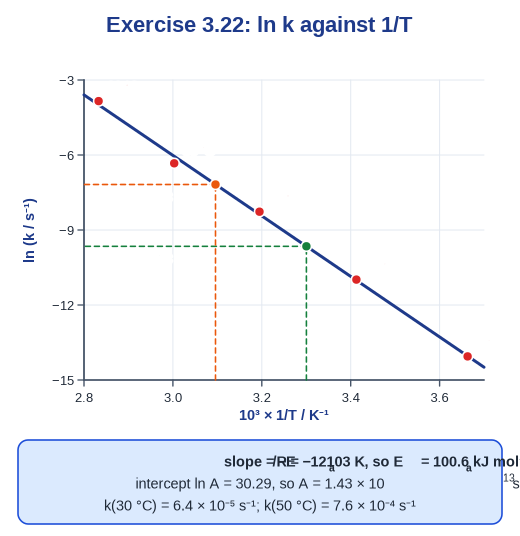
Slope = −Ea/R = −12 100 K, so Ea = 12 100 × 8.314 = 1.006 × 10⁵ J mol⁻¹ = 100.6 kJ mol⁻¹
Intercept = ln A = 30.29, so A = 1.4 × 10¹³ s⁻¹
At 30 °C (303 K): ln k = 30.29 − 12 100/303 = −9.65, so k ≈ 6.4 × 10⁻⁵ s⁻¹
At 50 °C (323 K): ln k = 30.29 − 12 100/323 = −7.18, so k ≈ 7.6 × 10⁻⁴ s⁻¹
A line drawn by hand gives slightly different numbers (Ea near 100 kJ mol⁻¹); the answer key gives none for this exercise.
3.23 “The rate constant for the decomposition of hydrocarbons is 2.418 × 10⁻⁵s⁻¹ at 546 K. If the energy of activation is 179.9 kJ/mol, what will be the value of pre-exponential factor.”
k = A e−Ea/RT, so log A = log k + Ea/(2.303RT).
Ea/(2.303RT) = 179 900 ÷ (2.303 × 8.314 × 546) = 179 900 ÷ 10 454 = 17.208
log A = log(2.418 × 10⁻⁵) + 17.208 = −4.617 + 17.208 = 12.592
A = 3.9 × 10¹² s⁻¹
3.24 “Consider a certain reaction A → Products with k = 2.0 × 10⁻²s⁻¹. Calculate the concentration of A remaining after 100 s if the initial concentration of A is 1.0 mol L⁻¹.”
The unit s⁻¹ shows a first order reaction. log([A]₀/[A]) = kt/2.303 = 2.0 × 10⁻² × 100 ÷ 2.303 = 0.8684
[A]₀/[A] = antilog 0.8684 = 7.39, so [A] = 1.0/7.39 = 0.135 mol L⁻¹
(The same as [A] = [A]₀e−kt = e⁻² = 0.135.)
3.25 “Sucrose decomposes in acid solution into glucose and fructose according to the first order rate law, with t₁/₂ = 3.00 hours. What fraction of sample of sucrose remains after 8 hours ?”
k = 0.693/3.00 = 0.231 h⁻¹
log([R]₀/[R]) = kt/2.303 = 0.231 × 8 ÷ 2.303 = 0.8024, so [R]₀/[R] = 6.35
Fraction left = [R]/[R]₀ = 1/6.35 = 0.158 (about 16%)
(The key prints “0.158 M”; it is a fraction, so it has no unit.)
3.26 “The decomposition of hydrocarbon follows the equation k = (4.5 × 10¹¹s⁻¹) e−28000K/T Calculate Ea.”
Comparing with k = A e−Ea/RT: Ea/R = 28 000 K.
Ea = 28 000 K × 8.314 J K⁻¹ mol⁻¹ = 232 792 J mol⁻¹ = 232.79 kJ mol⁻¹
3.27 “The rate constant for the first order decomposition of H₂O₂ is given by the following equation: log k = 14.34 – 1.25 × 10⁴K/T Calculate Ea for this reaction and at what temperature will its half-period be 256 minutes?”
The Arrhenius equation in base-10 logs is log k = log A − Ea/(2.303RT). Comparing:
Ea/(2.303R) = 1.25 × 10⁴ K
Ea = 1.25 × 10⁴ × 2.303 × 8.314 = 239 339 J mol⁻¹ = 239.3 kJ mol⁻¹
For t½ = 256 min = 15 360 s: k = 0.693/15 360 = 4.51 × 10⁻⁵ s⁻¹, so log k = −4.346.
−4.346 = 14.34 − 1.25 × 10⁴/T, so 1.25 × 10⁴/T = 18.686 and T = 669 K
3.28 “The decomposition of A into product has value of k as 4.5 × 10³ s⁻¹ at 10°C and energy of activation 60 kJ mol⁻¹. At what temperature would k be 1.5 × 10⁴s⁻¹?”
T₁ = 283 K, k₁ = 4.5 × 10³ s⁻¹, k₂ = 1.5 × 10⁴ s⁻¹, Ea = 60 000 J mol⁻¹.
log(k₂/k₁) = (Ea/2.303R)(1/T₁ − 1/T₂)
log 3.333 = 0.5229 = (60 000 ÷ 19.147)(1/283 − 1/T₂) = 3133.6 (1/283 − 1/T₂)
1/283 − 1/T₂ = 1.669 × 10⁻⁴, so 1/T₂ = 3.534 × 10⁻³ − 1.669 × 10⁻⁴ = 3.367 × 10⁻³ K⁻¹
T₂ = 297 K = 24 °C
3.29 “The time required for 10% completion of a first order reaction at 298K is equal to that required for its 25% completion at 308K. If the value of A is 4 × 10¹⁰s⁻¹. Calculate k at 318K and Ea.”
For a first order reaction, t = (2.303/k) log([R]₀/[R]).
At 298 K, 10% done: t = (2.303/k₂₉₈) log(100/90). At 308 K, 25% done: t = (2.303/k₃₀₈) log(100/75). The times are equal, so
k₃₀₈/k₂₉₈ = log(4/3)/log(10/9) = 0.1249 ÷ 0.04576 = 2.730
log 2.730 = 0.4362 = (Ea/2.303R) × (308 − 298)/(298 × 308)
Ea = 0.4362 × 19.147 × 9178.4 = 76 660 J mol⁻¹ ≈ 76.7 kJ mol⁻¹
At 318 K: log k = log A − Ea/(2.303RT) = 10.602 − 76 660/(19.147 × 318) = 10.602 − 12.591 = −1.989
k = 1.03 × 10⁻² s⁻¹
(The key prints Ea = 76.750 kJ mol⁻¹ and k = 0.9965 × 10⁻² s⁻¹. Our Ea is 0.09 kJ lower; at 318 K every 0.1 kJ mol⁻¹ in Ea changes k by about 4%, which explains the gap. Both round to k ≈ 1.0 × 10⁻² s⁻¹.)
3.30 “The rate of a reaction quadruples when the temperature changes from 293 K to 313 K. Calculate the energy of activation of the reaction assuming that it does not change with temperature.”
log(k₂/k₁) = log 4 = 0.6021 = (Ea/2.303R) × (313 − 293)/(293 × 313)
Ea = 0.6021 × 2.303 × 8.314 × (293 × 313)/20 = 0.6021 × 19.147 × 4585.5 = 52 860 J mol⁻¹ = 52.86 kJ mol⁻¹ (the key gives 52.8 kJ mol⁻¹)
Intext Questions 3.1 to 3.9
Intext 3.1 (page 66): For R → P, [R] falls from 0.03 M to 0.02 M in 25 minutes. Find the average rate in minutes and in seconds.
rav = −Δ[R]/Δt = (0.03 − 0.02)/25 = 4 × 10⁻⁴ M min⁻¹
In seconds: 0.01/(25 × 60) = 0.01/1500 = 6.67 × 10⁻⁶ M s⁻¹ (the book’s answer prints 6.66 × 10⁻⁶ M s⁻¹)
Intext 3.2 (page 66): For 2A → products, [A] falls from 0.5 to 0.4 mol L⁻¹ in 10 minutes. Find the rate in this interval.
Rate of disappearance of A = −Δ[A]/Δt = 0.1/10 = 0.01 mol L⁻¹ min⁻¹
Rate of reaction = −½ Δ[A]/Δt = 0.005 mol L⁻¹ min⁻¹
(The book’s answer calls 0.005 mol L⁻¹ min⁻¹ the “rate of disappearance of A”; it is the rate of reaction, half the rate at which A disappears.)
Intext 3.3 (page 71): The rate law is r = k[A]½[B]². What is the order?
Order = ½ + 2 = 2.5
Intext 3.4 (page 71): X → Y is second order. How does the rate of forming Y change if [X] is tripled?
Rate = k[X]². With 3[X], Rate′ = k(3[X])² = 9k[X]²: the rate becomes 9 times.
Intext 3.5 (page 78): A first order reaction has k = 1.15 × 10⁻³ s⁻¹. How long does 5 g of reactant take to fall to 3 g?
The amounts are in the same volume, so their ratio equals the ratio of concentrations.
t = (2.303/k) log(5/3) = (2.303 ÷ 1.15 × 10⁻³) × 0.2218 = 2003 × 0.2218 = 444 s (about 7.4 min)
Intext 3.6 (page 78): SO₂Cl₂ decomposes to half in 60 minutes by a first order reaction. Find k.
k = 0.693/t½ = 0.693/60 min = 1.155 × 10⁻² min⁻¹ = 0.693/3600 s = 1.925 × 10⁻⁴ s⁻¹
Intext 3.7 (page 84): How does temperature change the rate constant?
The rate constant increases with temperature, nearly doubling for a 10° rise, because a larger fraction of molecules then has energy at least equal to Ea. It follows the Arrhenius equation, k = A e−Ea/RT (see Exercise 3.7).
Intext 3.8 (page 84): The rate doubles for a 10 K rise from 298 K. Find Ea.
k₂/k₁ = 2, T₁ = 298 K, T₂ = 308 K
log 2 = (Ea/2.303R) × (308 − 298)/(298 × 308)
Ea = 0.3010 × 2.303 × 8.314 × 298 × 308 ÷ 10 = 0.3010 × 19.147 × 9178.4 = 52 897 J mol⁻¹ = 52.9 kJ mol⁻¹ (book: 52.897 kJ mol⁻¹)
Intext 3.9 (page 84): For 2HI(g) → H₂ + I₂(g), Ea = 209.5 kJ mol⁻¹ at 581 K. What fraction of molecules has energy at least Ea?
The fraction is x = e−Ea/RT, so log x = −Ea/(2.303RT).
log x = −209 500 ÷ (2.303 × 8.314 × 581) = −209 500 ÷ 11 124 = −18.832
x = antilog(−18.832) = 1.47 × 10⁻¹⁹ (book: 1.471 × 10⁻¹⁹)
With exact natural logs, Ea/RT = 43.37 and e−43.37 = 1.46 × 10⁻¹⁹; the small difference comes from rounding ln 10 to 2.303. Either way, only about 1 molecule in 7 × 10¹⁸ has enough energy, which is why this reaction is slow.
Worked examples 3.1 to 3.5 (pages 63–74)
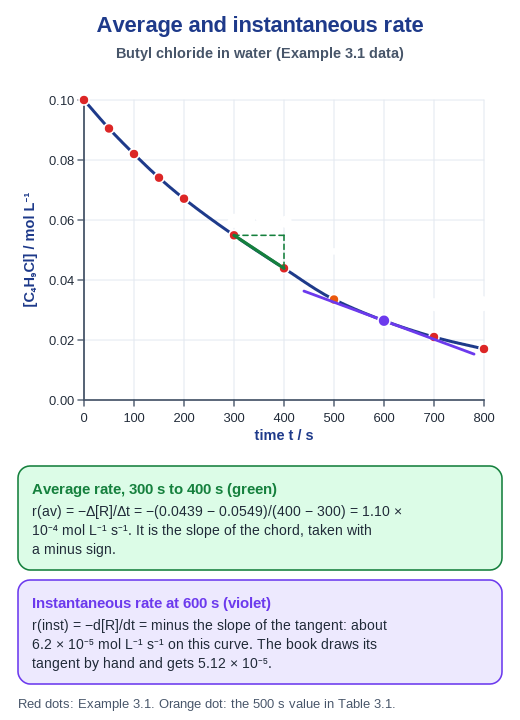
Example 3.1 (page 63): Find the average rates of hydrolysis of butyl chloride, C₄H₉Cl + H₂O → C₄H₉OH + HCl, over different intervals, from its concentration at 0, 50, 100, 150, 200, 300, 400, 700 and 800 s.
rav = −([C₄H₉Cl]₂ − [C₄H₉Cl]₁)/(t₂ − t₁) for each interval:
| Interval / s | Δ[C₄H₉Cl] / mol L⁻¹ | rav / 10⁻⁴ mol L⁻¹ s⁻¹ |
|---|---|---|
| 0–50 | 0.100 → 0.0905 | 1.90 |
| 50–100 | 0.0905 → 0.0820 | 1.70 |
| 100–150 | 0.0820 → 0.0741 | 1.58 |
| 150–200 | 0.0741 → 0.0671 | 1.40 |
| 200–300 | 0.0671 → 0.0549 | 1.22 |
| 300–400 | 0.0549 → 0.0439 | 1.10 |
| 400–500 | 0.0439 → 0.0335 | 1.04 |
| 700–800 | 0.0210 → 0.017 | 0.4 |
(The 500 s value, 0.0335 mol L⁻¹, appears only in the book’s Table 3.1, not in the list of data.) The average rate falls as the butyl chloride is used up.
The instantaneous rate at 600 s is minus the slope of the tangent there. The book’s tangent passes through (400 s, 0.037 M) and (800 s, 0.0165 M): rinst = (0.037 − 0.0165)/400 = 5.12 × 10⁻⁵ mol L⁻¹ s⁻¹. A tangent drawn by hand varies a little: on the smooth curve in our graph it comes out about 6 × 10⁻⁵ mol L⁻¹ s⁻¹, close to the average rate between 500 and 700 s, 6.25 × 10⁻⁵. The book also lists 1.22 × 10⁻⁴ at 250 s, 1.0 × 10⁻⁴ at 350 s and 6.4 × 10⁻⁵ at 450 s, read from its own graph.
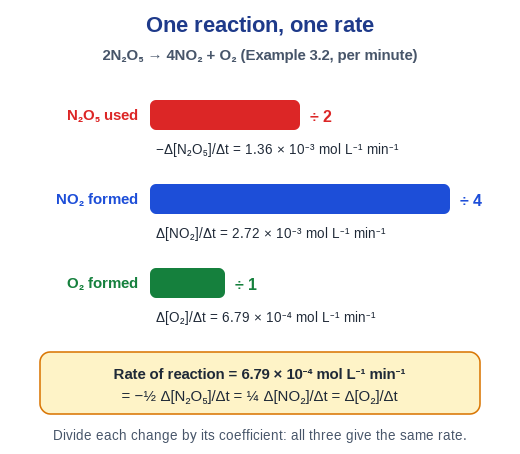
Example 3.2 (page 66): N₂O₅ in CCl₄ at 318 K falls from 2.33 to 2.08 mol L⁻¹ in 184 minutes by 2N₂O₅ → 4NO₂ + O₂. Find the average rate in hours, minutes and seconds, and the rate of production of NO₂.
Rate = −½ Δ[N₂O₅]/Δt = −½ × (2.08 − 2.33)/184 = 0.125/184 = 6.79 × 10⁻⁴ mol L⁻¹ min⁻¹
Per hour: 6.79 × 10⁻⁴ × 60 = 4.07 × 10⁻² mol L⁻¹ h⁻¹
Per second: 6.79 × 10⁻⁴ ÷ 60 = 1.13 × 10⁻⁵ mol L⁻¹ s⁻¹
Rate = ¼ Δ[NO₂]/Δt, so Δ[NO₂]/Δt = 4 × 6.79 × 10⁻⁴ = 2.72 × 10⁻³ mol L⁻¹ min⁻¹
Example 3.3 (page 68): Find the overall order for (a) Rate = k[A]½[B]3/2 (b) Rate = k[A]3/2[B]−1.
(a) ½ + 3/2 = 2, second order. (b) 3/2 + (−1) = ½, half order.
Example 3.4 (page 69): Find the order from (i) k = 2.3 × 10⁻⁵ L mol⁻¹ s⁻¹ (ii) k = 3 × 10⁻⁴ s⁻¹.
(i) L mol⁻¹ s⁻¹ is the unit for a second order reaction. (ii) s⁻¹ is the unit for a first order reaction.
Example 3.5 (page 74): N₂O₅ → 2NO₂ + ½O₂ is first order. At 318 K, [N₂O₅] falls from 1.24 × 10⁻² to 0.20 × 10⁻² mol L⁻¹ in 60 minutes. Find k.
k = (2.303/(t₂ − t₁)) log([R]₁/[R]₂) = (2.303/60) log(1.24/0.20) = (2.303/60) log 6.2
log 6.2 = 0.7924, so k = 0.03838 × 0.7924 = 0.0304 min⁻¹
Worked examples 3.6 to 3.10 (pages 75–82)
Example 3.6 (page 75): For the first order decomposition 2N₂O₅(g) → 2N₂O₄(g) + O₂(g) at constant volume, the total pressure is 0.5 atm at 0 s and 0.512 atm at 100 s. Find k.
If N₂O₅ falls by 2x atm, N₂O₄ rises by 2x and O₂ by x, so pₜ = (0.5 − 2x) + 2x + x = 0.5 + x and x = pₜ − 0.5.
pN₂O₅ = 0.5 − 2x = 0.5 − 2(pₜ − 0.5) = 1.5 − 2pₜ = 1.5 − 2 × 0.512 = 0.476 atm
k = (2.303/t) log(pᵢ/pA) = (2.303/100) log(0.5/0.476) = (2.303/100) × 0.0214 = 4.92 × 10⁻⁴ s⁻¹
(The book writes log(0.5/0.476) as 0.0216 and gets 4.98 × 10⁻⁴ s⁻¹; log 1.0504 is 0.0214, which gives 4.92 × 10⁻⁴ s⁻¹.)
Example 3.7 (page 77): A first order reaction has k = 5.5 × 10⁻¹⁴ s⁻¹. Find its half-life.
t½ = 0.693/k = 0.693 ÷ 5.5 × 10⁻¹⁴ = 1.26 × 10¹³ s (about 4 × 10⁵ years)
Example 3.8 (page 77): Show that 99.9% completion of a first order reaction takes about 10 half-lives.
At 99.9% completion, [R] = [R]₀ − 0.999[R]₀ = 0.001[R]₀, so [R]₀/[R] = 10³.
t = (2.303/k) log 10³ = 6.909/k, and t½ = 0.693/k
t/t½ = 6.909/0.693 = 9.97 ≈ 10
Example 3.9 (page 81): k = 0.02 s⁻¹ at 500 K and 0.07 s⁻¹ at 700 K. Find Ea and A.
log(k₂/k₁) = (Ea/2.303R) × (T₂ − T₁)/(T₁T₂)
log(0.07/0.02) = log 3.5 = 0.544 = (Ea ÷ 19.147) × 200/350 000 = Ea × 5.714 × 10⁻⁴ ÷ 19.147
Ea = 0.544 × 19.147 ÷ 5.714 × 10⁻⁴ = 18 230 J mol⁻¹ (18.2 kJ mol⁻¹)
A = k ÷ e−Ea/RT at 500 K: Ea/RT = 18 230.8 ÷ (8.314 × 500) = 4.386, and e−4.386 = 0.01246
A = 0.02 ÷ 0.01246 = 1.61 s⁻¹
(The book writes the last step as 0.02/0.012, rounding the exponential to 0.012; 0.02/0.012 alone would be 1.67, so 1.61 comes from 0.01246. A has the unit of k, s⁻¹.)
Example 3.10 (page 81): For C₂H₅I(g) → C₂H₄(g) + HI(g), k = 1.60 × 10⁻⁵ s⁻¹ at 600 K and Ea = 209 kJ mol⁻¹. Find k at 700 K.
log k₂ = log k₁ + (Ea/2.303R)(1/T₁ − 1/T₂)
= log(1.60 × 10⁻⁵) + (209 000 ÷ 19.147)(1/600 − 1/700)
= −4.796 + 10 915 × 2.381 × 10⁻⁴ = −4.796 + 2.599 = −2.197
k₂ = 6.36 × 10⁻³ s⁻¹: about 400 times faster for a 100 K rise. (The book writes the units of Ea and R here as “J mol L⁻¹” and “J mol L⁻¹ K⁻¹”; they are J mol⁻¹ and J K⁻¹ mol⁻¹.)
Practice
-
For 2N₂O₅ → 4NO₂ + O₂, NO₂ forms at 0.08 mol L⁻¹ s⁻¹. The rate of reaction is:
Show answer
Answer: (c) 0.02 mol L⁻¹ s⁻¹
-
A first order reaction has t½ = 69.3 s. Its rate constant is:
Show answer
Answer: (b) 0.01 s⁻¹
-
For a zero order reaction, the unit of k is:
Show answer
Answer: (c) mol L⁻¹ s⁻¹
-
How much of a first order reactant is left after three half-lives?
Show answer
Answer: (½)³ = 1/8, that is 12.5% of the starting amount.
-
The rate of a reaction doubles from 300 K to 310 K. Find Ea.
Show answer
Answer: log 2 = (Ea/(2.303 × 8.314)) × 10/(300 × 310), so Ea = 0.3010 × 19.147 × 9300 = 53 600 J mol⁻¹ ≈ 53.6 kJ mol⁻¹.
Stuck on a question?
Take a photo and Lagnever AI explains it step by step. Try it for 7 days for ₹2.
Get it on Google Play Open in browser
For parents: after the trial, the plan renews monthly by UPI or card autopay. You can cancel anytime in the app.