
Class 12 Chemistry Chapter 3: Chemical Kinetics Notes
This chapter in five lines
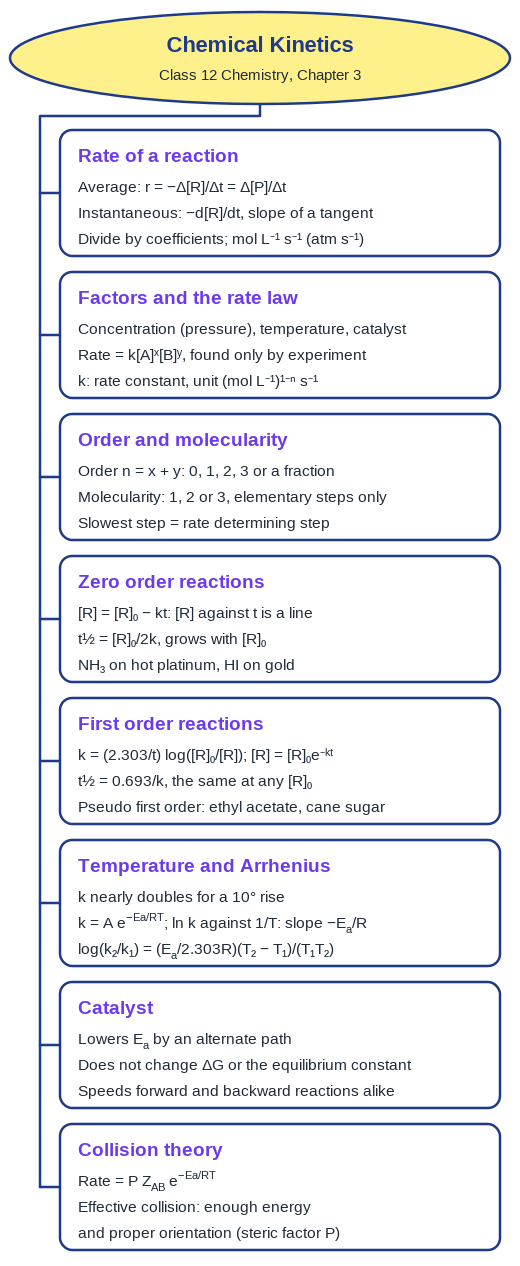
Chemical kinetics measures how fast reactions go. The rate is the change in concentration per unit time, average or instantaneous. The rate law, Rate = k[A]ˣ[B]ʸ, is found by experiment; x + y is the order. Zero and first order reactions have their own integrated equations and half-lives (t½ = 0.693/k for first order). The Arrhenius equation, k = A e^(−Ea/RT), explains why heating and catalysts speed reactions up.
What is this chapter about?
Milk turns sour in a day in summer but lasts longer in the fridge. A firecracker is over in a flash, while an iron gate takes years to rust. Chemical kinetics asks how fast a reaction goes, what changes its speed, and by which steps it happens. Thermodynamics can tell us whether a reaction is feasible (ΔG < 0) and equilibrium tells us how far it goes, but neither tells us how long it takes. A notebook should, by thermodynamics, burn in air; it sits on the desk for years because the reaction is far too slow without a flame. This chapter, Unit 3 of Chemistry Part I, covers reaction rates, rate laws, order and molecularity, zero and first order reactions, and the effect of temperature and catalysts, ending with collision theory.
How is the rate of a reaction measured?
The rate of a reaction tells us how much the concentration of a reactant or product changes per unit time, at constant volume. For R → P, if [R] falls by Δ[R] in time Δt,
rav = −Δ[R]/Δt = +Δ[P]/Δt
The minus sign makes the rate positive, because Δ[R] is negative. This is the average rate over the interval. Its unit is concentration per time, usually mol L⁻¹ s⁻¹; for gases measured by partial pressure it is atm s⁻¹.
Our own example. If [R] falls from 0.80 to 0.50 mol L⁻¹ in 60 s, rav = (0.80 − 0.50)/60 = 5.0 × 10⁻³ mol L⁻¹ s⁻¹.
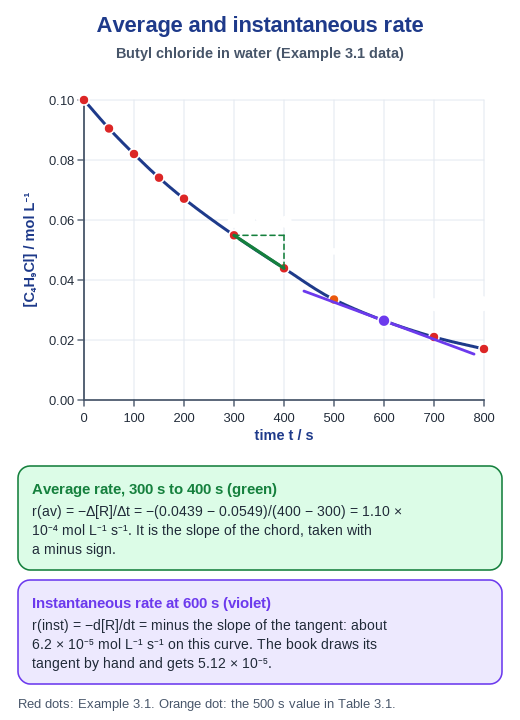
The average rate changes from one interval to the next, because the rate falls as reactants are used up. In the book’s butyl chloride data (Example 3.1), it falls from 1.90 × 10⁻⁴ mol L⁻¹ s⁻¹ in the first 50 s to 0.4 × 10⁻⁴ between 700 and 800 s.
What is the instantaneous rate?
Make Δt smaller and smaller and the average rate approaches the rate at one moment, the instantaneous rate:
rinst = −d[R]/dt = d[P]/dt
On a graph of [R] against t, it is minus the slope of the tangent drawn at that time. The average rate is the slope of a chord between two points.
How do coefficients enter the rate?
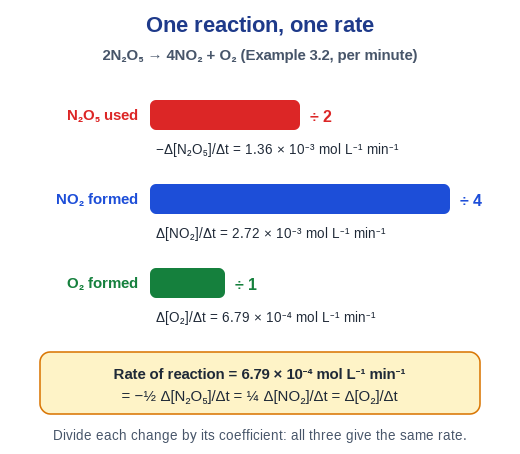
When the coefficients in the balanced equation are not all 1, each species changes at a different speed. To get one rate for the reaction, divide each rate of change by its coefficient. For 2HI(g) → H₂(g) + I₂(g), HI is used up twice as fast as H₂ forms, so
Rate = −½ Δ[HI]/Δt = Δ[H₂]/Δt = Δ[I₂]/Δt
Our own example. In N₂ + 3H₂ → 2NH₃, if ammonia forms at 0.004 mol L⁻¹ s⁻¹, the rate of reaction is 0.004/2 = 0.002 mol L⁻¹ s⁻¹; N₂ is used at 0.002 and H₂ at 0.006 mol L⁻¹ s⁻¹.
What affects the rate of a reaction?
The rate depends on the conditions: the concentration of the reactants (the pressure, for gases), the temperature and the presence of a catalyst. As reactants are used up the rate falls; raise their concentration and it usually rises. Read rate law, order and molecularity.
What is a rate law?
For aA + bB → cC + dD, experiments give a rate law (rate equation, rate expression) of the form
Rate = k[A]x[B]y, or −d[R]/dt = k[A]x[B]y (the differential rate equation)
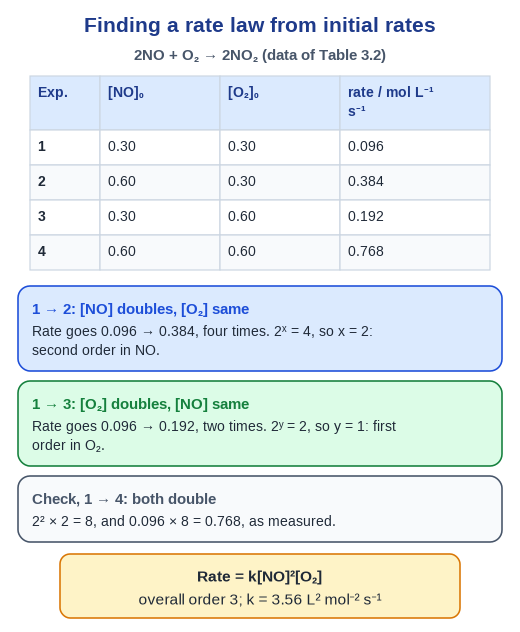
Here k is the rate constant, and x and y may or may not equal a and b. The only way to find them is to measure rates. For 2NO + O₂ → 2NO₂, doubling [NO] alone makes the initial rate four times larger, and doubling [O₂] alone doubles it, so Rate = k[NO]²[O₂]. Here the powers happen to match the coefficients. They need not: CHCl₃ + Cl₂ → CCl₄ + HCl has Rate = k[CHCl₃][Cl₂]½, and the hydrolysis of ethyl acetate is zero order in water.
What is the order of a reaction?
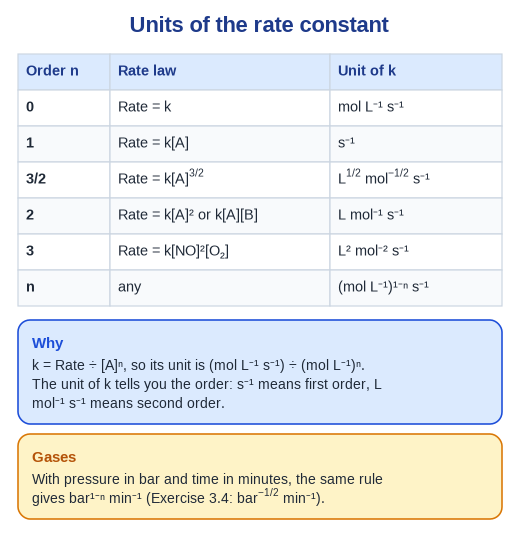
In Rate = k[A]x[B]y, x is the order with respect to A, y the order with respect to B, and x + y is the overall order. The order shows how sensitive the rate is to each concentration. It may be zero, a whole number such as 1, 2 or 3, or a fraction; a zero order reaction has a rate that does not depend on concentration at all. For example, Rate = k[A]½[B]3/2 is second order and Rate = k[A]3/2[B]−1 is of order ½.
Since k = Rate/[A]n, the unit of k depends on the order n: (mol L⁻¹)1−n s⁻¹.
What is molecularity?
A balanced equation rarely shows how a reaction really happens. A reaction that happens in a single step is an elementary reaction; one that happens through a sequence of elementary steps (its mechanism) is a complex reaction, such as the oxidation of ethane to CO₂ and water through an alcohol, an aldehyde and an acid. The molecularity of an elementary step is the number of species that must collide at the same moment for it to happen:
- Unimolecular: one species, as in NH₄NO₂ → N₂ + 2H₂O.
- Bimolecular: two species colliding, as in 2HI → H₂ + I₂.
- Termolecular: three at once, as in 2NO + O₂ → 2NO₂.
Three particles meeting at the same instant is unlikely, so termolecular steps are rare and slow, and a reaction with many molecules in its equation must go in several steps. KClO₃ + 6FeSO₄ + 3H₂SO₄ → KCl + 3Fe₂(SO₄)₃ + 3H₂O has ten molecules on the left, yet it is second order.
Which step decides the rate?
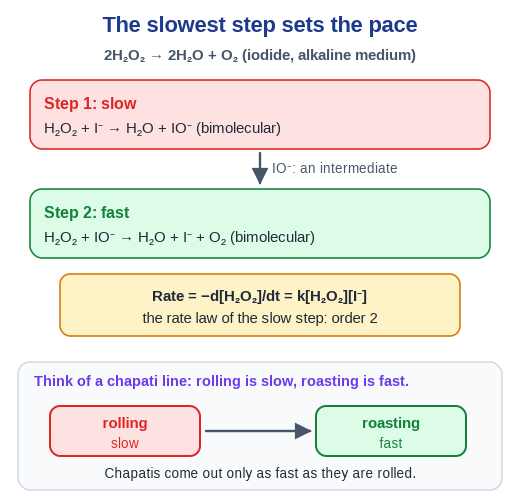
The slowest step of a mechanism, the rate determining step. In alkaline solution, iodide ions catalyse 2H₂O₂ → 2H₂O + O₂ in two bimolecular steps: H₂O₂ + I⁻ → H₂O + IO⁻ (slow), then H₂O₂ + IO⁻ → H₂O + I⁻ + O₂ (fast). IO⁻ is an intermediate: it forms and is used up, so it is missing from the overall equation. The rate law, Rate = −d[H₂O₂]/dt = k[H₂O₂][I⁻], is that of the slow step.
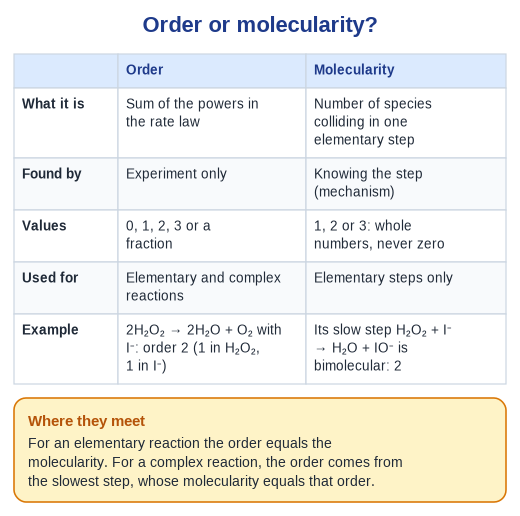
So: order is found by experiment and can be zero or fractional, but molecularity is a whole number, never zero; order applies to any reaction, molecularity only to elementary steps; and in a complex reaction the order is set by the slowest step, whose molecularity equals that order.
What is a zero order reaction?
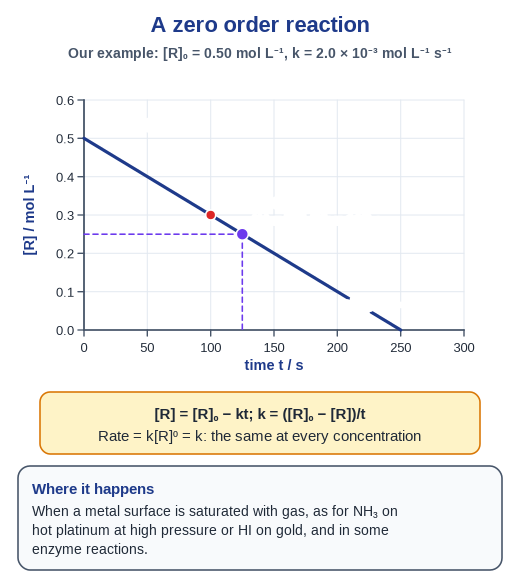
Measuring tangents is awkward, so the rate law is integrated to link concentration directly with time. For a zero order reaction R → P, −d[R]/dt = k. Integrating, and using [R] = [R]₀ at t = 0,
[R] = [R]₀ − kt, so k = ([R]₀ − [R])/t
Plotted against t, [R] falls along a straight line; its slope is −k and it meets the [R] axis at [R]₀. Zero order reactions are uncommon. They happen when a metal surface is saturated with gas, as for ammonia decomposing on hot platinum at high pressure (2NH₃ → N₂ + 3H₂ at 1130 K) or HI on gold, and in some enzyme reactions: extra gas cannot crowd onto a full surface, so the rate stays the same.
What is a first order reaction?
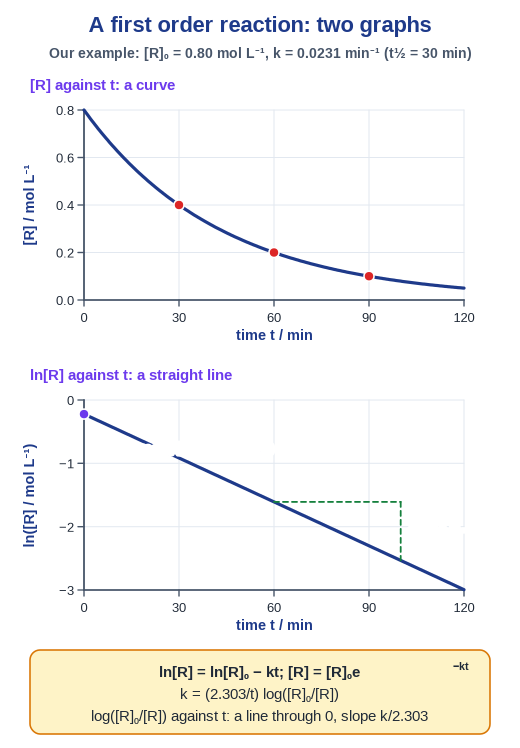
For a first order reaction, −d[R]/dt = k[R]. Separating and integrating gives ln[R] = −kt + ln[R]₀, which can be written in three useful ways:
- k = (1/t) ln([R]₀/[R]) = (2.303/t) log([R]₀/[R])
- [R] = [R]₀e−kt
- between two times, k = (2.303/(t₂ − t₁)) log([R]₁/[R]₂)
A graph of ln[R] against t is a straight line of slope −k, and log([R]₀/[R]) against t is a line through the origin of slope k/2.303. Examples: the hydrogenation of ethene, the decomposition of N₂O₅ and N₂O, and every radioactive decay, such as ²²⁶Ra → ⁴He + ²²²Rn. Read first order reactions and half-life.
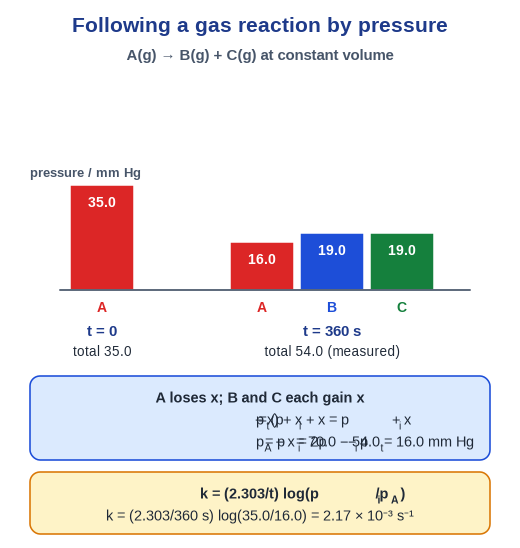
For a gas reaction A(g) → B(g) + C(g) followed by the total pressure pt from an initial pressure pi, the pressure of A is pA = 2pi − pt, so
k = (2.303/t) log[pi/(2pi − pt)]
What is half-life?
The half-life, t½, is how long a reactant’s concentration takes to drop to half its starting value.
- Zero order: put [R] = [R]₀/2 in the integrated equation: t½ = [R]₀/2k. It is proportional to the starting concentration.
- First order: (2.303/k) log 2 = t½ = 0.693/k. It does not depend on concentration: every half-life is the same.
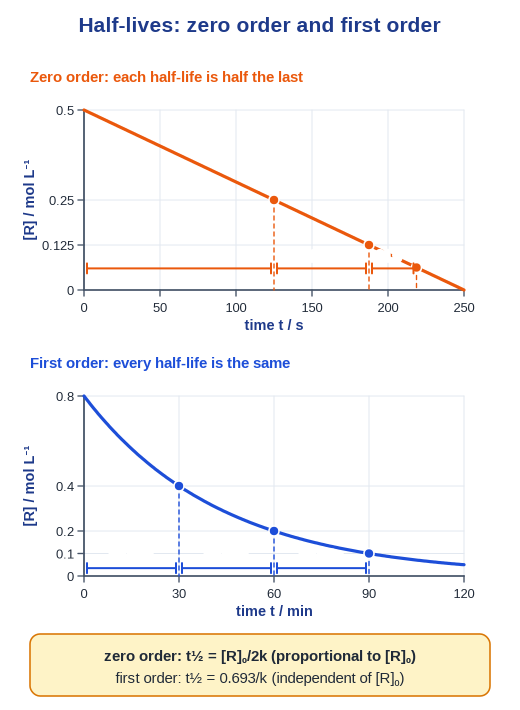
In a first order reaction, 99.9% completion takes about ten half-lives, 99% takes twice as long as 90%, and k and t½ give each other directly.
What is a pseudo first order reaction?
Some reactions are really second order but behave as first order because one reactant is in huge excess. When 0.01 mol of ethyl acetate is hydrolysed with 10 mol of water (acid catalyst), the water only falls to 9.99 mol, so its concentration hardly changes and the rate depends on the ester alone. The inversion of cane sugar in acid, C₁₂H₂₂O₁₁ + H₂O → glucose + fructose, is another: Rate = k[C₁₂H₂₂O₁₁].
How does temperature change the rate?
Most reactions speed up when heated. The half-life of N₂O₅ is 12 min at 50 °C, 5 h at 25 °C and 10 days at 0 °C, and potassium permanganate mixed with oxalic acid loses its colour faster when warm. As a rough rule, a 10° rise nearly doubles the rate constant. The exact relation is the Arrhenius equation, first proposed by van’t Hoff and given a physical meaning by Arrhenius:
k = A e−Ea/RT
Here A is the Arrhenius factor (frequency factor, pre-exponential factor), constant for a reaction, R = 8.314 J K⁻¹ mol⁻¹, T is in kelvin and Ea is the activation energy in J mol⁻¹. Read the Arrhenius equation and activation energy.
What is activation energy?
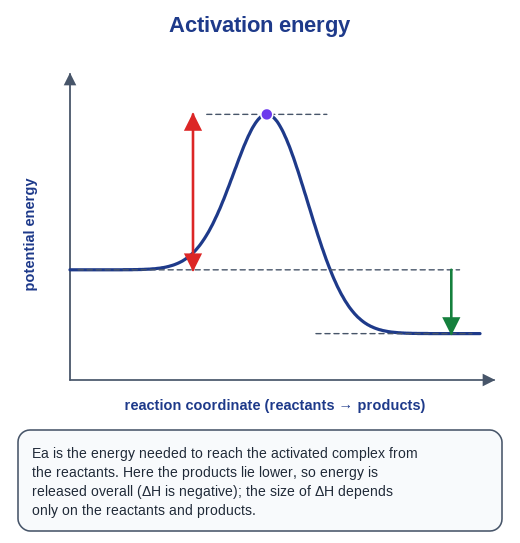
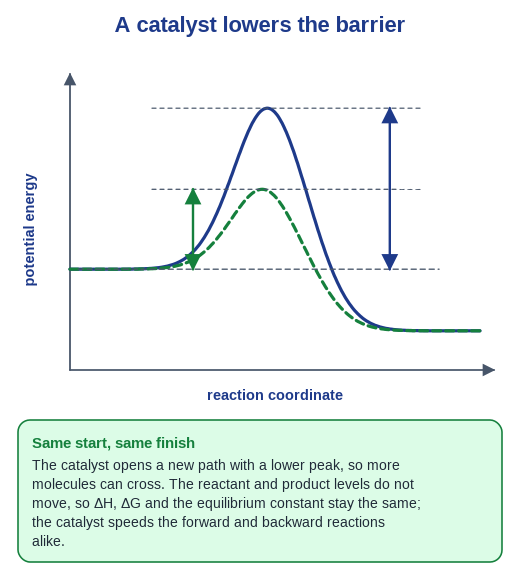
Picture H₂ + I₂ → 2HI. A hydrogen molecule and an iodine molecule must collide and pass through an unstable arrangement in which old bonds are half broken and new ones half made, the activated complex. It lasts for a moment and then splits into two HI molecules. The energy needed to reach it from the reactants is the activation energy. On a graph of potential energy against the reaction coordinate (the path from reactants to products), it is the height of the hump. Energy is released as the complex breaks up, and the overall enthalpy change depends only on the reactants and products.
Why does a small rise in temperature matter so much?
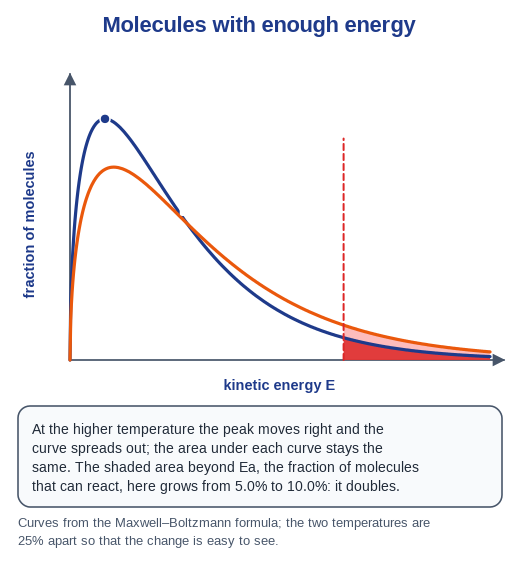
Molecules in a sample do not all have the same kinetic energy. Maxwell and Boltzmann used statistics to describe the spread: a graph of the fraction of molecules against kinetic energy rises to a peak, the most probable kinetic energy, and then tails off. On heating, the peak moves to higher energy and the curve spreads out, while the total area stays the same (all molecules are counted once). The fraction with energy at least Ea, the tail beyond Ea, grows a lot; the factor e−Ea/RT in the Arrhenius equation is that fraction. For many reactions near room temperature, a 10° rise about doubles it, and so doubles the rate.
How is Ea found from data?
Taking logarithms, ln k = ln A − Ea/RT. A plot of ln k against 1/T is a straight line with slope −Ea/R and intercept ln A. With rate constants at just two temperatures,
log(k₂/k₁) = (Ea/2.303R) × (T₂ − T₁)/(T₁T₂)
A higher temperature or a lower Ea raises k exponentially.
How does a catalyst work?
A catalyst raises the rate of a reaction without itself being permanently changed, as MnO₂ does for 2KClO₃ → 2KCl + 3O₂. A substance that lowers the rate is an inhibitor, not a catalyst. By the intermediate complex theory, the catalyst forms short-lived bonds with the reactants, giving an intermediate complex that breaks up into products and the catalyst again. In energy terms, it offers another path with a lower activation energy, so by the Arrhenius equation the rate rises. A little catalyst handles a lot of reactant. It does not change ΔG, so it can speed up only a spontaneous reaction, and it does not change the equilibrium constant: it speeds the forward and backward reactions equally, so equilibrium is reached sooner but in the same place.
What does collision theory say?
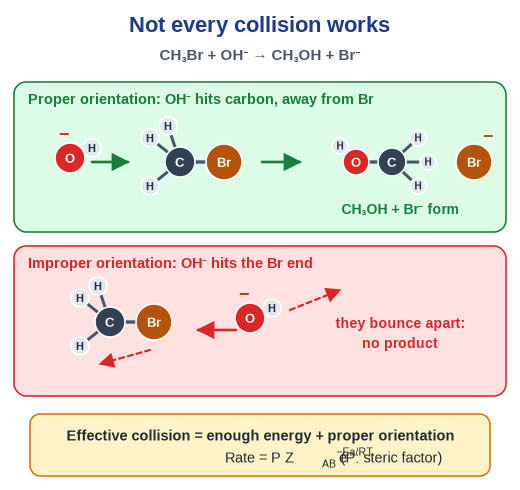
Collision theory (Max Trautz and William Lewis, 1916–18), built on the kinetic theory of gases, treats molecules as hard spheres that react only when they collide. How many collisions happen in each unit volume every second is the collision frequency, Z. For A + B → products, Rate = ZABe−Ea/RT, so the Arrhenius factor A is linked to the collision frequency. This works for atoms and simple molecules, but complex molecules react more slowly than it predicts, because not every collision counts. An effective collision needs energy at least equal to the threshold energy (the activation energy plus the energy the molecules already have) and the proper orientation. When OH⁻ meets CH₃Br from the side away from bromine, CH₃OH and Br⁻ form; if it hits the bromine end, the two simply bounce apart. A probability or steric factor, P, allows for this:
Rate = P ZAB e−Ea/RT
The theory still treats molecules as hard spheres and ignores their structure; higher classes go further.
Stay safe
Reactions in this chapter use acids, hydrogen peroxide and potassium permanganate, which irritate skin and eyes, and some of the gases named, such as NO₂, are poisonous. Do any rate experiment only in the school laboratory with your teacher.
Before we move on
Three ideas run through the chapter: the rate law comes from experiment, the integrated equations turn concentration–time data into k and t½, and the Arrhenius equation links k to temperature through Ea. Learn the zero and first order formulas with their graphs and units, and the two-temperature Arrhenius form. Every exercise, Intext Question and worked example of the unit is solved in the NCERT solutions for Chapter 3.
Key terms
| Term | Meaning |
|---|---|
| Chemical kinetics | The branch of chemistry that studies reaction rates, the factors that change them and the steps (mechanism) by which reactions happen. |
| Average rate | How much a reactant’s or product’s concentration changes, divided by the time taken: r(av) = −Δ[R]/Δt = Δ[P]/Δt. |
| Instantaneous rate | The rate at one moment, −d[R]/dt or d[P]/dt: the slope of the tangent to the concentration–time curve at that time. |
| Rate law | An expression, found by experiment, that gives the rate in terms of reactant concentrations, such as Rate = k[A]ˣ[B]ʸ. Also called the rate equation or rate expression. |
| Rate constant (k) | The proportionality constant in the rate law; the rate when every concentration is 1 mol L⁻¹. Its unit depends on the order. |
| Order of a reaction | The sum of the powers of the concentrations in the rate law. It may be zero, a whole number or a fraction. |
| Molecularity | How many atoms, ions or molecules must collide at once in one elementary step: 1, 2 or, rarely, 3. |
| Elementary and complex reactions | An elementary reaction happens in one step; a complex reaction is a sequence of elementary steps, its mechanism. |
| Rate determining step | The slowest step of a mechanism; it controls the rate of the whole reaction. |
| Half-life (t½) | How long a reactant’s concentration takes to fall to half its starting value: [R]₀/2k for zero order, 0.693/k for first order. |
| Pseudo first order reaction | A reaction of higher order that behaves as first order because one reactant, such as water, is in large excess. |
| Activation energy (Ea) | The energy needed to form the activated complex from the reactants; the height of the energy barrier, in J mol⁻¹. |
| Arrhenius equation | k = A e^(−Ea/RT), where A is the frequency (pre-exponential) factor; it gives the temperature dependence of k. |
| Catalyst | A substance that speeds a reaction without a permanent chemical change, by giving a path of lower activation energy. One that slows a reaction is an inhibitor. |
| Effective collision | A collision with enough energy (at least the threshold energy) and the proper orientation, so that bonds break and new ones form. |
Topics in this chapter
Practice
-
For Rate = k[A]^(1/2)[B]², the overall order is:
Show answer
Answer: (b) 2.5
-
A rate constant has the unit L mol⁻¹ s⁻¹. The reaction is of order:
Show answer
Answer: (c) second
-
A first order reaction has a half-life of 30 min. What fraction of the reactant is left after 90 min?
Show answer
Answer: (c) 1/8
-
Which statement about molecularity is true?
Show answer
Answer: (c) It applies only to elementary steps
-
A catalyst increases the rate of a reaction because it:
Show answer
Answer: (b) lowers the activation energy
-
In a plot of ln k against 1/T, the slope equals:
Show answer
Answer: (a) −Ea/R
Questions students ask
What are the main topics of Class 12 Chemistry Chapter 3?
Average and instantaneous rates, the factors that affect rate, the rate law and rate constant, order and molecularity, integrated rate equations for zero and first order reactions with half-life and pseudo first order reactions, the temperature dependence of rate with the Arrhenius equation, the effect of a catalyst, and collision theory.
Which formulas of Chemical Kinetics should I learn?
Rate = k[A]ˣ[B]ʸ; unit of k = (mol L⁻¹)¹⁻ⁿ s⁻¹; zero order [R] = [R]₀ − kt and t½ = [R]₀/2k; first order k = (2.303/t) log([R]₀/[R]), [R] = [R]₀e^(−kt) and t½ = 0.693/k; k = A e^(−Ea/RT); log(k₂/k₁) = (Ea/2.303R)(T₂ − T₁)/(T₁T₂).
Is Chemical Kinetics in the 2026-27 NCERT Class 12 Chemistry book?
Yes. It is Unit 3 of Chemistry Part I, the Class 12 textbook marked Reprint 2026-27, on pages 61 to 88. The book calls it a unit; here it is Chapter 3.
What is the difference between order and molecularity?
Order is found by experiment from the rate law and can be zero or a fraction; it applies to any reaction. Molecularity is the number of species that collide in one elementary step, so it is always 1, 2 or 3 and has no meaning for a complex reaction as a whole.
Stuck on a question?
Take a photo and Lagnever AI explains it step by step. Try it for 7 days for ₹2.
Get it on Google Play Open in browser
For parents: after the trial, the plan renews monthly by UPI or card autopay. You can cancel anytime in the app.