
What is the Arrhenius equation, and what is activation energy?
Answer in short
Most reactions speed up when heated; the rate constant nearly doubles for a 10° rise. The Arrhenius equation, k = A e^(−Ea/RT), explains this: only molecules with at least the activation energy Ea can react, and their share grows sharply with temperature. A catalyst speeds a reaction by giving it a path with a lower Ea.
Stuck on a question? Take a photo and Lagnever AI explains it step by step. Try it for 7 days for ₹2. Get it on Google Play
How does temperature affect the rate?
Food keeps longer in a fridge, and dal cooks faster in a pressure cooker, where the water boils at a higher temperature. In the lab, most reactions speed up on heating: the book gives the half-life of N₂O₅ as 12 min at 50 °C, 5 h at 25 °C and 10 days at 0 °C. A rough rule says that a 10° rise nearly doubles the rate constant.
What is activation energy?
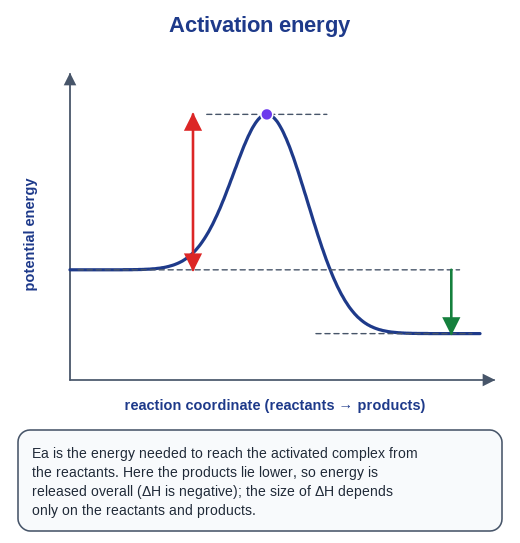
Molecules must collide to react, and they must pass over an energy barrier. In H₂ + I₂ → 2HI, the two molecules form a short-lived arrangement, the activated complex, with the H–H and I–I bonds partly broken and two H–I bonds partly formed. It then splits into two HI molecules. The energy needed to climb from the reactants to the activated complex is the activation energy, Ea. On a graph of potential energy against the reaction coordinate, Ea is the height of the hump above the reactants; the enthalpy change ΔH is the drop (or rise) from reactants to products.
What is the Arrhenius equation?
k = A e−Ea/RT
- A: the Arrhenius factor, also called the frequency or pre-exponential factor, a constant for each reaction, in the same unit as k.
- Ea: activation energy, in J mol⁻¹; R = 8.314 J K⁻¹ mol⁻¹; T in kelvin.
Taking natural logarithms, ln k = ln A − Ea/RT. Writing this at two temperatures and subtracting removes A:
log(k₂/k₁) = (Ea/2.303R) × (T₂ − T₁)/(T₁T₂)
So k rises when T rises or when Ea is lower, and it rises exponentially.
Why does heating help so much?
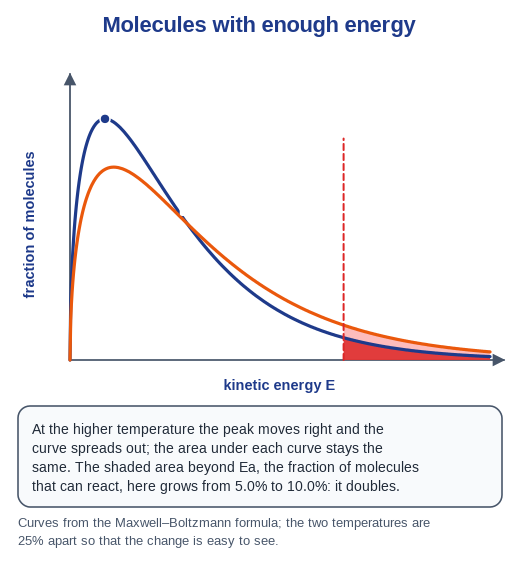
In any sample, molecules have a spread of kinetic energies. The fraction of molecules plotted against energy rises to a peak, the most probable energy, and then tails off. On heating, the peak moves right and the curve flattens and spreads, with the same total area. Only the tail beyond Ea can react, and that tail grows much faster than the temperature. The factor e−Ea/RT is exactly this fraction.
Our own example. For Ea = 50 kJ mol⁻¹:
At 300 K: Ea/RT = 50 000/(8.314 × 300) = 20.05, so the fraction is e−20.05 ≈ 2.0 × 10⁻⁹
At 310 K: the fraction is about 3.8 × 10⁻⁹
log(k₂/k₁) = 50 000/(2.303 × 8.314) × 10/(300 × 310) = 0.281, so k₂/k₁ = 1.91: a 10 K rise almost doubles the rate.
How is Ea found from data?
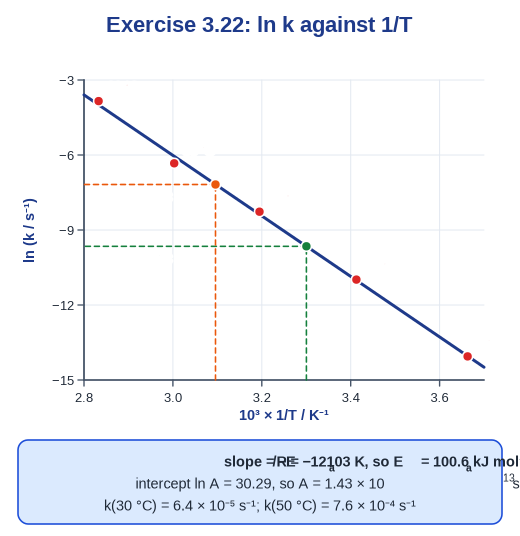
Measure k at several temperatures and plot ln k against 1/T. The points fall on a straight line of slope −Ea/R and intercept ln A. The graph below uses the book’s N₂O₅ data (Exercise 3.22): its slope, about −12 100 K, gives Ea ≈ 100.6 kJ mol⁻¹. With only two temperatures, use the log(k₂/k₁) form.
How does a catalyst work?
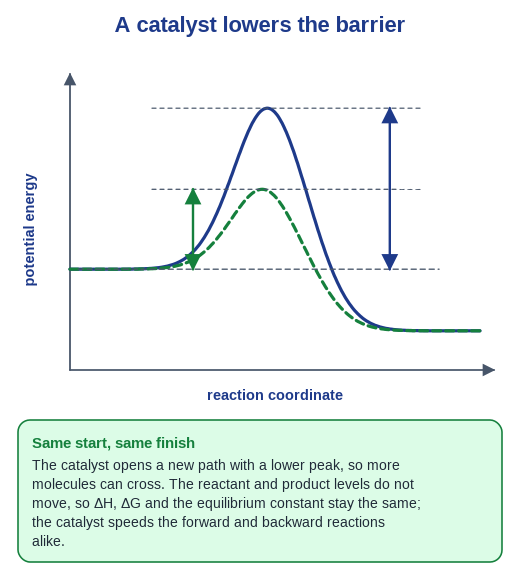
A catalyst, such as MnO₂ in the decomposition of KClO₃, speeds up a reaction and is left unchanged at the end. It forms a short-lived intermediate complex with the reactants, and this gives the reaction a different path with a lower activation energy. Our own example: if a catalyst lowered Ea from 75 to 50 kJ mol⁻¹ at 298 K with A unchanged, k would grow by e25 000/(8.314 × 298) ≈ 2.4 × 10⁴ times. The reactants and products stay at the same energies, so ΔG and the equilibrium constant do not change; a catalyst only helps a reaction that is already spontaneous reach equilibrium sooner. A substance that slows a reaction is an inhibitor.
What does collision theory add?
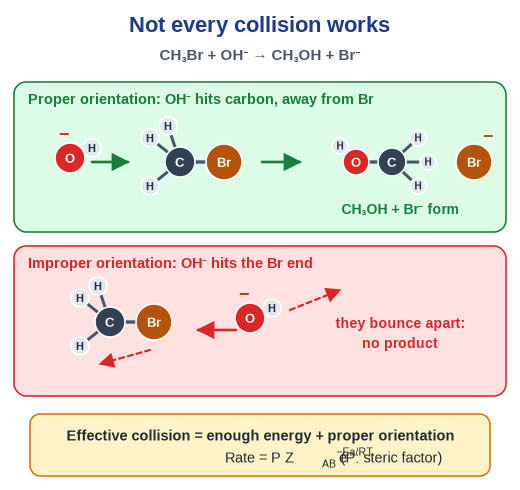
Collision theory pictures molecules as hard spheres. How many collisions happen in each unit volume every second is the collision frequency, Z, and Rate = ZABe−Ea/RT for A + B → products, so A is linked to the collision frequency. But only effective collisions give products: the molecules need energy at least equal to the threshold energy and the proper orientation. A steric factor, P, accounts for orientation: Rate = P ZAB e−Ea/RT.
Before: first order reactions and half-life. Practise with the NCERT solutions, or go back to the chapter notes.
Practice
-
In the Arrhenius equation, the factor e^(−Ea/RT) stands for:
Show answer
Answer: (b) the fraction of molecules with energy at least Ea
-
A catalyst changes which of these?
Show answer
Answer: (c) the activation energy
-
The rate of a reaction doubles from 300 K to 310 K. Its activation energy is about:
Show answer
Answer: (c) 53.6 kJ mol⁻¹
-
A reaction has Ea = 100 kJ mol⁻¹. By what factor does k grow from 300 K to 310 K?
Show answer
Answer: log(k₂/k₁) = 100 000/(2.303 × 8.314) × 10/(300 × 310) = 0.562, so k₂/k₁ = 3.6: a higher Ea makes the rate more sensitive to temperature.
-
What two conditions make a collision effective?
Show answer
Answer: The colliding molecules need energy at least equal to the threshold energy, and they must meet in the proper orientation so the right bonds can break and form.
Questions students ask
What is the activated complex?
It is the short-lived arrangement of atoms at the top of the energy barrier, in which old bonds are partly broken and new ones partly formed. It breaks up at once into products or back into reactants. The energy needed to reach it from the reactants is the activation energy.
How do you find activation energy from a graph?
Plot ln k against 1/T. The points lie on a straight line whose slope is −Ea/R, so Ea = −slope × 8.314 J mol⁻¹. The intercept is ln A. With log k instead of ln k, the slope is −Ea/2.303R.
Why does a 10° rise nearly double the rate?
Because the rate depends on the fraction of molecules with at least the activation energy. A small rise in temperature shifts the energy distribution to higher energies, and the small tail beyond Ea roughly doubles for many reactions near room temperature.
Does a catalyst change the equilibrium constant?
No. It lowers the barrier for the forward and backward reactions equally, so both speed up by the same factor. Equilibrium is reached sooner, but at the same position, and ΔG does not change.
Stuck on a question?
Take a photo and Lagnever AI explains it step by step. Try it for 7 days for ₹2.
Get it on Google Play Open in browser
For parents: after the trial, the plan renews monthly by UPI or card autopay. You can cancel anytime in the app.