
What is a first order reaction, and what is its half-life?
Answer in short
In a first order reaction, Rate = k[R]. Integrating gives k = (2.303/t) log([R]₀/[R]), or [R] = [R]₀e^(−kt). Its half-life, t½ = 0.693/k, does not depend on the starting concentration. A zero order reaction instead follows [R] = [R]₀ − kt, with t½ = [R]₀/2k.
Stuck on a question? Take a photo and Lagnever AI explains it step by step. Try it for 7 days for ₹2. Get it on Google Play
Why integrate the rate law?
A rate law such as −d[R]/dt = k[R] needs instantaneous rates, which come from tangents, and tangents are hard to draw accurately. Integrating the rate law gives a relation between concentration and time, the quantities we actually measure. Each order has its own integrated rate equation; the book derives them for zero and first order.
What is a zero order reaction?
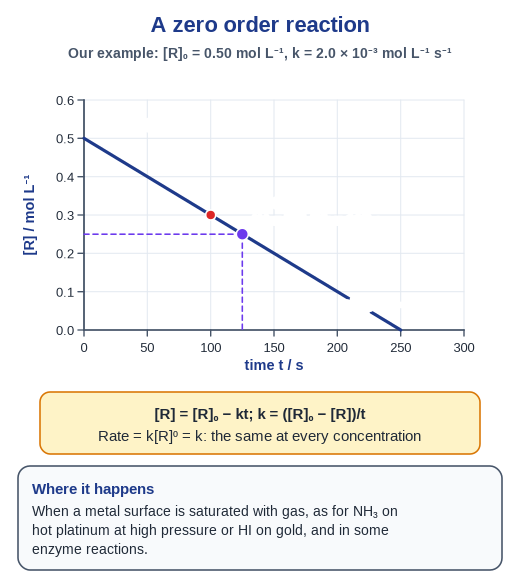
Here −d[R]/dt = k[R]⁰ = k. So d[R] = −k dt, and integrating with [R] = [R]₀ at t = 0 gives
[R] = [R]₀ − kt, or k = ([R]₀ − [R])/t
A graph of [R] against t is a straight line of slope −k. Our own example: [R]₀ = 0.50 mol L⁻¹ and k = 2.0 × 10⁻³ mol L⁻¹ s⁻¹. After 100 s, [R] = 0.50 − 0.20 = 0.30 mol L⁻¹, and the reactant is gone at 250 s.
How is the first order equation derived?
For R → P with −d[R]/dt = k[R]:
- Separate: d[R]/[R] = −k dt
- Integrate: ln[R] = −kt + I
- At t = 0, [R] = [R]₀, so I = ln[R]₀
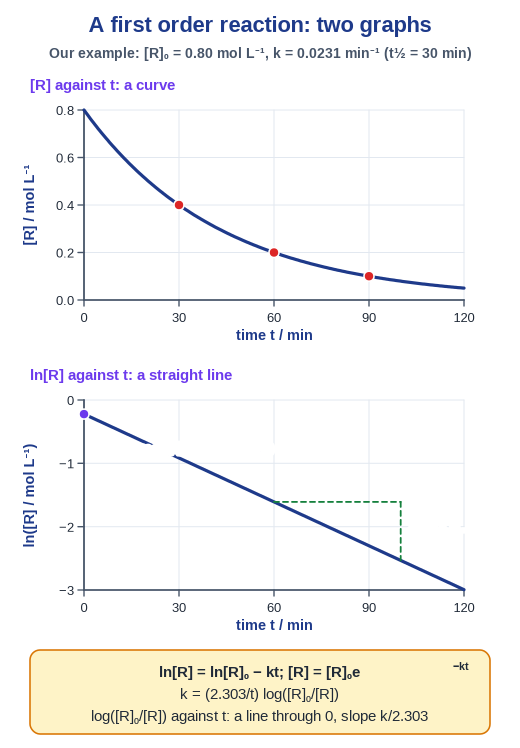
- ln[R] = ln[R]₀ − kt, so k = (1/t) ln([R]₀/[R]) = (2.303/t) log([R]₀/[R])
- Taking antilogs: [R] = [R]₀e−kt
Between two times, k = (2.303/(t₂ − t₁)) log([R]₁/[R]₂). A graph of ln[R] against t is a straight line with slope −k; log([R]₀/[R]) against t is a line through the origin with slope k/2.303.
How do we use it?
Our own example. A first order reaction has k = 0.0231 min⁻¹.
Half-life: t½ = 0.693/0.0231 = 30 min
Time for 75% to react ([R] = [R]₀/4): t = (2.303/0.0231) log 4 = 99.7 × 0.602 = 60 min, which is two half-lives
Time for 90% to react: t = (2.303/0.0231) log 10 = 99.7 min
Fraction left after 45 min: [R]/[R]₀ = e−0.0231 × 45 = e−1.04 = 0.354, about 35%
What is the half-life?
The half-life, t½, is the time for the reactant’s concentration to fall to half.
- Zero order: put [R] = [R]₀/2 in [R] = [R]₀ − kt: t½ = [R]₀/2k. A larger starting amount takes longer to halve. In our zero order example, t½ = 0.50/(2 × 2.0 × 10⁻³) = 125 s; the next half-life is only 62.5 s.
- First order: put [R] = [R]₀/2 in the first order equation: t½ = 2.303 × log 2 ÷ k, and since 2.303 × 0.301 = 0.693, t½ = 0.693/k, with no concentration in it. After n half-lives, (½)n of the reactant is left.
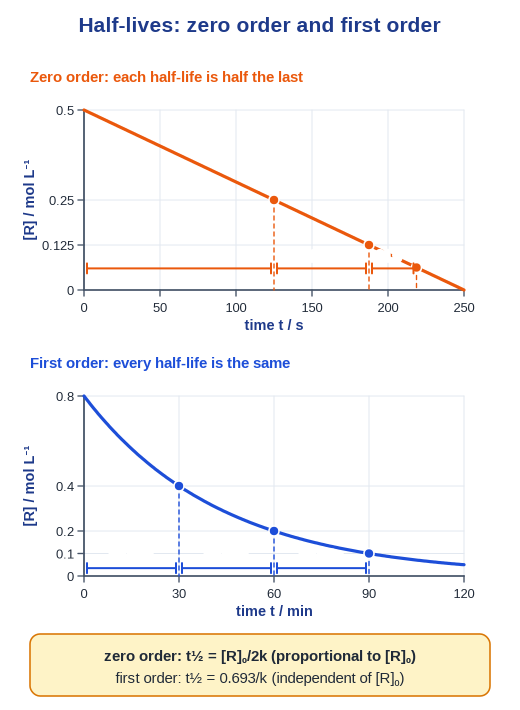
This is why radioactive decay, which is first order, is described by a half-life: carbon-14’s is 5730 years, whatever the amount.
How do we follow a gas reaction by pressure?
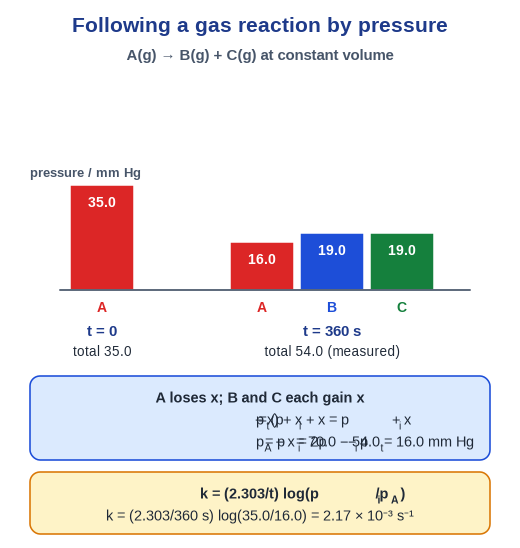
For A(g) → B(g) + C(g) at constant volume, let the starting pressure of A be pi. If A falls by x, B and C each rise by x, so the total pressure is pt = pi + x and the pressure of A is pA = 2pi − pt. Pressure stands in for concentration:
k = (2.303/t) log[pi/(2pi − pt)]
For other equations, such as 2N₂O₅ → 2N₂O₄ + O₂, work out pA the same way from the coefficients.
What is a pseudo first order reaction?
The hydrogenation of ethene and the decomposition of N₂O₅ are truly first order. Some reactions only look first order. The acid hydrolysis of ethyl acetate depends on both ester and water, but with water in large excess (10 mol of water for 0.01 mol of ester) its concentration hardly changes, so the rate depends on the ester alone. The inversion of cane sugar into glucose and fructose works the same way. Such reactions are pseudo first order.
Next topic: the Arrhenius equation and activation energy. Before: rate law, order and molecularity. See also the chapter notes and the NCERT solutions.
Practice
-
A first order reaction has k = 0.0693 min⁻¹. Its half-life is:
Show answer
Answer: (c) 10 min
-
For a zero order reaction, if the starting concentration is halved, the half-life:
Show answer
Answer: (b) is halved
-
Which graph is a straight line for a first order reaction?
Show answer
Answer: (b) ln[R] against t
-
A first order reaction has t½ = 10 min. How long until 87.5% has reacted?
Show answer
Answer: 87.5% reacted leaves 12.5% = 1/8 = (½)³, which is three half-lives: 3 × 10 = 30 min.
-
Why is the inversion of cane sugar called pseudo first order?
Show answer
Answer: It involves sugar and water, but water is in such excess that its concentration hardly changes, so the rate depends only on the sugar: Rate = k[C₁₂H₂₂O₁₁].
Questions students ask
Why does a first order reaction have a constant half-life?
Because the formula t½ = 0.693/k contains no concentration. In a first order reaction the same fraction reacts in the same time, so going from 1 M to 0.5 M takes as long as going from 0.1 M to 0.05 M.
What is the formula for the rate constant of a first order reaction?
k = (2.303/t) log([R]₀/[R]), where [R]₀ is the starting concentration and [R] the concentration after time t. Between two times, k = (2.303/(t₂ − t₁)) log([R]₁/[R]₂).
What are some examples of first order reactions?
The hydrogenation of ethene, the decomposition of N₂O₅ and N₂O, and all radioactive decay, such as radium-226 giving helium-4 and radon-222.
Where do zero order reactions occur?
Mostly on metal surfaces that are saturated with gas, such as ammonia decomposing on hot platinum at high pressure or HI on gold, and in some enzyme reactions. The rate stays the same until the reactant is nearly used up.
Stuck on a question?
Take a photo and Lagnever AI explains it step by step. Try it for 7 days for ₹2.
Get it on Google Play Open in browser
For parents: after the trial, the plan renews monthly by UPI or card autopay. You can cancel anytime in the app.