
What is a rate law, and how do order and molecularity differ?
Answer in short
A rate law gives the rate in terms of reactant concentrations, Rate = k[A]ˣ[B]ʸ, and is found only by experiment. The order is x + y and can be 0, 1, 2, 3 or a fraction. Molecularity is the number of species colliding in one elementary step, so it is always 1, 2 or 3.
Stuck on a question? Take a photo and Lagnever AI explains it step by step. Try it for 7 days for ₹2. Get it on Google Play
What is the rate of a reaction?
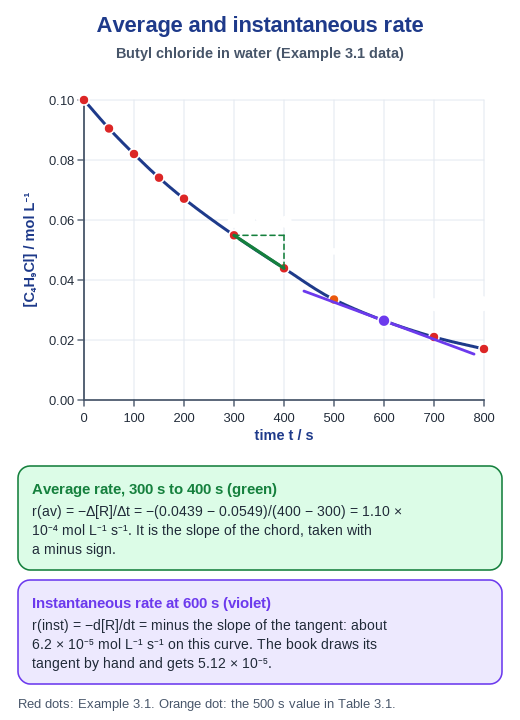
The rate tells us how fast the concentration of a reactant or product changes with time. Over an interval it is the average rate, rav = −Δ[R]/Δt = Δ[P]/Δt, in mol L⁻¹ s⁻¹. At one moment it is the instantaneous rate, −d[R]/dt, which is minus the slope of the tangent to the [R]–t curve. If the coefficients are not 1, divide by them: for 2A → B, Rate = −½ Δ[A]/Δt = Δ[B]/Δt.
How is a rate law found?
The rate depends on the concentration of reactants, the temperature and any catalyst. At a fixed temperature, experiments give the rate law:
Rate = k[A]x[B]y
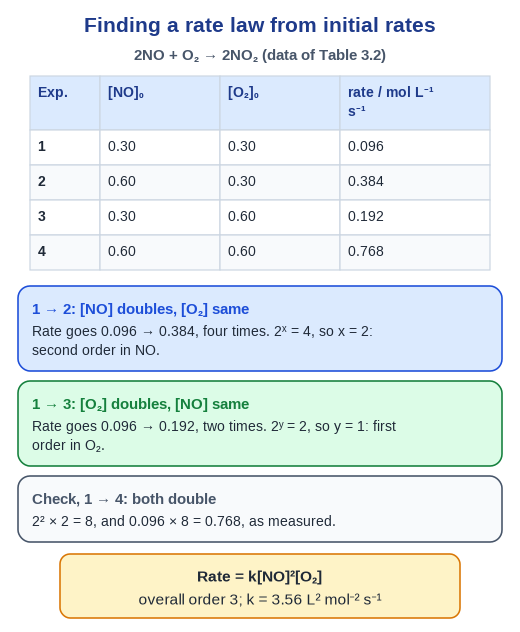
The constant k is the rate constant. The powers x and y must be measured; they cannot be read from the balanced equation. A neat way is the method of initial rates: start the reaction several times, change one concentration at a time, and compare the starting rates.
Our own example. For A + B → products:
- [A] = 0.10, [B] = 0.10 mol L⁻¹: rate = 2.0 × 10⁻⁴ mol L⁻¹ s⁻¹
- [A] = 0.20, [B] = 0.10: rate = 8.0 × 10⁻⁴
- [A] = 0.10, [B] = 0.30: rate = 6.0 × 10⁻⁴
Doubling [A] makes the rate 4 times larger: 2ˣ = 4, so x = 2. Tripling [B] makes it 3 times larger: 3ʸ = 3, so y = 1. The rate law is Rate = k[A]²[B], and
k = 2.0 × 10⁻⁴ ÷ (0.10² × 0.10) = 0.20 L² mol⁻² s⁻¹
The book does the same with 2NO + O₂ → 2NO₂ and finds Rate = k[NO]²[O₂].
What is the order of a reaction?
The order with respect to A is x, with respect to B is y, and the overall order is x + y. Our example is second order in A, first order in B and third order overall. Order may be zero, a whole number or a fraction: Rate = k[A]½[B]3/2 is second order. A zero order reaction runs at the same rate whatever the concentration.
What does the unit of k tell us?
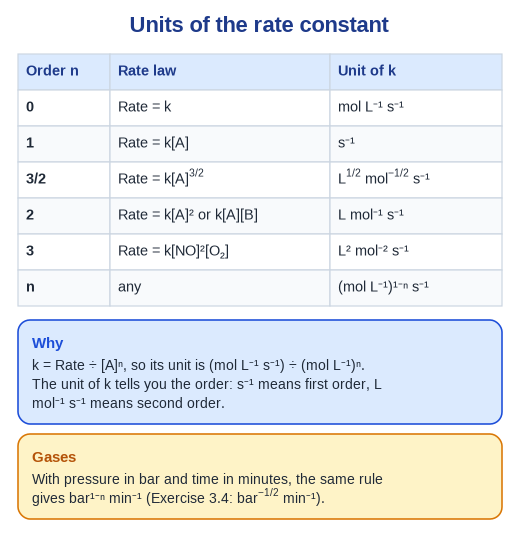
Since k = Rate ÷ [A]n, its unit is (mol L⁻¹)1−n s⁻¹: mol L⁻¹ s⁻¹ for zero order, s⁻¹ for first order, L mol⁻¹ s⁻¹ for second order, L² mol⁻² s⁻¹ for third order. So k = 3 × 10⁻⁴ s⁻¹ belongs to a first order reaction, and k = 2.3 × 10⁻⁵ L mol⁻¹ s⁻¹ to a second order one.
What is molecularity?
Most reactions happen in several simple steps, the mechanism. A reaction that happens in one step is elementary. The molecularity of an elementary step is the number of atoms, ions or molecules that must collide at the same moment: one for a unimolecular step (NH₄NO₂ → N₂ + 2H₂O), two for a bimolecular one (2HI → H₂ + I₂), three for a termolecular one (2NO + O₂ → 2NO₂). Three particles meeting at once is rare, and more than three practically never happens.
How do order and molecularity differ?
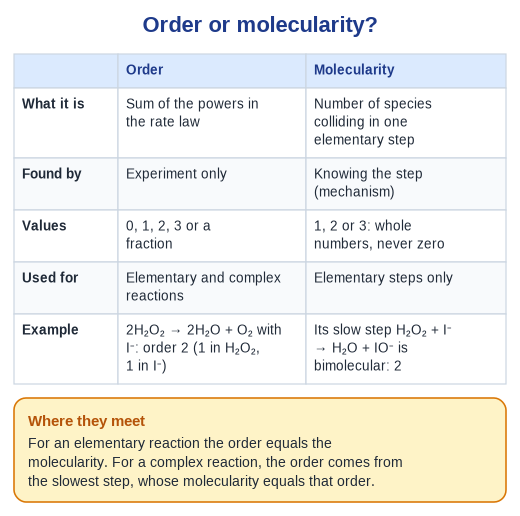
- Order comes from experiment; molecularity comes from the step itself.
- Order can be zero or a fraction; molecularity is 1, 2 or 3.
- Order applies to any reaction; molecularity has meaning only for elementary steps.
For an elementary reaction the two are equal.
What is the rate determining step?
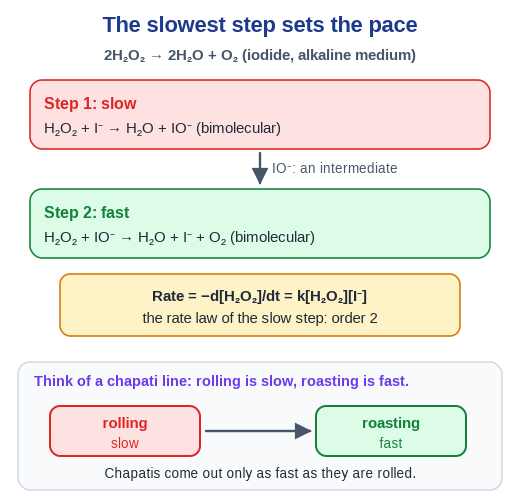
In a mechanism, the slowest step controls the overall rate, just as chapatis come off the tawa only as fast as someone rolls them. Iodide ions in alkaline solution decompose hydrogen peroxide in two steps:
- H₂O₂ + I⁻ → H₂O + IO⁻ (slow)
- H₂O₂ + IO⁻ → H₂O + I⁻ + O₂ (fast)
IO⁻ is an intermediate: made in step 1, used in step 2. The rate law is that of the slow step, Rate = k[H₂O₂][I⁻], so the reaction is first order in each and second order overall, and the molecularity of the slow step is 2.
Next topic: first order reactions and half-life. See also the chapter notes and the NCERT solutions.
Practice
-
For 2A → B, [A] falls from 0.50 to 0.30 mol L⁻¹ in 20 s. The rate of reaction is:
Show answer
Answer: (b) 0.005 mol L⁻¹ s⁻¹
-
A reaction is second order in A. If [A] is tripled, the rate becomes:
Show answer
Answer: (c) 9 times
-
Which of these can never be a molecularity?
Show answer
Answer: (d) ½
-
Rate = k[X][Y]². How does the rate change if both concentrations are halved?
Show answer
Answer: It becomes ½ × ¼ = 1/8 of the old rate, because the reaction is first order in X and second order in Y.
-
Why can the oxidation of Fe²⁺ by KClO₃ in acid not be a single step?
Show answer
Answer: Its equation has ten molecules on the left. Ten particles never collide at once (even three is rare), so the reaction must go in several steps; it is in fact second order.
Questions students ask
What is the difference between rate and rate constant?
The rate is how fast concentrations change at a given moment, and it falls as reactants are used up. The rate constant k is the rate when every concentration in the rate law is 1 mol L⁻¹; it stays fixed at a given temperature.
Can the order of a reaction be negative or a fraction?
Yes, order is found by experiment, so it can be a fraction such as ½ or 3/2, and a concentration can even appear with a negative power, as in Rate = k[A]^(3/2)[B]^(−1), which is of order ½ overall.
How is the order of a reaction found?
By experiment. One way is the method of initial rates: change one concentration at a time and see how the starting rate changes. Doubling a concentration that doubles the rate means first order in it; four times means second order; no change means zero order.
What is a rate determining step?
It is the slowest step in the mechanism of a complex reaction. The whole reaction cannot go faster than this step, so its rate law is the rate law of the overall reaction.
Stuck on a question?
Take a photo and Lagnever AI explains it step by step. Try it for 7 days for ₹2.
Get it on Google Play Open in browser
For parents: after the trial, the plan renews monthly by UPI or card autopay. You can cancel anytime in the app.