
NCERT Solutions Class 12 Chemistry Chapter 4: The d- and f-Block Elements
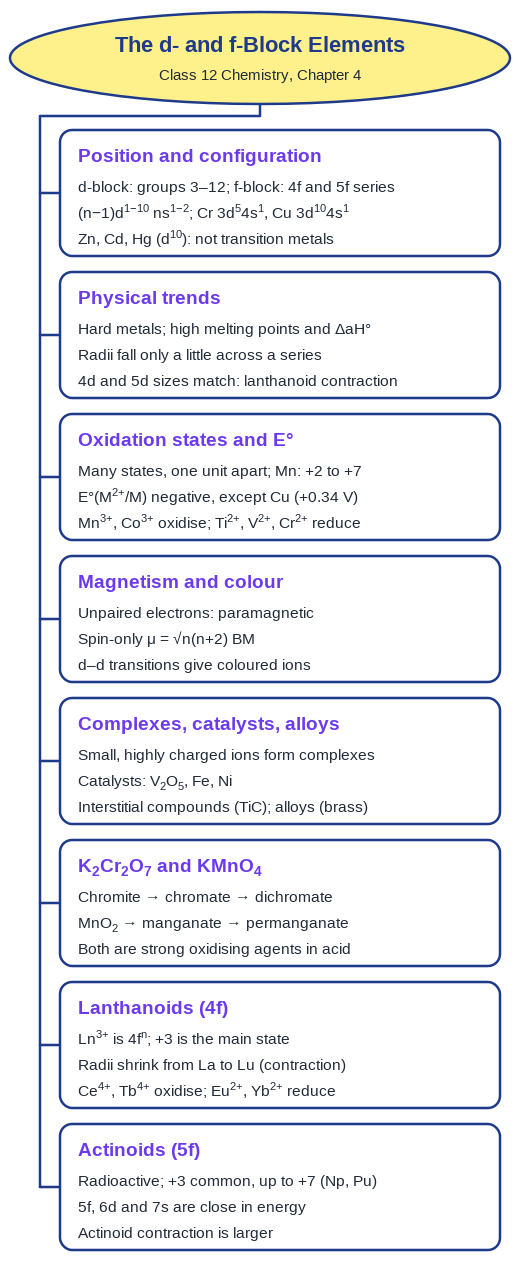
Answers to all 38 end-of-unit exercises, all 10 Intext Questions and all 10 worked examples of Unit 4, The d- and f-Block Elements, of Chemistry Part I, the Class 12 NCERT textbook. Page numbers follow the 2026-27 reprint (pages 89–117). The exercises come first, quoted from the book; the Intext Questions and the examples follow, restated in short. Short notes: Chapter 4 notes.
Data used. Configurations, ionisation enthalpies, E° values and radii are from the book’s Tables 4.1 to 4.11. Spin-only moments use μ = √n(n+2) BM. Every ionic equation is balanced for atoms and for charge.
Stay safe. Potassium dichromate, potassium permanganate and acids irritate skin and eyes, and H₂S and SO₂ are poisonous gases. Do these reactions only in the school laboratory with your teacher, and never taste or sniff a chemical.
Exercises 4.1 to 4.10: configurations and oxidation states
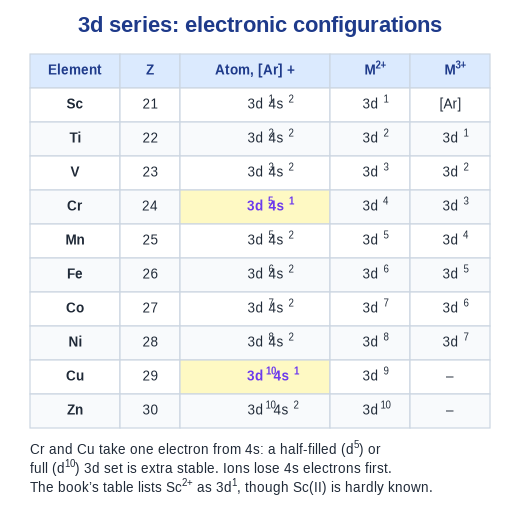
4.1 “Write down the electronic configuration of: (i) Cr³⁺ (ii) Pm³⁺ (iii) Cu⁺ (iv) Ce⁴⁺ (v) Co²⁺ (vi) Lu²⁺ (vii) Mn²⁺ (viii) Th⁴⁺”
Write the atom first, then remove the outermost s electrons before any d or f electrons.
| Ion | Atom | Ion |
|---|---|---|
| (i) Cr³⁺ (Z = 24) | [Ar]3d⁵4s¹ | [Ar]3d³ |
| (ii) Pm³⁺ (Z = 61) | [Xe]4f⁵6s² | [Xe]4f⁴ |
| (iii) Cu⁺ (Z = 29) | [Ar]3d¹⁰4s¹ | [Ar]3d¹⁰ |
| (iv) Ce⁴⁺ (Z = 58) | [Xe]4f¹5d¹6s² | [Xe] (4f⁰) |
| (v) Co²⁺ (Z = 27) | [Ar]3d⁷4s² | [Ar]3d⁷ |
| (vi) Lu²⁺ (Z = 71) | [Xe]4f¹⁴5d¹6s² | [Xe]4f¹⁴5d¹ |
| (vii) Mn²⁺ (Z = 25) | [Ar]3d⁵4s² | [Ar]3d⁵ |
| (viii) Th⁴⁺ (Z = 90) | [Rn]6d²7s² | [Rn] (5f⁰) |
4.2 “Why are Mn²⁺ compounds more stable than Fe²⁺ towards oxidation to their +3 state?”
Mn²⁺ is 3d⁵, a half-filled and extra stable set. Oxidising it to Mn³⁺ (3d⁴) breaks that set, so the third ionisation enthalpy of Mn is high, 3260 kJ mol⁻¹. Fe²⁺ is 3d⁶; losing one electron gives Fe³⁺ with the stable 3d⁵ set, so its third ionisation enthalpy is lower, 2962 kJ mol⁻¹. The E° values agree: +1.57 V for Mn³⁺/Mn²⁺ against +0.77 V for Fe³⁺/Fe²⁺. So Mn²⁺ resists oxidation and Fe²⁺ is oxidised much more easily.
4.3 “Explain briefly how +2 state becomes more and more stable in the first half of the first row transition elements with increasing atomic number?”
In the +2 state the two 4s electrons have been lost and the 3d electrons remain. From Sc to Mn the nuclear charge rises, the 3d electrons are held more firmly, and the third ionisation enthalpy climbs: 2393 (Sc), 2657 (Ti), 2833 (V), 2990 (Cr), 3260 kJ mol⁻¹ (Mn). So it becomes harder and harder to go beyond +2.
The chemistry shows this. Sc(II) is practically unknown; Ti²⁺, V²⁺ and Cr²⁺ are strong reducing agents that readily move to higher states; Mn²⁺, with its half-filled 3d⁵ set, is very stable. E°(M³⁺/M²⁺) rises from −0.37 V for Ti to +1.57 V for Mn.
4.4 “To what extent do the electronic configurations decide the stability of oxidation states in the first series of the transition elements? Illustrate your answer with examples.”
To a large extent. Ions with an empty (d⁰), half-filled (d⁵) or full (d¹⁰) d subshell are especially stable:
- d⁰: Sc³⁺ and Ti⁴⁺. Scandium shows only +3.
- d⁵: Mn²⁺ and Fe³⁺. Mn²⁺ resists oxidation; Fe²⁺ is easily oxidised to Fe³⁺.
- d¹⁰: Zn²⁺ (zinc shows only +2) and Cu⁺.
But configuration is not the whole story. Cu⁺ (d¹⁰) is unstable in water and disproportionates, because Cu²⁺ has a far more negative hydration enthalpy. Cr³⁺ (d³) is the most stable chromium ion in water. Enthalpies of atomisation, ionisation and hydration all play a part, and the book itself calls the problem complex.
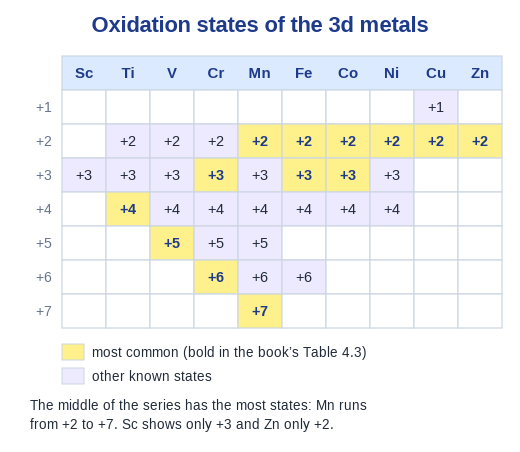
4.5 “What may be the stable oxidation state of the transition element with the following d electron configurations in the ground state of their atoms : 3d³, 3d⁵, 3d⁸ and 3d⁴?”
- 3d³ is vanadium (3d³4s²). All five outer electrons can be used: +5 is its most common state (+2, +3 and +4 also exist).
- 3d⁵ is chromium (3d⁵4s¹), with +3 and +6, or manganese (3d⁵4s²), with +2 and +7.
- 3d⁸ is nickel (3d⁸4s²): +2.
- 3d⁴: no 3d atom has this ground-state configuration, since chromium is 3d⁵4s¹, not 3d⁴4s².
The book’s answer key lists more states: V (+2), +3, +4, +5; Cr +3, +4, +6; Mn +2, +4, +6, +7; Ni +2, +3 (in complexes).
4.6 “Name the oxometal anions of the first series of the transition metals in which the metal exhibits the oxidation state equal to its group number.”
- Vanadate, VO₃⁻ (also VO₄³⁻): V is +5, group 5.
- Chromate, CrO₄²⁻, and dichromate, Cr₂O₇²⁻: Cr is +6, group 6.
- Permanganate, MnO₄⁻: Mn is +7, group 7.
4.7 “What is lanthanoid contraction? What are the consequences of lanthanoid contraction?”
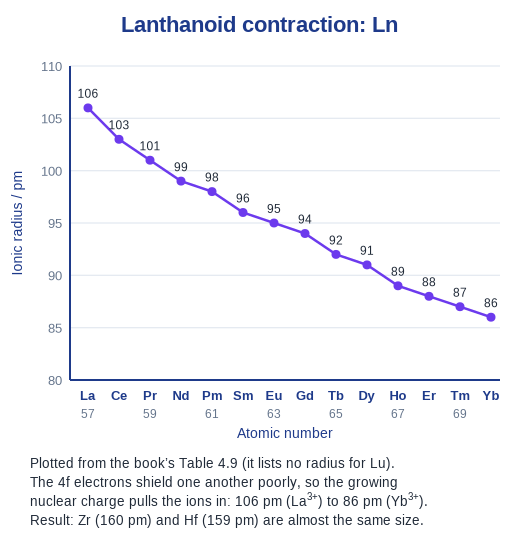
Lanthanoid contraction is the steady shrinking of atoms and ions as we go from lanthanum to lutetium. As the nuclear charge rises by one at each step, the new electron enters the 4f subshell. One 4f electron shields another very poorly, so the outer electrons feel a growing pull and the size falls. The Ln³⁺ radius goes from 106 pm (La³⁺) to 86 pm (Yb³⁺).
Consequences:
- The 5d metals have almost the same radii as the 4d metals above them (Zr 160 pm, Hf 159 pm).
- Such pairs have very similar properties, occur together in nature and are difficult to separate.
- The lanthanoids differ only slightly from one another in size, so they are chemically very alike.
4.8 “What are the characteristics of the transition elements and why are they called transition elements? Which of the d-block elements may not be regarded as the transition elements?”
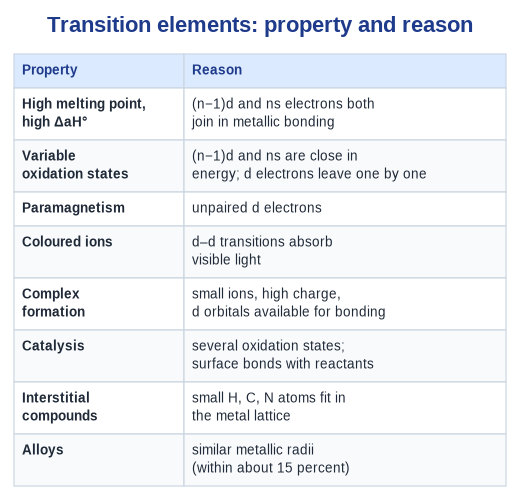
Characteristics: they are hard metals with high melting points and enthalpies of atomisation; they show variable oxidation states; they form coloured ions and many complexes; many of their ions are paramagnetic; they and their compounds act as catalysts; they form interstitial compounds and alloys.
They were named transition elements because their properties are in between those of the s-block and the p-block. IUPAC now defines a transition metal as one with an incomplete d subshell in its atom or its ions.
Zn, Cd and Hg (group 12) have a full d¹⁰ subshell in the atom and in their common oxidation states, so they are not regarded as transition elements.
4.9 “In what way is the electronic configuration of the transition elements different from that of the non transition elements?”
In transition elements the last electron enters the d orbitals of the shell inside the outermost one: (n−1)d¹⁻¹⁰ ns¹⁻². Their atoms or ions have a partly filled d subshell. In non-transition (s- and p-block) elements the last electron enters the outermost shell, ns¹⁻² or ns²np¹⁻⁶, and any inner d subshell is either empty or full.
4.10 “What are the different oxidation states exhibited by the lanthanoids?”
+3 is the common and most stable state of all lanthanoids. Some also show +2 (Eu, Yb, Sm) and +4 (Ce; also Pr, Nd, Tb and Dy, but only in oxides MO₂).
Exercises 4.11 to 4.19: properties, dichromate and permanganate
4.11 “Explain giving reasons: (i) Transition metals and many of their compounds show paramagnetic behaviour. (ii) The enthalpies of atomisation of the transition metals are high. (iii) The transition metals generally form coloured compounds. (iv) Transition metals and their many compounds act as good catalyst.”
(i) Their atoms and ions have unpaired electrons in the (n−1)d orbitals. Each unpaired electron has a magnetic moment, so the substance is drawn into a magnetic field.
(ii) Their atoms have many unpaired electrons, and the (n−1)d electrons take part in metallic bonding along with the ns electrons. The strong bonding between atoms needs a lot of energy to break.
(iii) An electron can move from a lower-energy d orbital to a higher one (a d–d transition) by absorbing visible light. The compound shows the complementary colour.
(iv) They can adopt several oxidation states and form complexes, and their surfaces bond reactant molecules using 3d and 4s electrons. This gives a path with a lower activation energy. Examples: V₂O₅ in the Contact process, iron in Haber’s process, nickel in hydrogenation.
4.12 “What are interstitial compounds? Why are such compounds well known for transition metals?”
Interstitial compounds form when small atoms such as H, C or N are trapped in the gaps (interstices) of a metal’s crystal lattice. Examples: TiC, Mn₄N, Fe₃H, VH₀.₅₆, TiH₁.₇. They are usually non-stoichiometric and are neither typically ionic nor covalent.
They are well known for transition metals because the close-packed lattices of these metals have gaps of the right size to hold such small atoms. The products are useful: they melt higher than the pure metal, are very hard, keep metallic conductivity and are chemically inert.
4.13 “How is the variability in oxidation states of transition metals different from that of the non transition metals? Illustrate with examples.”
- In transition metals the oxidation states usually differ by one unit, because (n−1)d electrons can be removed one at a time: V(II), V(III), V(IV), V(V); Mn from +2 to +7.
- In non-transition (p-block) elements they usually differ by two units: Sn(II) and Sn(IV), Pb(II) and Pb(IV), P(III) and P(V).
- Down a group the trends are opposite. In the p-block the lower state becomes more stable for heavier members (inert pair effect). In the d-block the higher state does: Mo(VI) and W(VI) are more stable than Cr(VI).
4.14 “Describe the preparation of potassium dichromate from iron chromite ore. What is the effect of increasing pH on a solution of potassium dichromate?”
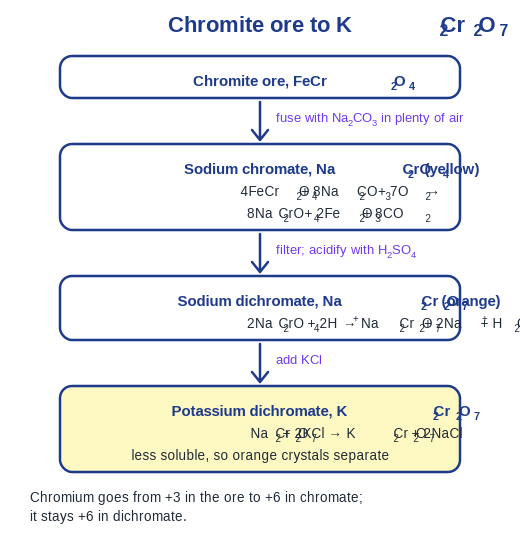
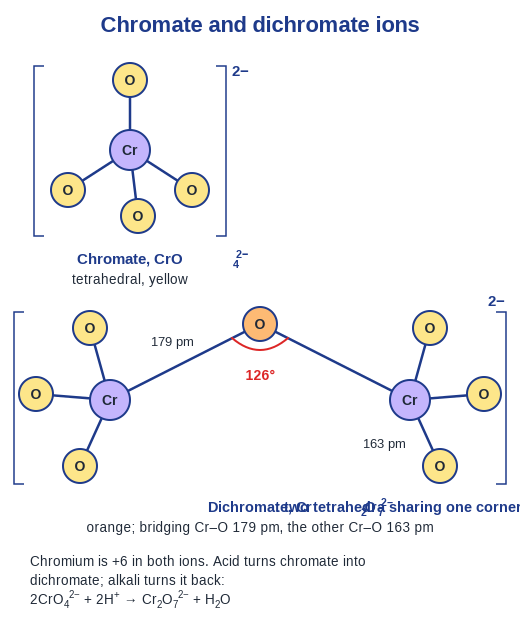
Preparation.
- Chromite ore is fused with sodium carbonate in plenty of air, giving sodium chromate: 4FeCr₂O₄ + 8Na₂CO₃ + 7O₂ → 8Na₂CrO₄ + 2Fe₂O₃ + 8CO₂
- The yellow solution is filtered and acidified with sulphuric acid, giving orange sodium dichromate: 2Na₂CrO₄ + 2H⁺ → Na₂Cr₂O₇ + 2Na⁺ + H₂O
- Potassium chloride is added; the less soluble potassium dichromate crystallises: Na₂Cr₂O₇ + 2KCl → K₂Cr₂O₇ + 2NaCl
Effect of increasing pH. Adding alkali turns the orange dichromate into yellow chromate:
Cr₂O₇²⁻ + 2OH⁻ → 2CrO₄²⁻ + H₂O
Lowering the pH again reverses it: 2CrO₄²⁻ + 2H⁺ → Cr₂O₇²⁻ + H₂O. Chromium stays +6.
4.15 “Describe the oxidising action of potassium dichromate and write the ionic equations for its reaction with: (i) iodide (ii) iron(II) solution and (iii) H₂S”
In acidic solution dichromate is a strong oxidising agent. Each Cr₂O₇²⁻ ion gains six electrons and chromium falls from +6 to +3:
Cr₂O₇²⁻ + 14H⁺ + 6e⁻ → 2Cr³⁺ + 7H₂O (E° = 1.33 V)
(i) Iodide (6I⁻ → 3I₂ + 6e⁻): Cr₂O₇²⁻ + 14H⁺ + 6I⁻ → 2Cr³⁺ + 3I₂ + 7H₂O
(ii) Iron(II) (6Fe²⁺ → 6Fe³⁺ + 6e⁻): Cr₂O₇²⁻ + 14H⁺ + 6Fe²⁺ → 2Cr³⁺ + 6Fe³⁺ + 7H₂O
(iii) H₂S (3H₂S → 6H⁺ + 3S + 6e⁻): Cr₂O₇²⁻ + 8H⁺ + 3H₂S → 2Cr³⁺ + 3S + 7H₂O
In (iii) the six H⁺ released by H₂S cancel six of the fourteen needed, leaving 8H⁺. Charge check: −2 + 8 = +6 on the left, 2 × (+3) = +6 on the right.
4.16 “Describe the preparation of potassium permanganate. How does the acidified permanganate solution react with (i) iron(II) ions (ii) SO₂ and (iii) oxalic acid? Write the ionic equations for the reactions.”
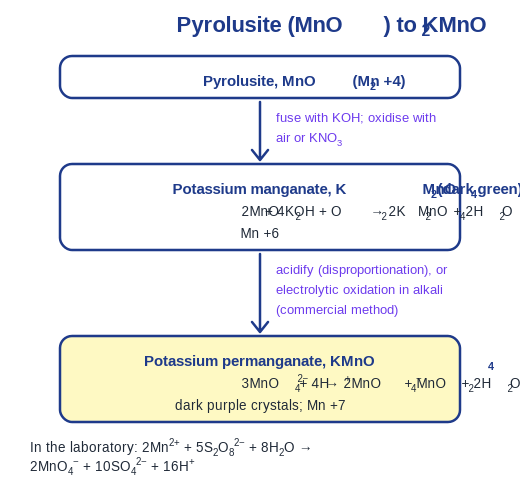
Preparation. MnO₂ is fused with KOH and an oxidising agent such as air or KNO₃, giving dark green potassium manganate:
2MnO₂ + 4KOH + O₂ → 2K₂MnO₄ + 2H₂O
In neutral or acidic solution the manganate disproportionates to permanganate:
3MnO₄²⁻ + 4H⁺ → 2MnO₄⁻ + MnO₂ + 2H₂O
Commercially, the manganate is oxidised electrolytically in alkaline solution instead.
Reactions in acid. MnO₄⁻ + 8H⁺ + 5e⁻ → Mn²⁺ + 4H₂O
(i) Iron(II) is oxidised to iron(III): MnO₄⁻ + 8H⁺ + 5Fe²⁺ → Mn²⁺ + 5Fe³⁺ + 4H₂O
(ii) SO₂ is oxidised to sulphate (SO₂ + 2H₂O → SO₄²⁻ + 4H⁺ + 2e⁻): 2MnO₄⁻ + 5SO₂ + 2H₂O → 2Mn²⁺ + 5SO₄²⁻ + 4H⁺
(iii) Oxalic acid is oxidised to CO₂, at about 333 K (H₂C₂O₄ → 2CO₂ + 2H⁺ + 2e⁻): 2MnO₄⁻ + 5H₂C₂O₄ + 6H⁺ → 2Mn²⁺ + 10CO₂ + 8H₂O
With the oxalate ion, as the book writes it: 5C₂O₄²⁻ + 2MnO₄⁻ + 16H⁺ → 2Mn²⁺ + 8H₂O + 10CO₂.
4.17 “For M²⁺/M and M³⁺/M²⁺ systems the E° values for some metals are as follows: Cr²⁺/Cr −0.9V, Cr³⁺/Cr²⁺ −0.4 V; Mn²⁺/Mn −1.2V, Mn³⁺/Mn²⁺ +1.5 V; Fe²⁺/Fe −0.4V, Fe³⁺/Fe²⁺ +0.8 V. Use this data to comment upon: (i) the stability of Fe³⁺ in acid solution as compared to that of Cr³⁺ or Mn³⁺ and (ii) the ease with which iron can be oxidised as compared to a similar process for either chromium or manganese metal.”
(i) A higher E°(M³⁺/M²⁺) means M³⁺ is reduced to M²⁺ more readily, so it is less stable. The order of E° is Cr (−0.4 V) < Fe (+0.8 V) < Mn (+1.5 V). So the stability of the +3 ion is Cr³⁺ > Fe³⁺ > Mn³⁺: Fe³⁺ is more stable than Mn³⁺ but less stable than Cr³⁺.
(ii) A more negative E°(M²⁺/M) means the metal is oxidised to M²⁺ more easily. The values are Mn (−1.2 V), Cr (−0.9 V), Fe (−0.4 V). So the ease of oxidation is Mn > Cr > Fe: iron is oxidised less easily than chromium or manganese.
4.18 “Predict which of the following will be coloured in aqueous solution? Ti³⁺, V³⁺, Cu⁺, Sc³⁺, Mn²⁺, Fe³⁺ and Co²⁺. Give reasons for each.”
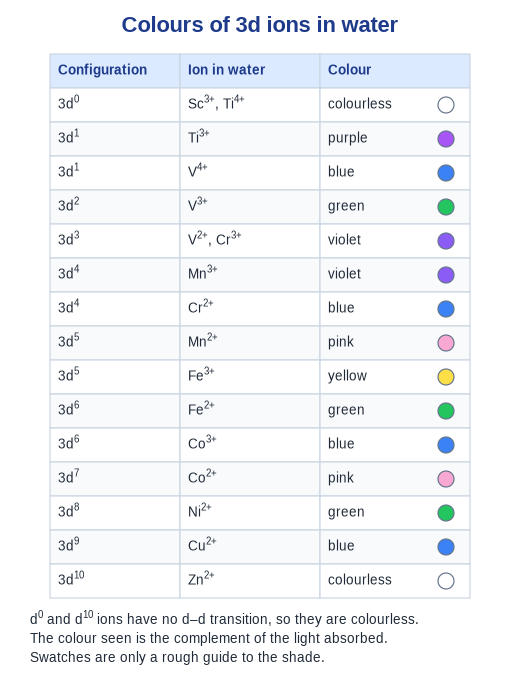
An ion is coloured if it has a partly filled d subshell, so that d–d transitions can happen.
| Ion | Configuration | Coloured? |
|---|---|---|
| Ti³⁺ | 3d¹ | Yes (purple) |
| V³⁺ | 3d² | Yes (green) |
| Cu⁺ | 3d¹⁰ | No: full d subshell |
| Sc³⁺ | 3d⁰ | No: empty d subshell |
| Mn²⁺ | 3d⁵ | Yes (pink) |
| Fe³⁺ | 3d⁵ | Yes (yellow) |
| Co²⁺ | 3d⁷ | Yes (pink) |
The book’s answer key says all except Sc³⁺ are coloured. By the same reasoning Cu⁺ (3d¹⁰) should be colourless too, like Zn²⁺ in Table 4.8.
4.19 “Compare the stability of +2 oxidation state for the elements of the first transition series.”
- Sc: Sc(II) is virtually unknown; scandium goes straight to +3 (d⁰).
- Ti, V, Cr: the M²⁺ ions exist but are strong reducing agents; they are easily oxidised to higher states.
- Mn: Mn²⁺ (3d⁵) is very stable.
- Fe: Fe²⁺ is common but is easily oxidised to Fe³⁺ (3d⁵).
- Co, Ni: +2 is the usual state; Co³⁺ is a strong oxidising agent in water (E° = +1.97 V).
- Cu: Cu²⁺ is the stable state in water, though E°(Cu²⁺/Cu) is positive (+0.34 V).
- Zn: +2 (3d¹⁰) is its only state.
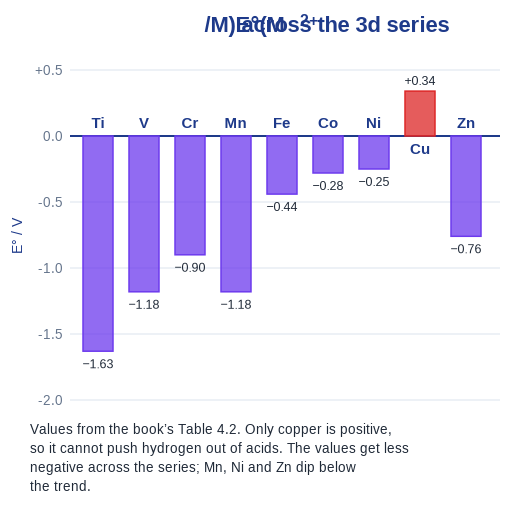
Overall, E°(M²⁺/M) becomes less negative across the series, from −1.63 V (Ti) to −0.25 V (Ni) and +0.34 V (Cu), because the sum of the first two ionisation enthalpies rises. So the tendency of the metal to form M²⁺ falls, with Mn (−1.18 V) and Zn (−0.76 V) below the trend because of their d⁵ and d¹⁰ ions.
Exercises 4.20 to 4.29: comparisons, disproportionation and the f-block
4.20 “Compare the chemistry of actinoids with that of the lanthanoids with special reference to: (i) electronic configuration (ii) atomic and ionic sizes and (iii) oxidation state (iv) chemical reactivity.”
| Lanthanoids | Actinoids | |
|---|---|---|
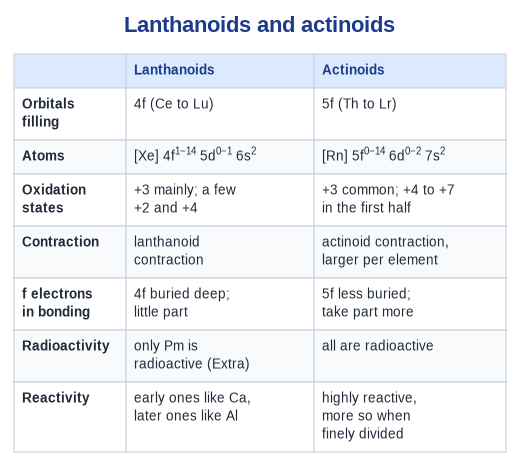
| (i) Configuration | [Xe]4f¹⁻¹⁴5d⁰⁻¹6s²; 4f orbitals are buried deep | [Rn]5f⁰⁻¹⁴6d⁰⁻²7s²; 5f orbitals are less buried and take more part in bonding |
| (ii) Sizes | Radii fall from La to Lu (lanthanoid contraction) | Radii fall across the series (actinoid contraction), by more from element to element, as 5f shielding is poorer |
| (iii) Oxidation states | +3 mainly; +2 and +4 only in a few | +3 common, but +4, +5, +6 and +7 in the first half, since 5f, 6d and 7s are close in energy |
| (iv) Reactivity | Early members react like calcium, later ones like aluminium | Highly reactive, most when finely divided; boiling water gives oxide and hydride; HCl attacks all; alkalis have no action |
4.21 “How would you account for the following: (i) Of the d⁴ species, Cr²⁺ is strongly reducing while manganese(III) is strongly oxidising. (ii) Cobalt(II) is stable in aqueous solution but in the presence of complexing reagents it is easily oxidised. (iii) The d¹ configuration is very unstable in ions.”
(i) Cr²⁺ (d⁴) loses an electron to become Cr³⁺ (d³), which has a stable half-filled t2g level; so Cr²⁺ is a reducing agent (E° of Cr³⁺/Cr²⁺ = −0.41 V). Mn³⁺ (d⁴) gains an electron to become Mn²⁺ with the stable half-filled d⁵ set; so Mn³⁺ is an oxidising agent (E° of Mn³⁺/Mn²⁺ = +1.57 V).
(ii) In water, Co³⁺ is a very strong oxidising agent (E° = +1.97 V), so Co(II) is the stable state. With strong complexing agents, the crystal field stabilisation energy gained by Co(III) (d⁶) more than makes up for the third ionisation enthalpy, so Co(II) is easily oxidised to Co(III). Chapter 5 explains this energy.
(iii) An ion with one d electron can lose it and reach the stable d⁰ configuration. The extra hydration or lattice energy of the more highly charged ion more than pays for the ionisation enthalpy needed. So d¹ ions tend to be oxidised.
4.22 “What is meant by ‘disproportionation’? Give two examples of disproportionation reaction in aqueous solution.”
Disproportionation is a reaction in which one oxidation state of an element becomes less stable than a higher and a lower state, and changes into both at once. The same species is oxidised and reduced.
- Copper(I): 2Cu⁺(aq) → Cu²⁺(aq) + Cu(s) (+1 becomes +2 and 0)
- Manganate(VI) in acid: 3MnO₄²⁻ + 4H⁺ → 2MnO₄⁻ + MnO₂ + 2H₂O (+6 becomes +7 and +4)
4.23 “Which metal in the first series of transition metals exhibits +1 oxidation state most frequently and why?”
Copper. Its atom is 3d¹⁰4s¹; losing the single 4s electron leaves Cu⁺ with a full, stable 3d¹⁰ subshell.
4.24 “Calculate the number of unpaired electrons in the following gaseous ions: Mn³⁺, Cr³⁺, V³⁺ and Ti³⁺. Which one of these is the most stable in aqueous solution?”
| Ion | Configuration | Unpaired electrons |
|---|---|---|
| Mn³⁺ | 3d⁴ | 4 |
| Cr³⁺ | 3d³ | 3 |
| V³⁺ | 3d² | 2 |
| Ti³⁺ | 3d¹ | 1 |
Cr³⁺ is the most stable in aqueous solution: its 3d³ arrangement is a half-filled t2g level. Mn³⁺ is a strong oxidising agent, and Ti³⁺ and V³⁺ are oxidised to higher states.
4.25 “Give examples and suggest reasons for the following features of the transition metal chemistry: (i) The lowest oxide of transition metal is basic, the highest is amphoteric/acidic. (ii) A transition metal exhibits highest oxidation state in oxides and fluorides. (iii) The highest oxidation state is exhibited in oxoanions of a metal.”
(i) Examples: MnO is basic but Mn₂O₇ is acidic (it gives HMnO₄); CrO is basic, Cr₂O₃ amphoteric and CrO₃ acidic; V₂O₃ is basic and V₂O₅ amphoteric. Reason: in a low oxidation state the bonding is ionic and the oxide ion acts as a base. In a high oxidation state the bonding is covalent and the oxide gives an acid with water.
(ii) Examples: CrF₆, VF₅, Mn₂O₇, CrO₃. Reason: oxygen and fluorine are small and highly electronegative, so they can oxidise the metal to its highest state. Fluorine stabilises it through high lattice or bond enthalpies; oxygen can also form multiple bonds.
(iii) Examples: Cr(VI) in CrO₄²⁻ and Cr₂O₇²⁻, Mn(VII) in MnO₄⁻, V(V) in VO₃⁻. Reason: oxygen forms multiple bonds with the metal, which stabilises the high oxidation state.
4.26 “Indicate the steps in the preparation of: (i) K₂Cr₂O₇ from chromite ore. (ii) KMnO₄ from pyrolusite ore.”
(i) K₂Cr₂O₇ from chromite:
- 4FeCr₂O₄ + 8Na₂CO₃ + 7O₂ → 8Na₂CrO₄ + 2Fe₂O₃ + 8CO₂ (fusion in air)
- 2Na₂CrO₄ + 2H⁺ → Na₂Cr₂O₇ + 2Na⁺ + H₂O (acidify)
- Na₂Cr₂O₇ + 2KCl → K₂Cr₂O₇ + 2NaCl (add KCl; crystallise)
(ii) KMnO₄ from pyrolusite, MnO₂:
- 2MnO₂ + 4KOH + O₂ → 2K₂MnO₄ + 2H₂O (fuse with KOH and an oxidising agent)
- 3MnO₄²⁻ + 4H⁺ → 2MnO₄⁻ + MnO₂ + 2H₂O (acidify), or oxidise the manganate electrolytically in alkaline solution: MnO₄²⁻ → MnO₄⁻ + e⁻
4.27 “What are alloys? Name an important alloy which contains some of the lanthanoid metals. Mention its uses.”
An alloy is a blend of metals made by mixing the components. It may be a homogeneous solid solution in which atoms of one metal are spread randomly among those of the other.
Mischmetall contains a lanthanoid metal (about 95%), iron (about 5%) and a little S, C, Ca and Al. Much of it goes into magnesium-based alloys, which the book says are used for bullets, shells and lighter flints.
4.28 “What are inner transition elements? Decide which of the following atomic numbers are the atomic numbers of the inner transition elements : 29, 59, 74, 95, 102, 104.”
Inner transition elements are the f-block elements, in which the 4f or 5f orbitals are being filled: the lanthanoids (Z = 58 to 71) and the actinoids (Z = 90 to 103).
- 59 (Pr), 95 (Am) and 102 (No) are inner transition elements.
- 29 (Cu), 74 (W) and 104 (Rf) are d-block elements.
4.29 “The chemistry of the actinoid elements is not so smooth as that of the lanthanoids. Justify this statement by giving some examples from the oxidation state of these elements.”
The lanthanoids show essentially one state, +3, with +2 or +4 in only a few cases, so their chemistry changes smoothly along the series.
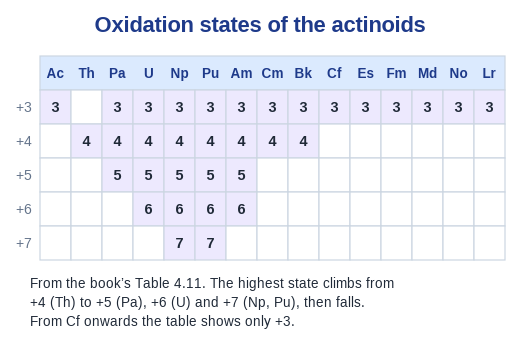
The actinoids show a wide and uneven range, because the 5f, 6d and 7s levels are close in energy. The highest state is +4 for Th, +5 for Pa, +6 for U and +7 for Np and Pu, then it falls again: Am up to +6, Cm and Bk up to +4, and only +3 from Cf onwards. The early and later actinoids therefore behave quite differently. Their +3 and +4 ions also tend to hydrolyse, and their radioactivity makes them harder to study.
Exercises 4.30 to 4.38: f-block configurations and magnetic moments
4.30 “Which is the last element in the series of the actinoids? Write the electronic configuration of this element. Comment on the possible oxidation state of this element.”
Lawrencium, Lr (Z = 103). Its configuration is [Rn]5f¹⁴6d¹7s². Losing the 6d¹ and 7s² electrons leaves the full, stable 5f¹⁴ subshell, so its oxidation state is +3.
4.31 “Use Hund’s rule to derive the electronic configuration of Ce³⁺ ion, and calculate its magnetic moment on the basis of ‘spin-only’ formula.”
Ce (Z = 58) is [Xe]4f¹5d¹6s². Ce³⁺ loses the two 6s electrons and the 5d electron: Ce³⁺ = [Xe]4f¹. By Hund’s rule the single electron sits alone in one of the seven 4f orbitals, so n = 1.
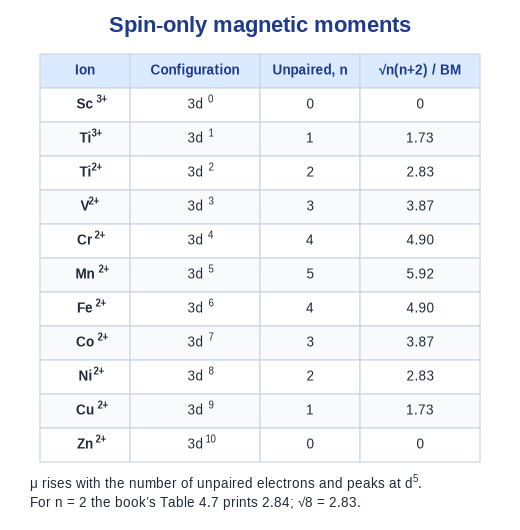
μ = √n(n+2) = √(1 × 3) = √3 = 1.73 BM
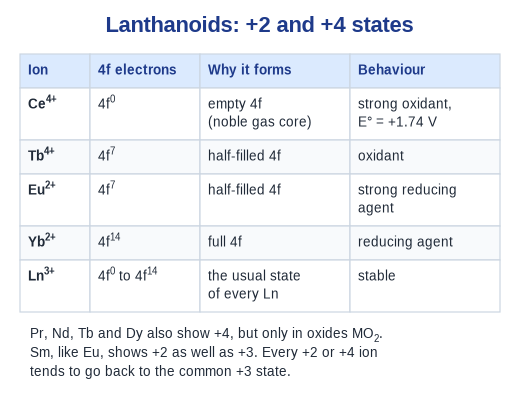
4.32 “Name the members of the lanthanoid series which exhibit +4 oxidation states and those which exhibit +2 oxidation states. Try to correlate this type of behaviour with the electronic configurations of these elements.”
- +4: Ce, Pr, Nd, Tb, Dy (the last four only in oxides MO₂).
- +2: Eu, Yb and Sm.
The extra states appear when they give, or come close to, an empty, half-filled or full 4f subshell:
| Ion | Configuration | 4f subshell |
|---|---|---|
| Ce⁴⁺ | 4f⁰ | empty |
| Tb⁴⁺ | 4f⁷ | half-filled |
| Eu²⁺ | 4f⁷ | half-filled |
| Yb²⁺ | 4f¹⁴ | full |
Pr⁴⁺ (4f¹), Nd⁴⁺ (4f²), Dy⁴⁺ (4f⁸) and Sm²⁺ (4f⁶) are only near these arrangements, so they are less stable. All of them tend to return to +3: the +4 ions are oxidants and the +2 ions are reductants.
4.33 “Compare the chemistry of the actinoids with that of lanthanoids with reference to: (i) electronic configuration (ii) oxidation states and (iii) chemical reactivity.”
(i) Configuration. Lanthanoids: [Xe]4f¹⁻¹⁴5d⁰⁻¹6s². Actinoids: [Rn]5f⁰⁻¹⁴6d⁰⁻²7s². The 5f orbitals are less buried than the 4f, so 5f electrons bond more.
(ii) Oxidation states. Lanthanoids: +3, with +2 and +4 in a few. Actinoids: +3 generally, with +4 to +7 in the first half of the series.
(iii) Reactivity. The early lanthanoids resemble calcium and the later ones aluminium. Actinoids are highly reactive metals, more so when finely divided; they give oxide and hydride with boiling water, are attacked by hydrochloric acid, are only slightly affected by nitric acid (a protective oxide layer forms) and are not attacked by alkalis. See the table under 4.20.
4.34 “Write the electronic configurations of the elements with the atomic numbers 61, 91, 101, and 109.”
| Z | Element | Configuration |
|---|---|---|
| 61 | Promethium, Pm | [Xe]4f⁵6s² |
| 91 | Protactinium, Pa | [Rn]5f²6d¹7s² |
| 101 | Mendelevium, Md | [Rn]5f¹³7s² |
| 109 | Meitnerium, Mt | [Rn]5f¹⁴6d⁷7s² |
4.35 “Compare the general characteristics of the first series of the transition metals with those of the second and third series metals in the respective vertical columns. Give special emphasis on the following points: (i) electronic configurations (ii) oxidation states (iii) ionisation enthalpies and (iv) atomic sizes.”
(i) Electronic configurations. Elements in a column have the same number of outer electrons, in (n−1)d and ns orbitals, but the exceptions are not the same. Group 6: Cr 3d⁵4s¹, Mo 4d⁵5s¹, W 5d⁴6s². Group 10: Ni 3d⁸4s², Pd 4d¹⁰5s⁰, Pt 5d⁹6s¹. The 5d metals also have a filled 4f¹⁴ subshell.
(ii) Oxidation states. In the first series the lower states, +2 and +3, are the important ones. In the second and third series the higher states are more stable: Mo(VI) and W(VI) are more stable than Cr(VI), so dichromate is a strong oxidising agent while MoO₃ and WO₃ are not.
(iii) Ionisation enthalpies. In each series the values rise slowly across the row, with breaks at half-filled and full d subshells. Extra (not in the chapter’s tables): the third-series metals generally have higher first ionisation enthalpies than the first and second, because their 4f electrons shield the nuclear charge poorly.
(iv) Atomic sizes. The second series atoms are larger than the first. The third series atoms are almost the same size as the second (Zr 160 pm, Hf 159 pm) because of the lanthanoid contraction.
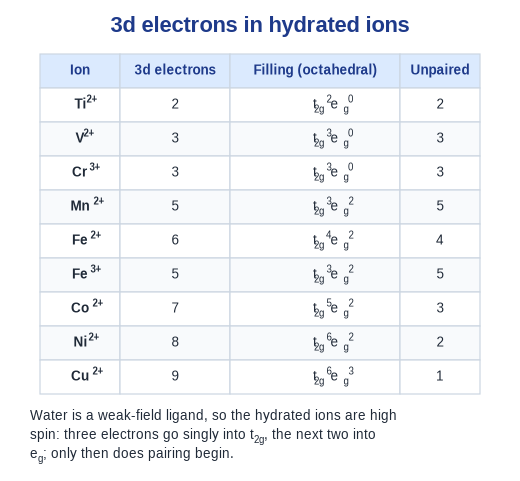
4.36 “Write down the number of 3d electrons in each of the following ions: Ti²⁺, V²⁺, Cr³⁺, Mn²⁺, Fe²⁺, Fe³⁺, Co²⁺, Ni²⁺ and Cu²⁺. Indicate how would you expect the five 3d orbitals to be occupied for these hydrated ions (octahedral).”
In an octahedral complex the five d orbitals split into a lower set of three (t2g) and an upper set of two (eg); Chapter 5 explains why. Water is a weak-field ligand, so electrons fill all five orbitals singly before pairing.
| Ion | 3d electrons | Occupancy | Unpaired |
|---|---|---|---|
| Ti²⁺ | 2 | t2g² | 2 |
| V²⁺ | 3 | t2g³ | 3 |
| Cr³⁺ | 3 | t2g³ | 3 |
| Mn²⁺ | 5 | t2g³ eg² | 5 |
| Fe²⁺ | 6 | t2g⁴ eg² | 4 |
| Fe³⁺ | 5 | t2g³ eg² | 5 |
| Co²⁺ | 7 | t2g⁵ eg² | 3 |
| Ni²⁺ | 8 | t2g⁶ eg² | 2 |
| Cu²⁺ | 9 | t2g⁶ eg³ | 1 |
4.37 “Comment on the statement that elements of the first transition series possess many properties different from those of heavier transition elements.”
The statement is true. The 4d and 5d metals resemble each other closely, but the 3d metals differ from both:
- Size. 3d atoms are smaller; 4d and 5d atoms are larger and almost equal in size (lanthanoid contraction).
- Oxidation states. For 3d metals +2 and +3 are the important states. Heavier metals prefer higher states: Mo(VI) and W(VI) are stable, while Cr(VI) is strongly oxidising.
- Bonding in the metal. Heavier metals have higher enthalpies of atomisation and melting points, and form metal–metal bonds in their compounds much more often.
- Reactivity. Most 3d metals (except Cu) are oxidised by 1 M H⁺. Metals with very high enthalpies of atomisation tend to be noble.
- Magnetism. The spin-only formula works well for 3d ions, as the orbital contribution is quenched.
4.38 “What can be inferred from the magnetic moment values of the following complex species? Example, Magnetic Moment (BM): K₄[Mn(CN)₆], 2.2; [Fe(H₂O)₆]²⁺, 5.3; K₂[MnCl₄], 5.9”
Spin-only values for n = 1 to 5 are 1.73, 2.83, 3.87, 4.90 and 5.92 BM. Match each measured value to the nearest one.
| Complex | Metal ion | μ (BM) | n | What it shows |
|---|---|---|---|---|
| K₄[Mn(CN)₆] | Mn²⁺, 3d⁵ | 2.2 | 1 | CN⁻ is a strong-field ligand: electrons pair up (t2g⁵). Low spin, d²sp³, octahedral |
| [Fe(H₂O)₆]²⁺ | Fe²⁺, 3d⁶ | 5.3 | 4 | H₂O is a weak-field ligand: no extra pairing (t2g⁴ eg²). High spin, sp³d², octahedral |
| K₂[MnCl₄] | Mn²⁺, 3d⁵ | 5.9 | 5 | Cl⁻ is a weak-field ligand: all five d electrons unpaired. sp³, tetrahedral |
The measured 2.2 BM lies between the values for one and two unpaired electrons; with five d electrons in a low-spin octahedral complex only n = 1 is possible. The hybridisations belong to Chapter 5.
Intext Questions 4.1 to 4.10
These are restated in short; the full wording is on the page given.
Intext 4.1 (page 92). Silver has a full 4d¹⁰ set in its ground state. Why is it still a transition element?
Silver (Z = 47) can show the +2 oxidation state, in which its configuration is 4d⁹. That is an incomplete d subshell in an ion, which is enough to make it a transition element.
Intext 4.2 (page 95). Why does zinc have the lowest enthalpy of atomisation (126 kJ mol⁻¹) from Sc to Zn?
Zinc is 3d¹⁰4s². Its d subshell is full, so no 3d electrons take part in metallic bonding. In every other 3d metal, d electrons do take part. The weaker bonding in zinc means less energy is needed to separate its atoms.
Intext 4.3 (page 97). Which 3d metal has the most oxidation states, and what is the reason?
Manganese (3d⁵4s²). It has five unpaired 3d electrons and two 4s electrons, and all seven can be used, so it shows every state from +2 to +7. (The book’s answer gives the reason as manganese having the most unpaired electrons; counting 4s as well, chromium, 3d⁵4s¹, has six.)
Intext 4.4 (page 98). Why is E°(M²⁺/M) positive (+0.34 V) for copper?
To turn Cu(s) into Cu²⁺(aq), energy is needed for atomisation and for the first two ionisations, and energy is given back on hydration. With the book’s Table 4.4 data:
Cu: 339 + 745 + 1958 − 2121 = +921 kJ mol⁻¹
Zn: 130 + 906 + 1734 − 2059 = +711 kJ mol⁻¹; Fe: 418 + 762 + 1561 − 1998 = +743 kJ mol⁻¹
Copper’s total is the highest of the series: its high enthalpy of atomisation and second ionisation enthalpy are not balanced by its hydration enthalpy. So Cu²⁺(aq) forms least readily, and E° is positive.
Intext 4.5 (page 100). Why do the first and second ionisation enthalpies vary irregularly in the 3d series?
Because different 3d configurations differ in stability; d⁰, d⁵ and d¹⁰ are especially stable. Removing an electron from such a set needs extra energy, and reaching one needs less. So the second ionisation enthalpy is unusually high for Cr (Cr⁺ is 3d⁵) and Cu (Cu⁺ is 3d¹⁰). Removing an electron also changes the relative energies of 4s and 3d.
Intext 4.6 (page 101). Why is the highest oxidation state of a metal shown only in its oxide or fluoride?
Oxygen and fluorine are small and highly electronegative, so they can oxidise a metal to its highest state. Oxygen can also form multiple bonds with the metal.
Intext 4.7 (page 101). Which is the stronger reducing agent, Cr²⁺ or Fe²⁺?
Cr²⁺. E°(Cr³⁺/Cr²⁺) = −0.41 V while E°(Fe³⁺/Fe²⁺) = +0.77 V, so Cr²⁺ gives up an electron far more readily. Cr²⁺ goes from d⁴ to d³ (a half-filled t2g level, very stable in water); Fe²⁺ goes from d⁶ to d⁵.
Intext 4.8 (page 103). Find the spin-only magnetic moment of M²⁺(aq) for Z = 27.
Z = 27 is cobalt, 3d⁷4s². Co²⁺ is 3d⁷: five orbitals hold seven electrons, so two orbitals are paired and n = 3.
μ = √(3 × 5) = √15 = 3.87 BM
Intext 4.9 (page 105). Why is Cu⁺ not stable in aqueous solution?
It disproportionates: 2Cu⁺(aq) → Cu²⁺(aq) + Cu(s). Cu²⁺ has a much more negative hydration enthalpy than Cu⁺, which more than makes up for the second ionisation enthalpy of copper, so the E° for this change is favourable.
Intext 4.10 (page 113). Why is the actinoid contraction greater from element to element than the lanthanoid contraction?
The 5f electrons shield the nuclear charge more poorly than the 4f electrons do. Each added proton therefore pulls the outer electrons in more strongly in the actinoids.
Worked examples 4.1 to 4.10 (pages 91–113)
Example 4.1 (page 91). Why is scandium a transition element but zinc not?
Sc is 3d¹4s²: its 3d subshell is incomplete in the ground state. Zn is 3d¹⁰4s², and Zn²⁺ is 3d¹⁰: the d subshell is full in the atom and in the ion.
Example 4.2 (page 95). Why do transition elements have high enthalpies of atomisation?
Their atoms have many unpaired electrons, which give strong interatomic bonding. Separating the atoms therefore takes a lot of energy.
Example 4.3 (page 97). Name a transition element that does not show variable oxidation states.
Scandium (Z = 21); it shows only +3.
Example 4.4 (page 98). Cr²⁺ and Mn³⁺ are both d⁴. Why is one reducing and the other oxidising?
Cr²⁺ changes from d⁴ to d³, a half-filled t2g level, so it gives up an electron (reducing). Mn³⁺ changes from d⁴ to d⁵, a half-filled d subshell, so it takes an electron (oxidising).
Example 4.5 (page 100). Why does oxidising power increase in the order VO₂⁺ < Cr₂O₇²⁻ < MnO₄⁻?
Because the lower species to which each is reduced becomes more stable along the series, so the reduction is more and more favoured.
Example 4.6 (page 101). Explain the irregular E°(M²⁺/M) values: V −1.18, Cr −0.91, Mn −1.18, Fe −0.44, Co −0.28, Ni −0.25, Cu +0.34 V.
E° depends on the enthalpy of atomisation (sublimation) and on the sum of the first two ionisation enthalpies, and neither changes regularly. The sublimation enthalpies of manganese and vanadium are relatively low, which makes their E° values more negative. (Table 4.2 of the book gives −0.90 V for Cr; this example prints −0.91.)
Example 4.7 (page 101). Why is E°(Mn³⁺/Mn²⁺) much more positive than E°(Cr³⁺/Cr²⁺) or E°(Fe³⁺/Fe²⁺)?
The third ionisation enthalpy of Mn is very large (3260 kJ mol⁻¹), because the electron must leave the stable d⁵ set of Mn²⁺. So Mn³⁺ readily goes back to Mn²⁺. This is also why the +3 state of manganese matters little.
Example 4.8 (page 102). Find the magnetic moment of a divalent ion in aqueous solution if Z = 25.
Z = 25 is manganese; Mn²⁺ is 3d⁵ with five unpaired electrons.
μ = √(5 × 7) = √35 = 5.92 BM
Example 4.9 (page 105). What is disproportionation of an oxidation state? Give an example.
When one oxidation state is less stable than a higher and a lower state, it changes into both. Mn(VI) does this in acid:
3MnO₄²⁻ + 4H⁺ → 2MnO₄⁻ + MnO₂ + 2H₂O
Manganese goes from +6 to +7 (in MnO₄⁻) and +4 (in MnO₂).
Example 4.10 (page 113). Name a lanthanoid well known for the +4 state.
Cerium (Z = 58); Ce⁴⁺ has the noble gas configuration [Xe].
Practice
-
The electronic configuration of Fe³⁺ (Z = 26) is:
Show answer
Answer: (b) [Ar]3d⁵
-
The spin-only magnetic moment of an ion with three unpaired electrons is:
Show answer
Answer: (c) 3.87 BM
-
Which of these is an inner transition element?
Show answer
Answer: (b) Z = 59
-
Why is Sc³⁺ colourless while Ti³⁺ is purple?
Show answer
Answer: Sc³⁺ is 3d⁰: it has no d electron to make a d–d transition. Ti³⁺ is 3d¹, and its one d electron absorbs visible light.
-
How many moles of Fe²⁺ can 0.02 mol of KMnO₄ oxidise in acid?
Show answer
Answer: MnO₄⁻ + 8H⁺ + 5Fe²⁺ → Mn²⁺ + 5Fe³⁺ + 4H₂O, so 1 mol of MnO₄⁻ oxidises 5 mol of Fe²⁺. 0.02 × 5 = 0.10 mol.
Stuck on a question?
Take a photo and Lagnever AI explains it step by step. Try it for 7 days for ₹2.
Get it on Google Play Open in browser
For parents: after the trial, the plan renews monthly by UPI or card autopay. You can cancel anytime in the app.