
Class 12 Chemistry Chapter 4: The d- and f-Block Elements Notes
This chapter in five lines
The d-block (groups 3–12) holds the transition metals, whose (n−1)d orbitals fill up; the f-block holds the lanthanoids (4f) and actinoids (5f). Partly filled d orbitals give transition metals variable oxidation states, coloured and paramagnetic ions, complexes and catalytic activity. K₂Cr₂O₇ and KMnO₄ are strong oxidising agents. Lanthanoids mainly show +3 and shrink steadily in size (lanthanoid contraction); actinoids are radioactive and show many oxidation states.
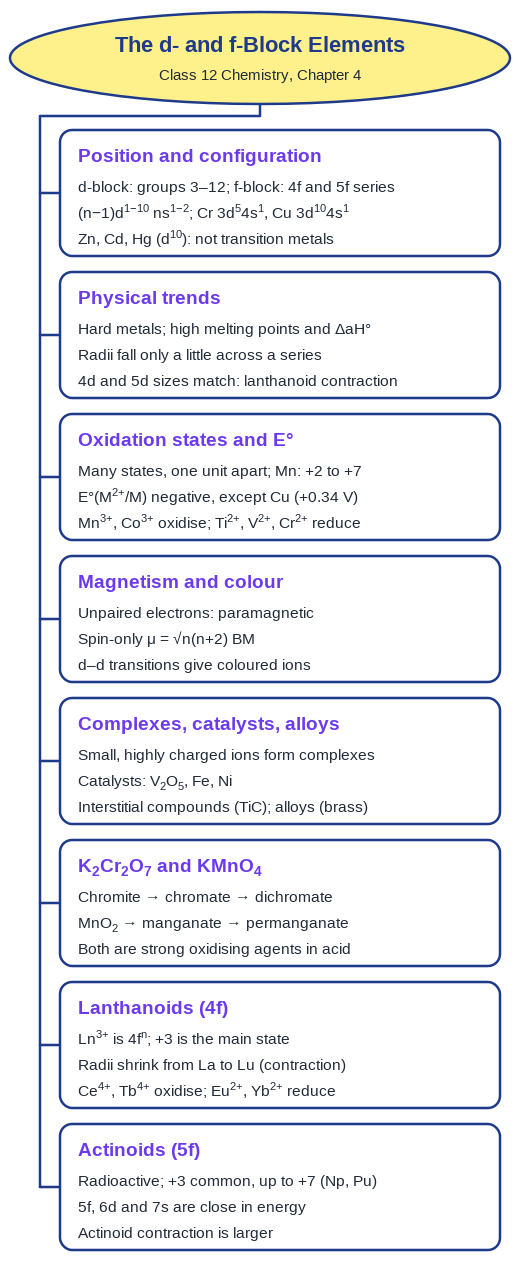
What is this chapter about?
An iron grille, a copper wire, a silver anklet and a gold ring are all made of transition metals. So are the chromium in stainless steel and the nickel in coins. Uranium and thorium, used as nuclear fuels, are inner transition metals. This chapter, Unit 4 of Chemistry Part I, first studies the d-block, mostly its first row (Sc to Zn), then two compounds you will use in titrations, K₂Cr₂O₇ and KMnO₄, and finally the f-block: the lanthanoids and the actinoids.
Where are the d- and f-blocks in the periodic table?
The d-block is the wide middle part of the table, groups 3 to 12, between the s- and p-blocks. Its atoms add electrons to the d orbitals of the shell just inside the outermost one. There are four series: 3d (Sc to Zn), 4d (Y to Cd), 5d (La, then Hf to Hg) and 6d (Ac, then Rf to Cn).
The f-block is the separate panel at the bottom. It has two series: the lanthanoids (4f, Ce to Lu) and the actinoids (5f, Th to Lr).
The name “transition” first meant that these metals sit between the s- and p-blocks in their properties. Today a transition metal is one with an incomplete d subshell in its atom or in its ions. Zinc, cadmium and mercury have a full d¹⁰ set both as atoms and in their common ions, so they are not counted as transition metals. They are studied here anyway because they end the 3d, 4d and 5d series.
What are the electronic configurations of the d-block elements?
The general outer configuration is (n−1)d¹⁻¹⁰ ns¹⁻². The (n−1)d and ns orbitals are very close in energy, and a half-filled or full d set is extra stable, so there are exceptions:
- Cr is 3d⁵4s¹, not 3d⁴4s².
- Cu is 3d¹⁰4s¹, not 3d⁹4s².
- Pd is 4d¹⁰5s⁰.
Zn, Cd, Hg and Cn are (n−1)d¹⁰ns².
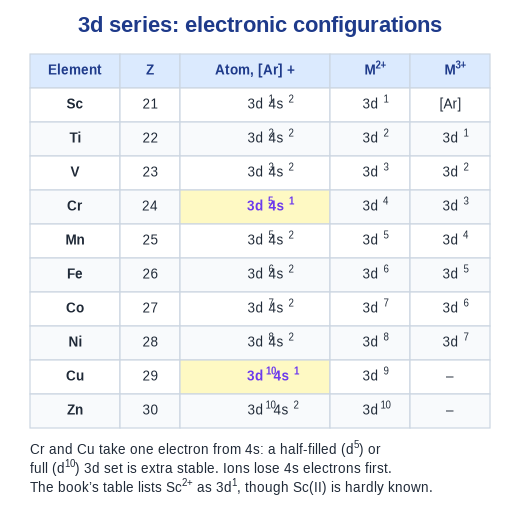
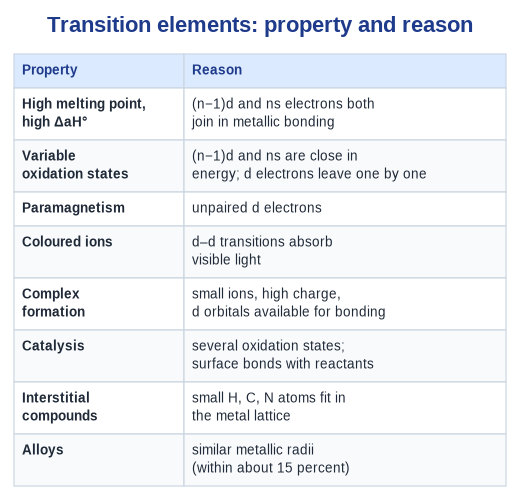
The d orbitals reach out towards the edge of the atom more than s and p orbitals do. So they are affected by whatever surrounds the atom, and affect it in turn. This is why partly filled d orbitals lead to several oxidation states, colour, complexes, catalysis and paramagnetism. Read properties of transition elements.
What are their physical properties?
Almost all transition metals are typical metals: strong, ductile, malleable, lustrous and good conductors of heat and electricity. Except Zn, Cd and Hg, they are very hard and not volatile, with high melting and boiling points.
The reason is strong metallic bonding: the (n−1)d electrons join the ns electrons in holding the atoms together. In each row the melting point rises to a maximum near d⁵ and then falls, with Mn and Tc out of line. The enthalpy of atomisation behaves the same way, peaking near the middle of each series, where each d orbital has one unpaired electron to share. For the 3d metals it runs from 326 kJ mol⁻¹ (Sc) up to 515 (V) and down to 126 (Zn). The 4d and 5d metals have higher values than the 3d metal above them, which is one reason metal–metal bonds are common in their compounds.
How do atomic and ionic sizes change?
Across a series, ions of the same charge get slightly smaller. Each step adds one proton and one d electron; a d electron shields the outer electrons poorly, so the nucleus pulls them in a little more. Atomic radii follow the same trend, but the change is small: 164 pm for Sc, about 125 pm for Co and Ni.
Down a group, radii rise from 3d to 4d as expected. But the 5d metals are almost the same size as the 4d metals above them. The fourteen 4f electrons added before the 5d series shield even more poorly, and the shrinkage they cause, the lanthanoid contraction, cancels the expected increase. So Zr (160 pm) and Hf (159 pm) are nearly identical in size and in chemistry.
Smaller radius with larger mass means higher density: from 4.1 g cm⁻³ for Ti to 8.9 g cm⁻³ for Cu.
How do ionisation enthalpies change?
Ionisation enthalpy rises from left to right, because the nuclear charge grows while the inner d orbitals fill. But the rise is far gentler than across a period of main-group elements, since the added 3d electrons shield the 4s electrons fairly well. The first values go only from 631 (Sc) to 906 kJ mol⁻¹ (Zn).
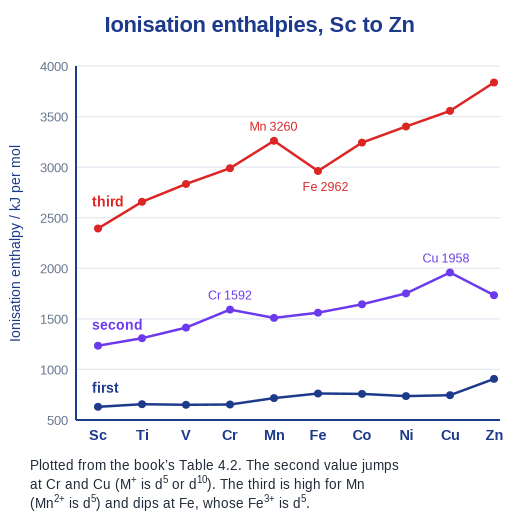
Three features are worth learning:
- Second ionisation enthalpy is unusually high for Cr (1592) and Cu (1958): the electron must leave a d⁵ or d¹⁰ M⁺ ion. It is low for Zn (1734, below Cu), because losing the 4s electron leaves a stable d¹⁰ ion.
- Third ionisation enthalpy is high for Mn (3260): Mn²⁺ is d⁵. It is lower for Fe (2962), because Fe³⁺ becomes d⁵.
- The third values of Ni, Cu and Zn are very high, which is why these metals rarely go beyond +2.
The book explains the d⁵ effect by exchange energy: the more pairs of electrons with parallel spins in a set of degenerate orbitals, the more stable the set. A half-filled set has the most such pairs.
Why do transition metals show many oxidation states?
The ns and (n−1)d electrons have similar energies, so different numbers of them can be lost or shared. The states usually differ by one unit (V²⁺, V³⁺, V⁴⁺, V⁵⁺). In the p-block they usually differ by two.
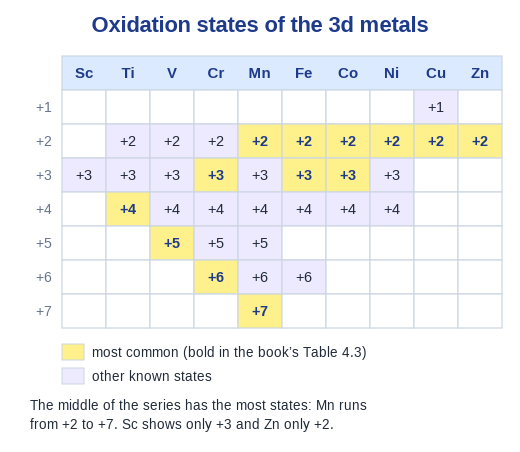
- The most states are found in the middle: Mn shows every state from +2 to +7.
- At the ends there are few: Sc and Ti have too few electrons to lose; Cu and Zn have too many d electrons and so too few orbitals to share through.
- Up to Mn, the highest state equals the total of the 4s and 3d electrons: Ti(IV) in TiO₂, V(V) in VO₂⁺, Cr(VI) in CrO₄²⁻, Mn(VII) in MnO₄⁻. After Mn the high states drop off sharply: Fe(II, III), Co(II, III), Ni(II), Cu(I, II), Zn(II).
- Down a d-block group the higher state becomes more stable, the opposite of the p-block. Mo(VI) and W(VI) are more stable than Cr(VI), so dichromate is a strong oxidising agent while MoO₃ and WO₃ are not.
- With ligands such as CO, which can accept electrons back from the metal, even the zero state is found: Ni(CO)₄ and Fe(CO)₅.
What do the electrode potentials tell us?
The standard electrode potential E°(M²⁺/M) tells how easily a metal turns into M²⁺(aq). It depends on the enthalpy of atomisation, the first two ionisation enthalpies and the hydration enthalpy of the ion.
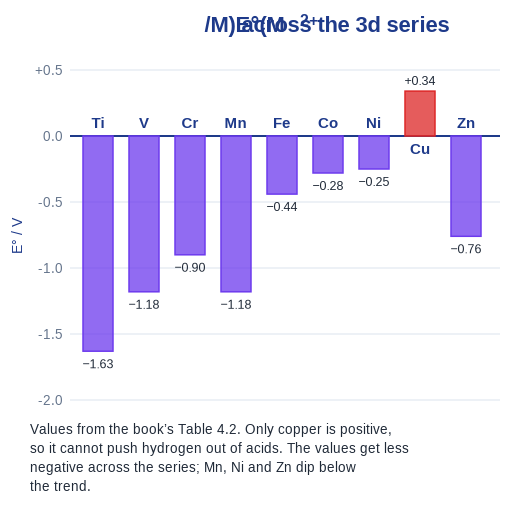
- The values become less negative across the series, because the sum of the first two ionisation enthalpies grows.
- Copper alone is positive (+0.34 V): the energy needed to turn Cu(s) into Cu²⁺(aq) is not paid back by its hydration enthalpy. So copper does not release H₂ from acids; only oxidising acids (nitric acid, hot concentrated sulphuric acid) attack it.
- Mn, Ni and Zn sit below the trend line (more negative): Mn²⁺ is d⁵, Zn²⁺ is d¹⁰, and Ni²⁺ has the most negative hydration enthalpy.
For the M³⁺/M²⁺ couples the book gives Ti −0.37, V −0.26, Cr −0.41, Mn +1.57, Fe +0.77 and Co +1.97 V. The high value for Mn shows how stable Mn²⁺ (d⁵) is; the lower value for Fe shows the stability of Fe³⁺ (d⁵). So Mn³⁺ and Co³⁺ are the strongest oxidising agents in water, and Ti²⁺, V²⁺ and Cr²⁺ are strong reducing agents that release hydrogen from dilute acid:
2Cr²⁺(aq) + 2H⁺(aq) → 2Cr³⁺(aq) + H₂(g)
Which elements bring out the highest oxidation states?
Fluorine and oxygen. Among halides the highest states are in TiX₄, VF₅ and CrF₆. Mn(VII) has no simple halide, though MnO₃F is known, and beyond Mn only FeX₃ and CoF₃ are trihalides. Fluorine works through high lattice energy (CoF₃) or high bond enthalpy (VF₅, CrF₆).
All copper(II) halides exist except the iodide, because Cu²⁺ oxidises iodide:
2Cu²⁺ + 4I⁻ → Cu₂I₂(s) + I₂
Many copper(I) compounds are unstable in water and disproportionate: 2Cu⁺ → Cu²⁺ + Cu. The much more negative hydration enthalpy of Cu²⁺ more than covers copper’s second ionisation enthalpy.
Oxygen does even better. In oxides the highest oxidation number equals the group number from Sc₂O₃ to Mn₂O₇. The highest manganese fluoride is MnF₄, but the highest oxide is Mn₂O₇, because oxygen can form multiple bonds to a metal. Beyond group 7, iron has no oxide above Fe₂O₃; ferrates(VI), FeO₄²⁻, form in alkali but soon break down to Fe₂O₃ and O₂.
What makes transition metal ions magnetic?
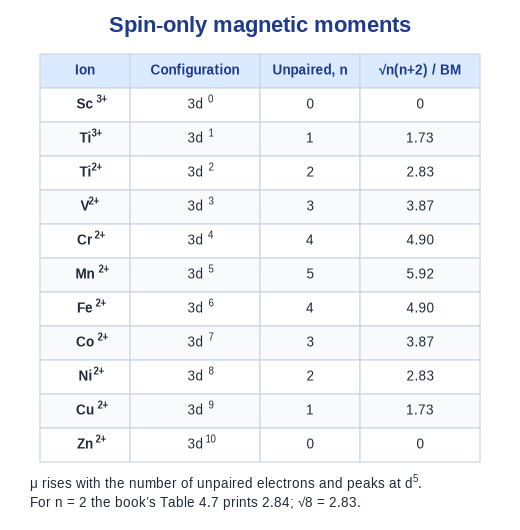
A substance attracted into a magnetic field is paramagnetic; one pushed out is diamagnetic. Very strong attraction, as in iron, is ferromagnetism. Paramagnetism comes from unpaired electrons. For 3d ions only the spin of the electrons matters, and the spin-only formula gives the magnetic moment:
μ = √n(n+2) BM
where n is the number of unpaired electrons and BM is the Bohr magneton. One unpaired electron gives √3 = 1.73 BM; five give √35 = 5.92 BM.
Why are their ions coloured?
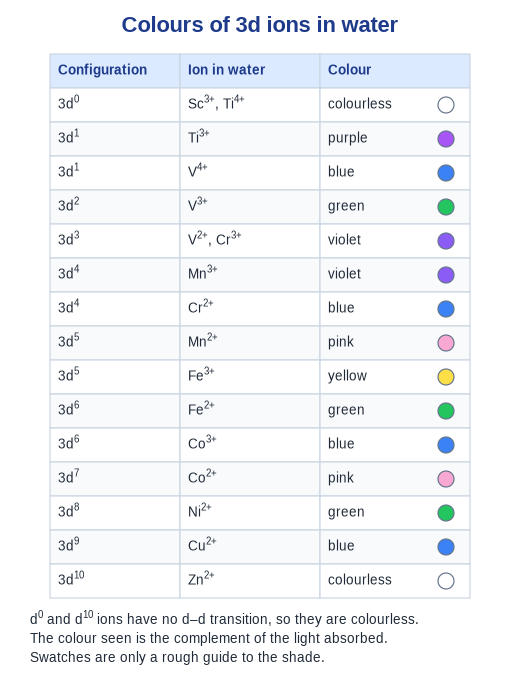
When light falls on an ion with a partly filled d subshell, an electron can jump from a lower d orbital to a higher one. The energy of that jump usually matches visible light. The ion absorbs that colour and we see the complementary colour. The ligand decides which colour is absorbed. Ions with d⁰ (Sc³⁺, Ti⁴⁺) or d¹⁰ (Zn²⁺) have no such jump and are colourless.
Complexes, catalysts, interstitial compounds and alloys
- Complexes. Transition metal ions are small, highly charged and have d orbitals available for bonding, so they form many complexes: [Fe(CN)₆]³⁻, [Fe(CN)₆]⁴⁻, [Cu(NH₃)₄]²⁺, [PtCl₄]²⁻. Chapter 5 studies them.
- Catalysts. V₂O₅ (Contact process), finely divided iron (Haber’s process) and nickel (hydrogenation). A solid catalyst bonds reactant molecules to its surface, which gathers them together and weakens their bonds. The ions can also switch oxidation state. Iron(III) speeds up 2I⁻ + S₂O₈²⁻ → I₂ + 2SO₄²⁻ in two steps: 2Fe³⁺ + 2I⁻ → 2Fe²⁺ + I₂, then 2Fe²⁺ + S₂O₈²⁻ → 2Fe³⁺ + 2SO₄²⁻.
- Interstitial compounds. Small H, C or N atoms are trapped in the metal lattice: TiC, Mn₄N, Fe₃H, VH₀.₅₆, TiH₁.₇. They melt higher than the pure metal, are very hard, still conduct like metals and are chemically inert.
- Alloys. Transition metals have similar radii (within about 15 percent), so their atoms can replace one another in a lattice. Steels contain Cr, V, W, Mo and Mn; brass is copper–zinc and bronze is copper–tin.
What are the oxides and oxoanions like?
Metals form oxides when heated with oxygen. All 3d metals except scandium form an ionic oxide MO. As the oxidation number rises, the oxide becomes less ionic and more acidic:
- Mn₂O₇ is a covalent green oil that gives HMnO₄; CrO₃ gives H₂CrO₄ and H₂Cr₂O₇.
- V₂O₃ is basic, V₂O₄ less basic and V₂O₅ amphoteric, though mainly acidic.
- CrO is basic and Cr₂O₃ is amphoteric.
How is potassium dichromate made, and what does it do?
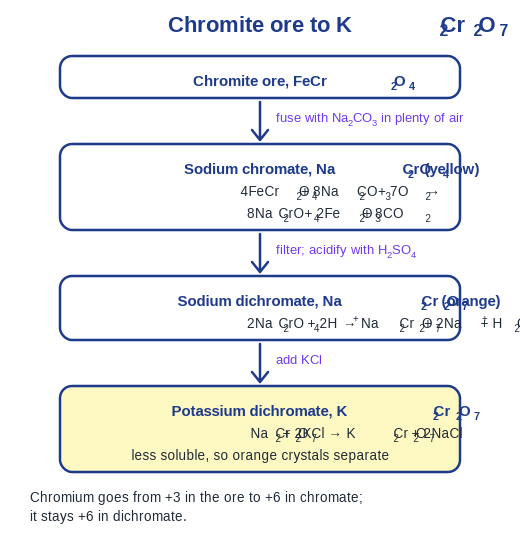
Chromite ore, FeCr₂O₄, is fused with sodium (or potassium) carbonate with plenty of air. This gives yellow sodium chromate. Acid turns it into orange sodium dichromate, and potassium chloride then gives the less soluble potassium dichromate.
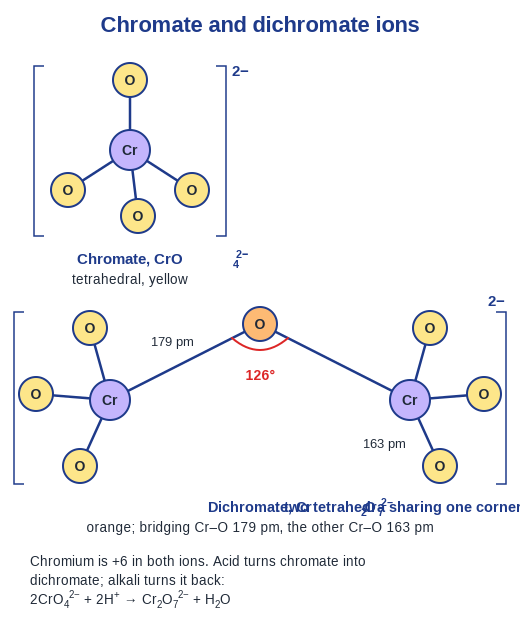
Chromate and dichromate change into each other with pH, and chromium stays +6 in both:
2CrO₄²⁻ + 2H⁺ → Cr₂O₇²⁻ + H₂O (acid: yellow to orange)
Cr₂O₇²⁻ + 2OH⁻ → 2CrO₄²⁻ + H₂O (alkali: orange to yellow)
In acid, dichromate is a strong oxidising agent:
Cr₂O₇²⁻ + 14H⁺ + 6e⁻ → 2Cr³⁺ + 7H₂O (E° = 1.33 V)
It oxidises iodide to iodine, sulphide to sulphur, tin(II) to tin(IV) and iron(II) to iron(III). For example, Cr₂O₇²⁻ + 14H⁺ + 6Fe²⁺ → 2Cr³⁺ + 6Fe³⁺ + 7H₂O. K₂Cr₂O₇ is used in the leather industry, to make azo compounds and as a primary standard in volumetric analysis. Read potassium dichromate and potassium permanganate.
How is potassium permanganate made, and what does it do?
MnO₂ (the ore pyrolusite) is fused with KOH and an oxidising agent such as air or KNO₃. This gives dark green potassium manganate, K₂MnO₄, which is then turned into purple permanganate.
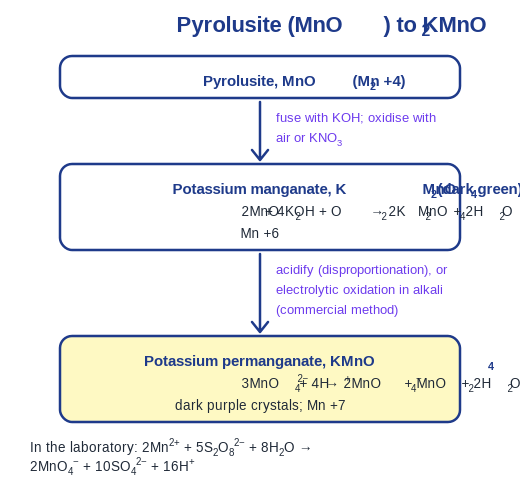
KMnO₄ forms dark purple, almost black crystals. It is not very soluble in water (6.4 g in 100 g of water at 293 K) and breaks down at 513 K: 2KMnO₄ → K₂MnO₄ + MnO₂ + O₂. Both MnO₄²⁻ and MnO₄⁻ are tetrahedral. Green manganate has one unpaired electron and is paramagnetic; permanganate has none and is diamagnetic.
How far MnO₄⁻ is reduced depends on the acidity:
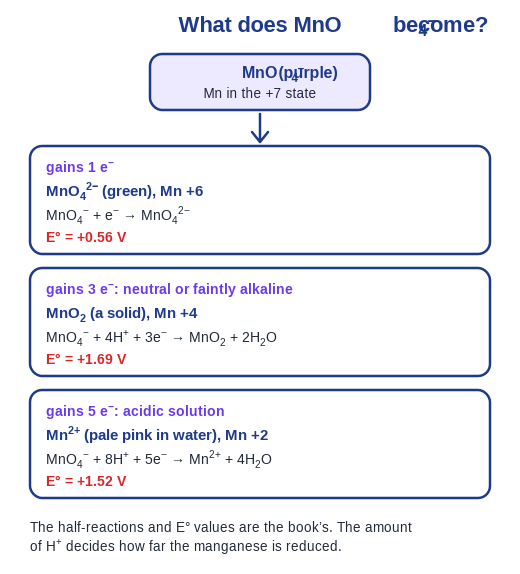
In acid it oxidises iodide to iodine, Fe²⁺ to Fe³⁺, oxalate to CO₂ (at 333 K), H₂S to sulphur, sulphite to sulphate and nitrite to nitrate. In neutral or faintly alkaline solution it oxidises iodide to iodate and thiosulphate to sulphate, and is itself reduced to MnO₂. Titrations with permanganate are not done in hydrochloric acid, because the acid itself is oxidised to chlorine. KMnO₄ is used in analysis, as an oxidant in organic chemistry, to bleach wool, cotton and silk, and to decolourise oils.
What are the lanthanoids?
The lanthanoids are the fourteen elements after lanthanum, Ce (Z = 58) to Lu (Z = 71). Lanthanum is so similar that it is discussed with them, and the symbol Ln stands for any of them.
- Configuration. The atoms have 6s² and a varying number of 4f electrons. Every Ln³⁺ ion is simply 4fⁿ, from 4f⁰ (La³⁺) to 4f¹⁴ (Lu³⁺).
- Size. Atomic and ionic radii fall steadily from La to Lu: the lanthanoid contraction. The cause is the poor shielding of one 4f electron by another as the nuclear charge grows.
- Oxidation states. +3 is the main state. A few ions with an empty, half-filled or full 4f subshell show +2 or +4: Ce⁴⁺ (4f⁰), Tb⁴⁺ (4f⁷), Eu²⁺ (4f⁷), Yb²⁺ (4f¹⁴).
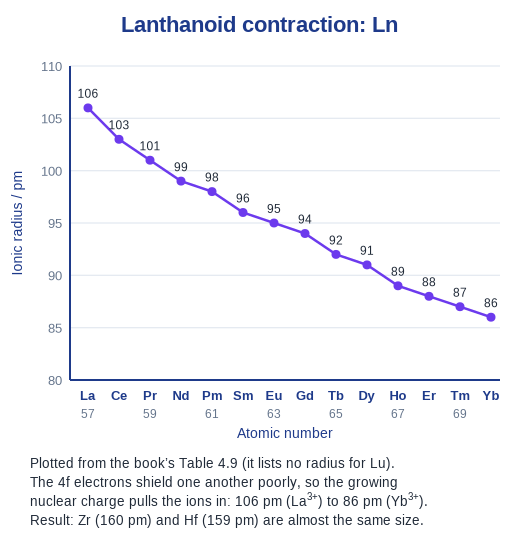
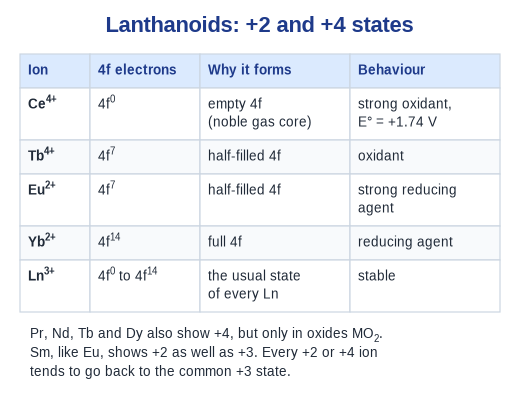
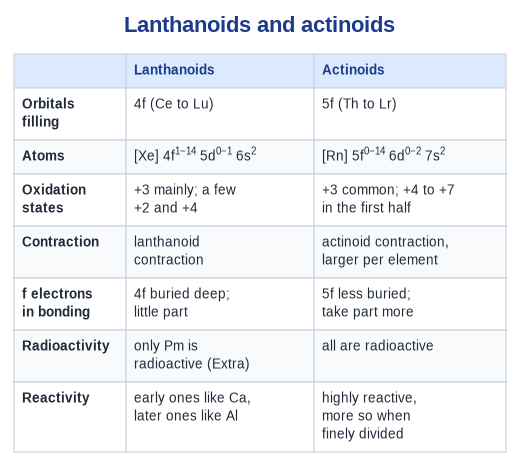
The lanthanoids are soft, silvery-white metals that tarnish quickly in air. Many Ln³⁺ ions are coloured and paramagnetic. Chemically the early ones behave like calcium and the later ones more like aluminium. They burn in oxygen to Ln₂O₃, react with water to give Ln(OH)₃ and H₂, release H₂ from acids, and combine with halogens (LnX₃), sulphur (Ln₂S₃), nitrogen (LnN) and carbon (LnC₂, at 2773 K). Mischmetall, about 95% lanthanoid metal and 5% iron, goes into magnesium-based alloys and lighter flints. Read lanthanoids and actinoids.
What are the actinoids?
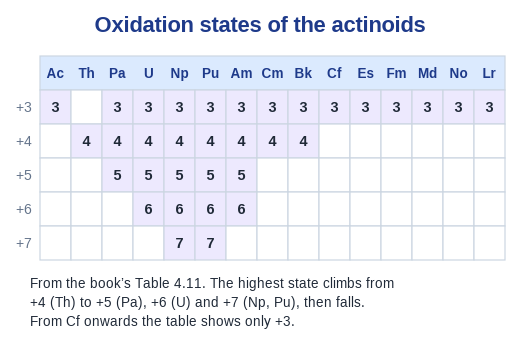
The actinoids are the fourteen elements from Th (Z = 90) to Lr (Z = 103). All are radioactive. The early ones have long half-lives; the later ones last from a day down to 3 minutes (lawrencium) and have been made only in nanogram amounts, so they are hard to study.
- Configuration. 7s² with a varying number of 5f and 6d electrons. Am is [Rn]5f⁷7s² and Cm is [Rn]5f⁷6d¹7s². The 5f orbitals are less buried than 4f, so 5f electrons take a larger part in bonding.
- Size. Atoms and M³⁺ ions shrink across the series: the actinoid contraction. It is greater from one element to the next than in the lanthanoids, because 5f electrons shield poorly.
- Oxidation states. +3 is general, but the 5f, 6d and 7s levels are close in energy, so the first half shows much more: +4 in Th, +5 in Pa, +6 in U and +7 in Np and Pu.
Where are d- and f-block elements used?
- Iron and steel are the main construction materials; Cr, Mn and Ni are added to make alloy steels.
- Pigments and batteries. A titanium oxide is used as a pigment (the book prints TiO), MnO₂ goes into dry cells, and batteries also need Zn and Ni/Cd.
- Coinage metals. Group 11 (Cu, Ag, Au); many modern coins are copper-coated steel or copper–nickel alloy.
- Catalysts. V₂O₅ for making sulphuric acid, iron in the Haber process, nickel for hydrogenating fats, TiCl₄ with Al(CH₃)₃ (Ziegler catalysts) for polythene, and PdCl₂ in the Wacker process for ethanal.
- Photography depends on light-sensitive AgBr.
Stay safe
Potassium dichromate and potassium permanganate are strong oxidising agents that stain and irritate skin and eyes; chromium(VI) compounds are also poisonous (Extra). Hydrogen sulphide and chlorine are poisonous gases. Do the reactions of this chapter only in the school laboratory with your teacher, with goggles on, and never taste or sniff a chemical.
Before we move on
Most of this chapter comes back to one idea: partly filled d (or f) orbitals. Use it to explain a trend first, then learn the data that backs it: the configurations, the common oxidation states, the E° values and the spin-only moments. Write out the dichromate and permanganate equations until you can balance them without looking. Every exercise, Intext Question and worked example of the unit is answered in the NCERT solutions for Chapter 4.
Key terms
| Term | Meaning |
|---|---|
| Transition element | A metal with an incomplete d subshell in its neutral atom or in one of its ions (the IUPAC definition the book uses). Zn, Cd and Hg are d-block elements but not transition metals. |
| Inner transition elements | The f-block elements: the lanthanoids (4f, Ce to Lu) and the actinoids (5f, Th to Lr). |
| Enthalpy of atomisation (ΔaH°) | The enthalpy needed to turn one mole of a solid metal into separate gaseous atoms. It is high for transition metals because of strong metallic bonding. |
| Lanthanoid contraction | The steady fall in atomic and ionic radii from La to Lu, caused by the poor shielding of one 4f electron by another. |
| Oxidation state | The charge an atom would have if its bonds were fully ionic. Transition metals show several, usually one unit apart. |
| Standard electrode potential (E°) | The potential of a couple such as M²⁺/M under standard conditions. A more negative value means the metal is oxidised more easily. |
| Disproportionation | A reaction in which one oxidation state changes into a higher and a lower one at the same time, as in 2Cu⁺ → Cu²⁺ + Cu. |
| Paramagnetism | Attraction into a magnetic field, caused by unpaired electrons. Diamagnetic substances, with no unpaired electrons, are repelled. |
| Spin-only magnetic moment | μ = √n(n+2) Bohr magnetons (BM), where n is the number of unpaired electrons. |
| Complex compound | A compound in which a metal ion binds a fixed number of anions or neutral molecules (ligands), such as [Fe(CN)₆]⁴⁻ or [Cu(NH₃)₄]²⁺. |
| Interstitial compound | A compound formed when small atoms such as H, C or N sit in the gaps of a metal lattice, such as TiC or Fe₃H. It is usually non-stoichiometric. |
| Alloy | A blend of metals made by mixing the components, such as brass (copper–zinc) or bronze (copper–tin). |
| Oxoanion | An anion in which a metal is bonded to oxygen atoms, such as chromate CrO₄²⁻, dichromate Cr₂O₇²⁻ and permanganate MnO₄⁻. |
| Actinoid contraction | The fall in the size of atoms and M³⁺ ions across the actinoids; it is larger from element to element because 5f electrons shield poorly. |
| Mischmetall | An alloy of a lanthanoid metal (about 95%) and iron (about 5%) with a little S, C, Ca and Al. |
Topics in this chapter
Practice
-
Which of these is NOT regarded as a transition element?
Show answer
Answer: (c) Zinc
-
The outer electronic configuration of chromium (Z = 24) is:
Show answer
Answer: (b) 3d⁵4s¹
-
The spin-only magnetic moment of Mn²⁺ (3d⁵) is:
Show answer
Answer: (d) 5.92 BM
-
Which 3d metal has a positive E°(M²⁺/M)?
Show answer
Answer: (c) Copper
-
In acidic solution, one MnO₄⁻ ion gains how many electrons when it becomes Mn²⁺?
Show answer
Answer: (c) 5
-
Zr and Hf have almost the same radius because of:
Show answer
Answer: (b) the lanthanoid contraction
Questions students ask
What are the main topics of Class 12 Chemistry Chapter 4?
The position and electronic configurations of the d-block, the general properties of the transition elements (sizes, ionisation enthalpies, oxidation states, electrode potentials, magnetism, colour, complexes, catalysis, interstitial compounds and alloys), potassium dichromate and potassium permanganate, the lanthanoids, the actinoids and some applications.
Why are Zn, Cd and Hg not called transition elements?
Their d subshell is full (d¹⁰) in the atom and also in their common +2 ions. A transition element needs an incomplete d subshell in the atom or in an ion. They are still studied with the transition metals because they end the 3d, 4d and 5d series.
Is The d- and f-Block Elements in the 2026-27 NCERT Class 12 Chemistry book?
Yes. It is Unit 4 of Chemistry Part I, the Class 12 textbook marked Reprint 2026-27, on pages 89 to 117. The book calls it a unit; here it is Chapter 4.
Which equations of this chapter should I learn?
The three steps from chromite ore to K₂Cr₂O₇, the chromate–dichromate change with pH, the two steps from MnO₂ to KMnO₄, the half-reactions of Cr₂O₇²⁻ and MnO₄⁻ in acid, and the ionic equations for their reactions with I⁻, Fe²⁺, H₂S, oxalate, sulphite and nitrite. Also learn μ = √n(n+2).
Stuck on a question?
Take a photo and Lagnever AI explains it step by step. Try it for 7 days for ₹2.
Get it on Google Play Open in browser
For parents: after the trial, the plan renews monthly by UPI or card autopay. You can cancel anytime in the app.