
What are the general properties of the transition elements?
Answer in short
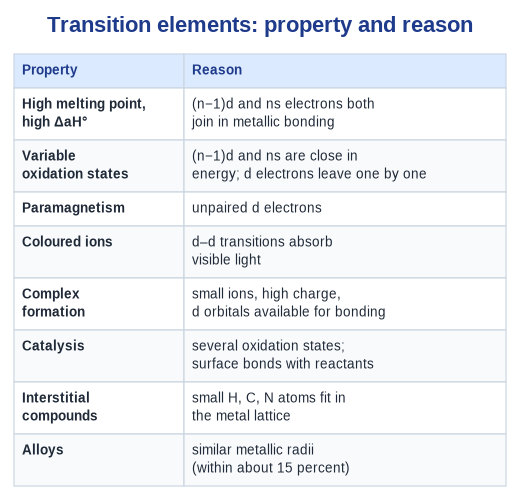
Transition elements are hard, high-melting metals with partly filled d orbitals. Because the (n−1)d and ns electrons are close in energy, they show several oxidation states, form coloured and paramagnetic ions, make complexes and act as catalysts. They also form interstitial compounds and alloys. Their spin-only magnetic moment is μ = √n(n+2) BM.
Stuck on a question? Take a photo and Lagnever AI explains it step by step. Try it for 7 days for ₹2. Get it on Google Play
Which elements are transition elements?
The d-block covers groups 3 to 12. A transition element has an incomplete d subshell in its atom or in one of its ions. Scandium (3d¹4s²) qualifies. Silver’s atom is 4d¹⁰5s¹, but its +2 ion is 4d⁹, so silver qualifies too. Zinc, cadmium and mercury are d¹⁰ in the atom and in their +2 ions, so they do not.
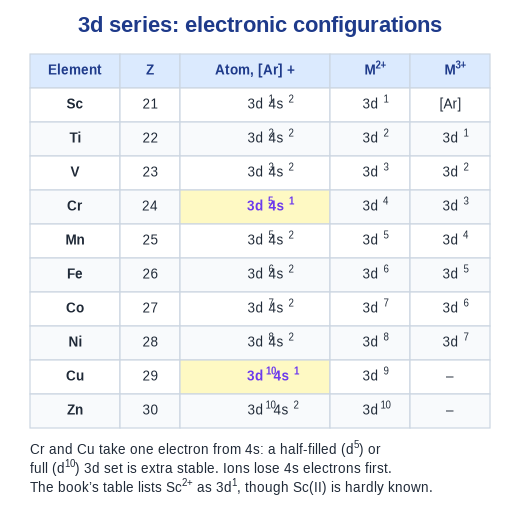
The outer configuration is (n−1)d¹⁻¹⁰ ns¹⁻². Chromium (3d⁵4s¹) and copper (3d¹⁰4s¹) are exceptions, because a half-filled or full d set is extra stable. When an ion forms, the 4s electrons leave first.
Why are they hard, high-melting metals?
In a transition metal the (n−1)d electrons bond along with the ns electrons, so the metallic bonding is strong. Melting points and enthalpies of atomisation rise to a maximum near the middle of each series, where every d orbital has one unpaired electron, and then fall. Zinc, with no d electrons to spare, has the lowest enthalpy of atomisation of the 3d series, 126 kJ mol⁻¹.
Radii fall only slightly across a series, since d electrons shield poorly. The 4d and 5d metals of a group are almost the same size (Zr 160 pm, Hf 159 pm) because of the lanthanoid contraction.
What decides their oxidation states?
The 3d and 4s energies are close, so a metal can lose or share different numbers of electrons. The states go up in steps of one.
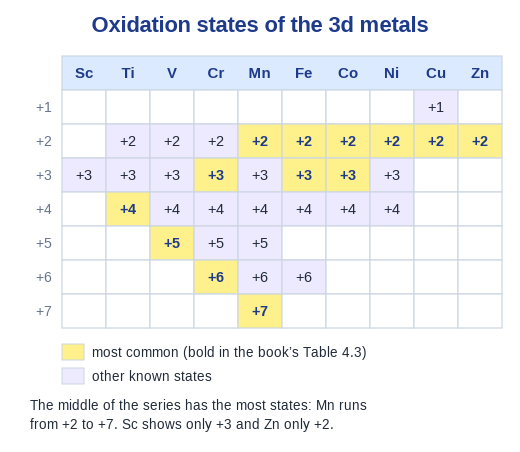
Manganese, in the middle, shows +2 to +7. Scandium shows only +3 and zinc only +2. Stability often follows the configuration: Mn²⁺ and Fe³⁺ are d⁵, Zn²⁺ is d¹⁰, Sc³⁺ and Ti⁴⁺ are d⁰.
The highest states need fluorine or oxygen: CrF₆ and VF₅, but Mn₂O₇ and MnO₄⁻. Oxygen can form multiple bonds to the metal, so it goes further than fluorine.
How do E° values show stability?
E°(M²⁺/M) is negative for all 3d metals except copper, so all except copper can be oxidised by 1 M H⁺ (though Ti and V react very slowly in practice).
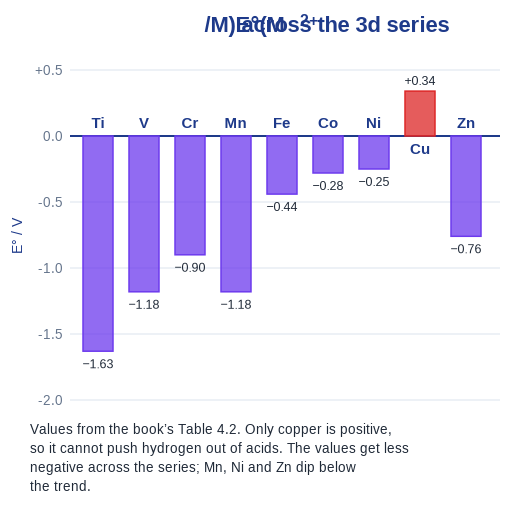
For M³⁺/M²⁺ the values are Cr −0.41, Mn +1.57 and Fe +0.77 V. Read them like this:
- Cr²⁺ is a reducing agent. It easily becomes Cr³⁺ (d³, a half-filled t2g level).
- Mn³⁺ is an oxidising agent. It easily becomes Mn²⁺ (d⁵). Both ions start as d⁴ but head in opposite directions.
- Fe²⁺ is in between: Fe³⁺ is d⁵, so Fe²⁺ is oxidised more easily than Mn²⁺.
Cu⁺ is unstable in water: 2Cu⁺ → Cu²⁺ + Cu. This is disproportionation. Cu²⁺ has a much more negative hydration enthalpy, which more than makes up for copper’s second ionisation enthalpy.
How is the magnetic moment found?
Unpaired electrons make an ion paramagnetic. Count them, call the number n, and use
μ = √n(n+2) BM
Our own example. Fe³⁺ is 3d⁵, so n = 5 and μ = √(5 × 7) = √35 = 5.92 BM. Cr³⁺ is 3d³, so μ = √(3 × 5) = √15 = 3.87 BM. Zn²⁺ (3d¹⁰) has n = 0, so μ = 0 and it is diamagnetic.
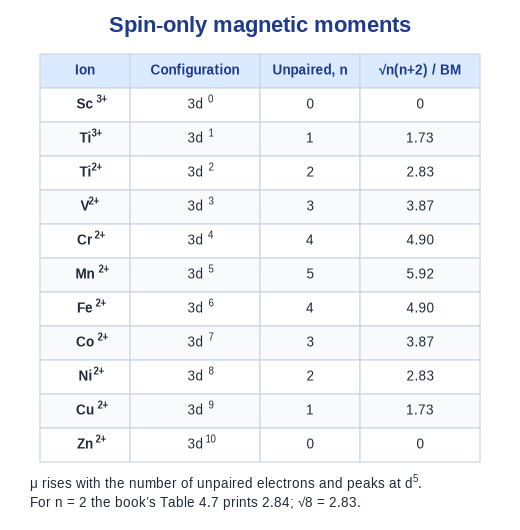
A measured moment works backwards too: a value near 3.9 BM points to three unpaired electrons.
Why colour, complexes and catalysis?
All three come from the d orbitals.
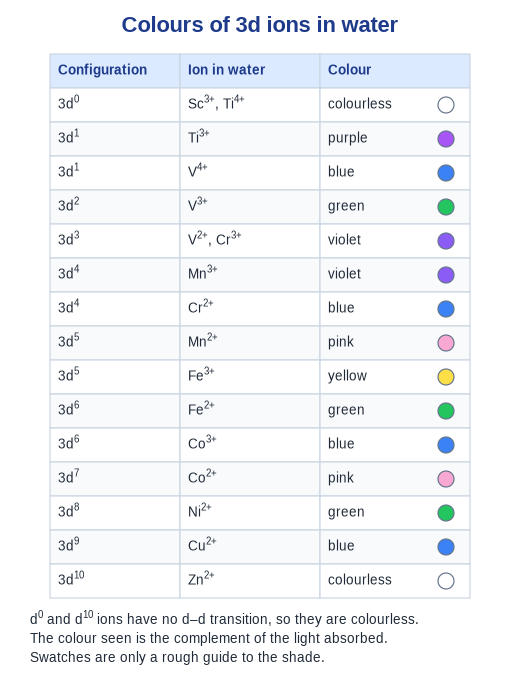
- Colour. A d electron absorbs visible light and jumps to a higher d orbital; we see the complementary colour. In water Ti³⁺ is purple, Fe²⁺ green, Cu²⁺ blue.
- Complexes. Small size, high charge and available d orbitals let the ions bind ligands: [Cu(NH₃)₄]²⁺, [Fe(CN)₆]⁴⁻.
- Catalysis. V₂O₅ in the Contact process, iron in Haber’s process, nickel in hydrogenation. Iron(III) catalyses the reaction of iodide with persulphate by switching between Fe³⁺ and Fe²⁺.
What are interstitial compounds and alloys?
In an interstitial compound, small H, C or N atoms sit in the gaps of the metal lattice, as in TiC, Mn₄N and TiH₁.₇. The formulas do not fit any normal oxidation state. These compounds are very hard, melt higher than the pure metal, keep metallic conductivity and are chemically inert.
An alloy is a blend of metals. Atoms whose radii are within about 15 percent of each other can replace one another in a lattice, and transition metals are close in size, so they alloy easily: steels with Cr, V, W, Mo and Mn, brass (copper–zinc) and bronze (copper–tin).
Next: potassium dichromate and potassium permanganate. Practise with the NCERT solutions, or go back to the chapter notes.
Practice
-
How many unpaired electrons does Co²⁺ (3d⁷) have?
Show answer
Answer: (c) 3
-
Which ion is colourless in water?
Show answer
Answer: (b) Sc³⁺
-
Which pair are both strong oxidising agents in aqueous solution?
Show answer
Answer: (c) Mn³⁺ and Co³⁺
-
Calculate the spin-only magnetic moment of Ni²⁺ (3d⁸).
Show answer
Answer: Ni²⁺ has 2 unpaired electrons, so μ = √(2 × 4) = √8 = 2.83 BM. (The book’s Table 4.7 prints 2.84.)
-
Why does copper not release hydrogen from dilute acids?
Show answer
Answer: E°(Cu²⁺/Cu) is +0.34 V, positive, so Cu cannot reduce H⁺ to H₂. The energy needed to turn Cu(s) into Cu²⁺(aq) is not balanced by the hydration enthalpy of Cu²⁺.
Questions students ask
Why do transition elements show variable oxidation states?
The (n−1)d and ns orbitals have nearly the same energy, so electrons from both can be lost or shared. Because d electrons can leave one at a time, the states usually differ by one unit, as in V(II), V(III), V(IV) and V(V).
Why are transition metal ions coloured?
An electron in a partly filled d subshell can absorb visible light and jump to a higher d orbital (a d–d transition). The ion shows the complementary colour of the light absorbed. Ions with d⁰ or d¹⁰, such as Sc³⁺ and Zn²⁺, cannot do this and are colourless.
Why are transition metals good catalysts?
They can take up several oxidation states and form complexes, and a solid metal surface can bond reactant molecules using its 3d and 4s electrons. This brings the reactants together and weakens their bonds, which lowers the activation energy.
Why is the enthalpy of atomisation of zinc the lowest in the 3d series?
Zinc has a full 3d¹⁰ set, so its d electrons take no part in metallic bonding; only the 4s electrons bond. The other 3d metals also use d electrons, which makes their bonding stronger. Zinc’s value is 126 kJ mol⁻¹.
Stuck on a question?
Take a photo and Lagnever AI explains it step by step. Try it for 7 days for ₹2.
Get it on Google Play Open in browser
For parents: after the trial, the plan renews monthly by UPI or card autopay. You can cancel anytime in the app.