
How are potassium dichromate and potassium permanganate made, and how do they oxidise?
Answer in short
Potassium dichromate is made from chromite ore through sodium chromate and sodium dichromate. Potassium permanganate is made from MnO₂ through green potassium manganate. Both are strong oxidising agents in acid: Cr₂O₇²⁻ takes six electrons and becomes 2Cr³⁺, while MnO₄⁻ takes five and becomes Mn²⁺. In neutral or faintly alkaline solution, permanganate is reduced to MnO₂ instead.
Stuck on a question? Take a photo and Lagnever AI explains it step by step. Try it for 7 days for ₹2. Get it on Google Play
Why study these two compounds?
In the higher oxides of the 3d metals, the metal is in a high oxidation state and the oxide is acidic: CrO₃ gives chromic and dichromic acids, Mn₂O₇ gives permanganic acid, HMnO₄. Their potassium salts, K₂Cr₂O₇ and KMnO₄, are the two oxidising agents you meet most in titrations. In both, the metal has reached its group oxidation state: Cr(VI) and Mn(VII).
How is potassium dichromate prepared?
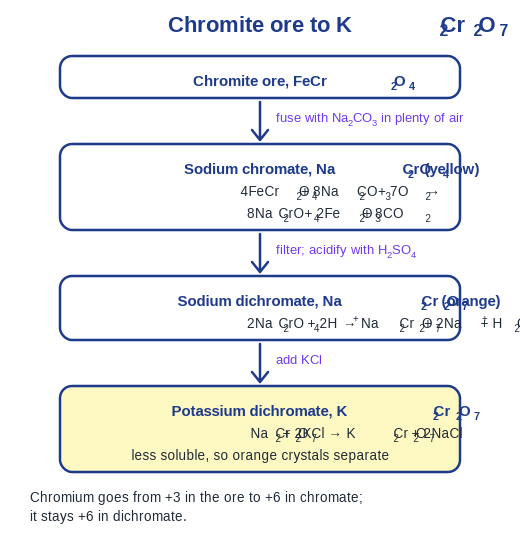
The ore is chromite, FeCr₂O₄. There are three steps.
1. Chromite to sodium chromate. The ore is fused with sodium carbonate in a good supply of air:
4FeCr₂O₄ + 8Na₂CO₃ + 7O₂ → 8Na₂CrO₄ + 2Fe₂O₃ + 8CO₂
2. Chromate to dichromate. The yellow solution is filtered and acidified with sulphuric acid. Orange sodium dichromate, Na₂Cr₂O₇·2H₂O, can be crystallised:
2Na₂CrO₄ + 2H⁺ → Na₂Cr₂O₇ + 2Na⁺ + H₂O
3. Sodium salt to potassium salt. Potassium chloride is added. K₂Cr₂O₇ is less soluble than the sodium salt, so its orange crystals separate:
Na₂Cr₂O₇ + 2KCl → K₂Cr₂O₇ + 2NaCl
What happens when the pH changes?
Chromate and dichromate exist together in water, and the pH decides which one wins:
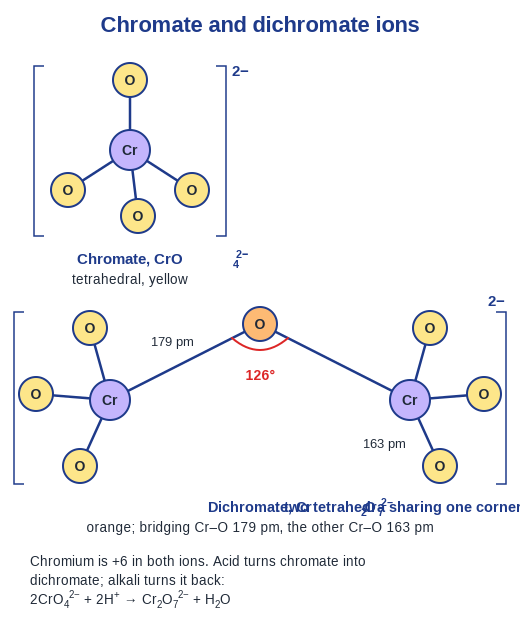
2CrO₄²⁻ + 2H⁺ → Cr₂O₇²⁻ + H₂O
Cr₂O₇²⁻ + 2OH⁻ → 2CrO₄²⁻ + H₂O
Acid gives orange dichromate; alkali gives yellow chromate. Chromium is +6 in both, so this is not a redox reaction.
How does dichromate oxidise?
In acid, each dichromate ion takes six electrons:
Cr₂O₇²⁻ + 14H⁺ + 6e⁻ → 2Cr³⁺ + 7H₂O (E° = 1.33 V)
Add this to the half-reaction of the reducing agent, scaled to six electrons:
- Iodide: Cr₂O₇²⁻ + 14H⁺ + 6I⁻ → 2Cr³⁺ + 3I₂ + 7H₂O
- Iron(II): Cr₂O₇²⁻ + 14H⁺ + 6Fe²⁺ → 2Cr³⁺ + 6Fe³⁺ + 7H₂O
- Hydrogen sulphide: Cr₂O₇²⁻ + 8H⁺ + 3H₂S → 2Cr³⁺ + 3S + 7H₂O
- Tin(II): Cr₂O₇²⁻ + 14H⁺ + 3Sn²⁺ → 2Cr³⁺ + 3Sn⁴⁺ + 7H₂O
Charge check for iron(II). Left: −2 + 14 + 12 = +24. Right: +6 + 18 = +24.
How is potassium permanganate prepared?
The ore is pyrolusite, MnO₂.
1. MnO₂ is fused with KOH and an oxidising agent (air or KNO₃). Dark green potassium manganate forms:
2MnO₂ + 4KOH + O₂ → 2K₂MnO₄ + 2H₂O
2. In neutral or acidic solution the manganate disproportionates:
3MnO₄²⁻ + 4H⁺ → 2MnO₄⁻ + MnO₂ + 2H₂O
Commercially, the manganate is instead oxidised electrolytically in alkaline solution. In the laboratory, a manganese(II) salt can be oxidised by peroxodisulphate:
2Mn²⁺ + 5S₂O₈²⁻ + 8H₂O → 2MnO₄⁻ + 10SO₄²⁻ + 16H⁺
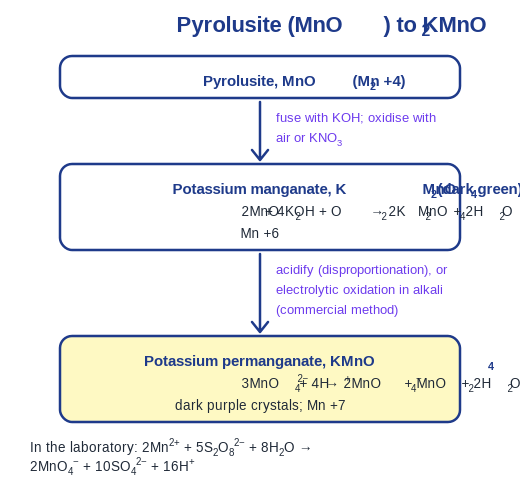
KMnO₄ forms dark purple crystals. On heating to 513 K it decomposes: 2KMnO₄ → K₂MnO₄ + MnO₂ + O₂.
How does permanganate oxidise?
The product depends on how much acid is present.
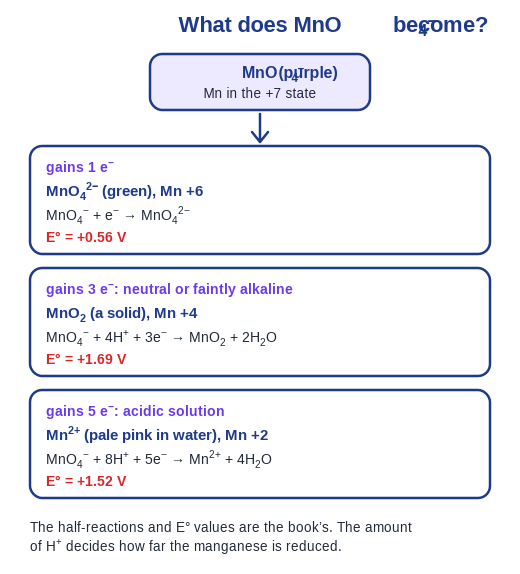
In acid (MnO₄⁻ + 8H⁺ + 5e⁻ → Mn²⁺ + 4H₂O):
- Iodide: 10I⁻ + 2MnO₄⁻ + 16H⁺ → 2Mn²⁺ + 8H₂O + 5I₂
- Iron(II): 5Fe²⁺ + MnO₄⁻ + 8H⁺ → Mn²⁺ + 4H₂O + 5Fe³⁺
- Oxalate, at 333 K: 5C₂O₄²⁻ + 2MnO₄⁻ + 16H⁺ → 2Mn²⁺ + 8H₂O + 10CO₂
- Sulphide: 5S²⁻ + 2MnO₄⁻ + 16H⁺ → 2Mn²⁺ + 8H₂O + 5S
- Sulphite: 5SO₃²⁻ + 2MnO₄⁻ + 6H⁺ → 2Mn²⁺ + 3H₂O + 5SO₄²⁻
- Nitrite: 5NO₂⁻ + 2MnO₄⁻ + 6H⁺ → 2Mn²⁺ + 5NO₃⁻ + 3H₂O
In neutral or faintly alkaline solution (product MnO₂):
- Iodide to iodate: 2MnO₄⁻ + H₂O + I⁻ → 2MnO₂ + 2OH⁻ + IO₃⁻
- Thiosulphate to sulphate: 8MnO₄⁻ + 3S₂O₃²⁻ + H₂O → 8MnO₂ + 6SO₄²⁻ + 2OH⁻
- Manganese(II) to MnO₂: 2MnO₄⁻ + 3Mn²⁺ + 2H₂O → 5MnO₂ + 4H⁺
Our own example. How much KMnO₄ oxidises 0.50 mol of Fe²⁺ in acid? The ratio is 1 MnO₄⁻ to 5 Fe²⁺, so 0.50/5 = 0.10 mol.
Extra: the purple MnO₄⁻ ion turns into very pale Mn²⁺, so in a titration the solution shows its own end point. In the school laboratory, do these titrations only with your teacher: both compounds stain and irritate skin and eyes.
Before: properties of transition elements. Next: lanthanoids and actinoids. Practise with the NCERT solutions, or go back to the chapter notes.
Practice
-
The oxidation state of Mn in K₂MnO₄ is:
Show answer
Answer: (b) +6
-
How many moles of Fe²⁺ does one mole of Cr₂O₇²⁻ oxidise in acid?
Show answer
Answer: (c) 6
-
When alkali is added to an orange dichromate solution, it turns:
Show answer
Answer: (b) yellow
-
How many moles of KMnO₄ are needed to oxidise 1 mol of oxalate ions in acid?
Show answer
Answer: 5C₂O₄²⁻ + 2MnO₄⁻ + 16H⁺ → 2Mn²⁺ + 8H₂O + 10CO₂, so 5 mol of oxalate need 2 mol of permanganate. One mole needs 2/5 = 0.4 mol.
-
Write the ionic equation for acidified dichromate with iodide.
Show answer
Answer: Cr₂O₇²⁻ + 14H⁺ + 6I⁻ → 2Cr³⁺ + 3I₂ + 7H₂O. Charge check: −2 + 14 − 6 = +6 on the left; 2 × (+3) = +6 on the right.
Questions students ask
What is the effect of pH on a dichromate solution?
Raising the pH (adding alkali) turns orange dichromate into yellow chromate: Cr₂O₇²⁻ + 2OH⁻ → 2CrO₄²⁻ + H₂O. Lowering the pH turns chromate back into dichromate. Chromium stays in the +6 state throughout.
Why is KMnO₄ purple although Mn(VII) has no d electrons?
The book says the intense colour and the magnetic behaviour of permanganate need molecular orbital theory, which is beyond the Class 12 course. It is not a d–d transition, because Mn(VII) is d⁰.
Why is potassium dichromate, not sodium dichromate, used as a primary standard?
The book states that K₂Cr₂O₇ is used as a primary standard in volumetric analysis and that the sodium salt is more soluble in water. Extra: the sodium salt also takes up moisture from the air, so it cannot be weighed out as accurately.
What are the structures of the chromate and dichromate ions?
Chromate, CrO₄²⁻, is a tetrahedron. Dichromate, Cr₂O₇²⁻, is two tetrahedra sharing one oxygen corner, with a Cr–O–Cr angle of 126°. Manganate and permanganate ions are tetrahedral too.
Stuck on a question?
Take a photo and Lagnever AI explains it step by step. Try it for 7 days for ₹2.
Get it on Google Play Open in browser
For parents: after the trial, the plan renews monthly by UPI or card autopay. You can cancel anytime in the app.