
What are the lanthanoids and actinoids, and what is lanthanoid contraction?
Answer in short
The lanthanoids (Ce to Lu) fill the 4f orbitals and the actinoids (Th to Lr) fill the 5f orbitals. Lanthanoids mainly show the +3 state, and their radii shrink steadily from La to Lu: the lanthanoid contraction. Actinoids are radioactive, show many oxidation states up to +7, and have an even larger contraction.
Stuck on a question? Take a photo and Lagnever AI explains it step by step. Try it for 7 days for ₹2. Get it on Google Play
Where is the f-block?
The f-block is the two-row panel placed below the main periodic table. Its elements are the inner transition elements. The first row, the lanthanoids, are the fourteen elements after lanthanum: cerium (Z = 58) to lutetium (Z = 71), filling the 4f orbitals. The second row, the actinoids, are the fourteen after actinium: thorium (Z = 90) to lawrencium (Z = 103), filling the 5f orbitals. Lanthanum and actinium are usually discussed with their rows. The symbol Ln stands for any lanthanoid.
What are the configurations of the lanthanoids?
Every lanthanoid atom has 6s² outside the xenon core; the 4f count varies. Most are 4fⁿ6s². Three keep one 5d electron: Ce (4f¹5d¹6s²), Gd (4f⁷5d¹6s²) and Lu (4f¹⁴5d¹6s²). Gd and Lu do so to hold a half-filled or full 4f set.
The ions are simpler. Every Ln³⁺ is just 4fⁿ, from 4f⁰ in La³⁺ to 4f¹⁴ in Lu³⁺. For example, Ce³⁺ is 4f¹ and Gd³⁺ is 4f⁷.
What is lanthanoid contraction?
From La to Lu the atoms and ions get steadily smaller. The radius of Ln³⁺ falls from 106 pm (La³⁺) to 86 pm (Yb³⁺).
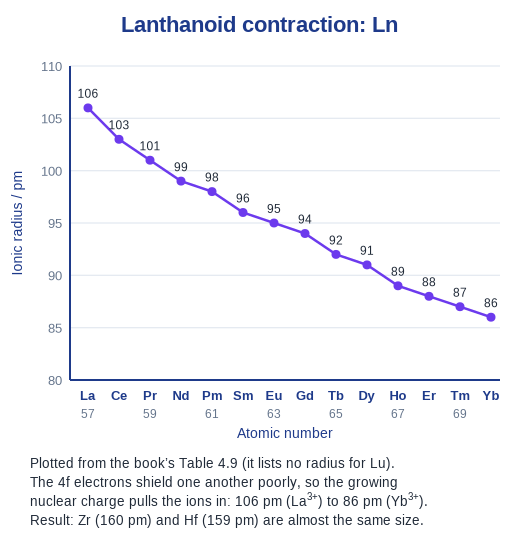
Cause. Each step adds one proton to the nucleus and one electron to the 4f subshell. Electrons in the same subshell shield one another imperfectly, and 4f electrons do so even less well than d electrons. So the pull of the nucleus on the outer electrons grows, and the size shrinks. The fall is smooth for the Ln³⁺ ions and a little irregular for the atoms.
Consequences.
- The 5d transition metals are almost the same size as the 4d metals above them, when we would expect them to be larger.
- Zr (160 pm) and Hf (159 pm) are found together in nature and are hard to separate.
- The lanthanoids themselves differ only slightly in size, so their chemistry is very similar.
Which oxidation states do lanthanoids show?
+3 is the common state of every lanthanoid. A few show +2 or +4, mostly when that gives an empty, half-filled or full 4f subshell.
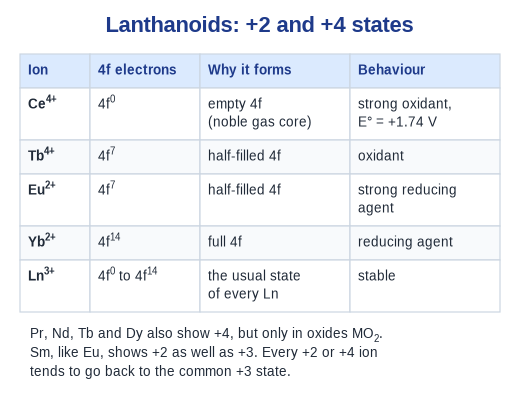
- Ce⁴⁺ (4f⁰) is a strong oxidant; E° for Ce⁴⁺/Ce³⁺ is +1.74 V. It could oxidise water, but the reaction is very slow, so Ce(IV) is a useful analytical reagent.
- Eu²⁺ (4f⁷) and Yb²⁺ (4f¹⁴) are reducing agents: they go back to +3.
- Tb⁴⁺ (4f⁷) is an oxidant. Pr, Nd, Tb and Dy show +4 only in oxides MO₂.
- Samarium behaves much like europium, with +2 and +3.
What are the lanthanoids like?
They are soft, silvery-white metals that tarnish quickly in air. Hardness rises with atomic number; samarium is as hard as steel. Melting points lie between 1000 and 1200 K, except samarium at 1623 K. Many Ln³⁺ ions are coloured, in solids and in solution, because of their f electrons; La³⁺ and Lu³⁺ are colourless. All Ln³⁺ ions except the f⁰ and f¹⁴ ones are paramagnetic.
The first ionisation enthalpies are about 600 kJ mol⁻¹ and the second about 1200 kJ mol⁻¹, close to those of calcium. The early lanthanoids react much like calcium; the later ones behave more like aluminium. E° for Ln³⁺(aq) + 3e⁻ → Ln(s) is between −2.2 and −2.4 V (−2.0 V for Eu).
Reactions. They burn in oxygen to give Ln₂O₃, react with water to give Ln(OH)₃ and H₂, release H₂ from dilute acids, form LnX₃ with halogens, Ln₂S₃ with sulphur and LnN with nitrogen on heating, and LnC₂ with carbon at 2773 K. The hydroxides are basic, like those of the alkaline earth metals.
Uses. Alloy steels for plates and pipes; mischmetall; mixed oxides as catalysts in petroleum cracking; some oxides as phosphors in television screens.
What is special about the actinoids?
All actinoids are radioactive. The early members have long half-lives; the later ones last from a day down to 3 minutes (lawrencium) and exist only in nanogram amounts.
- Configuration. 7s² with varying 5f and 6d occupancy: Th is 6d²7s², U is 5f³6d¹7s², Am is 5f⁷7s², Cm is 5f⁷6d¹7s², Lr is 5f¹⁴6d¹7s². The 5f orbitals are not as buried as 4f, so 5f electrons take a larger part in bonding.
- Size. Atoms and M³⁺ ions shrink across the series: the actinoid contraction, greater from element to element than the lanthanoid one.
- Oxidation states. +3 is general, but the range is wide because 5f, 6d and 7s are close in energy.
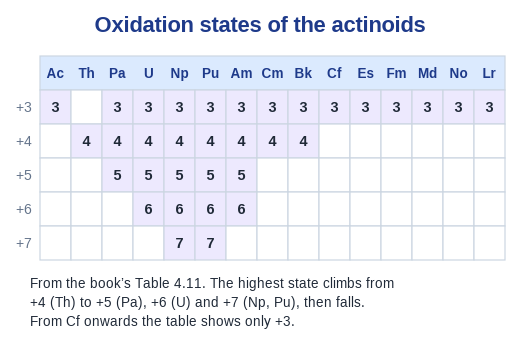
The highest state rises from +4 (Th) through +5 (Pa) and +6 (U) to +7 (Np, Pu), then falls. The metals are silvery and highly reactive, most of all when finely divided. Boiling water gives a mixture of oxide and hydride. Hydrochloric acid attacks all of them, nitric acid affects most only slightly because a protective oxide layer forms, and alkalis do not act.
How do the two series compare?
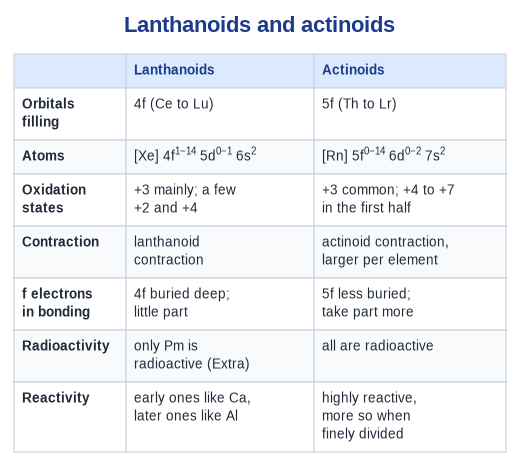
The early actinoids have lower ionisation enthalpies than the early lanthanoids, because 5f electrons are shielded from the nucleus more effectively than 4f electrons and so are held less firmly. Their magnetic behaviour is also more complex. Only the second half of the actinoid series behaves much like the lanthanoids.
Before: potassium dichromate and potassium permanganate. Practise with the NCERT solutions, or go back to the chapter notes.
Practice
-
Which lanthanoid is well known to show the +4 oxidation state?
Show answer
Answer: (b) Cerium
-
The configuration of Gd (Z = 64) outside the xenon core is:
Show answer
Answer: (b) 4f⁷5d¹6s²
-
Which is the last actinoid?
Show answer
Answer: (c) Lawrencium
-
How many unpaired electrons does Gd³⁺ (4f⁷) have, and is it paramagnetic?
Show answer
Answer: Seven: each of the seven 4f orbitals holds one electron. With unpaired electrons, Gd³⁺ is paramagnetic. Only f⁰ ions (La³⁺, Ce⁴⁺) and f¹⁴ ions (Yb²⁺, Lu³⁺) are not.
-
Why is the actinoid contraction greater from element to element than the lanthanoid contraction?
Show answer
Answer: The 5f electrons shield the nuclear charge even more poorly than 4f electrons, so each added proton pulls the outer electrons in more strongly.
Questions students ask
What is lanthanoid contraction?
It is the steady shrinking of atoms and ions as we go from lanthanum to lutetium. As the nuclear charge rises, electrons enter the 4f subshell, and one 4f electron shields another poorly. The outer electrons are pulled in a little more at each step.
What are the consequences of lanthanoid contraction?
The 5d metals are almost the same size as the 4d metals above them, such as Zr (160 pm) and Hf (159 pm). Such pairs have very similar properties, occur together in nature and are difficult to separate. The lanthanoids themselves are very alike.
Why do actinoids show more oxidation states than lanthanoids?
In the actinoids the 5f, 6d and 7s levels have comparable energies, so electrons from all three can be used. In the lanthanoids the 4f electrons are buried deep inside and hardly take part in bonding.
What is mischmetall?
An alloy of a lanthanoid metal (about 95%) and iron (about 5%) with a little S, C, Ca and Al. Much of it goes into magnesium-based alloys, which the book says are used for bullets, shells and lighter flints.
Stuck on a question?
Take a photo and Lagnever AI explains it step by step. Try it for 7 days for ₹2.
Get it on Google Play Open in browser
For parents: after the trial, the plan renews monthly by UPI or card autopay. You can cancel anytime in the app.