
NCERT Solutions Class 12 Chemistry Chapter 7: Alcohols, Phenols and Ethers
Answers to all 33 end-of-unit exercises, all 12 Intext Questions and all 7 worked examples of Unit 7, Alcohols, Phenols and Ethers, of Chemistry Part II, the Class 12 NCERT textbook. Page numbers follow the 2026-27 reprint (pages 193–226). The exercises come first, quoted from the book; the Intext Questions and the examples follow, restated in short. Short notes: Chapter 7 notes.
How the answers were checked. Every equation was checked atom by atom and charge by charge with a script. Every IUPAC name was checked twice against its structure: the longest chain, the lowest locants, alphabetical order, and the molecular formula worked out from both the name and the structure. Our answers were compared with the Answers section at the back of Part II and with the answers the chapter prints on pages 225–226; where they differ, the notes say so.
How structures are written. Condensed formulas: a group in brackets hangs from the carbon written just before it, so CH₃CH(OH)CH₃ is propan-2-ol. C₆H₅– is phenyl, C₆H₁₁– is cyclohexyl, and o-, m-, p- mark 1,2-, 1,3- and 1,4- positions on a ring. Where the book draws a structure, the question shows it as a condensed formula or in words.
Stay safe. Several reactions here use sodium, concentrated acids, bromine, phenol or heat. They are described for the exam only; any practical work is done in the school laboratory with your teacher, never at home.
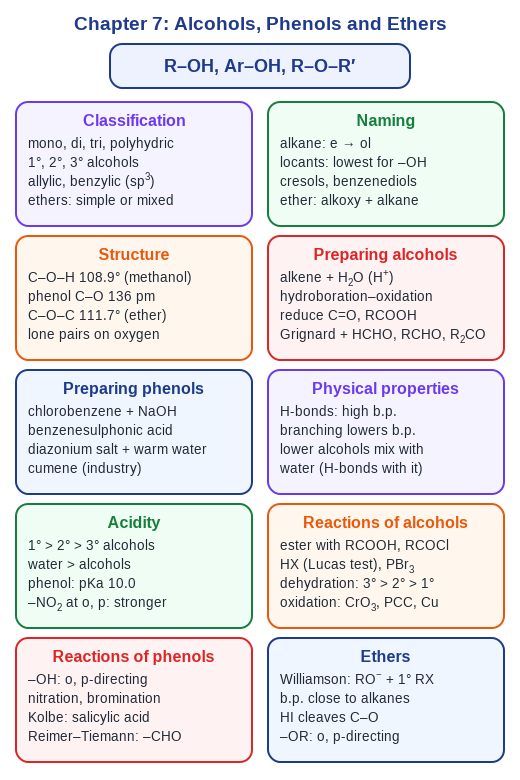
Exercises 7.1 to 7.8: names, structures and properties
7.1 “Write IUPAC names of the following compounds:” The book draws twelve structures; here they are as condensed formulas.
| Structure | IUPAC name | |
|---|---|---|
| (i) | CH₃CH(CH₃)CH(OH)C(CH₃)₂CH₃ | 2,2,4-trimethylpentan-3-ol |
| (ii) | CH₃CH(OH)CH₂CH(OH)CH(C₂H₅)CH₂CH₃ | 5-ethylheptane-2,4-diol |
| (iii) | CH₃CH(OH)CH(OH)CH₃ | butane-2,3-diol |
| (iv) | HOCH₂CH(OH)CH₂OH | propane-1,2,3-triol |
| (v) | benzene ring, –OH and –CH₃ on neighbouring carbons | 2-methylphenol |
| (vi) | benzene ring, –OH and –CH₃ opposite (1,4) | 4-methylphenol |
| (vii) | ring with –OH at C-1, one –CH₃ next to it (C-2) and the other at C-5 | 2,5-dimethylphenol |
| (viii) | ring with –OH between two –CH₃ groups | 2,6-dimethylphenol |
| (ix) | CH₃OCH₂CH(CH₃)CH₃ | 1-methoxy-2-methylpropane |
| (x) | C₆H₅OC₂H₅ | ethoxybenzene |
| (xi) | C₆H₅O(CH₂)₆CH₃ | 1-phenoxyheptane |
| (xii) | CH₃CH₂OCH(CH₃)CH₂CH₃ | 2-ethoxybutane |
Notes:
- (i) The chain has five carbons with –OH on C-3 from either end. Numbering from the right gives the methyl groups 2,2,4, lower than 2,4,4.
- (ii) Number from the left so that the two –OH groups get 2 and 4 (from the right they would get 4 and 6).
- (vii) In the drawing –OH is at C-1, one –CH₃ is ortho to it (C-2) and the other is para to that methyl (C-5). Numbering the other way would give 3,6, which is higher.
- (ix), (xii) For ethers the larger group is the parent: propane in (ix), butane in (xii), with the smaller group as an alkoxy prefix.
All twelve names agree with the book’s answer key.
7.2 “Write structures of the compounds whose IUPAC names are as follows: (i) 2-Methylbutan-2-ol (ii) 1-Phenylpropan-2-ol (iii) 3,5-Dimethylhexane –1, 3, 5-triol (iv) 2,3 – Diethylphenol (v) 1 – Ethoxypropane (vi) 2-Ethoxy-3-methylpentane (vii) Cyclohexylmethanol (viii) 3-Cyclohexylpentan-3-ol (ix) Cyclopent-3-en-1-ol (x) 4-Chloro-3-ethylbutan-1-ol.”
| Structure | |
|---|---|
| (i) | CH₃C(OH)(CH₃)CH₂CH₃ |
| (ii) | C₆H₅CH₂CH(OH)CH₃ |
| (iii) | HOCH₂CH₂C(OH)(CH₃)CH₂C(OH)(CH₃)CH₃ |
| (iv) | benzene ring with –OH at C-1 and –C₂H₅ at C-2 and C-3 |
| (v) | CH₃CH₂OCH₂CH₂CH₃ |
| (vi) | CH₃CH(OC₂H₅)CH(CH₃)CH₂CH₃ |
| (vii) | C₆H₁₁CH₂OH (–CH₂OH on a cyclohexane ring) |
| (viii) | CH₃CH₂C(OH)(C₆H₁₁)CH₂CH₃ |
| (ix) | five-membered ring: –OH on C-1, double bond between C-3 and C-4 |
| (x) | HOCH₂CH₂CH(C₂H₅)CH₂Cl |
Note on (x): the book’s name keeps the CH₂Cl carbon in a four-carbon chain. A strict longest-chain choice runs through the ethyl group instead (five carbons) and would call the same molecule 3-(chloromethyl)pentan-1-ol. Draw the structure as above; it is the same compound either way.
7.3 “(i) Draw the structures of all isomeric alcohols of molecular formula C₅H₁₂O and give their IUPAC names. (ii) Classify the isomers of alcohols in question 11.3 (i) as primary, secondary and tertiary alcohols.” (The “11.3 (i)” in part (ii) is a misprint for 7.3 (i).)
| Structure | IUPAC name | Class | |
|---|---|---|---|
| (a) | CH₃CH₂CH₂CH₂CH₂OH | pentan-1-ol | 1° |
| (b) | CH₃CH(OH)CH₂CH₂CH₃ | pentan-2-ol | 2° |
| (c) | CH₃CH₂CH(OH)CH₂CH₃ | pentan-3-ol | 2° |
| (d) | HOCH₂CH(CH₃)CH₂CH₃ | 2-methylbutan-1-ol | 1° |
| (e) | (CH₃)₂CHCH₂CH₂OH | 3-methylbutan-1-ol | 1° |
| (f) | (CH₃)₂C(OH)CH₂CH₃ | 2-methylbutan-2-ol | 3° |
| (g) | (CH₃)₂CHCH(OH)CH₃ | 3-methylbutan-2-ol | 2° |
| (h) | (CH₃)₃CCH₂OH | 2,2-dimethylpropan-1-ol | 1° |
Eight structural isomers: four primary, three secondary, one tertiary. The answer key’s list (e) prints pentan-3-ol a second time with a broken formula; it should be pentan-2-ol, (b) above. Extra: pentan-2-ol, 2-methylbutan-1-ol and 3-methylbutan-2-ol each have a chiral carbon, so each also exists as a pair of enantiomers (Unit 6); the question asks only for the structural isomers.
7.4 “Explain why propanol has higher boiling point than that of the hydrocarbon, butane?”
Propanol (C₃H₇OH, molecular mass 60) and butane (C₄H₁₀, 58) have nearly the same mass. Propanol molecules are joined to one another by intermolecular hydrogen bonds between the H of one –OH group and the O of another; extra energy is needed to break them before the liquid boils. Butane has only weak van der Waals forces. So propanol boils much higher.
7.5 “Alcohols are comparatively more soluble in water than hydrocarbons of comparable molecular masses. Explain this fact.”
The –OH group of an alcohol forms hydrogen bonds with water molecules: the H of –OH bonds to the O of water, and the H of water bonds to the O of the alcohol. This releases enough energy to pull alcohol molecules in among water molecules. A hydrocarbon cannot form hydrogen bonds with water, so it does not dissolve. (Solubility falls as the alkyl part grows, because that part is hydrophobic.)
7.6 “What is meant by hydroboration-oxidation reaction? Illustrate it with an example.”
Addition of diborane to an alkene followed by oxidation of the trialkylborane with alkaline hydrogen peroxide. Boron joins the doubly bonded carbon with more hydrogen atoms, so the –OH ends up there, and the overall result looks like addition of water against Markovnikov’s rule. Example, propene to propan-1-ol:
6CH₃CH=CH₂ + (BH₃)₂ → 2(CH₃CH₂CH₂)₃B
(CH₃CH₂CH₂)₃B + 3H₂O₂ → 3CH₃CH₂CH₂OH + B(OH)₃ (H₂O₂ with aqueous NaOH)
7.7 “Give the structures and IUPAC names of monohydric phenols of molecular formula, C₇H₈O.”
Three: the cresols, CH₃C₆H₄OH.
- –CH₃ at C-2: 2-methylphenol (o-cresol)
- –CH₃ at C-3: 3-methylphenol (m-cresol)
- –CH₃ at C-4: 4-methylphenol (p-cresol)
(Benzyl alcohol, C₆H₅CH₂OH, and anisole, C₆H₅OCH₃, also have the formula C₇H₈O, but they are an alcohol and an ether, not phenols.)
7.8 “While separating a mixture of ortho and para nitrophenols by steam distillation, name the isomer which will be steam volatile. Give reason.”
o-Nitrophenol. Its –OH and –NO₂ groups are next to each other, so the H of –OH forms a hydrogen bond with an O of the nitro group in the same molecule (intramolecular). The molecules are not held to one another, so it is volatile and distils with steam. In p-nitrophenol the groups are too far apart; hydrogen bonds form between different molecules (intermolecular), which hold them together and make it much less volatile.
Exercises 7.9 to 7.16: phenol, mechanisms and acidity
7.9 “Give the equations of reactions for the preparation of phenol from cumene.”
C₆H₅CH(CH₃)₂ + O₂ → C₆H₅C(CH₃)₂OOH (air; cumene → cumene hydroperoxide)
C₆H₅C(CH₃)₂OOH → C₆H₅OH + CH₃COCH₃ (dilute acid, H⁺/H₂O)
Acetone is the by-product.
7.10 “Write chemical reaction for the preparation of phenol from chlorobenzene.”
C₆H₅Cl + 2NaOH → C₆H₅ONa + NaCl + H₂O (fused, 623 K, about 300 atm)
C₆H₅ONa + HCl → C₆H₅OH + NaCl
The book’s scheme on page 202 shows 300 atm; its text says 320 atm. Either way the point is a very high pressure.
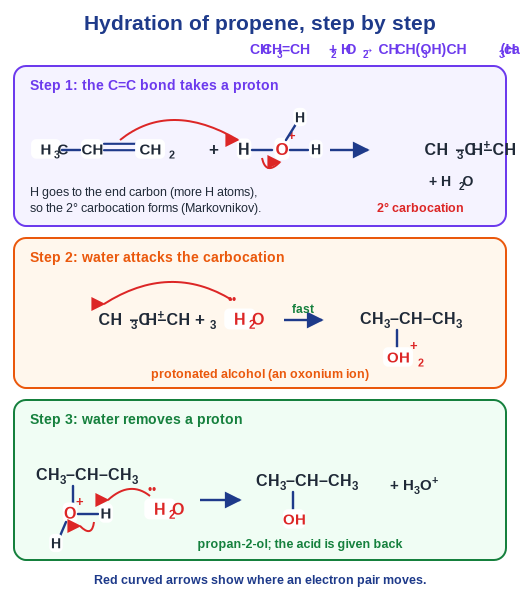
7.11 “Write the mechanism of hydration of ethene to yield ethanol.”
Overall: CH₂=CH₂ + H₂O → CH₃CH₂OH (acid catalyst). First H₂O + H⁺ → H₃O⁺.
- Protonation of the alkene: the π electrons take a proton from H₃O⁺, giving a carbocation: CH₂=CH₂ + H₃O⁺ → CH₃CH₂⁺ + H₂O
- Water attacks the carbocation with a lone pair: CH₃CH₂⁺ + H₂O → CH₃CH₂OH₂⁺
- Water removes a proton: CH₃CH₂OH₂⁺ + H₂O → CH₃CH₂OH + H₃O⁺
The acid is given back in step 3, so it is a catalyst. The same three steps, drawn with curved arrows for propene:
7.12 “You are given benzene, conc. H₂SO₄ and NaOH. Write the equations for the preparation of phenol using these reagents.”
C₆H₆ + H₂SO₄ → C₆H₅SO₃H + H₂O (sulphonation; the book uses oleum)
C₆H₅SO₃H + NaOH → C₆H₅SO₃Na + H₂O
C₆H₅SO₃Na + 2NaOH → C₆H₅ONa + Na₂SO₃ + H₂O (fused)
2C₆H₅ONa + H₂SO₄ → 2C₆H₅OH + Na₂SO₄
The answer key’s hint, “sulphonation followed by nucleophilic substitution”, is the same route. The sulphite by-product in the third equation is Extra; the book shows only the main product.
7.13 “Show how will you synthesise: (i) 1-phenylethanol from a suitable alkene. (ii) cyclohexylmethanol using an alkyl halide by an SN2 reaction. (iii) pentan-1-ol using a suitable alkyl halide?”
- (i) Acid-catalysed hydration of styrene (phenylethene). By Markovnikov’s rule the –OH goes to the carbon next to the ring: C₆H₅CH=CH₂ + H₂O → C₆H₅CH(OH)CH₃ (H⁺)
- (ii) Hydrolysis of (chloromethyl)cyclohexane, a primary halide, by aqueous NaOH: C₆H₁₁CH₂Cl + NaOH → C₆H₁₁CH₂OH + NaCl
- (iii) Hydrolysis of 1-chloropentane by aqueous NaOH: CH₃(CH₂)₄Cl + NaOH → CH₃(CH₂)₄OH + NaCl
These agree with the answer key.
7.14 “Give two reactions that show the acidic nature of phenol. Compare acidity of phenol with that of ethanol.”
2C₆H₅OH + 2Na → 2C₆H₅ONa + H₂
C₆H₅OH + NaOH → C₆H₅ONa + H₂O
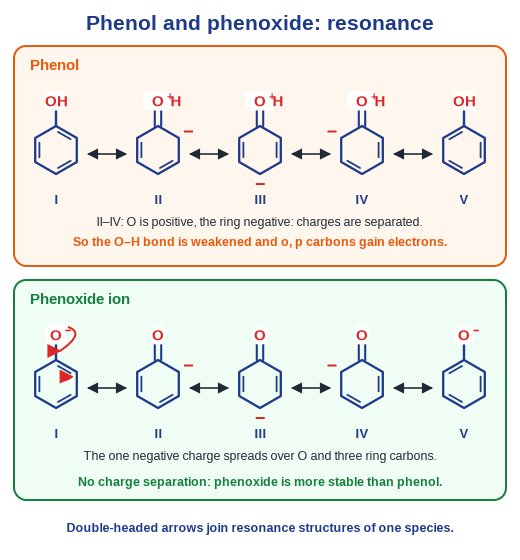
Phenol is much more acidic: pKa 10.0 against 15.9 for ethanol (about a million times stronger). Ethanol reacts with sodium but not with aqueous NaOH. Reasons: the –OH of phenol is on an sp² carbon, which pulls electrons from oxygen, and the phenoxide ion is stabilised by resonance, while the charge of the ethoxide ion stays on oxygen (and the ethyl group pushes more electron density onto it).
7.15 “Explain why is ortho nitrophenol more acidic than ortho methoxyphenol ?”
The nitro group withdraws electrons, both inductively and by resonance. In the o-nitrophenoxide ion the negative charge can spread onto the oxygens of –NO₂, which stabilises the ion and favours loss of the proton. The methoxy group releases electrons into the ring through the lone pair on its oxygen. That puts more negative charge near the phenoxide oxygen, destabilises the ion and holds the proton more firmly. So o-nitrophenol is the stronger acid. (Answer key: electron-withdrawing effect of the nitro group and electron-releasing effect of the methoxy group.)
7.16 “Explain how does the –OH group attached to a carbon of benzene ring activate it towards electrophilic substitution?”
A lone pair on the oxygen of –OH is in conjugation with the π electrons of the ring. In the resonance structures of phenol this pair moves into the ring, putting a negative charge on the two ortho carbons and the para carbon. The ring as a whole becomes richer in electrons than benzene, so electrophiles attack it faster (activation), and they attack at ortho and para, where the electron density is highest. That is why phenol brominates even without a Lewis acid.
Exercises 7.17 to 7.22: reactions and reagents
7.17 “Give equations of the following reactions: (i) Oxidation of propan-1-ol with alkaline KMnO₄ solution. (ii) Bromine in CS₂ with phenol. (iii) Dilute HNO₃ with phenol. (iv) Treating phenol wih chloroform in presence of aqueous NaOH.”
- (i) A primary alcohol goes all the way to the acid: CH₃CH₂CH₂OH + 2[O] → CH₃CH₂COOH + H₂O. In alkaline solution the acid stays as its salt, potassium propanoate, and acidifying gives propanoic acid.
- (ii) Monobromination at low temperature (273 K): C₆H₅OH + Br₂ → BrC₆H₄OH + HBr. The product is mainly p-bromophenol, with some o-bromophenol.
- (iii) At 298 K: C₆H₅OH + HNO₃ → O₂NC₆H₄OH + H₂O, a mixture of o-nitrophenol and p-nitrophenol.
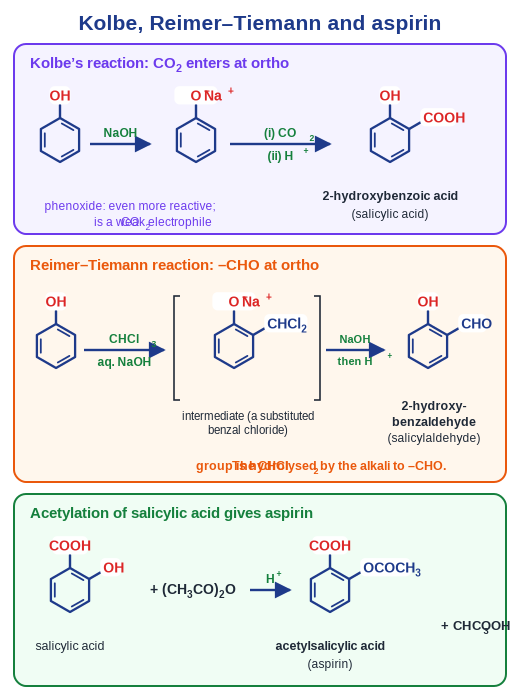
- (iv) Reimer–Tiemann reaction. Overall, with acid at the end: C₆H₅OH + CHCl₃ + 4NaOH → NaOC₆H₄CHO + 3NaCl + 3H₂O and NaOC₆H₄CHO + HCl → HOC₆H₄CHO + NaCl. The product is 2-hydroxybenzaldehyde (salicylaldehyde), formed through the o-CHCl₂ intermediate. (The book shows the steps; the balanced overall equation is our own.)
7.18 “Explain the following with an example. (i) Kolbe’s reaction. (ii) Reimer-Tiemann reaction. (iii) Williamson ether synthesis. (iv) Unsymmetrical ether.”
- (i) Kolbe’s reaction: sodium phenoxide, more reactive than phenol towards electrophiles, reacts with carbon dioxide, and acid then gives salicylic acid. C₆H₅ONa + CO₂ → HOC₆H₄COONa and HOC₆H₄COONa + HCl → HOC₆H₄COOH + NaCl (–COOH ortho to –OH).
- (ii) Reimer–Tiemann reaction: phenol with chloroform and aqueous NaOH, then acid, gives salicylaldehyde; a –CHO group enters at the ortho position through a –CHCl₂ intermediate (equations in 7.17 (iv)).
- (iii) Williamson synthesis: an alkyl halide reacts with a sodium alkoxide by SN2 to give an ether: CH₃CH₂ONa + CH₃Br → CH₃CH₂OCH₃ + NaBr. The halide should be primary.
- (iv) Unsymmetrical (mixed) ether: the two groups on oxygen are different, for example ethyl methyl ether, C₂H₅OCH₃, or anisole, C₆H₅OCH₃.
7.19 “Write the mechanism of acid dehydration of ethanol to yield ethene.”
Overall: C₂H₅OH → CH₂=CH₂ + H₂O (conc. H₂SO₄, 443 K)
- Protonated alcohol (fast): CH₃CH₂OH + H⁺ → CH₃CH₂OH₂⁺
- Carbocation (slow, rate determining): CH₃CH₂OH₂⁺ → CH₃CH₂⁺ + H₂O
- Ethene (a C–H bond pair forms the double bond and a proton leaves): CH₃CH₂⁺ → CH₂=CH₂ + H⁺
Each step is reversible; ethene is removed as it forms to drive the change forward, and the acid of step 1 is given back in step 3.
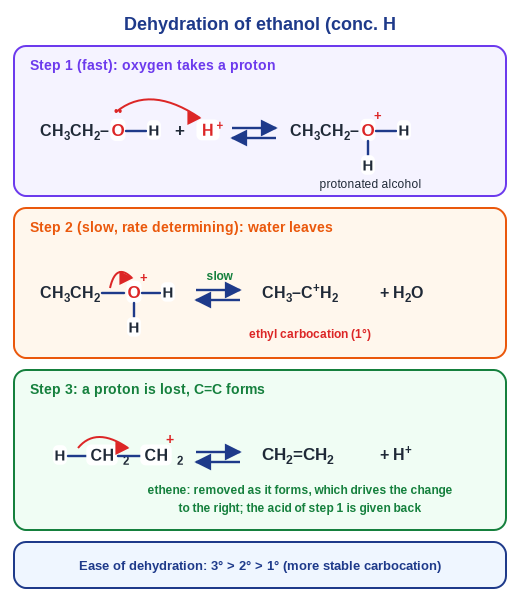
7.20 “How are the following conversions carried out? (i) Propene → Propan-2-ol. (ii) Benzyl chloride → Benzyl alcohol. (iii) Ethyl magnesium chloride → Propan-1-ol. (iv) Methyl magnesium bromide → 2-Methylpropan-2-ol.”
- (i) Acid-catalysed hydration (Markovnikov): CH₃CH=CH₂ + H₂O → CH₃CH(OH)CH₃ (H⁺)
- (ii) Nucleophilic substitution with aqueous NaOH: C₆H₅CH₂Cl + NaOH → C₆H₅CH₂OH + NaCl
- (iii) Add methanal, then water: C₂H₅MgCl + HCHO → CH₃CH₂CH₂OMgCl and CH₃CH₂CH₂OMgCl + H₂O → CH₃CH₂CH₂OH + Mg(OH)Cl
- (iv) Add propanone, then water: CH₃MgBr + CH₃COCH₃ → (CH₃)₃COMgBr and (CH₃)₃COMgBr + H₂O → (CH₃)₃COH + Mg(OH)Br
The answer key writes (iii) with C₂H₅MgBr; the question names the chloride, which reacts the same way.
7.21 “Name the reagents used in the following reactions: (i) Oxidation of a primary alcohol to carboxylic acid. (ii) Oxidation of a primary alcohol to aldehyde. (iii) Bromination of phenol to 2,4,6-tribromophenol. (iv) Benzyl alcohol to benzoic acid. (v) Dehydration of propan-2-ol to propene. (vi) Butan-2-one to butan-2-ol.”
| Reagent | |
|---|---|
| (i) | acidified (or alkaline) potassium permanganate, KMnO₄ |
| (ii) | pyridinium chlorochromate (PCC), or CrO₃ in an anhydrous medium |
| (iii) | bromine water (aqueous Br₂) |
| (iv) | acidified KMnO₄ (alkaline KMnO₄ followed by acid also works) |
| (v) | 85% phosphoric acid at 440 K (or concentrated H₂SO₄) |
| (vi) | NaBH₄ or LiAlH₄, or H₂ with Ni, Pd or Pt |
7.22 “Give reason for the higher boiling point of ethanol in comparison to methoxymethane.”
Both have molecular mass 46. Ethanol has an O–H bond, so its molecules are joined by intermolecular hydrogen bonds, which need extra energy to break. Methoxymethane has no hydrogen on oxygen and cannot hydrogen bond with itself; only weaker dipole–dipole and van der Waals forces hold its molecules. Hence ethanol boils at 351 K and methoxymethane at 248 K.
Exercises 7.23 to 7.27: ethers
7.23 “Give IUPAC names of the following ethers:” The book gives six structures.
| Structure | IUPAC name | |
|---|---|---|
| (i) | C₂H₅OCH₂CH(CH₃)CH₃ | 1-ethoxy-2-methylpropane |
| (ii) | CH₃OCH₂CH₂Cl | 1-chloro-2-methoxyethane |
| (iii) | O₂NC₆H₄OCH₃ (p) | 1-methoxy-4-nitrobenzene (4-nitroanisole) |
| (iv) | CH₃CH₂CH₂OCH₃ | 1-methoxypropane |
| (v) | cyclohexane ring: two –CH₃ on one carbon, –OC₂H₅ on the carbon opposite (1,4) | 4-ethoxy-1,1-dimethylcyclohexane |
| (vi) | C₆H₅OC₂H₅ | ethoxybenzene |
Two notes against the answer key:
- (ii) The key gives 2-chloro-1-methoxyethane. Both substituents are prefixes and get locants 1 and 2 either way, so the tie goes to the one first in alphabetical order: chloro gets 1. Hence 1-chloro-2-methoxyethane.
- (v) The key gives 1-ethoxy-4,4-dimethylcyclohexane. In an ether the alkoxy group has no priority, so the lowest locant set wins: 1,1,4 is lower than 1,4,4. Hence 4-ethoxy-1,1-dimethylcyclohexane, the same way the book’s own Table 7.2 names 2-ethoxy-1,1-dimethylcyclohexane.
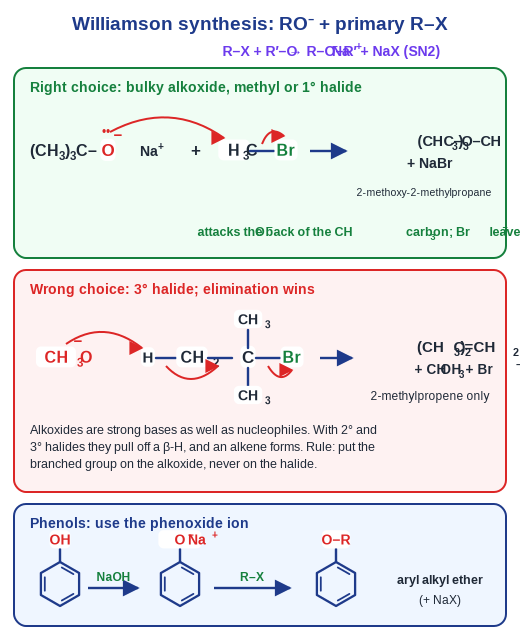
7.24 “Write the names of reagents and equations for the preparation of the following ethers by Williamson’s synthesis: (i) 1-Propoxypropane (ii) Ethoxybenzene (iii) 2-Methoxy-2-methylpropane (iv) 1-Methoxyethane”
The alkoxide is made from the alcohol and sodium, for example 2CH₃CH₂CH₂OH + 2Na → 2CH₃CH₂CH₂ONa + H₂.
- (i) Sodium propoxide + 1-bromopropane: CH₃CH₂CH₂ONa + CH₃CH₂CH₂Br → CH₃CH₂CH₂OCH₂CH₂CH₃ + NaBr
- (ii) Sodium phenoxide + bromoethane: C₆H₅ONa + C₂H₅Br → C₆H₅OC₂H₅ + NaBr. (Bromobenzene with sodium ethoxide would not work: an aryl halide does not undergo SN2.)
- (iii) Sodium tert-butoxide + bromomethane: (CH₃)₃CONa + CH₃Br → (CH₃)₃COCH₃ + NaBr. The reverse pairing, CH₃ONa with (CH₃)₃CBr, gives only 2-methylpropene.
- (iv) Methoxyethane (the 1- is not needed): sodium ethoxide + bromomethane, C₂H₅ONa + CH₃Br → C₂H₅OCH₃ + NaBr; sodium methoxide + bromoethane also works because both halides are unhindered.
7.25 “Illustrate with examples the limitations of Williamson synthesis for the preparation of certain types of ethers.”
The alkoxide is a strong base as well as a nucleophile, so the method works well only with methyl and primary halides.
- Tertiary halides give only alkenes: (CH₃)₃CBr + CH₃ONa → (CH₃)₂C=CH₂ + CH₃OH + NaBr. tert-Butyl methyl ether must be made the other way round, from (CH₃)₃CONa and CH₃Br.
- Secondary halides give a mixture: elimination competes with substitution.
- Aryl (and vinyl) halides do not react by SN2, so ethoxybenzene cannot be made from bromobenzene and sodium ethoxide; the aryl part must come in as the phenoxide.
7.26 “How is 1-propoxypropane synthesised from propan-1-ol? Write mechanism of this reaction.”
Heat propan-1-ol with concentrated H₂SO₄, keeping the temperature low (for ethanol the book uses 413 K; at higher temperature the alkene forms): 2CH₃CH₂CH₂OH → CH₃CH₂CH₂OCH₂CH₂CH₃ + H₂O.
Mechanism (SN2, as for ethanol):
- Protonation: CH₃CH₂CH₂OH + H⁺ → CH₃CH₂CH₂OH₂⁺
- A second alcohol molecule attacks the carbon next to –OH₂⁺ from the back, and water leaves: CH₃CH₂CH₂OH + CH₃CH₂CH₂OH₂⁺ → (CH₃CH₂CH₂)₂OH⁺ + H₂O
- Loss of a proton: (CH₃CH₂CH₂)₂OH⁺ → (CH₃CH₂CH₂)₂O + H⁺
Propan-1-ol is a primary, unhindered alcohol, so this works. It can also be made by Williamson synthesis, as in 7.24 (i), with propan-1-ol giving both the alkoxide (with Na) and the bromide (with PBr₃).
7.27 “Preparation of ethers by acid dehydration of secondary or tertiary alcohols is not a suitable method. Give reason.”
With 2° and 3° alcohols the protonated alcohol easily loses water to give a fairly stable carbocation (the reaction takes the SN1 path). That carbocation loses a proton to give an alkene faster than a second, crowded alcohol molecule can attack it. Elimination wins over substitution, so the main product is an alkene, not an ether.
Exercises 7.28 to 7.33: cleavage, substitution and synthesis
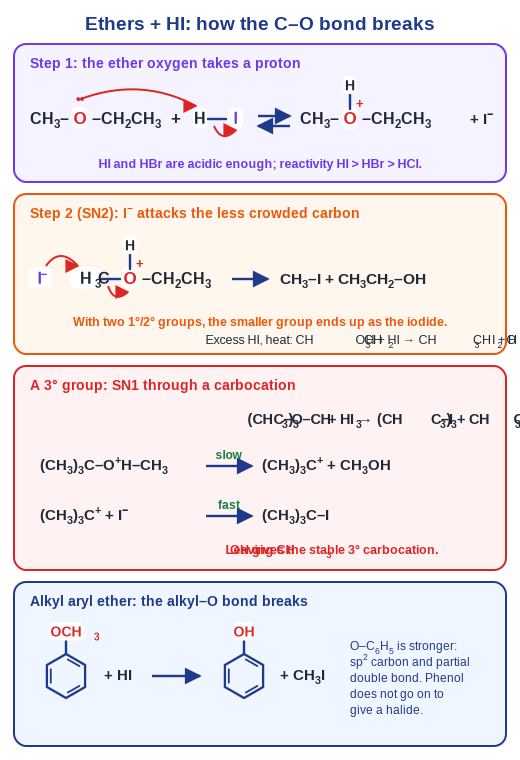
7.28 “Write the equation of the reaction of hydrogen iodide with: (i) 1-propoxypropane (ii) methoxybenzene and (iii) benzyl ethyl ether.”
- (i) CH₃CH₂CH₂OCH₂CH₂CH₃ + HI → CH₃CH₂CH₂I + CH₃CH₂CH₂OH; with excess HI, CH₃CH₂CH₂OH + HI → CH₃CH₂CH₂I + H₂O.
- (ii) C₆H₅OCH₃ + HI → C₆H₅OH + CH₃I. The O–CH₃ bond breaks: the O–C₆H₅ bond is stronger (sp² carbon, partial double bond), and phenol does not go on to an aryl halide.
- (iii) C₆H₅CH₂OC₂H₅ + HI → C₆H₅CH₂I + C₂H₅OH. The protonated ether breaks at the benzyl–O bond, because the benzyl carbocation, C₆H₅CH₂⁺, is stabilised by resonance with the ring (the same reason the tertiary case goes by SN1). With excess HI the ethanol also gives iodoethane.
7.29 “Explain the fact that in aryl alkyl ethers (i) the alkoxy group activates the benzene ring towards electrophilic substitution and (ii) it directs the incoming substituents to ortho and para positions in benzene ring.”
- (i) A lone pair on the oxygen of –OR is in conjugation with the ring. Moving into the ring by resonance, it raises the electron density of the ring, so electrophiles attack faster than with benzene.
- (ii) In the resonance structures of anisole the negative charge appears only at the two ortho carbons and the para carbon. These positions are the richest in electrons, so the electrophile goes there. (The structures are like those of phenol, with –OR in place of –OH.)
7.30 “Write the mechanism of the reaction of HI with methoxymethane.”
Overall: CH₃OCH₃ + HI → CH₃I + CH₃OH; with excess HI, CH₃OH + HI → CH₃I + H₂O.
- Protonation: the ether oxygen takes the proton and becomes an oxonium ion, CH₃OCH₃ + HI → (CH₃)₂OH⁺ + I⁻.
- SN2 attack: iodide, a good nucleophile, attacks a methyl carbon and methanol leaves: I⁻ + (CH₃)₂OH⁺ → CH₃I + CH₃OH
- With excess HI at high temperature, methanol is protonated and attacked by iodide in the same way: CH₃OH + HI → CH₃OH₂⁺ + I⁻, then I⁻ + CH₃OH₂⁺ → CH₃I + H₂O.
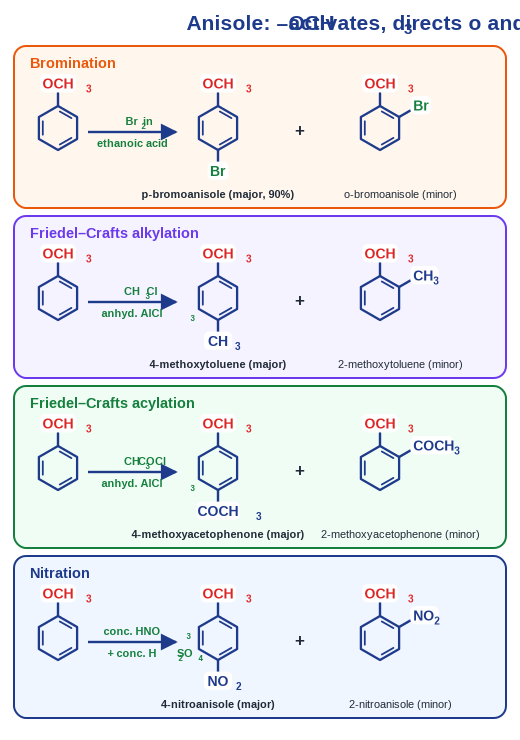
7.31 “Write equations of the following reactions: (i) Friedel-Crafts reaction – alkylation of anisole. (ii) Nitration of anisole. (iii) Bromination of anisole in ethanoic acid medium. (iv) Friedel-Craft’s acetylation of anisole.”
In each case the para product is major and the ortho product minor.
- (i) C₆H₅OCH₃ + CH₃Cl → CH₃C₆H₄OCH₃ + HCl (anhydrous AlCl₃): 4-methoxytoluene and 2-methoxytoluene
- (ii) C₆H₅OCH₃ + HNO₃ → O₂NC₆H₄OCH₃ + H₂O (conc. H₂SO₄): 4-nitroanisole and 2-nitroanisole
- (iii) C₆H₅OCH₃ + Br₂ → BrC₆H₄OCH₃ + HBr (ethanoic acid, no FeBr₃): p-bromoanisole (about 90%) and o-bromoanisole
- (iv) C₆H₅OCH₃ + CH₃COCl → CH₃COC₆H₄OCH₃ + HCl (anhydrous AlCl₃): 4-methoxyacetophenone and 2-methoxyacetophenone
7.32 “Show how would you synthesise the following alcohols from appropriate alkenes?” The book draws four alcohols as skeletal structures.
In each case use acid-catalysed hydration (H₂O with H⁺), choosing an alkene whose more stable carbocation sits on the carbon that must carry –OH.
| Alcohol | Alkene | |
|---|---|---|
| (i) | 1-methylcyclohexan-1-ol (–OH and –CH₃ on one ring carbon) | 1-methylcyclohexene |
| (ii) | 4-methylheptan-4-ol, CH₃CH₂CH₂C(OH)(CH₃)CH₂CH₂CH₃ | 4-methylhept-3-ene, CH₃CH₂CH=C(CH₃)CH₂CH₂CH₃ |
| (iii) | pentan-2-ol, CH₃CH(OH)CH₂CH₂CH₃ | pent-1-ene, CH₂=CHCH₂CH₂CH₃ |
| (iv) | 2-cyclohexylbutan-2-ol, C₆H₁₁C(OH)(CH₃)CH₂CH₃ | 2-cyclohexylbut-1-ene, CH₂=C(C₆H₁₁)CH₂CH₃ |
- (i) The proton adds to C-2 of the ring, giving a 3° carbocation at C-1, where water attacks.
- (ii) CH₃CH₂CH=C(CH₃)CH₂CH₂CH₃ + H₂O → CH₃CH₂CH₂C(OH)(CH₃)CH₂CH₂CH₃: the 3° carbocation forms at C-4.
- (iii) CH₂=CHCH₂CH₂CH₃ + H₂O → CH₃CH(OH)CH₂CH₂CH₃. Pent-2-ene would give a mixture of pentan-2-ol and pentan-3-ol, so pent-1-ene is the better choice.
- (iv) CH₂=C(C₆H₁₁)CH₂CH₃ + H₂O → C₆H₁₁C(OH)(CH₃)CH₂CH₃: the 3° carbocation forms at C-2. 2-Cyclohexylbut-2-ene would also work.
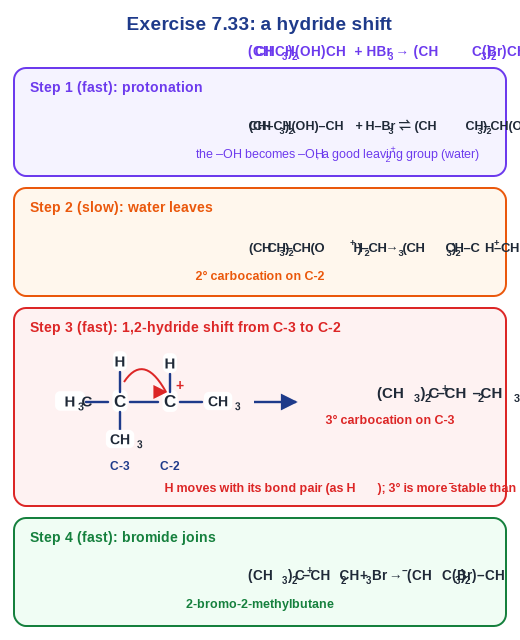
7.33 “When 3-methylbutan-2-ol is treated with HBr, the following reaction takes place: [3-methylbutan-2-ol → 2-bromo-2-methylbutane] Give a mechanism for this reaction. (Hint : The secondary carbocation formed in step II rearranges to a more stable tertiary carbocation by a hydride ion shift from 3rd carbon atom.”
Overall: (CH₃)₂CHCH(OH)CH₃ + HBr → (CH₃)₂C(Br)CH₂CH₃ + H₂O
- Protonation: (CH₃)₂CHCH(OH)CH₃ + HBr → (CH₃)₂CHCH(OH₂⁺)CH₃ + Br⁻
- Loss of water gives a 2° carbocation on C-2: (CH₃)₂CHCH(OH₂⁺)CH₃ → (CH₃)₂CHC⁺HCH₃ + H₂O
- 1,2-Hydride shift: the H on C-3 moves with its bond pair to C-2, leaving the positive charge on C-3, which is now a 3° carbocation and more stable: (CH₃)₂CHC⁺HCH₃ → (CH₃)₂C⁺CH₂CH₃
- Bromide attacks the 3° carbocation: (CH₃)₂C⁺CH₂CH₃ + Br⁻ → (CH₃)₂C(Br)CH₂CH₃, 2-bromo-2-methylbutane.
Intext Questions
Intext 7.1 (page 195): classify six alcohols as 1°, 2° or 3°. The six are (i) (CH₃)₃CCH₂OH, (ii) CH₂=CHCH₂OH, (iii) CH₃CH₂CH₂OH, (iv) C₆H₅CH(OH)CH₃, (v) C₆H₅CH₂CH(OH)CH₃ and (vi) C₆H₅CH=CHC(OH)(CH₃)₂. Primary: (i), (ii), (iii). Secondary: (iv), (v). Tertiary: (vi). This matches the book’s answer on page 225.
Intext 7.2 (page 195): which of these are allylic? (ii) and (vi): in each, the –OH carbon is next to a C=C bond. (iv) is benzylic, not allylic.
Intext 7.3 (page 198): IUPAC names of five compounds.
| Structure | Name | |
|---|---|---|
| (i) | CH₃CH₂CH(CH₂Cl)CH(CH₂OH)CH(CH₃)₂ | book: 4-chloro-3-ethyl-2-(1-methylethyl)butan-1-ol; strict longest chain: 3-(chloromethyl)-2-(1-methylethyl)pentan-1-ol |
| (ii) | CH₃CH(CH₃)CH₂CH(OH)CH(CH₂OH)CH₃ | 2,5-dimethylhexane-1,3-diol |
| (iii) | cyclohexane ring, –OH at C-1, –Br at C-3 | 3-bromocyclohexan-1-ol (3-bromocyclohexanol) |
| (iv) | CH₂=CHCH(OH)CH₂CH₂CH₃ | hex-1-en-3-ol |
| (v) | CH₃C(CH₃)=C(Br)CH₂OH | 2-bromo-3-methylbut-2-en-1-ol |
For (i), the chain that carries the –CH₂OH and runs through the ethyl group has five carbons, so the strict longest-chain rule gives a pentan-1-ol; the book keeps the CH₂Cl carbon in a four-carbon chain. Both names describe the same molecule (C₉H₁₉ClO); the book’s answer is the one printed on page 225. The other four agree with the book.
Intext 7.4 (page 203): make two alcohols from a Grignard reagent and methanal.
- (i) 2-Methylpropan-1-ol: (CH₃)₂CHMgBr + HCHO → (CH₃)₂CHCH₂OMgBr, then (CH₃)₂CHCH₂OMgBr + H₂O → (CH₃)₂CHCH₂OH + Mg(OH)Br
- (ii) Cyclohexylmethanol: C₆H₁₁MgBr + HCHO → C₆H₁₁CH₂OMgBr, then water gives C₆H₁₁CH₂OH.
Intext 7.5 (page 203): products of three reactions.
- (i) Propene with H₂O/H⁺: propan-2-ol, CH₃CH(OH)CH₃.
- (ii) Methyl (2-oxocyclohexyl)ethanoate with NaBH₄: only the ring ketone is reduced, giving methyl (2-hydroxycyclohexyl)ethanoate; NaBH₄ leaves the ester group alone.
- (iii) 2-Methylbutanal, CH₃CH₂CH(CH₃)CHO, with NaBH₄: 2-methylbutan-1-ol, CH₃CH₂CH(CH₃)CH₂OH.
Intext 7.6 (page 213): products of butan-1-ol and 2-methylbutan-2-ol with (a) HCl–ZnCl₂, (b) HBr, (c) SOCl₂.
| (a) HCl–ZnCl₂ | (b) HBr | (c) SOCl₂ | |
|---|---|---|---|
| Butan-1-ol | CH₃CH₂CH₂CH₂Cl (slow) | CH₃CH₂CH₂CH₂Br | CH₃CH₂CH₂CH₂Cl |
| 2-Methylbutan-2-ol | (CH₃)₂C(Cl)CH₂CH₃ (fast) | (CH₃)₂C(Br)CH₂CH₃ | (CH₃)₂C(Cl)CH₂CH₃ |
The tertiary alcohol reacts at once with Lucas reagent; the primary one reacts only slowly, on heating.
Intext 7.7 (page 213): major products of acid dehydration. (i) 1-Methylcyclohexanol gives 1-methylcyclohexene (the more substituted alkene). (ii) Butan-1-ol gives both but-1-ene and but-2-ene, which is the major product: the 1° carbocation rearranges (a hydride shift) to the more stable 2° carbocation, which loses a proton to give mainly the more substituted alkene. Both agree with the book’s answers.
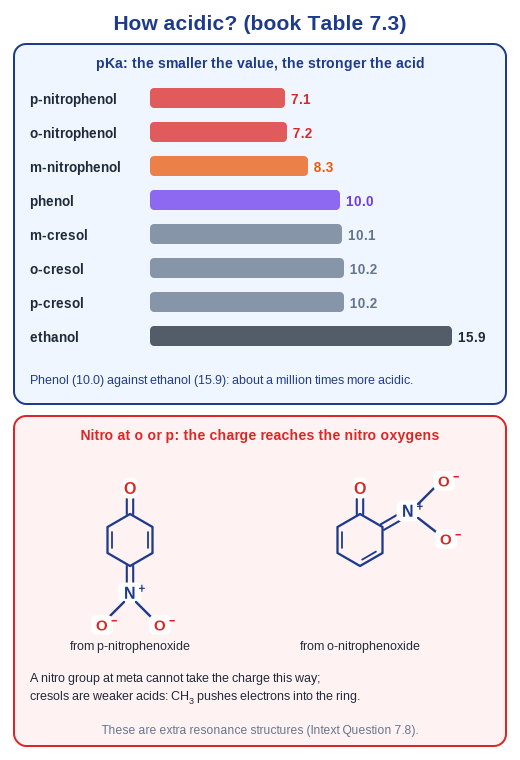
Intext 7.8 (page 213): resonance structures of o- and p-nitrophenoxide. Draw the five phenoxide structures (negative charge on O, then on C-2, C-4 and C-6). With –NO₂ at C-2 or C-4, the structure with the charge on that carbon gives one more structure, in which the ring carbon is double bonded to N and both nitro oxygens carry the negative charge: C=N⁺(O⁻)₂. This extra spreading of the charge makes o- and p-nitrophenol more acidic than phenol.
Intext 7.9 (page 213): equations for the Reimer–Tiemann and Kolbe reactions. See Exercises 7.17 (iv) and 7.18 (i): phenol + CHCl₃ + NaOH, then acid, gives salicylaldehyde; sodium phenoxide + CO₂, then acid, gives salicylic acid.
Intext 7.10 (page 220): make 2-ethoxy-3-methylpentane by Williamson synthesis from 3-methylpentan-2-ol and ethanol. Put the branched part on the alkoxide and use ethanol as the source of a primary halide:
2CH₃CH₂CH(CH₃)CH(OH)CH₃ + 2Na → 2CH₃CH₂CH(CH₃)CH(ONa)CH₃ + H₂
C₂H₅OH + HBr → C₂H₅Br + H₂O
CH₃CH₂CH(CH₃)CH(ONa)CH₃ + C₂H₅Br → CH₃CH₂CH(CH₃)CH(OC₂H₅)CH₃ + NaBr
This is the route printed in the book’s answer.
Intext 7.11 (page 220): which pair makes 1-methoxy-4-nitrobenzene? (ii), sodium 4-nitrophenoxide with bromomethane. The alkoxide part (4-nitrophenoxide) attacks a methyl carbon by SN2, which is easy. Pair (i), 4-bromonitrobenzene with sodium methoxide, would need substitution at a carbon of the ring, which is far harder for an aryl halide.
Intext 7.12 (page 221): products of four reactions.
- (i) CH₃CH₂CH₂OCH₃ + HBr → CH₃CH₂CH₂OH + CH₃Br: the smaller group becomes the halide.
- (ii) C₆H₅OC₂H₅ + HBr → C₆H₅OH + C₂H₅Br
- (iii) Ethoxybenzene with conc. H₂SO₄ and conc. HNO₃: 1-ethoxy-2-nitrobenzene and 1-ethoxy-4-nitrobenzene (para major): C₆H₅OC₂H₅ + HNO₃ → O₂NC₆H₄OC₂H₅ + H₂O
- (iv) (CH₃)₃COC₂H₅ + HI → (CH₃)₃CI + C₂H₅OH: the 3° group leaves as a carbocation (SN1) and becomes the iodide.
All four agree with the book’s answers on page 226.
Worked examples
Example 7.1 (page 198): IUPAC names of four compounds. (i) CH₃CH(Cl)CH(CH₃)CH(CH₃)CH₂OH, 4-chloro-2,3-dimethylpentan-1-ol; (ii) CH₃CH(CH₃)OCH₂CH₃, 2-ethoxypropane; (iii) phenol with –CH₃ at both ortho positions, 2,6-dimethylphenol; (iv) cyclohexane with –OC₂H₅ and –NO₂ on neighbouring carbons, 1-ethoxy-2-nitrocyclohexane (ethoxy comes first alphabetically and gets C-1).
Example 7.2 (page 201): products and names. (a) Catalytic reduction of butanal gives butan-1-ol, CH₃CH₂CH₂CH₂OH. (b) Hydration of propene with dilute H₂SO₄ gives propan-2-ol. (c) Propanone with CH₃MgBr, then water, gives 2-methylpropan-2-ol, (CH₃)₃COH.
Example 7.3 (page 204): increasing boiling points. (a) methanol < ethanol < propan-1-ol < butan-2-ol < butan-1-ol < pentan-1-ol: more carbons raise the boiling point, and branching (butan-2-ol) lowers it. (b) n-butane < ethoxyethane < pentanal < pentan-1-ol: no polarity, then weak polarity, then a strongly polar C=O, then hydrogen bonding.
Example 7.4 (page 207): increasing acid strength. Propan-1-ol < 4-methylphenol < phenol < 3-nitrophenol < 3,5-dinitrophenol < 2,4,6-trinitrophenol. The alcohol has no resonance in its anion; –CH₃ weakens and each –NO₂ strengthens a phenol, most of all at ortho and para.
Example 7.5 (page 212): major products of nitration. (a) Mononitration of 3-methylphenol: 3-methyl-4-nitrophenol and 5-methyl-2-nitrophenol (the –OH directs to its ortho and para positions; the crowded position between –OH and –CH₃ is avoided). (b) Dinitration: 5-methyl-2,4-dinitrophenol. (c) Mononitration of phenyl methanoate: the –O–CO– group directs para, giving 4-nitrophenyl methanoate. Note: the book’s drawn answer for (c) shows an ethanoate, –OCOCH₃, although the question names a methanoate (–OCHO); the position of the nitro group, para, is the same.
Example 7.6 (page 216): why the given route fails for tert-butyl ethyl ether. (i) Sodium ethoxide with 2-chloro-2-methylpropane gives mainly 2-methylprop-1-ene: the ethoxide acts as a base and elimination wins over substitution. (ii) Use (CH₃)₃CONa + CH₃CH₂Cl → (CH₃)₃COC₂H₅ + NaCl.
Example 7.7 (page 219): products of heating three ethers with HI. (i) CH₃CH₂CH(CH₃)CH₂OCH₂CH₃ gives 2-methylbutan-1-ol and iodoethane (the smaller group becomes the iodide). (ii) CH₃CH₂CH₂OC(CH₃)₂CH₂CH₃ gives propan-1-ol and 2-iodo-2-methylbutane (the 3° group leaves as a carbocation, SN1). (iii) Benzyl phenyl ether, C₆H₅CH₂OC₆H₅, gives benzyl iodide and phenol (the phenyl–O bond does not break).
Practice
-
The IUPAC name of CH₃CH(OH)CH₂CH(CH₃)₂ is:
Show answer
Answer: (a) 4-methylpentan-2-ol
-
Ethylmagnesium bromide with methanal, followed by water, gives:
Show answer
Answer: (b) propan-1-ol
-
Which is the most acidic?
Show answer
Answer: (d) p-nitrophenol
-
Heating anisole with HI gives:
Show answer
Answer: (b) phenol and iodomethane
-
Give the reagents for making 2-methoxy-2-methylpropane by Williamson synthesis.
Show answer
Answer: Sodium tert-butoxide and bromomethane: (CH₃)₃CONa + CH₃Br → (CH₃)₃COCH₃ + NaBr. The bulky group is on the alkoxide and the halide is a methyl halide, so SN2 works; the other pairing, CH₃ONa with (CH₃)₃CBr, gives only 2-methylpropene.
Stuck on a question?
Take a photo and Lagnever AI explains it step by step. Try it for 7 days for ₹2.
Get it on Google Play Open in browser
For parents: after the trial, the plan renews monthly by UPI or card autopay. You can cancel anytime in the app.