
Class 12 Chemistry Chapter 7: Alcohols, Phenols and Ethers Notes
This chapter in five lines
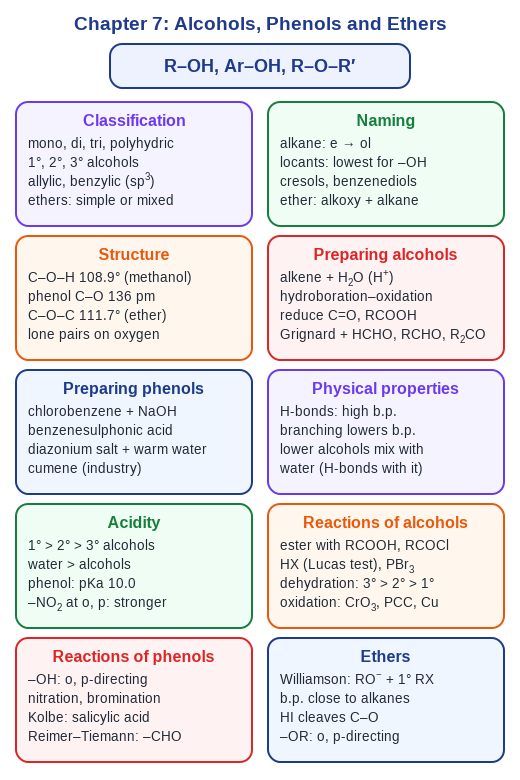
Alcohols (R–OH) carry –OH on an sp³ carbon, phenols (Ar–OH) on a benzene ring, and ethers (R–O–R′) have oxygen between two carbon groups. Hydrogen bonding gives alcohols and phenols high boiling points. Phenols are far more acidic than alcohols, alcohols dehydrate and oxidise, phenol rings react readily at ortho and para, and HI cleaves ethers.
What is this chapter about?
Replace a hydrogen of a hydrocarbon by an –OH group and you get an alcohol if the carbon is part of an aliphatic chain, or a phenol if it is part of an aromatic ring. Replace the hydrogen of that –OH by an alkyl or aryl group and you get an ether. The book reminds us how common the –OH group is: the spirit used to polish furniture is mostly ethanol, and sugar, cotton and paper are all built from compounds with many –OH groups. This chapter is Unit 7, the second unit of Chemistry Part II.
How structures are written on this site. We use condensed formulas: each carbon is written with its hydrogens, and a group in brackets hangs from the carbon written just before it, so CH₃CH(OH)CH₃ is propan-2-ol. C₆H₅– is phenyl, and o-, m-, p- mark the 1,2-, 1,3- and 1,4- positions on a ring. In the mechanism drawings, red curved arrows show where an electron pair moves.
How are they classified?
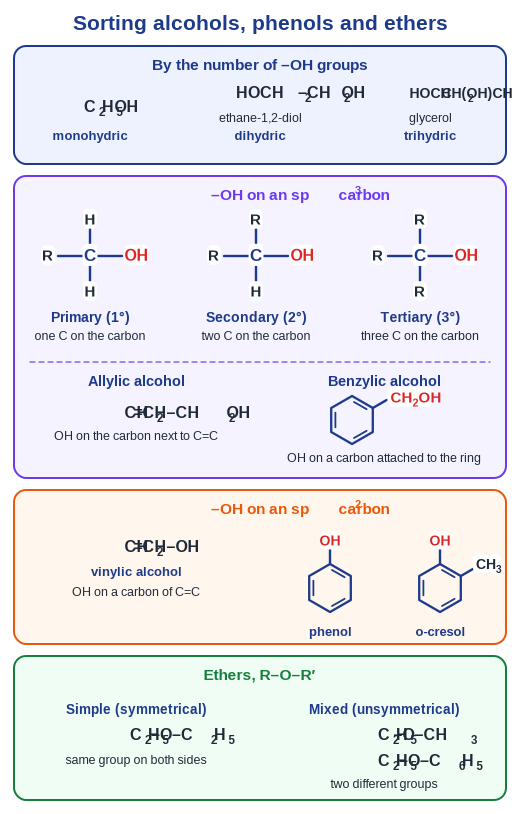
- By the number of –OH groups: monohydric (C₂H₅OH), dihydric (HOCH₂CH₂OH) and trihydric (glycerol). Phenols are classified the same way.
- –OH on an sp³ carbon: 1°, 2° and 3° alcohols, by how many carbons are joined to the carbon carrying –OH; allylic alcohols (next to C=C) and benzylic alcohols (on a carbon attached to a ring). Allylic and benzylic alcohols can themselves be 1°, 2° or 3°.
- –OH on an sp² carbon: vinylic alcohols (CH₂=CH–OH) and phenols.
- Ethers: simple or symmetrical (C₂H₅OC₂H₅) and mixed or unsymmetrical (C₂H₅OCH₃, C₂H₅OC₆H₅).
How are they named?
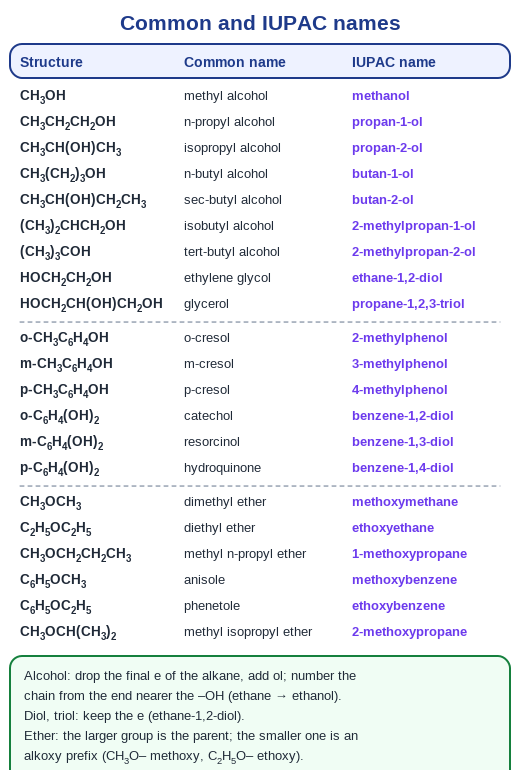
Alcohols. The common name is the alkyl group plus the word alcohol (methyl alcohol). In the IUPAC name the final e of the alkane becomes ol. Take the longest chain that carries the –OH, number it from the end nearer the –OH, and give each substituent its locant: (CH₃)₂CHCH₂OH is 2-methylpropan-1-ol. For two or three –OH groups the e stays and di or tri goes before ol: ethane-1,2-diol, propane-1,2,3-triol. In a cyclic alcohol the –OH carbon is C-1 (2-methylcyclopentanol).
Phenols. Phenol is both the common and the IUPAC name. The methylphenols are the cresols (o-cresol is 2-methylphenol), and the benzenediols are catechol (1,2), resorcinol (1,3) and hydroquinone or quinol (1,4).
Ethers. The common name lists the two groups in alphabetical order and adds ether (ethyl methyl ether); a symmetrical ether takes di (diethyl ether). IUPAC treats the larger group as the parent hydrocarbon and the smaller one as an alkoxy prefix: CH₃OCH₂CH₂CH₃ is 1-methoxypropane, C₆H₅OCH₃ (anisole) is methoxybenzene.
What do the functional groups look like?
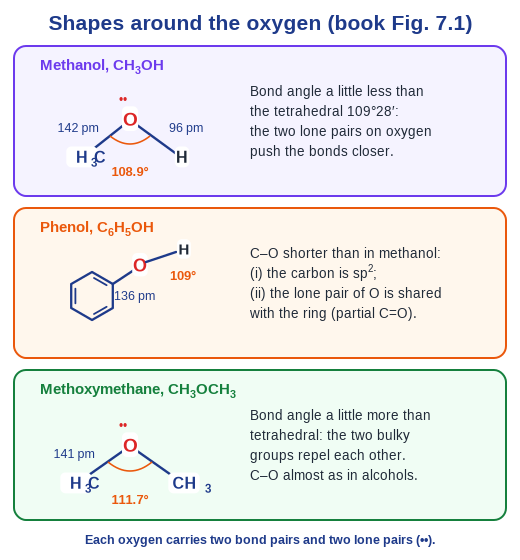
The oxygen of an alcohol is bonded to carbon through an sp³–sp³ sigma bond and carries two lone pairs. In methanol the C–O–H angle is 108.9°, a little less than the tetrahedral angle, because the lone pairs repel the bond pairs. In phenol the C–O bond (136 pm) is shorter than in methanol (142 pm): the carbon is sp² and the lone pair of oxygen is partly shared with the ring. In methoxymethane the C–O–C angle (111.7°) is a little wider than tetrahedral, because the two bulky groups push apart; its C–O bond (141 pm) is close to that in alcohols.
How are alcohols and phenols prepared?
Alcohols come from:
- Alkenes. Acid-catalysed hydration follows Markovnikov’s rule: CH₃CH=CH₂ + H₂O → CH₃CH(OH)CH₃. The mechanism has three steps: the alkene takes a proton to give a carbocation, water attacks it, and a proton is lost. Hydroboration–oxidation (diborane, then H₂O₂ in aqueous NaOH) gives the other isomer, propan-1-ol, in excellent yield.
- Carbonyl compounds. H₂ with Pd, Pt or Ni, or NaBH₄ or LiAlH₄, reduce aldehydes to 1° and ketones to 2° alcohols. LiAlH₄ reduces carboxylic acids to 1° alcohols but is costly; industry turns the acid into an ester and hydrogenates it.
- Grignard reagents. RMgX adds to a carbonyl group and water then releases the alcohol. Methanal gives a 1°, other aldehydes a 2° and ketones a 3° alcohol.
Phenol comes from chlorobenzene fused with NaOH at 623 K and high pressure, from benzenesulphonic acid fused with NaOH, from a diazonium salt warmed with water, and, in industry, from cumene: air oxidises it to cumene hydroperoxide, which dilute acid splits into phenol and acetone. Read how alcohols and phenols are prepared.
What are their physical properties?
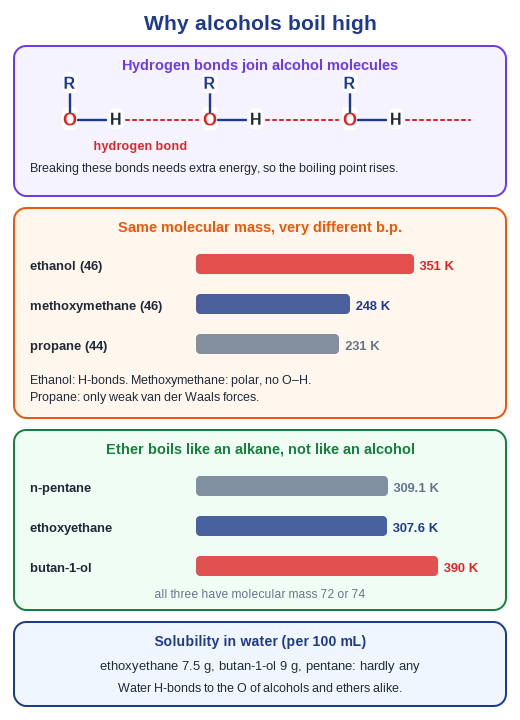
- Boiling points rise with the number of carbon atoms (stronger van der Waals forces) and fall with branching (smaller surface area).
- The –OH group forms intermolecular hydrogen bonds, so alcohols and phenols boil much higher than hydrocarbons, ethers and haloalkanes of similar mass: ethanol 351 K, methoxymethane 248 K, propane 231 K (molecular masses 46, 46 and 44).
- Alcohols and phenols dissolve in water because they form hydrogen bonds with water molecules. Solubility falls as the hydrocarbon part grows; several lower alcohols mix with water in all proportions.
How acidic are alcohols and phenols?
Alcohols react with active metals such as Na, K and Al to give alkoxides and hydrogen: 2CH₃CH₂OH + 2Na → 2CH₃CH₂ONa + H₂. Phenols do the same and also react with aqueous NaOH: C₆H₅OH + NaOH → C₆H₅ONa + H₂O. Both are Brönsted acids.
- Alcohols: alkyl groups push electrons towards oxygen and make the O–H bond less polar, so acid strength falls 1° > 2° > 3°. Alcohols are weaker acids than water: an alkoxide takes a proton from water, so alkoxides are stronger bases than hydroxide.
- Phenols: the sp² carbon draws electrons from oxygen, and the phenoxide ion is stabilised by resonance (the negative charge spreads over the ring). Phenol (pKa 10.0) is about a million times more acidic than ethanol (pKa 15.9).
- Electron-withdrawing –NO₂ groups make phenol more acidic, most of all at ortho and para; electron-releasing alkyl groups make it less acidic, so cresols are weaker acids than phenol.
Read the acidity of alcohols and phenols.
How do alcohols react?
Alcohols act as nucleophiles when the O–H bond breaks, and, once protonated, as electrophiles when the C–O bond breaks.
- Esterification: with a carboxylic acid or anhydride (a little conc. H₂SO₄) or an acid chloride (in pyridine) they give esters. Acetylation of salicylic acid gives aspirin.
- With HX: ROH + HX → RX + H₂O. In the Lucas test (conc. HCl + ZnCl₂), a 3° alcohol turns cloudy at once and a 1° alcohol not at all at room temperature. PBr₃ turns alcohols into alkyl bromides.
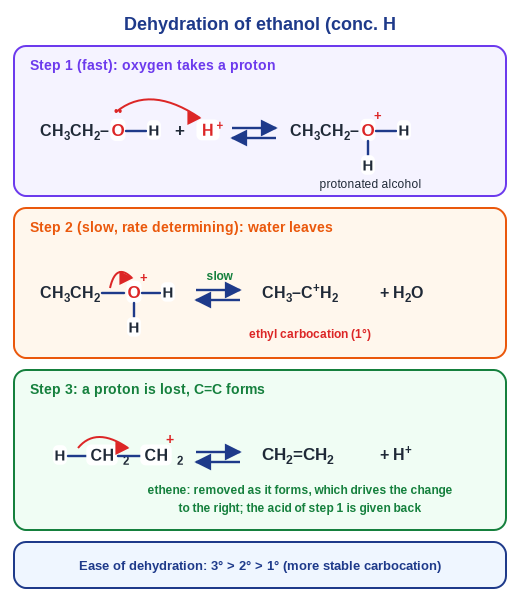
- Dehydration: conc. H₂SO₄ or H₃PO₄, or ZnCl₂ or alumina, gives an alkene. Ethanol needs 443 K; ease of dehydration is 3° > 2° > 1° because the step that sets the rate forms a carbocation.
- Oxidation: a 1° alcohol gives an aldehyde (CrO₃ in an anhydrous medium, or PCC) and then a carboxylic acid (acidified KMnO₄); a 2° alcohol gives a ketone; a 3° alcohol is not oxidised under these conditions. Over hot copper at 573 K, 1° and 2° alcohols lose H₂ and 3° alcohols lose water.
The book’s box on methanol in the body: enzymes oxidise methanol to methanal, which is oxidised further to methanoic acid; this can cause blindness and death. A patient poisoned with methanol is treated in hospital with intravenous dilute ethanol, which keeps the enzyme busy so the kidneys have time to remove the methanol.
How do phenols react?
The –OH group makes the ring much more reactive towards electrophiles and sends the new group to the ortho and para positions.
- Nitration: dilute HNO₃ at 298 K gives o- and p-nitrophenol, separated by steam distillation (the o-isomer, with an intramolecular hydrogen bond, is steam volatile). Concentrated HNO₃ gives 2,4,6-trinitrophenol (picric acid).
- Bromination: Br₂ in CS₂ or CHCl₃ at 273 K gives mainly p-bromophenol; bromine water gives a white precipitate of 2,4,6-tribromophenol. No Lewis acid is needed.
- Kolbe’s reaction: sodium phenoxide + CO₂, then acid, gives salicylic acid.
- Reimer–Tiemann reaction: CHCl₃ + aqueous NaOH puts –CHO at the ortho position, giving salicylaldehyde.
- Heating with zinc dust gives benzene; chromic acid oxidises phenol to benzoquinone, and air slowly darkens phenols.
Read the reactions of alcohols and phenols.
What are methanol and ethanol used for?
- Methanol (CH₃OH, wood spirit), once made by destructive distillation of wood, is now made by catalytic hydrogenation of carbon monoxide: CO + 2H₂ → CH₃OH (ZnO–Cr₂O₃, 200–300 atm, 573–673 K). It boils at 337 K, is highly poisonous (small amounts can cause blindness, large amounts death) and is used as a solvent for paints and varnishes and mainly to make formaldehyde.
- Ethanol (C₂H₅OH, b.p. 351 K) is made by fermentation. Invertase turns sucrose into glucose and fructose, C₁₂H₂₂O₁₁ + H₂O → C₆H₁₂O₆ + C₆H₁₂O₆, and zymase from yeast turns these into ethanol, C₆H₁₂O₆ → 2C₂H₅OH + 2CO₂, without air. Zymase stops working once the alcohol passes 14 percent. Large amounts of ethanol are now made by hydration of ethene. Ethanol is a solvent in the paint industry and a starting material for many carbon compounds; commercial alcohol is denatured with copper sulphate and pyridine to make it unfit for drinking. The book also notes that ethanol taken into the body acts on the central nervous system and that high amounts can be fatal.
How are ethers made, and how do they behave?
- From alcohols: ethanol with H₂SO₄ at 413 K gives ethoxyethane (at 443 K, ethene). One alcohol molecule attacks a protonated one by SN2, so the method suits only unhindered primary alcohols; 2° and 3° alcohols give alkenes instead.
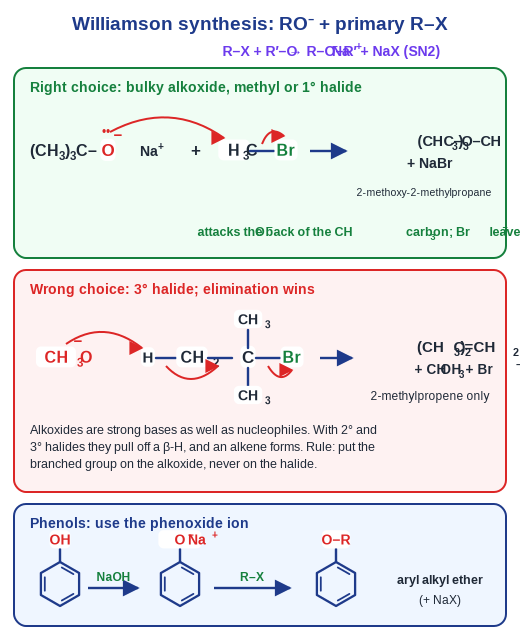
- Williamson synthesis: CH₃CH₂Br + CH₃ONa → CH₃CH₂OCH₃ + NaBr. The alkoxide attacks by SN2, so the halide should be primary: with a 3° halide the alkoxide acts as a base and only an alkene forms. Phenols react as phenoxide ions.
- Physical properties: ethers have a small dipole moment but no O–H, so they boil close to alkanes of similar mass (ethoxyethane 307.6 K, pentane 309.1 K, butan-1-ol 390 K). They dissolve in water about as well as alcohols of the same mass, because water can hydrogen bond to the ether oxygen.
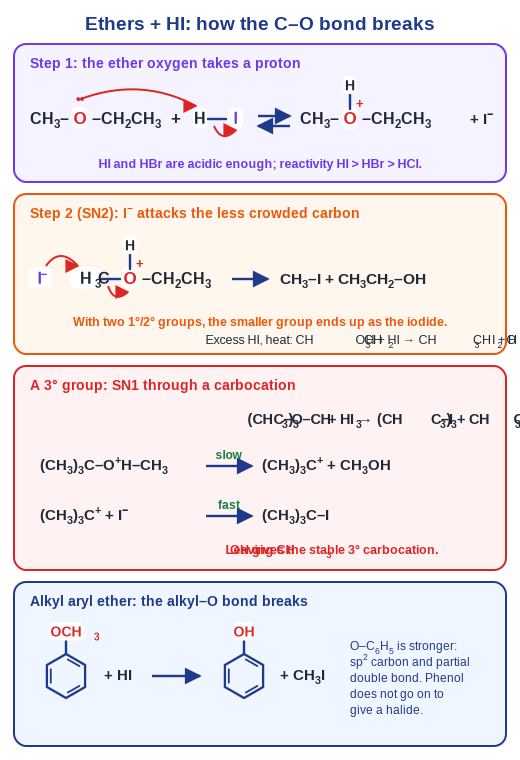
- Cleavage by HI or HBr: ethers are the least reactive of these groups, but hot concentrated HI breaks the C–O bond. The ether is protonated, then iodide attacks the less substituted carbon (SN2); with a 3° group the reaction goes through the 3° carbocation (SN1). Anisole gives phenol and CH₃I, because the aryl–O bond is stronger.
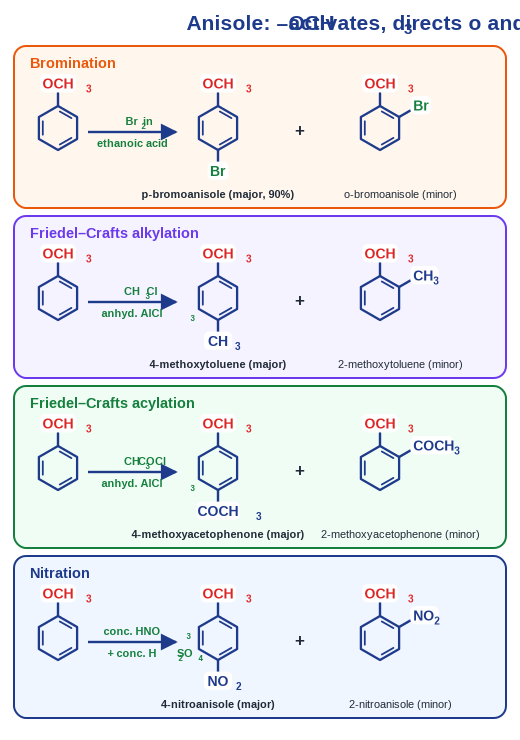
- Ring reactions of anisole: –OCH₃ is activating and o, p-directing: bromination in ethanoic acid (para isomer about 90%), Friedel–Crafts alkylation and acylation, and nitration.
Stay safe
Methanol, phenol, picric acid, bromine, concentrated acids and sodium are hazardous. Prepare or handle any of them only in the school laboratory with your teacher, never at home, and never taste or smell a chemical.
Before we move on
Three skills carry this chapter: naming an alcohol, phenol or ether from its formula, choosing the reagent for a conversion (hydration, reduction, Grignard, Williamson), and explaining an order (boiling points, acidity, ease of dehydration). Every exercise, Intext Question and worked example of the unit is answered in the NCERT solutions for Chapter 7.
Key terms
| Term | Meaning |
|---|---|
| Alcohol, phenol and ether | An alcohol has –OH on a carbon of an aliphatic chain (CH₃OH); a phenol has –OH directly on an aromatic ring (C₆H₅OH); an ether has an oxygen joined to two alkyl or aryl groups (CH₃OCH₃). |
| 1°, 2° and 3° alcohol | The carbon carrying –OH is joined to one, two or three other carbon atoms: CH₃CH₂OH is 1°, (CH₃)₂CHOH is 2°, (CH₃)₃COH is 3°. |
| Allylic and benzylic alcohol | Allylic: –OH on the sp³ carbon next to a C=C bond (CH₂=CHCH₂OH). Benzylic: –OH on the sp³ carbon attached to a ring (C₆H₅CH₂OH). |
| Symmetrical and unsymmetrical ether | Simple (symmetrical) ethers have the same group on both sides of oxygen (C₂H₅OC₂H₅); mixed (unsymmetrical) ethers have two different groups (C₂H₅OCH₃). |
| Hydroboration–oxidation | Diborane adds to an alkene and the trialkylborane is oxidised by H₂O₂ in aqueous NaOH. The –OH ends up on the carbon that had more hydrogens, as if water had added against Markovnikov’s rule. |
| Grignard synthesis of alcohols | RMgX adds to a carbonyl group and water then gives an alcohol: methanal gives a 1°, other aldehydes a 2°, ketones a 3° alcohol. |
| pKa | A measure of acid strength: the smaller the pKa, the stronger the acid. Phenol is 10.0 and ethanol 15.9 (book Table 7.3). |
| Lucas test | Concentrated HCl with ZnCl₂. A 3° alcohol gives turbidity at once because its chloride forms fast and does not dissolve; a 1° alcohol gives none at room temperature. |
| Kolbe’s reaction | Sodium phenoxide reacts with carbon dioxide, a weak electrophile, and acid then gives 2-hydroxybenzoic acid (salicylic acid). |
| Reimer–Tiemann reaction | Phenol with chloroform and aqueous NaOH gets a –CHO group at the ortho position, giving salicylaldehyde. |
| Williamson synthesis | An alkyl halide reacts with a sodium alkoxide by SN2: R–X + R′–O⁻Na⁺ → R–O–R′ + NaX. The halide should be primary. |
| Denatured alcohol | Commercial ethanol made unfit for drinking by adding copper sulphate (colour) and pyridine (a foul smell). |
Topics in this chapter
Practice
-
The IUPAC name of (CH₃)₃COH is:
Show answer
Answer: (c) 2-methylpropan-2-ol
-
Hydroboration–oxidation of propene gives mainly:
Show answer
Answer: (b) propan-1-ol
-
Which is the strongest acid?
Show answer
Answer: (d) p-nitrophenol
-
Phenol with bromine water gives:
Show answer
Answer: (c) 2,4,6-tribromophenol
-
The right pair for making tert-butyl methyl ether by Williamson synthesis is:
Show answer
Answer: (b) (CH₃)₃CONa + CH₃Br
Questions students ask
What are the main topics of Class 12 Chemistry Chapter 7?
Classification and naming of alcohols, phenols and ethers, the shapes around the oxygen atom, preparation of alcohols and phenols, physical properties, acidity, the reactions of alcohols (esterification, halides, dehydration, oxidation) and of phenols (nitration, bromination, Kolbe, Reimer–Tiemann), methanol and ethanol, and the preparation, properties and reactions of ethers.
Is Alcohols, Phenols and Ethers in the 2026-27 NCERT Class 12 Chemistry book?
Yes. It is Unit 7, the second unit of Chemistry Part II, the Class 12 textbook marked Reprint 2026-27, on pages 193 to 226. The book calls it a unit; here it is Chapter 7.
Why is phenol more acidic than ethanol?
The –OH of phenol is on an sp² carbon, which pulls electron density away from oxygen and makes the O–H bond more polar. More important, the negative charge of the phenoxide ion spreads over the ring by resonance, while in an alkoxide ion it stays on oxygen. A more stable anion means a stronger acid.
How should I write structures in my answers?
Condensed formulas such as CH₃CH(OH)CH₃ are fine: write each carbon with its hydrogens and put a branch in brackets after the carbon that carries it. Draw a ring when the position on a benzene ring matters, as in nitrophenols and cresols.
Stuck on a question?
Take a photo and Lagnever AI explains it step by step. Try it for 7 days for ₹2.
Get it on Google Play Open in browser
For parents: after the trial, the plan renews monthly by UPI or card autopay. You can cancel anytime in the app.