
How do alcohols and phenols react?
Answer in short
Alcohols form esters, give alkyl halides with HX (the Lucas test), lose water to give alkenes through a carbocation, and are oxidised to aldehydes, acids or ketones. Phenols undergo electrophilic substitution at ortho and para: nitration, bromination, Kolbe’s reaction to salicylic acid and the Reimer–Tiemann reaction to salicylaldehyde.
Stuck on a question? Take a photo and Lagnever AI explains it step by step. Try it for 7 days for ₹2. Get it on Google Play
Making esters
Carboxylic acids, acid anhydrides and acid chlorides all turn alcohols and phenols into esters. With an acid or an anhydride, a little concentrated sulphuric acid is the catalyst; the reaction is reversible, so water is removed as it forms. With an acid chloride, pyridine is added to take up the HCl formed:
CH₃COOH + C₂H₅OH ⇌ CH₃COOC₂H₅ + H₂O
CH₃COCl + C₂H₅OH → CH₃COOC₂H₅ + HCl
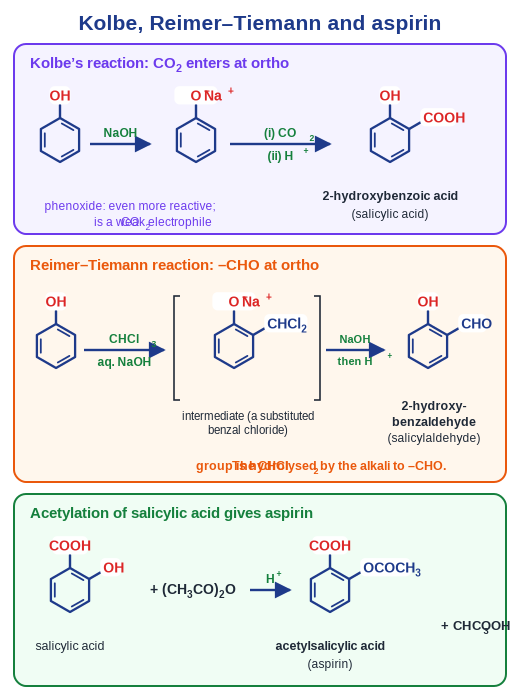
Putting a CH₃CO– (acetyl) group on an alcohol or phenol is acetylation. Acetylation of salicylic acid with acetic anhydride gives aspirin.
Breaking the C–O bond
With hydrogen halides: ROH + HX → RX + H₂O. The three classes react at very different speeds with HCl, which is the basis of the Lucas test. Alcohols dissolve in Lucas reagent (concentrated HCl with anhydrous ZnCl₂), but their chlorides do not, so a cloudiness appears as the chloride forms. A 3° alcohol turns cloudy at once; a 1° alcohol shows no cloudiness at room temperature. With phosphorus tribromide, alcohols give alkyl bromides.
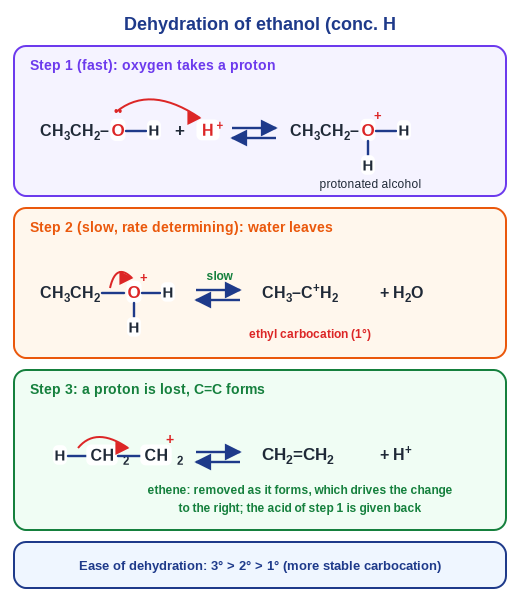
Dehydration. Concentrated H₂SO₄ or H₃PO₄, or anhydrous ZnCl₂ or alumina, removes a molecule of water and gives an alkene:
C₂H₅OH → CH₂=CH₂ + H₂O (conc. H₂SO₄, 443 K)
2° and 3° alcohols need milder conditions: propan-2-ol with 85% H₃PO₄ at 440 K, 2-methylpropan-2-ol with 20% H₃PO₄ at 358 K. The mechanism for ethanol:
- Protonation (fast): a lone pair on oxygen takes H⁺, giving the ethyl oxonium ion.
- Carbocation (slow, rate determining): water leaves, giving CH₃CH₂⁺.
- Alkene: a neighbouring C–H bond pair forms the C=C bond and H⁺ is lost.
The acid is given back in step 3, and ethene is removed as it forms to push the equilibrium forward. Because 3° carbocations are the most stable and form fastest, the ease of dehydration is 3° > 2° > 1°.
Oxidation
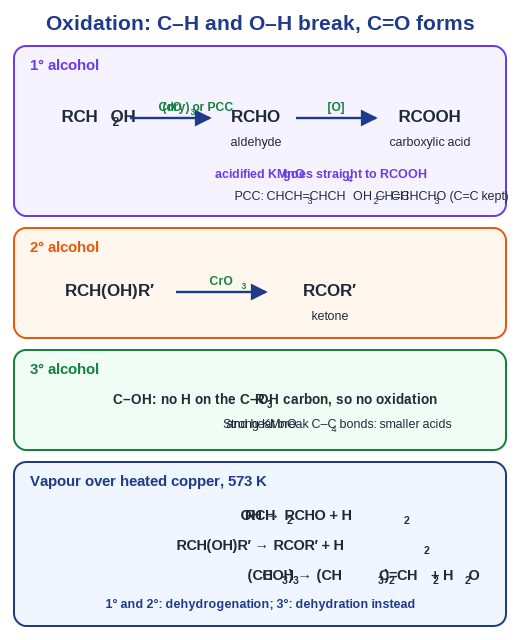
Oxidising an alcohol breaks one O–H and one C–H bond and makes a C=O bond, so it is also called dehydrogenation.
- 1° alcohols give aldehydes and then carboxylic acids. Acidified KMnO₄ goes straight to the acid. To stop at the aldehyde, the book uses CrO₃ in an anhydrous medium, or better pyridinium chlorochromate (PCC), which leaves a C=C bond untouched: CH₃CH=CHCH₂OH → CH₃CH=CHCHO (PCC).
- 2° alcohols give ketones with CrO₃.
- 3° alcohols are not oxidised under these conditions. Strong oxidising agents at high temperature break C–C bonds and give a mixture of smaller acids.
- Hot copper (573 K): vapours of 1° and 2° alcohols lose hydrogen, RCH₂OH → RCHO + H₂, while a 3° alcohol loses water, (CH₃)₃COH → (CH₃)₂C=CH₂ + H₂O.
Electrophilic substitution in phenol
The lone pair of the –OH oxygen is shared with the ring (the resonance structures of phenol), so the ortho and para carbons become rich in electrons. The ring is activated, and new groups go to ortho and para.
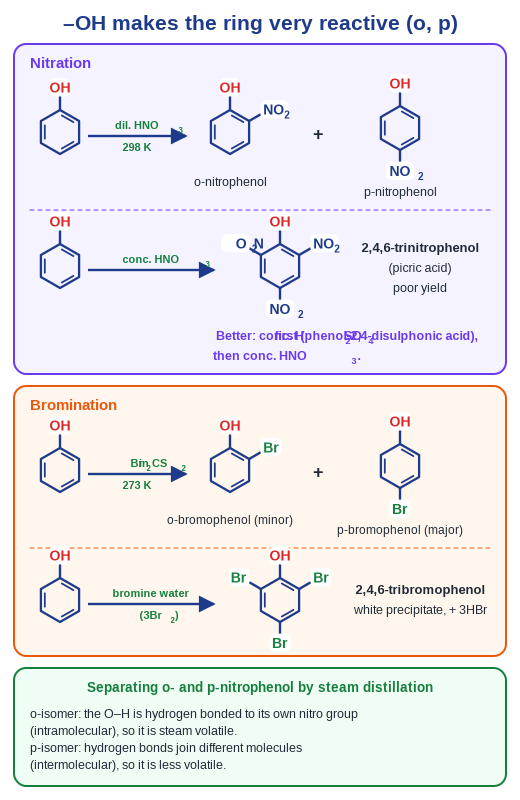
- Nitration. Dilute HNO₃ at 298 K gives a mixture of o- and p-nitrophenol. Concentrated HNO₃ gives 2,4,6-trinitrophenol (picric acid) in poor yield; a better route sulphonates phenol first, giving phenol-2,4-disulphonic acid, which is then nitrated.
- Bromination. In a solvent of low polarity (CHCl₃ or CS₂) at 273 K, bromine gives monobromophenols, mainly the para isomer. With bromine water a white precipitate of 2,4,6-tribromophenol forms at once: C₆H₅OH + 3Br₂ → C₆H₂Br₃OH + 3HBr. No Lewis acid is needed: the –OH group polarises the bromine molecule by itself.
Kolbe and Reimer–Tiemann reactions
- Kolbe’s reaction. NaOH turns phenol into phenoxide, and the phenoxide ion reacts with electrophiles even faster than phenol does. It reacts with carbon dioxide, a weak electrophile, and acid then gives 2-hydroxybenzoic acid (salicylic acid) as the main product.
- Reimer–Tiemann reaction. Phenol with chloroform and aqueous NaOH gives an intermediate with a –CHCl₂ group at the ortho position (a substituted benzal chloride). The alkali hydrolyses it to –CHO, and acid gives 2-hydroxybenzaldehyde (salicylaldehyde).
Two more reactions of phenol
- Zinc dust: heating phenol with zinc dust gives benzene, C₆H₅OH + Zn → C₆H₆ + ZnO.
- Oxidation: chromic acid (Na₂Cr₂O₇ with H₂SO₄) oxidises phenol to benzoquinone, a conjugated diketone. In air, phenols slowly darken as quinones form.
Lab safety
Concentrated acids, bromine, chloroform, picric acid and phenol are hazardous. These reactions are for understanding and the exam; any practical work is done only in the school laboratory with your teacher.
Back to the Chapter 7 notes, or practise with the NCERT solutions.
Practice
-
Which alcohol is dehydrated most easily?
Show answer
Answer: (d) 2-methylpropan-2-ol
-
PCC oxidises CH₃CH=CHCH₂OH to:
Show answer
Answer: (b) CH₃CH=CHCHO
-
Phenol with CHCl₃ and aqueous NaOH, then acid, gives:
Show answer
Answer: (b) salicylaldehyde
-
Which step is rate determining in the acid dehydration of ethanol, and why?
Show answer
Answer: Step 2, the loss of water from the protonated alcohol to give the carbocation CH₃CH₂⁺. It is the slowest step because a C–O bond breaks and a charged, unstable carbocation forms.
-
How can o- and p-nitrophenol be separated?
Show answer
Answer: By steam distillation. o-Nitrophenol has an intramolecular hydrogen bond between –OH and –NO₂, so its molecules do not stick together and it distils with steam. p-Nitrophenol molecules are joined by intermolecular hydrogen bonds and stay behind.
Questions students ask
What is the difference between O–H and C–O cleavage reactions?
When O–H breaks (acidity, esterification) the alcohol acts as a nucleophile and its oxygen stays on the product. When C–O breaks (with HX, in dehydration) the protonated alcohol acts as an electrophile and the –OH leaves as water. Phenols show C–O cleavage only with zinc.
Why is phenoxide more reactive than phenol towards electrophiles?
The negatively charged oxygen pushes even more electron density into the ring than a neutral –OH group. That is why sodium phenoxide reacts with carbon dioxide, a weak electrophile, in Kolbe’s reaction.
How is aspirin made from salicylic acid?
By acetylation. Salicylic acid reacts with acetic anhydride, (CH₃CO)₂O, with a little acid, and its –OH becomes –OCOCH₃. The product, acetylsalicylic acid, is aspirin, which the book notes relieves pain, inflammation and fever.
Stuck on a question?
Take a photo and Lagnever AI explains it step by step. Try it for 7 days for ₹2.
Get it on Google Play Open in browser
For parents: after the trial, the plan renews monthly by UPI or card autopay. You can cancel anytime in the app.