
Why are phenols more acidic than alcohols?
Answer in short
Alcohols and phenols both give up the proton of their O–H group. In phenol the oxygen sits on an sp² ring carbon, which pulls electrons away and makes O–H more polar, and the phenoxide ion is stabilised by resonance. So phenol (pKa 10.0) is about a million times more acidic than ethanol (pKa 15.9).
Stuck on a question? Take a photo and Lagnever AI explains it step by step. Try it for 7 days for ₹2. Get it on Google Play
What shows that they are acids?
The O–H bond of an alcohol or a phenol is polar, so the hydrogen can leave as a proton. Two kinds of reaction show this.
With active metals (sodium, potassium, aluminium), both give a salt and hydrogen:
2CH₃CH₂OH + 2Na → 2CH₃CH₂ONa + H₂ (sodium ethoxide)
6(CH₃)₃COH + 2Al → 2[(CH₃)₃CO]₃Al + 3H₂ (aluminium tert-butoxide)
2C₆H₅OH + 2Na → 2C₆H₅ONa + H₂ (sodium phenoxide)
With aqueous sodium hydroxide, only phenols react:
C₆H₅OH + NaOH → C₆H₅ONa + H₂O
This one difference already tells you that phenols are the stronger acids of the two, and in fact stronger than water. Both behave as Brönsted acids: they hand a proton to a stronger base.
How strong are alcohols?
Alkyl groups weaken the acid. Groups such as –CH₃ and –C₂H₅ push electrons towards the oxygen. The O–H bond becomes less polar, and the proton leaves less easily. The more alkyl groups on the carbon carrying –OH, the weaker the acid:
1° (RCH₂OH) > 2° (R₂CHOH) > 3° (R₃COH)
Alcohols are weaker acids than water. Put an alkoxide in water and it takes a proton:
CH₃CH₂O⁻ + H₂O → CH₃CH₂OH + OH⁻
Water is the better proton donor. Turned round, this means an alkoxide ion holds a proton more strongly than hydroxide does: sodium ethoxide is more basic than sodium hydroxide.
Alcohols are also weak bases. The two lone pairs on oxygen can take a proton, which is how an alcohol starts its dehydration in acid.
Why is phenol so much more acidic?
Compare the two ionisations: ROH ⇌ RO⁻ + H⁺ and C₆H₅OH ⇌ C₆H₅O⁻ + H⁺. Two effects favour phenol.
- The carbon is sp². The –OH of phenol is attached to an sp² carbon of the ring, which is more electronegative than an sp³ carbon. It draws electron density away from oxygen, so the O–H bond is more polar and ionises more.
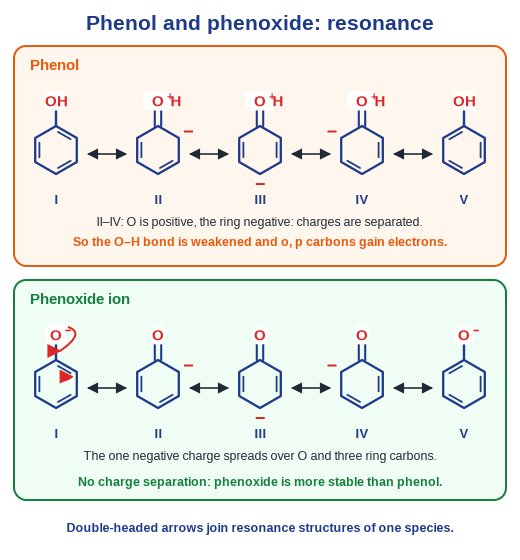
- The phenoxide ion is stabilised by resonance. In an alkoxide ion the negative charge stays on the oxygen. In the phenoxide ion it spreads over the oxygen and the two ortho and one para carbons (structures I to V). A charge spread out is a charge made stable.
Phenol itself also has resonance structures, but in them oxygen carries a positive charge and the ring a negative one. Separating charges costs energy, so these structures add little stability to phenol. The ion gains much more than the neutral molecule, and that pushes the ionisation forward.
How do substituents change the acidity of phenol?
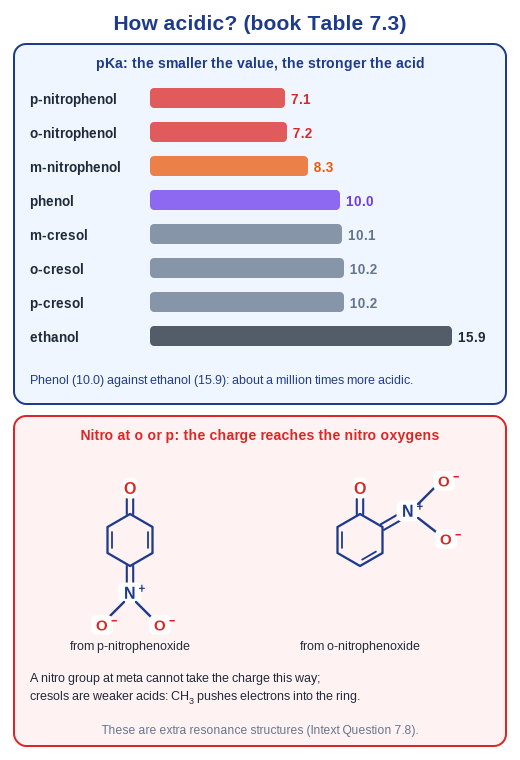
- Electron-withdrawing groups, such as –NO₂, make phenol more acidic. The effect is largest at the ortho and para positions, because there the negative charge of the anion can move by resonance onto the nitro group’s oxygens.
- Electron-releasing groups, such as –CH₃, make phenol less acidic. Cresols are weaker acids than phenol.
The book’s Table 7.3 lists the numbers (a smaller pKa means a stronger acid):
| Compound | pKa |
|---|---|
| p-nitrophenol | 7.1 |
| o-nitrophenol | 7.2 |
| m-nitrophenol | 8.3 |
| phenol | 10.0 |
| m-cresol | 10.1 |
| o-cresol, p-cresol | 10.2 |
| ethanol | 15.9 |
A difference of 5.9 pKa units means phenol ionises about 10⁵·⁹, roughly eight hundred thousand, times more than ethanol: the book rounds this to a million.
A worked order
The book’s Example 7.4 asks for the increasing order of acid strength of propan-1-ol, 2,4,6-trinitrophenol, 3-nitrophenol, 3,5-dinitrophenol, phenol and 4-methylphenol. Reason it step by step:
- The alcohol is weakest: no resonance in its anion.
- 4-Methylphenol is weaker than phenol: –CH₃ releases electrons.
- One nitro group, even at meta, makes the acid stronger than phenol; two make it stronger still.
- Three nitro groups, at 2, 4 and 6 (ortho and para), give the strongest acid.
Answer: propan-1-ol < 4-methylphenol < phenol < 3-nitrophenol < 3,5-dinitrophenol < 2,4,6-trinitrophenol.
Lab safety
Sodium reacts violently with water, and phenol and its nitro compounds burn the skin. Any reaction on this page is done only in the school laboratory with your teacher.
Back to the Chapter 7 notes, or see the NCERT solutions.
Practice
-
Which reacts with aqueous NaOH?
Show answer
Answer: (b) phenol
-
Which order of acid strength is right?
Show answer
Answer: (b) CH₃CH₂OH > (CH₃)₂CHOH > (CH₃)₃COH
-
Which phenol has the largest pKa?
Show answer
Answer: (c) p-cresol
-
Show by an equation that ethanol is a weaker acid than water.
Show answer
Answer: CH₃CH₂O⁻ + H₂O → CH₃CH₂OH + OH⁻. The ethoxide ion takes a proton from water, so water is the better proton donor (the stronger acid) and ethoxide the stronger base.
-
Why is 2,4,6-trinitrophenol a strong acid?
Show answer
Answer: It has three electron-withdrawing –NO₂ groups, two at ortho and one at para. Each pulls electron density from the ring and helps spread the negative charge of the anion, so the proton leaves very easily.
Questions students ask
Are alcohols acids or bases?
Both, weakly. The polar O–H bond lets them give a proton to a stronger base (Brönsted acid), and the lone pairs on oxygen let them take a proton (Brönsted base), as in the protonated alcohol of dehydration.
Why does a nitro group at ortho or para raise acidity more than at meta?
At ortho and para the negative charge of the phenoxide ion can move by resonance onto the nitro group’s oxygen atoms, which spreads it further. At meta that path does not exist, and only the weaker inductive pull remains.
Why are cresols weaker acids than phenol?
The methyl group releases electrons into the ring. This works against the spreading of the negative charge in the anion, so the cresoxide ion is less stable than phenoxide and the proton is held a little more firmly.
Stuck on a question?
Take a photo and Lagnever AI explains it step by step. Try it for 7 days for ₹2.
Get it on Google Play Open in browser
For parents: after the trial, the plan renews monthly by UPI or card autopay. You can cancel anytime in the app.