
How are alcohols and phenols prepared?
Answer in short
Alcohols come from alkenes (acid-catalysed hydration by Markovnikov’s rule, or hydroboration–oxidation), from reduction of aldehydes, ketones, acids and esters, and from Grignard reagents with carbonyl compounds. Phenol is made from chlorobenzene, benzenesulphonic acid or a diazonium salt in the laboratory, and from cumene in industry.
Stuck on a question? Take a photo and Lagnever AI explains it step by step. Try it for 7 days for ₹2. Get it on Google Play
From alkenes
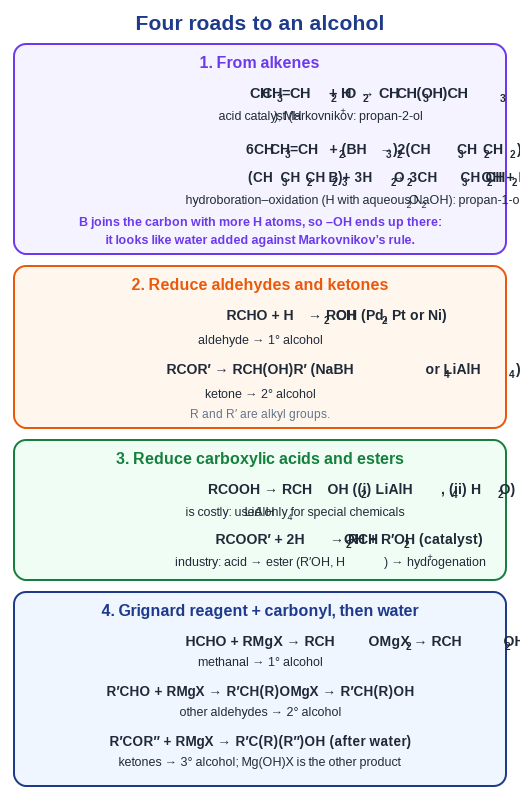
Acid-catalysed hydration. An alkene adds water in the presence of an acid catalyst. With an unsymmetrical alkene the hydrogen goes to the doubly bonded carbon that already has more hydrogen atoms, and the –OH to the other one (Markovnikov’s rule):
CH₃CH=CH₂ + H₂O → CH₃CH(OH)CH₃ (propan-2-ol)
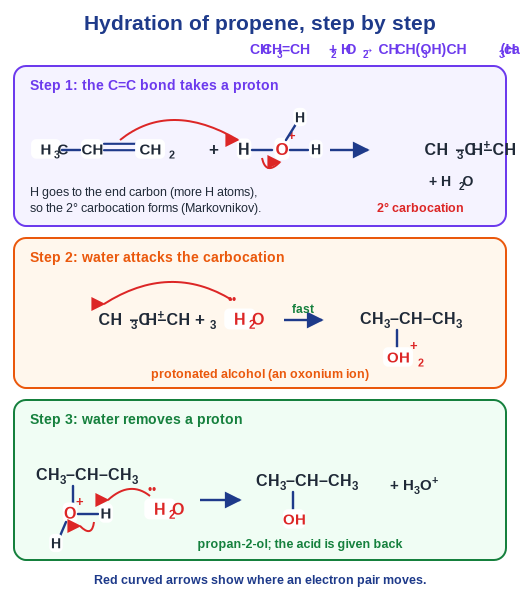
The mechanism takes three steps:
- The π electrons of the alkene take a proton from H₃O⁺, which forms from H₂O + H⁺ → H₃O⁺. The more stable carbocation forms: here the 2° ion CH₃C⁺HCH₃.
- A lone pair of a water molecule attacks the positive carbon, giving a protonated alcohol.
- Another water molecule removes a proton, giving the alcohol and giving back H₃O⁺.
Hydroboration–oxidation. Diborane adds to the alkene so that boron joins the carbon with more hydrogens. Three propene molecules end up on each boron, and hydrogen peroxide in aqueous NaOH replaces each C–B bond by C–OH:
6CH₃CH=CH₂ + (BH₃)₂ → 2(CH₃CH₂CH₂)₃B
(CH₃CH₂CH₂)₃B + 3H₂O₂ → 3CH₃CH₂CH₂OH + B(OH)₃
The product, propan-1-ol, looks as if water had added against Markovnikov’s rule, and the yield is excellent. So one alkene gives two different alcohols depending on the method.
From carbonyl compounds
Aldehydes and ketones take up hydrogen over a finely divided metal (Pt, Pd or Ni), or react with sodium borohydride or lithium aluminium hydride:
RCHO + H₂ → RCH₂OH aldehyde → 1° alcohol
RCOR′ + H₂ → RCH(OH)R′ ketone → 2° alcohol
LiAlH₄ (then water) turns carboxylic acids into primary alcohols, with excellent yield: RCOOH → RCH₂OH. Because LiAlH₄ is expensive, industry first makes an ester with an alcohol and a little acid, then hydrogenates the ester over a catalyst, which gives back the alcohol used as well:
RCOOR′ + 2H₂ → RCH₂OH + R′OH
From Grignard reagents
The carbon of RMgX is electron-rich. It adds to the δ+ carbon of a carbonyl group, giving an adduct, R–C–OMgX; water then frees the alcohol and leaves Mg(OH)X. The type of alcohol depends on the carbonyl compound:
- Methanal gives a primary alcohol: HCHO + CH₃MgBr → CH₃CH₂OMgBr, then water gives ethanol.
- Any other aldehyde gives a secondary alcohol: CH₃CHO + CH₃MgBr → (CH₃)₂CHOMgBr, then water gives propan-2-ol.
- A ketone gives a tertiary alcohol: CH₃COCH₃ + CH₃MgBr → (CH₃)₃COMgBr, then water gives 2-methylpropan-2-ol.
The water step for the last one: (CH₃)₃COMgBr + H₂O → (CH₃)₃COH + Mg(OH)Br.
Preparation of phenol
Phenol, also called carbolic acid, was first obtained from coal tar early in the nineteenth century. Today it is made synthetically.
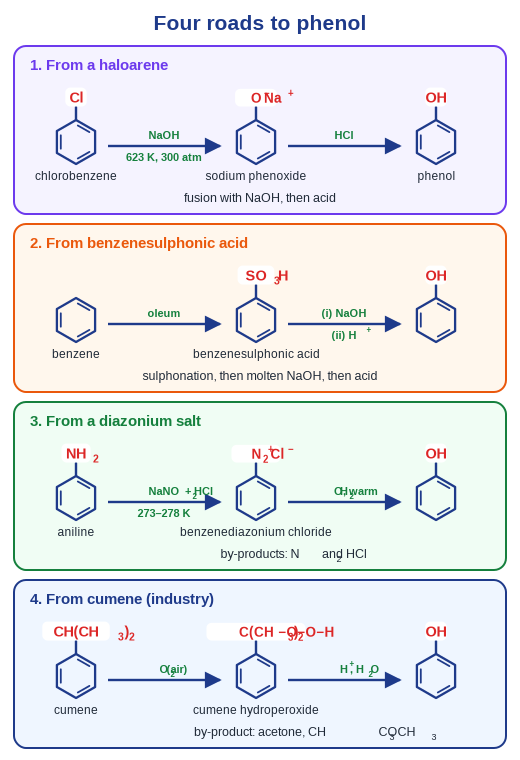
- From a haloarene. Chlorobenzene is fused with NaOH at 623 K and high pressure (the book’s scheme shows 300 atm; its text says 320 atm). Sodium phenoxide forms, and acid gives phenol: C₆H₅ONa + HCl → C₆H₅OH + NaCl.
- From benzenesulphonic acid. Oleum sulphonates benzene. The sulphonic acid is heated with molten NaOH to give sodium phenoxide, and acid gives phenol.
- From a diazonium salt. Aniline treated with NaNO₂ and HCl (that is, nitrous acid) at 273–278 K gives benzenediazonium chloride, which warm water hydrolyses: C₆H₅N₂Cl + H₂O → C₆H₅OH + N₂ + HCl.
- From cumene (industry). Air oxidises cumene to cumene hydroperoxide, C₆H₅CH(CH₃)₂ + O₂ → C₆H₅C(CH₃)₂OOH, and dilute acid splits it: C₆H₅C(CH₃)₂OOH → C₆H₅OH + CH₃COCH₃. Most of the world’s phenol is made this way, with acetone as a valuable by-product.
Lab safety
Diborane, sodium, Grignard reagents, phenol and concentrated acids are dangerous. These reactions are for understanding and the exam; any practical work is done only in the school laboratory with your teacher.
Back to the Chapter 7 notes, or practise with the NCERT solutions.
Practice
-
Which reagent turns but-1-ene into butan-1-ol?
Show answer
Answer: (b) B₂H₆, then H₂O₂ with NaOH
-
Propanone with CH₃MgBr, followed by water, gives:
Show answer
Answer: (c) 2-methylpropan-2-ol
-
The by-product in the cumene process for phenol is:
Show answer
Answer: (a) acetone
-
Write the Grignard reagent and carbonyl compound needed for 2-methylpropan-1-ol.
Show answer
Answer: (CH₃)₂CHMgBr and HCHO. Methanal always gives a primary alcohol RCH₂OH; here R is the isopropyl group: (CH₃)₂CHMgBr + HCHO → (CH₃)₂CHCH₂OMgBr, and water gives (CH₃)₂CHCH₂OH.
-
Why is LiAlH₄ not used to make alcohols from acids in industry?
Show answer
Answer: It is an expensive reagent, so it is kept for special chemicals. Industry converts the acid into an ester with an alcohol and acid, then reduces the ester with hydrogen over a catalyst.
Questions students ask
What is hydroboration–oxidation?
Diborane, (BH₃)₂, adds to the C=C bond with boron going to the carbon that has more hydrogens. Three alkene molecules add to each boron to give a trialkylborane, which hydrogen peroxide in aqueous NaOH oxidises to the alcohol and boric acid. H. C. Brown first reported it in 1959.
Why do ketones give secondary alcohols on reduction?
The carbonyl carbon of a ketone already carries two carbon groups. Adding H to it and H to the oxygen leaves a carbon with two carbon groups, one H and –OH, which is a secondary alcohol.
Which method makes most of the world’s phenol?
The cumene process. Cumene (isopropylbenzene) is oxidised by air to cumene hydroperoxide, and dilute acid splits that into phenol and acetone. The acetone is a useful by-product.
Stuck on a question?
Take a photo and Lagnever AI explains it step by step. Try it for 7 days for ₹2.
Get it on Google Play Open in browser
For parents: after the trial, the plan renews monthly by UPI or card autopay. You can cancel anytime in the app.