
NCERT Solutions Class 12 Chemistry Chapter 8: Aldehydes, Ketones and Carboxylic Acids
Answers to all 20 end-of-unit exercises, all 8 Intext Questions and all 5 worked examples of Unit 8, Aldehydes, Ketones and Carboxylic Acids, of Chemistry Part II, the Class 12 NCERT textbook. Page numbers follow the 2026-27 reprint (pages 227–258). The exercises come first, quoted from the book; the Intext Questions and the examples follow, restated in short. Short notes: Chapter 8 notes.
How the answers were checked. Every equation was checked atom by atom and charge by charge with a script. Every IUPAC name was checked twice against its structure: the longest chain, the lowest locants, alphabetical order, and the molecular formula worked out from both the name and the structure. Our answers were compared with the Answers section at the back of Part II (pages 304–305) and with the answers to the Intext Questions printed on pages 257–258; where they differ, the notes say so.
How structures are written. Condensed formulas: a group in brackets hangs from the carbon written just before it, so CH₃CH(OH)CN has –OH and –CN on the second carbon. C₆H₅– (Ph) is phenyl, C₆H₁₁– is cyclohexyl, C₆H₄ is a benzene ring with two substituents, and o-, m-, p- mark 1,2-, 1,3- and 1,4- positions. Where the book draws a structure, the question shows it in words or as a condensed formula.
Stay safe. Several reactions here use HCN or cyanides, concentrated acids, chromium(VI) reagents, bromine or heat. They are described for the exam only; any practical work or test is done in the school laboratory with your teacher, never at home.
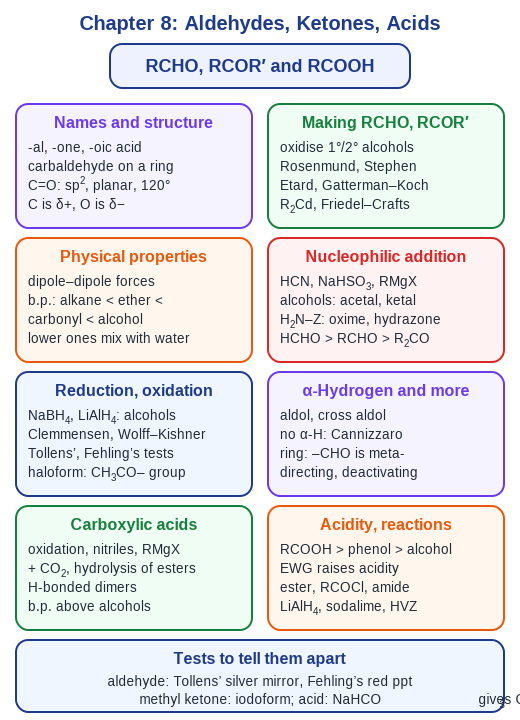
Exercises 8.1 to 8.6: terms, names and structures
8.1 “What is meant by the following terms ? Give an example of the reaction in each case. (i) Cyanohydrin (ii) Acetal (iii) Semicarbazone (iv) Aldol (v) Hemiacetal (vi) Oxime (vii) Ketal (vii) Imine (ix) 2,4-DNP-derivative (x) Schiff’s base” (The book numbers Imine “(vii)” a second time; it is the eighth term.)
- (i) Cyanohydrin: a compound with –OH and –CN on the same carbon, made by adding HCN (with a little base) to an aldehyde or ketone. CH₃CHO + HCN → CH₃CH(OH)CN (2-hydroxypropanenitrile).
- (ii) Acetal: a gem-dialkoxy compound, RCH(OR′)₂, from an aldehyde and two molecules of an alcohol in dry HCl. CH₃CHO + 2C₂H₅OH ⇌ CH₃CH(OC₂H₅)₂ + H₂O (1,1-diethoxyethane).
- (iii) Semicarbazone: the product >C=N–NHCONH₂ of a carbonyl compound and semicarbazide in weak acid. CH₃COCH₃ + H₂NNHCONH₂ → (CH₃)₂C=NNHCONH₂ + H₂O (propanone semicarbazone).
- (iv) Aldol: a β-hydroxy aldehyde (or β-hydroxy ketone, a ketol) formed when an aldehyde with an α-hydrogen reacts with dilute alkali. 2CH₃CHO → CH₃CH(OH)CH₂CHO (3-hydroxybutanal).
- (v) Hemiacetal: an alkoxyalcohol, RCH(OH)OR′, from an aldehyde and one molecule of an alcohol in dry HCl. CH₃CHO + C₂H₅OH ⇌ CH₃CH(OH)OC₂H₅ (1-ethoxyethanol).
- (vi) Oxime: the product >C=N–OH of a carbonyl compound and hydroxylamine. CH₃CHO + NH₂OH → CH₃CH=NOH + H₂O (ethanal oxime).
- (vii) Ketal: the ketone counterpart of an acetal; with ethylene glycol a ketone gives a cyclic ketal. (CH₃)₂CO + HOCH₂CH₂OH ⇌ (CH₃)₂C(OCH₂CH₂O) + H₂O, where (OCH₂CH₂O) closes a five-membered ring with the carbon (2,2-dimethyl-1,3-dioxolane).
- (viii) Imine: a compound with >C=NH, from a carbonyl compound and ammonia. CH₃CHO + NH₃ → CH₃CH=NH + H₂O (ethanimine).
- (ix) 2,4-DNP derivative: the 2,4-dinitrophenylhydrazone, >C=N–NHC₆H₃(NO₂)₂, a yellow, orange or red solid used to identify aldehydes and ketones. CH₃CHO + H₂NNHC₆H₃(NO₂)₂ → CH₃CH=NNHC₆H₃(NO₂)₂ + H₂O.
- (x) Schiff’s base: a substituted imine, >C=N–R, from a carbonyl compound and a primary amine. CH₃CHO + CH₃NH₂ → CH₃CH=NCH₃ + H₂O (N-methylethanimine).
8.2 “Name the following compounds according to IUPAC system of nomenclature: (i) CH₃CH(CH₃)CH₂CH₂CHO (ii) CH₃CH₂COCH(C₂H₅)CH₂CH₂Cl (iii) CH₃CH=CHCHO (iv) CH₃COCH₂COCH₃ (v) CH₃CH(CH₃)CH₂C(CH₃)₂COCH₃ (vi) (CH₃)₃CCH₂COOH (vii) OHCC₆H₄CHO-p”
| IUPAC name | Reason | |
|---|---|---|
| (i) | 4-methylpentanal | CHO carbon is C-1; the methyl is on C-4 |
| (ii) | 6-chloro-4-ethylhexan-3-one | six-carbon chain through the CH₂CH₂Cl; numbering from the ethyl end of the ketone gives C=O the locant 3 |
| (iii) | but-2-enal | C=C between C-2 and C-3 |
| (iv) | pentane-2,4-dione | two C=O groups; the e of pentane stays before dione |
| (v) | 3,3,5-trimethylhexan-2-one | numbering from the CH₃CO end gives C=O the locant 2 |
| (vi) | 3,3-dimethylbutanoic acid | COOH carbon is C-1 |
| (vii) | benzene-1,4-dicarbaldehyde | two –CHO groups para on a ring |
All seven agree with the book’s answer key.
8.3 “Draw the structures of the following compounds. (i) 3-Methylbutanal (ii) p-Nitropropiophenone (iii) p-Methylbenzaldehyde (iv) 4-Methylpent-3-en-2-one (v) 4-Chloropentan-2-one (vi) 3-Bromo-4-phenylpentanoic acid (vii) p,p’-Dihydroxybenzophenone (viii) Hex-2-en-4-ynoic acid”
| Structure | |
|---|---|
| (i) | (CH₃)₂CHCH₂CHO |
| (ii) | O₂N–C₆H₄–COCH₂CH₃, with –NO₂ para to the ketone group |
| (iii) | CH₃–C₆H₄–CHO, with –CH₃ para to –CHO |
| (iv) | (CH₃)₂C=CHCOCH₃ |
| (v) | CH₃COCH₂CH(Cl)CH₃ |
| (vi) | CH₃CH(C₆H₅)CH(Br)CH₂COOH |
| (vii) | HO–C₆H₄–CO–C₆H₄–OH, each –OH para to the C=O |
| (viii) | CH₃C≡CCH=CHCOOH |
All eight match the structures in the book’s answer key.
8.4 “Write the IUPAC names of the following ketones and aldehydes. Wherever possible, give also common names. (i) CH₃CO(CH₂)₄CH₃ (ii) CH₃CH₂CHBrCH₂CH(CH₃)CHO (iii) CH₃(CH₂)₅CHO (iv) Ph-CH=CH-CHO (v) [the book draws a cyclopentane ring carrying –CHO] (vi) PhCOPh”
| IUPAC name | Common name | |
|---|---|---|
| (i) | heptan-2-one | methyl n-pentyl ketone |
| (ii) | 4-bromo-2-methylhexanal | γ-bromo-α-methylcaproaldehyde (Extra) |
| (iii) | heptanal | n-heptaldehyde (Extra) |
| (iv) | 3-phenylprop-2-enal | cinnamaldehyde |
| (v) | cyclopentanecarbaldehyde | none in common use |
| (vi) | diphenylmethanone | benzophenone |
The IUPAC names agree with the answer key, which gives no common names. Methyl n-pentyl ketone follows the book’s rule (name the two groups); cinnamaldehyde and benzophenone are the book’s own names. The two marked Extra come from the acids caproic (hexanoic) and heptanoic acid by the book’s rule and are not printed in the book.
8.5 “Draw structures of the following derivatives. (i) The 2,4-dinitrophenylhydrazone of benzaldehyde (ii) Cyclopropanone oxime (iii) Acetaldehydedimethylacetal (iv) The semicarbazone of cyclobutanone (v) The ethylene ketal of hexan-3-one (vi) The methyl hemiacetal of formaldehyde”
| Structure | |
|---|---|
| (i) | C₆H₅CH=N–NH–C₆H₃(NO₂)₂, the nitro groups at positions 2 and 4 of the second ring |
| (ii) | a three-membered ring of two CH₂ groups and one carbon carrying =N–OH: (CH₂)₂C=NOH |
| (iii) | CH₃CH(OCH₃)₂ |
| (iv) | a four-membered ring of three CH₂ groups and one carbon carrying =N–NHCONH₂: (CH₂)₃C=NNHCONH₂ |
| (v) | CH₃CH₂C(OCH₂CH₂O)CH₂CH₂CH₃: C-3 of hexane joined to both oxygens of –OCH₂CH₂O–, a five-membered ring |
| (vi) | HOCH₂OCH₃, that is H₂C(OH)(OCH₃) |
All six match the answer key.
8.6 “Predict the products formed when cyclohexanecarbaldehyde reacts with following reagents. (i) PhMgBr and then H₃O⁺ (ii) Tollens’ reagent (iii) Semicarbazide and weak acid (iv) Excess ethanol and acid (v) Zinc amalgam and dilute hydrochloric acid” Cyclohexanecarbaldehyde is C₆H₁₁CHO.
- (i) Addition of the Grignard reagent, then hydrolysis: C₆H₁₁CH(OH)C₆H₅, cyclohexyl(phenyl)methanol, a 2° alcohol.
- (ii) Oxidation: cyclohexanecarboxylate ion, C₆H₁₁COO⁻, and a silver mirror. C₆H₁₁CHO + 2[Ag(NH₃)₂]⁺ + 3OH⁻ → C₆H₁₁COO⁻ + 2Ag + 2H₂O + 4NH₃
- (iii) C₆H₁₁CHO + H₂NNHCONH₂ → C₆H₁₁CH=NNHCONH₂ + H₂O, the semicarbazone.
- (iv) C₆H₁₁CHO + 2C₂H₅OH ⇌ C₆H₁₁CH(OC₂H₅)₂ + H₂O, the diethyl acetal (diethoxymethyl)cyclohexane.
- (v) The CHO group becomes CH₃: methylcyclohexane, C₆H₁₁CH₃ (Clemmensen reduction; the book’s text uses concentrated HCl for this reduction).
All five match the answer key.
Exercises 8.7 to 8.11: aldol, Cannizzaro and identification
8.7 “Which of the following compounds would undergo aldol condensation, which the Cannizzaro reaction and which neither? Write the structures of the expected products of aldol condensation and Cannizzaro reaction. (i) Methanal (ii) 2-Methylpentanal (iii) Benzaldehyde (iv) Benzophenone (v) Cyclohexanone (vi) 1-Phenylpropanone (vii) Phenylacetaldehyde (viii) Butan-1-ol (ix) 2,2-Dimethylbutanal”
The rule: an aldehyde or ketone with an α-hydrogen gives the aldol reaction; an aldehyde without one gives the Cannizzaro reaction.
Aldol condensation: (ii), (v), (vi), (vii).
- (ii) 2-Methylpentanal, CH₃CH₂CH₂CH(CH₃)CHO, has one α-hydrogen. Aldol: CH₃CH₂CH₂CH(CH₃)CH(OH)C(CH₃)(CH₂CH₂CH₃)CHO, 3-hydroxy-2,4-dimethyl-2-propylheptanal (C₁₂H₂₄O₂). Its α-carbon now has no hydrogen, so it cannot lose water to give a C=C conjugated with CHO.
- (v) Cyclohexanone: aldol 2-(1-hydroxycyclohexyl)cyclohexan-1-one (C₁₂H₂₀O₂); on heating it loses water to give 2-cyclohexylidenecyclohexan-1-one (C₁₂H₁₈O).
- (vi) 1-Phenylpropanone (propiophenone), C₆H₅COCH₂CH₃: aldol C₆H₅COCH(CH₃)C(OH)(C₂H₅)C₆H₅, 3-hydroxy-2-methyl-1,3-diphenylpentan-1-one; dehydration gives C₆H₅COC(CH₃)=C(C₂H₅)C₆H₅, 2-methyl-1,3-diphenylpent-2-en-1-one.
- (vii) Phenylacetaldehyde, C₆H₅CH₂CHO: aldol C₆H₅CH₂CH(OH)CH(C₆H₅)CHO, 3-hydroxy-2,4-diphenylbutanal; dehydration gives C₆H₅CH₂CH=C(C₆H₅)CHO, 2,4-diphenylbut-2-enal.
Cannizzaro reaction: (i), (iii), (ix).
- (i) 2HCHO + NaOH → CH₃OH + HCOONa: methanol and sodium methanoate.
- (iii) 2C₆H₅CHO + NaOH → C₆H₅CH₂OH + C₆H₅COONa: benzyl alcohol and sodium benzoate.
- (ix) 2,2-Dimethylbutanal has no α-hydrogen: 2CH₃CH₂C(CH₃)₂CHO + NaOH → CH₃CH₂C(CH₃)₂CH₂OH + CH₃CH₂C(CH₃)₂COONa: 2,2-dimethylbutan-1-ol and sodium 2,2-dimethylbutanoate.
Neither: (iv), (viii). Benzophenone is a ketone with no α-hydrogen, and the Cannizzaro reaction is for aldehydes. Butan-1-ol is not a carbonyl compound.
The classification agrees with the answer key, which does not draw the products.
8.8 “How will you convert ethanal into the following compounds? (i) Butane-1,3-diol (ii) But-2-enal (iii) But-2-enoic acid”
- (i) Aldol reaction with dilute NaOH, then reduction of the CHO with NaBH₄: 2CH₃CHO → CH₃CH(OH)CH₂CHO, then CH₃CH(OH)CH₂CHO → CH₃CH(OH)CH₂CH₂OH (butane-1,3-diol).
- (ii) Aldol reaction, then heat: CH₃CH(OH)CH₂CHO → CH₃CH=CHCHO + H₂O (but-2-enal).
- (iii) Make but-2-enal as in (ii), then oxidise it with Tollens’ reagent, a mild oxidant that leaves the C=C alone, and acidify: CH₃CH=CHCHO → CH₃CH=CHCOOH (but-2-enoic acid).
8.9 “Write structural formulas and names of four possible aldol condensation products from propanal and butanal. In each case, indicate which aldehyde acts as nucleophile and which as electrophile.”
The nucleophile is the carbanion (enolate) of one aldehyde; the electrophile is the C=O carbon of the other. The aldol (β-hydroxy aldehyde) forms first and loses water on heating.
| Nucleophile (enolate of) | Electrophile | Aldol | After loss of water |
|---|---|---|---|
| propanal | propanal | CH₃CH₂CH(OH)CH(CH₃)CHO, 3-hydroxy-2-methylpentanal | CH₃CH₂CH=C(CH₃)CHO, 2-methylpent-2-enal |
| butanal | butanal | CH₃CH₂CH₂CH(OH)CH(C₂H₅)CHO, 2-ethyl-3-hydroxyhexanal | CH₃CH₂CH₂CH=C(C₂H₅)CHO, 2-ethylhex-2-enal |
| propanal | butanal | CH₃CH₂CH₂CH(OH)CH(CH₃)CHO, 3-hydroxy-2-methylhexanal | CH₃CH₂CH₂CH=C(CH₃)CHO, 2-methylhex-2-enal |
| butanal | propanal | CH₃CH₂CH(OH)CH(C₂H₅)CHO, 2-ethyl-3-hydroxypentanal | CH₃CH₂CH=C(C₂H₅)CHO, 2-ethylpent-2-enal |
The first two are self (simple) aldol products, the last two cross aldol products.
8.10 “An organic compound with the molecular formula C₉H₁₀O forms 2,4-DNP derivative, reduces Tollens’ reagent and undergoes Cannizzaro reaction. On vigorous oxidation, it gives 1,2-benzenedicarboxylic acid. Identify the compound.”
- A 2,4-DNP derivative: an aldehyde or ketone. Reduces Tollens’ reagent: an aldehyde.
- Cannizzaro reaction: no α-hydrogen, so the –CHO is on a ring carbon.
- Vigorous oxidation gives benzene-1,2-dicarboxylic acid: a benzene ring with two side chains at 1,2.
- C₉H₁₀O minus C₆H₄ (ring) minus CHO leaves C₂H₅.
The compound is 2-ethylbenzaldehyde, C₂H₅–C₆H₄–CHO with the groups ortho, as in the answer key. Its Cannizzaro reaction: 2C₂H₅C₆H₄CHO + NaOH → C₂H₅C₆H₄CH₂OH + C₂H₅C₆H₄COONa. On vigorous oxidation (KMnO₄) both side chains become –COOH.
8.11 “An organic compound (A) (molecular formula C₈H₁₆O₂) was hydrolysed with dilute sulphuric acid to give a carboxylic acid (B) and an alcohol (C). Oxidation of (C) with chromic acid produced (B). (C) on dehydration gives but-1-ene. Write equations for the reactions involved.”
(C) gives but-1-ene on dehydration, so it is butan-1-ol. Oxidising it gives an acid with the same four carbons, so (B) is butanoic acid. (A) is their ester, butyl butanoate, C₈H₁₆O₂, as in the answer key.
CH₃CH₂CH₂COOCH₂CH₂CH₂CH₃ + H₂O ⇌ CH₃CH₂CH₂COOH + CH₃CH₂CH₂CH₂OH (dil. H₂SO₄)
CH₃CH₂CH₂CH₂OH + 2[O] → CH₃CH₂CH₂COOH + H₂O (chromic acid)
CH₃CH₂CH₂CH₂OH → CH₃CH₂CH=CH₂ + H₂O (conc. H₂SO₄, heat)
Exercises 8.12 to 8.16: orders, tests and conversions
8.12 “Arrange the following compounds in increasing order of their property as indicated: (i) Acetaldehyde, Acetone, Di-tert-butyl ketone, Methyl tert-butyl ketone (reactivity towards HCN) (ii) CH₃CH₂CH(Br)COOH, CH₃CH(Br)CH₂COOH, (CH₃)₂CHCOOH, CH₃CH₂CH₂COOH (acid strength) (iii) Benzoic acid, 4-Nitrobenzoic acid, 3,4-Dinitrobenzoic acid, 4-Methoxybenzoic acid (acid strength)”
- (i) Di-tert-butyl ketone < methyl tert-butyl ketone < acetone < acetaldehyde. Bulky groups crowd the carbonyl carbon and release electrons; two tert-butyl groups do this most, an aldehyde least.
- (ii) (CH₃)₂CHCOOH < CH₃CH₂CH₂COOH < CH₃CH(Br)CH₂COOH < CH₃CH₂CH(Br)COOH. Without Br, the branched acid has more electron release at the α-carbon and is weaker. Br withdraws electrons; its effect is larger at the α-carbon than at the β-carbon.
- (iii) 4-Methoxybenzoic acid < benzoic acid < 4-nitrobenzoic acid < 3,4-dinitrobenzoic acid. –OCH₃ donates electrons (pKa 4.46 against 4.19 for benzoic acid); one –NO₂ withdraws them (3.41); two withdraw more.
All three agree with the answer key.
8.13 “Give simple chemical tests to distinguish between the following pairs of compounds. (i) Propanal and Propanone (ii) Acetophenone and Benzophenone (iii) Phenol and Benzoic acid (iv) Benzoic acid and Ethyl benzoate (v) Pentan-2-one and Pentan-3-one (vi) Benzaldehyde and Acetophenone (vii) Ethanal and Propanal” (All tests: in the school laboratory with your teacher.)
| Test | Positive | Negative | |
|---|---|---|---|
| (i) | warm with Tollens’ reagent | propanal: silver mirror | propanone: none |
| (ii) | iodoform test (I₂ + NaOH, warm) | acetophenone: yellow CHI₃ | benzophenone: none |
| (iii) | add NaHCO₃ solution | benzoic acid: CO₂ bubbles | phenol: none |
| (iv) | add NaHCO₃ solution | benzoic acid: CO₂ bubbles | ethyl benzoate: none |
| (v) | iodoform test | pentan-2-one: yellow CHI₃ | pentan-3-one: none |
| (vi) | warm with Tollens’ reagent | benzaldehyde: silver mirror | acetophenone: none |
| (vii) | iodoform test | ethanal: yellow CHI₃ | propanal: none |
Equations:
- (i) CH₃CH₂CHO + 2[Ag(NH₃)₂]⁺ + 3OH⁻ → CH₃CH₂COO⁻ + 2Ag + 2H₂O + 4NH₃
- (ii) C₆H₅COCH₃ + 3NaOI → C₆H₅COONa + CHI₃ + 2NaOH
- (iii), (iv) C₆H₅COOH + NaHCO₃ → C₆H₅COONa + H₂O + CO₂
- (v) CH₃COCH₂CH₂CH₃ + 3NaOI → CH₃CH₂CH₂COONa + CHI₃ + 2NaOH
- (vii) CH₃CHO + 3NaOI → HCOONa + CHI₃ + 2NaOH
In (vi) the iodoform test also works (acetophenone positive). Fehling’s test is not used for benzaldehyde, because aromatic aldehydes do not respond to it.
8.14 “How will you prepare the following compounds from benzene? You may use any inorganic reagent and any organic reagent having not more than one carbon atom (i) Methyl benzoate (ii) m-Nitrobenzoic acid (iii) p-Nitrobenzoic acid (iv) Phenylacetic acid (v) p-Nitrobenzaldehyde.”
Every route starts by making toluene with chloromethane (one carbon) by Friedel–Crafts alkylation: C₆H₆ + CH₃Cl → C₆H₅CH₃ + HCl (anhydrous AlCl₃).
- (i) Toluene → benzoic acid (KMnO₄–KOH, heat; then H₃O⁺) → ester with methanol: C₆H₅COOH + CH₃OH ⇌ C₆H₅COOCH₃ + H₂O (conc. H₂SO₄).
- (ii) Toluene → benzoic acid → nitration with conc. HNO₃ + conc. H₂SO₄; –COOH is meta-directing: C₆H₅COOH + HNO₃ → O₂NC₆H₄COOH + H₂O (m-isomer).
- (iii) Nitrate toluene first (–CH₃ is o, p-directing) and separate the p-isomer: C₆H₅CH₃ + HNO₃ → O₂NC₆H₄CH₃ + H₂O; then oxidise the –CH₃ with KMnO₄–KOH and acidify, giving p-nitrobenzoic acid.
- (iv) Toluene → benzyl chloride (Cl₂, light): C₆H₅CH₃ + Cl₂ → C₆H₅CH₂Cl + HCl; → benzyl cyanide: C₆H₅CH₂Cl + KCN → C₆H₅CH₂CN + KCl; → hydrolysis: C₆H₅CH₂CN + 2H₂O + HCl → C₆H₅CH₂COOH + NH₄Cl.
- (v) Nitrate toluene and separate p-nitrotoluene (as in (iii)); then the Etard reaction (CrO₂Cl₂ in CS₂, then H₃O⁺), which stops at the aldehyde: p-nitrobenzaldehyde.
8.15 “How will you bring about the following conversions in not more than two steps? (i) Propanone to Propene (ii) Benzoic acid to Benzaldehyde (iii) Ethanol to 3-Hydroxybutanal (iv) Benzene to m-Nitroacetophenone (v) Benzaldehyde to Benzophenone (vi) Bromobenzene to 1-Phenylethanol (vii) Benzaldehyde to 3-Phenylpropan-1-ol (viii) Benazaldehyde to α-Hydroxyphenylacetic acid (ix) Benzoic acid to m- Nitrobenzyl alcohol” (“Benazaldehyde” in (viii) is a misprint for benzaldehyde.)
- (i) Reduce with NaBH₄ to propan-2-ol, then dehydrate with conc. H₂SO₄ on heating: CH₃COCH₃ → CH₃CH(OH)CH₃; CH₃CH(OH)CH₃ → CH₃CH=CH₂ + H₂O.
- (ii) SOCl₂, then Rosenmund reduction: C₆H₅COOH + SOCl₂ → C₆H₅COCl + SO₂ + HCl; C₆H₅COCl + H₂ → C₆H₅CHO + HCl (Pd–BaSO₄).
- (iii) Dehydrogenate over Cu at 573 K (or oxidise with PCC), then aldol with dilute NaOH: CH₃CH₂OH → CH₃CHO + H₂; 2CH₃CHO → CH₃CH(OH)CH₂CHO.
- (iv) Friedel–Crafts acylation, then nitration; –COCH₃ is meta-directing: C₆H₆ + CH₃COCl → C₆H₅COCH₃ + HCl (anhyd. AlCl₃); C₆H₅COCH₃ + HNO₃ → O₂NC₆H₄COCH₃ + H₂O (conc. HNO₃/H₂SO₄, cold; m-isomer).
- (v) Add phenylmagnesium bromide and hydrolyse, then oxidise the 2° alcohol (CrO₃ or PCC): C₆H₅CHO + C₆H₅MgBr → (C₆H₅)₂CHOMgBr, then H₃O⁺ gives (C₆H₅)₂CHOH; oxidation gives (C₆H₅)₂CO, benzophenone. (The Grignard route uses only reactions from Units 7 and 8.)
- (vi) Mg in dry ether, then ethanal and hydrolysis: C₆H₅Br + Mg → C₆H₅MgBr; C₆H₅MgBr + CH₃CHO → C₆H₅CH(CH₃)OMgBr, then H₃O⁺ gives C₆H₅CH(OH)CH₃, 1-phenylethanol.
- (vii) Cross aldol with ethanal (dilute NaOH, heat), then hydrogenation, which reduces both the C=C and the CHO: C₆H₅CHO + CH₃CHO → C₆H₅CH=CHCHO + H₂O; C₆H₅CH=CHCHO + 2H₂ → C₆H₅CH₂CH₂CH₂OH (H₂/Ni).
- (viii) HCN to give the cyanohydrin, then acid hydrolysis: C₆H₅CHO + HCN → C₆H₅CH(OH)CN; C₆H₅CH(OH)CN + 2H₂O + HCl → C₆H₅CH(OH)COOH + NH₄Cl.
- (ix) Nitration (–COOH is meta-directing), then reduction of –COOH with diborane, which the book says does not easily reduce a nitro group: C₆H₅COOH + HNO₃ → O₂NC₆H₄COOH + H₂O; then B₂H₆, then H₃O⁺, gives m-O₂NC₆H₄CH₂OH, m-nitrobenzyl alcohol.
8.16 “Describe the following: (i) Acetylation (ii) Cannizzaro reaction (iii) Cross aldol condensation (iv) Decarboxylation”
- (i) Acetylation: putting an acetyl group, CH₃CO–, in place of an active hydrogen of an –OH, –NH₂ or an aromatic ring, using acetyl chloride or acetic anhydride (usually with a base such as pyridine or, for the ring, AlCl₃). C₂H₅OH + CH₃COCl → CH₃COOC₂H₅ + HCl; C₆H₆ + CH₃COCl → C₆H₅COCH₃ + HCl (Friedel–Crafts acylation).
- (ii) Cannizzaro reaction: an aldehyde with no α-hydrogen, heated with concentrated alkali, disproportionates: one molecule is reduced to the alcohol and another oxidised to the acid salt. 2HCHO + KOH → CH₃OH + HCOOK.
- (iii) Cross aldol condensation: aldol condensation in which the two partners are different (two aldehydes, two ketones, or one of each). If both have α-hydrogens, four products form (ethanal and propanal give but-2-enal, 2-methylpent-2-enal, 2-methylbut-2-enal and pent-2-enal). With benzaldehyde, which has no α-hydrogen, the product is cleaner: C₆H₅CHO + C₆H₅COCH₃ → C₆H₅CH=CHCOC₆H₅ + H₂O (1,3-diphenylprop-2-en-1-one).
- (iv) Decarboxylation: loss of CO₂ from a carboxylic acid. The sodium salt heated with sodalime (NaOH and CaO, 3 : 1) gives a hydrocarbon with one carbon less: CH₃COONa + NaOH → CH₄ + Na₂CO₃. Electrolysis of the salts (Kolbe electrolysis) also removes CO₂ and gives hydrocarbons with twice the carbons of the alkyl group.
Exercises 8.17 to 8.20: syntheses and explanations
8.17 “Complete each synthesis by giving missing starting material, reagent or products” The book draws eleven schemes; here is each with the missing part in bold.
| Scheme | Missing part | |
|---|---|---|
| (i) | ethylbenzene, KMnO₄, KOH, heat | C₆H₅COOK (potassium benzoate; acid then gives benzoic acid) |
| (ii) | benzene-1,2-dicarboxylic acid, SOCl₂, heat | C₆H₄(COCl)₂, benzene-1,2-dicarbonyl dichloride |
| (iii) | C₆H₅CHO + H₂NCONHNH₂ | C₆H₅CH=NNHCONH₂, benzaldehyde semicarbazone |
| (iv) | benzene → benzophenone | C₆H₅COCl with anhydrous AlCl₃ (Friedel–Crafts acylation) |
| (v) | 4-oxocyclohexane-1-carbaldehyde, [Ag(NH₃)₂]⁺ | 4-oxocyclohexane-1-carboxylate ion (only –CHO is oxidised; the ketone is untouched) |
| (vi) | 2-formylbenzoic acid, NaCN/HCl | HOOC–C₆H₄–CH(OH)CN, the cyanohydrin of the –CHO group |
| (vii) | C₆H₅CHO + CH₃CH₂CHO, dil. NaOH, heat | C₆H₅CH=C(CH₃)CHO, 2-methyl-3-phenylprop-2-enal, with the self-aldol product of propanal |
| (viii) | CH₃COCH₂COOC₂H₅, (i) NaBH₄ (ii) H⁺ | CH₃CH(OH)CH₂COOC₂H₅, ethyl 3-hydroxybutanoate (NaBH₄ leaves the ester alone) |
| (ix) | cyclohexanol, CrO₃ | cyclohexanone |
| (x) | methylenecyclohexane → cyclohexanecarbaldehyde | 1. B₂H₆ 2. H₂O₂/OH⁻ 3. PCC: hydroboration–oxidation gives cyclohexylmethanol, which PCC oxidises |
| (xi) | ? then (i) O₃ (ii) Zn–H₂O gives two cyclohexanone | cyclohexylidenecyclohexane, two rings joined by a C=C |
Notes on the answer key: in (v) the key draws the product ring with two C=C bonds, but the starting ring is saturated and Tollens’ reagent does not create double bonds, so the product is the saturated 4-oxocyclohexane-1-carboxylate. In (vi) the key draws a cyclohexane ring, while the question has a benzene ring; the product keeps the benzene ring. The other nine agree.
8.18 “Give plausible explanation for each of the following: (i) Cyclohexanone forms cyanohydrin in good yield but 2,2,6-trimethylcyclohexanone does not. (ii) There are two –NH₂ groups in semicarbazide. However, only one is involved in the formation of semicarbazones. (iii) During the preparation of esters from a carboxylic acid and an alcohol in the presence of an acid catalyst, the water or the ester should be removed as soon as it is formed.”
- (i) In 2,2,6-trimethylcyclohexanone, three methyl groups sit on the two carbons next to C=O. They crowd the carbonyl carbon so that CN⁻ cannot easily approach (steric hindrance), and they also release electrons and make the carbon less positive. Cyclohexanone has no such groups, so its addition goes well.
- (ii) Semicarbazide is H₂N–CO–NH–NH₂. The –NH₂ joined to the C=O has its lone pair shared with the carbonyl group by resonance (H₂N–C=O ↔ H₂N⁺=C–O⁻), so it is a poor nucleophile. The –NH₂ at the other end, attached to NH, keeps its lone pair available and attacks the carbonyl carbon.
- (iii) Esterification is reversible: CH₃COOH + C₂H₅OH ⇌ CH₃COOC₂H₅ + H₂O. Removing a product shifts the equilibrium to the right, so more ester forms; leaving water in would allow the ester to be hydrolysed back.
8.19 “An organic compound contains 69.77% carbon, 11.63% hydrogen and rest oxygen. The molecular mass of the compound is 86. It does not reduce Tollens’ reagent but forms an addition compound with sodium hydrogensulphite and give positive iodoform test. On vigorous oxidation it gives ethanoic and propanoic acid. Write the possible structure of the compound.”
Oxygen = 100 – 69.77 – 11.63 = 18.60%.
| Element | % | ÷ atomic mass | ÷ smallest |
|---|---|---|---|
| C | 69.77 | 69.77 ÷ 12 = 5.814 | 5.00 |
| H | 11.63 | 11.63 ÷ 1 = 11.63 | 10.0 |
| O | 18.60 | 18.60 ÷ 16 = 1.1625 | 1.00 |
Empirical formula C₅H₁₀O, mass 5 × 12 + 10 × 1 + 16 = 86, equal to the molecular mass, so the molecular formula is C₅H₁₀O.
- No reaction with Tollens’ reagent, but a bisulphite compound: a ketone.
- Positive iodoform test: a methyl ketone, CH₃CO–.
- Vigorous oxidation gives ethanoic acid and propanoic acid: the C–C bond next to the carbonyl breaks into a two-carbon and a three-carbon acid.
The compound is pentan-2-one, CH₃COCH₂CH₂CH₃, as in the answer key. Breaking the bond between C-2 and C-3 gives CH₃COOH and CH₃CH₂COOH. Iodoform test: CH₃COCH₂CH₂CH₃ + 3NaOI → CH₃CH₂CH₂COONa + CHI₃ + 2NaOH.
8.20 “Although phenoxide ion has more number of resonating structures than carboxylate ion, carboxylic acid is a stronger acid than phenol. Why?”
An acid is strong when its anion (the ion left after it loses H⁺) is stable. So compare the two anions.
- Carboxylate ion, RCOO⁻. Its two resonance structures are equivalent. In both, the negative charge sits on an oxygen atom. So the charge is shared equally by two electronegative oxygen atoms. This makes the ion very stable.
- Phenoxide ion, C₆H₅O⁻. Its resonance structures are not equivalent. In most of them the negative charge sits on a ring carbon. Carbon is less electronegative than oxygen, so it holds the charge poorly. Only one oxygen atom is there to carry the charge.
- Counting structures is not enough; what matters is where the charge sits. The carboxylate ion is the more stable anion, even with fewer structures.
Answer: a carboxylic acid ionises more than phenol, so it is the stronger acid. Compare pKa about 4 to 5 for simple carboxylic acids (acetic acid 4.76) with about 10 for phenol (a lower pKa means a stronger acid).
Intext Questions
Intext 8.1 (page 231): structures of six compounds.
| Compound | Structure | |
|---|---|---|
| (i) | α-methoxypropionaldehyde | CH₃CH(OCH₃)CHO (2-methoxypropanal) |
| (ii) | 3-hydroxybutanal | CH₃CH(OH)CH₂CHO |
| (iii) | 2-hydroxycyclopentanecarbaldehyde | five-membered ring, –CHO on C-1 and –OH on C-2 |
| (iv) | 4-oxopentanal | CH₃COCH₂CH₂CHO |
| (v) | di-sec-butyl ketone | CH₃CH₂CH(CH₃)COCH(CH₃)CH₂CH₃ (3,5-dimethylheptan-4-one) |
| (vi) | 4-fluoroacetophenone | F–C₆H₄–COCH₃, F para to the acetyl group (1-(4-fluorophenyl)ethan-1-one) |
These match the answers on page 257.
Intext 8.2 (page 234): products of four reactions.
- (i) Benzene + propanoyl chloride (anhyd. AlCl₃, CS₂): C₆H₆ + C₂H₅COCl → C₆H₅COC₂H₅ + HCl, propiophenone.
- (ii) (C₆H₅CH₂)₂Cd + 2CH₃COCl → 2C₆H₅CH₂COCH₃ + CdCl₂, 1-phenylpropan-2-one.
- (iii) Propyne with Hg²⁺ and H₂SO₄: CH₃C≡CH + H₂O → CH₃COCH₃, propanone.
- (iv) 4-Nitrotoluene with 1. CrO₂Cl₂ 2. H₃O⁺ (Etard reaction): 4-nitrobenzaldehyde, O₂N–C₆H₄–CHO.
These match page 258.
Intext 8.3 (page 236): increasing boiling points of CH₃CHO, CH₃CH₂OH, CH₃OCH₃ and CH₃CH₂CH₃. The masses are close (44, 46, 46, 44). CH₃CH₂CH₃ < CH₃OCH₃ < CH₃CHO < CH₃CH₂OH: van der Waals forces only, a weak dipole, a strong C=O dipole, then hydrogen bonding. This matches page 258.
Intext 8.4 (page 243): increasing reactivity in nucleophilic addition.
- (i) Butanone < propanone < propanal < ethanal. Ketones are below aldehydes; within each pair the larger alkyl group crowds more and releases more electrons.
- (ii) Acetophenone < p-tolualdehyde < benzaldehyde < p-nitrobenzaldehyde. The ketone is least reactive; –CH₃ (electron-releasing) makes the carbonyl carbon less positive than in benzaldehyde, and –NO₂ (electron-withdrawing) makes it more positive. The book’s answer prints “p-Tolualdehyde , Benzaldehyde” with a comma between them; the order above is the reasoned one.
Intext 8.5 (page 243): predict the products.
- (i) Cyclopentanone + hydroxylamine (H⁺): cyclopentanone oxime, (CH₂)₄C=NOH.
- (ii) Cyclohexanone + 2,4-dinitrophenylhydrazine: the 2,4-DNP derivative, (CH₂)₅C=N–NH–C₆H₃(NO₂)₂.
- (iii) R–CH=CH–CHO + semicarbazide (H⁺): R–CH=CH–CH=N–NHCONH₂, the semicarbazone; the C=C is untouched.
- (iv) Acetophenone + ethylamine (H⁺): C₆H₅COCH₃ + CH₃CH₂NH₂ → C₆H₅C(CH₃)=NCH₂CH₃ + H₂O, a Schiff’s base.
These match page 258.
Intext 8.6 (page 245): IUPAC names.
| Structure | Name | |
|---|---|---|
| (i) | PhCH₂CH₂COOH | 3-phenylpropanoic acid |
| (ii) | (CH₃)₂C=CHCOOH | 3-methylbut-2-enoic acid |
| (iii) | cyclopentane ring with –COOH and a –CH₃ on the next carbon | 2-methylcyclopentane-1-carboxylic acid |
| (iv) | benzene ring with –COOH and three –NO₂ groups at 2, 4 and 6 | 2,4,6-trinitrobenzoic acid |
These agree with page 258 (which writes (iii) as 2-methylcyclopentanecarboxylic acid).
Intext 8.7 (page 248): convert into benzoic acid.
- (i) Ethylbenzene: KMnO₄–KOH, heat, gives C₆H₅COOK; H₃O⁺ gives C₆H₅COOH. The whole side chain is oxidised.
- (ii) Acetophenone: the same oxidation (as on page 258), or the iodoform reaction: C₆H₅COCH₃ + 3NaOI → C₆H₅COONa + CHI₃ + 2NaOH, then acid.
- (iii) Bromobenzene: Mg in dry ether gives C₆H₅MgBr; dry ice gives C₆H₅MgBr + CO₂ → C₆H₅COOMgBr; acid gives benzoic acid.
- (iv) Styrene: KMnO₄–KOH oxidises the side chain to give C₆H₅COOK (the book also shows HCOOK from the CH₂= end); H₃O⁺ gives benzoic acid.
Intext 8.8 (page 254): which acid is stronger?
- (i) CH₂FCOOH, because F withdraws electrons.
- (ii) CH₂FCOOH, because F is more electronegative than Cl.
- (iii) CH₃CHFCH₂COOH, because its F is nearer the –COOH.
- (iv) F₃C–C₆H₄–COOH, because –CF₃ withdraws electrons while –CH₃ releases them.
All four match page 258.
Worked examples
Example 8.1 (page 234): reagents. (i) hexan-1-ol → hexanal: PCC. (ii) cyclohexanol → cyclohexanone: anhydrous CrO₃. (iii) p-fluorotoluene → p-fluorobenzaldehyde: CrO₃ in acetic anhydride, or 1. CrO₂Cl₂ 2. H₂O. (iv) ethanenitrile → ethanal: DIBAL-H. (v) allyl alcohol → propenal: PCC. (vi) but-2-ene → ethanal: O₃, then H₂O and zinc dust.
Example 8.2 (page 235): boiling points. Butan-1-ol is highest (hydrogen bonds), butanal next (strong dipole), ethoxyethane below it (weak dipole), and the hydrocarbon lowest. Note: the book’s list prints the hydrocarbon as CH₃CH₂CH₂CH₃ (butane, mass 58), but its solution speaks of n-pentane and of masses 72 to 74, which fits pentane, CH₃CH₂CH₂CH₂CH₃ (72). The order is the same either way: hydrocarbon < ethoxyethane < butanal < butan-1-ol.
Example 8.3 (page 236): benzaldehyde or propanal? Benzaldehyde is less reactive: the ring shares its π electrons with the C=O by resonance, so the carbonyl carbon is less positive.
Example 8.4 (pages 240–241): identify C₈H₈O. It gives a 2,4-DNP derivative (carbonyl), no Tollens’ or Fehling’s reaction (ketone), a positive iodoform test (methyl ketone), no reaction with bromine water or Baeyer’s reagent (no C=C outside a ring), and chromic acid gives C₇H₆O₂, benzoic acid. So (A) is acetophenone, C₆H₅COCH₃, and (B) is benzoic acid. Iodoform reaction: C₆H₅COCH₃ + 3NaOI → C₆H₅COONa + CHI₃ + 2NaOH.
Example 8.5 (pages 247–248): six transformations.
- (i) Butan-1-ol → butanoic acid: CrO₃–H₂SO₄ (Jones reagent).
- (ii) Benzyl alcohol → phenylethanoic acid: HBr gives C₆H₅CH₂Br, KCN gives C₆H₅CH₂CN, and hot acid hydrolysis gives C₆H₅CH₂COOH (one carbon added).
- (iii) 3-Nitrobromobenzene → 3-nitrobenzoic acid: Mg in ether, then CO₂ (dry ice), then H₃O⁺, as the book shows.
- (iv) 4-Methylacetophenone → benzene-1,4-dicarboxylic acid: KMnO₄–KOH oxidises both side chains to –COOK; dilute H₂SO₄ gives terephthalic acid.
- (v) Cyclohexene → hexane-1,6-dioic acid (adipic acid): KMnO₄–H₂SO₄ with heat breaks the ring at the C=C and gives HOOC(CH₂)₄COOH.
- (vi) Butanal → butanoic acid: Tollens’ reagent (ammoniacal AgNO₃), then acid.
Practice
-
The IUPAC name of CH₃COCH₂CH(CH₃)₂ is:
Show answer
Answer: (a) 4-methylpentan-2-one
-
Which gives a yellow precipitate with I₂ and NaOH?
Show answer
Answer: (c) pentan-2-one
-
Which aldehyde gives both an alcohol and an acid salt with concentrated NaOH?
Show answer
Answer: (c) 2,2-dimethylpropanal
-
Benzoic acid is turned into benzaldehyde by:
Show answer
Answer: (b) SOCl₂, then H₂ over Pd–BaSO₄
-
Arrange in increasing acid strength: CH₃COOH, ClCH₂COOH, Cl₂CHCOOH.
Show answer
Answer: CH₃COOH < ClCH₂COOH < Cl₂CHCOOH. Each chlorine withdraws electrons and stabilises the carboxylate ion, so two chlorines on the α-carbon give the strongest acid.
Stuck on a question?
Take a photo and Lagnever AI explains it step by step. Try it for 7 days for ₹2.
Get it on Google Play Open in browser
For parents: after the trial, the plan renews monthly by UPI or card autopay. You can cancel anytime in the app.