
Class 12 Chemistry Chapter 8: Aldehydes, Ketones and Carboxylic Acids Notes
This chapter in five lines
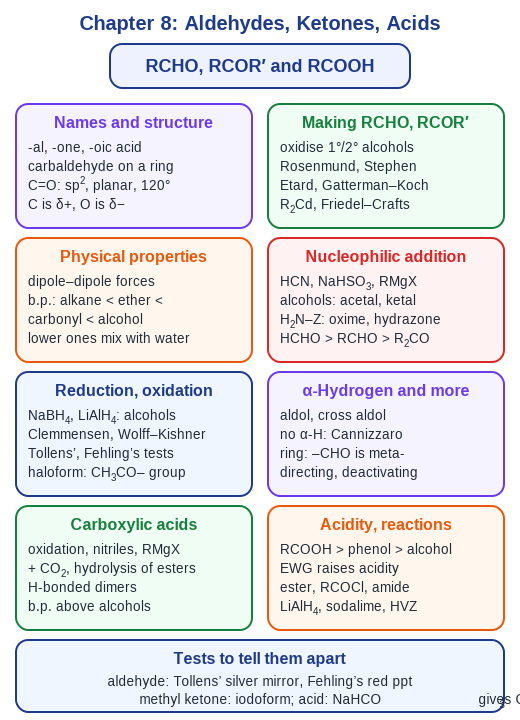
Aldehydes (RCHO) and ketones (RCOR′) carry the polar C=O group, whose carbon is attacked by nucleophiles. They add HCN, NaHSO₃, alcohols and H₂N–Z, are reduced to alcohols or to CH₂, and aldehydes are oxidised even by Tollens’ and Fehling’s reagents. Carboxylic acids (RCOOH) are more acidic than phenols because the carboxylate ion is stabilised by resonance.
What is this chapter about?
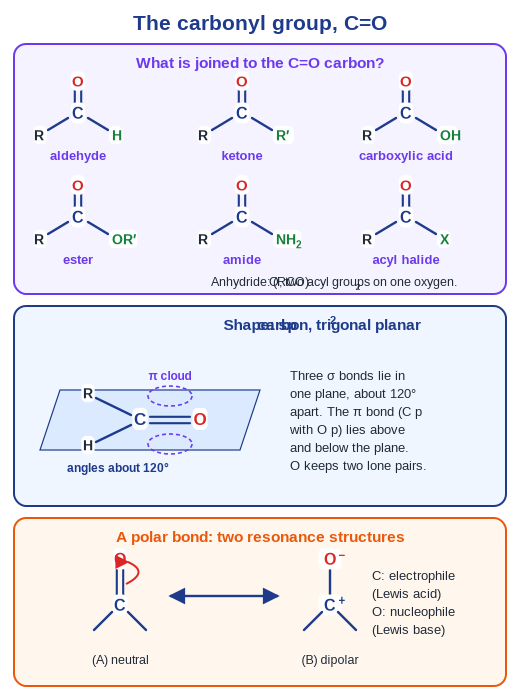
The last chapter dealt with carbon–oxygen single bonds. This one is about the carbon–oxygen double bond, the carbonyl group (>C=O). What is attached to the carbonyl carbon decides the family:
- aldehyde: one carbon group (or a second H) and one hydrogen, RCHO;
- ketone: two carbon groups, RCOR′;
- carboxylic acid: a carbon group (or H) and an –OH group, RCOOH.
Acyl halides (RCOX), amides (RCONH₂), esters (RCOOR′) and anhydrides ((RCO)₂O) are derivatives of the acids. Carbonyl compounds are everywhere: the book names vanillin, salicylaldehyde and cinnamaldehyde for their pleasant smells, acetone as a solvent, and their use in adhesives, paints, plastics and medicines. This chapter is Unit 8, the third unit of Chemistry Part II.
How structures are written on this site. Condensed formulas: a group in brackets hangs from the carbon written just before it, so CH₃CH(OH)CN has –OH and –CN on the second carbon. C₆H₅– (Ph) is phenyl; o-, m-, p- mark 1,2-, 1,3- and 1,4- positions on a ring. In the mechanism drawings, red curved arrows show where an electron pair moves.
How are they named?
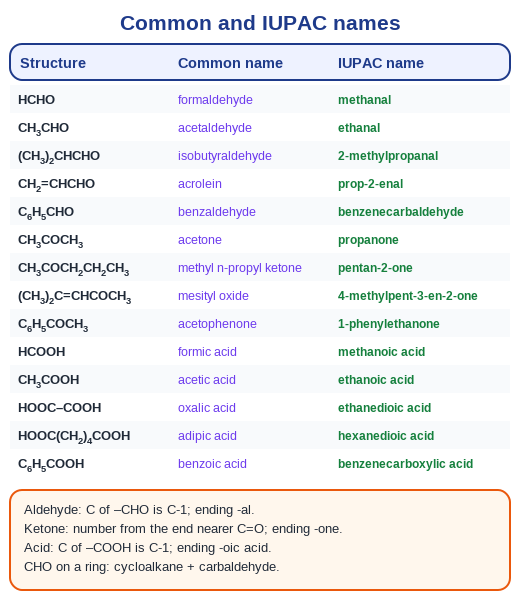
Common names. Aldehydes take their names from the matching acids, with -ic acid changed to aldehyde (formic acid, formaldehyde; acetic acid, acetaldehyde). Positions on the chain are Greek letters: α is the carbon next to the carbonyl group, then β, γ. Ketones are named from the two groups on the carbonyl carbon (methyl n-propyl ketone); a few have old names (acetone, mesityl oxide), and alkyl phenyl ketones end in -phenone (acetophenone).
IUPAC names. Replace the final e of the alkane by al for an aldehyde and one for a ketone. In an aldehyde the –CHO carbon is C-1; in a ketone the chain is numbered from the end nearer the C=O. Substituents go in alphabetical order with their locants: CH₃CH₂CH₂CH(Br)CH(CH₃)CH₂CHO is 4-bromo-3-methylheptanal. A –CHO on a ring takes the suffix carbaldehyde (cyclohexanecarbaldehyde); benzaldehyde keeps its common name. For acids, the ending is oic acid and the –COOH carbon is C-1; two –COOH groups give a dioic acid (hexanedioic acid).
What does the carbonyl group look like?
The carbonyl carbon is sp² hybridised. Its three σ bonds lie in one plane about 120° apart, and its remaining p orbital overlaps a p orbital of oxygen to form a π bond above and below that plane. Oxygen also keeps two lone pairs. Oxygen is more electronegative than carbon, so the bond is polar: the carbon is an electrophilic (Lewis acid) centre and the oxygen a nucleophilic (Lewis base) centre. A neutral and a dipolar (C⁺–O⁻) resonance structure describe this polarity, and carbonyl compounds have larger dipole moments than ethers.
How are aldehydes and ketones prepared?
- From alcohols: oxidation (1° → aldehyde, 2° → ketone) or, for volatile alcohols in industry, dehydrogenation over Cu or Ag.
- From hydrocarbons: ozonolysis of alkenes (then zinc dust and water); hydration of alkynes with H₂SO₄ and HgSO₄ (ethyne gives ethanal, other alkynes give ketones).
- Aldehydes only: Rosenmund reduction, RCOCl + H₂ → RCHO + HCl (Pd–BaSO₄); the Stephen reaction, nitrile + SnCl₂/HCl → imine, then hydrolysis; DIBAL-H for nitriles and esters.
- Aromatic aldehydes: the Etard reaction (CrO₂Cl₂), CrO₃ in acetic anhydride, hydrolysis of benzal chloride, and the Gatterman–Koch reaction (CO and HCl with anhydrous AlCl₃ or CuCl).
- Ketones only: acyl chloride + dialkylcadmium, nitrile + Grignard reagent then acid, and Friedel–Crafts acylation: C₆H₆ + CH₃COCl → C₆H₅COCH₃ + HCl (anhydrous AlCl₃).
Read how aldehydes and ketones are prepared.
What are their physical properties?
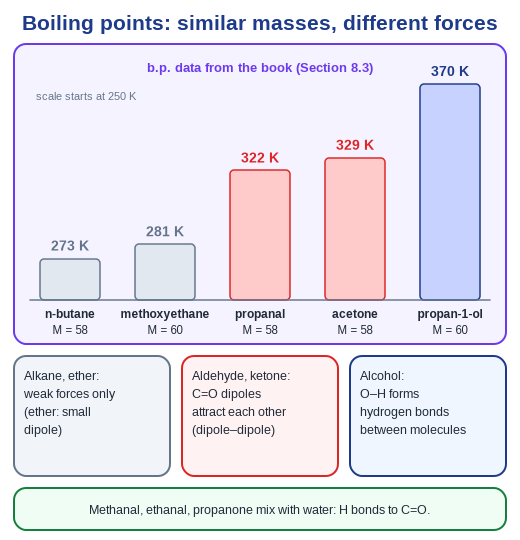
Methanal is a gas, ethanal a volatile liquid, and the others liquids or solids at room temperature. The C=O dipoles attract one another, so aldehydes and ketones boil higher than hydrocarbons and ethers of similar mass; they cannot hydrogen bond to one another, so they boil lower than alcohols. The book’s set of compounds with masses 58 and 60: n-butane 273 K, methoxyethane 281 K, propanal 322 K, acetone 329 K, propan-1-ol 370 K. Methanal, ethanal and propanone mix with water in all proportions because water hydrogen bonds to the carbonyl oxygen; solubility falls fast as the chain grows. The book describes the lower aldehydes as having sharp, pungent odours and larger ones as more fragrant, which is why several are used in perfumes and flavourings.
How do aldehydes and ketones react?
1. Nucleophilic addition. A nucleophile attacks the δ+ carbon from above the plane, the carbon turns sp³ and a tetrahedral alkoxide forms; a proton then adds to the oxygen. Aldehydes react faster than ketones: two groups on a ketone crowd the carbon and push more electron density onto it. Examples:
- HCN (with a little base) gives cyanohydrins: CH₃CHO + HCN → CH₃CH(OH)CN.
- NaHSO₃ gives crystalline bisulphite compounds; dilute acid or alkali reverses it, which helps to purify aldehydes.
- Grignard reagents give alcohols after hydrolysis (Unit 7).
- Alcohols (dry HCl) give hemiacetals and acetals; ketones with ethylene glycol give cyclic ketals.
- H₂N–Z gives >C=N–Z: imines, oximes, hydrazones, phenylhydrazones, 2,4-DNP derivatives and semicarbazones.
Read nucleophilic addition reactions.
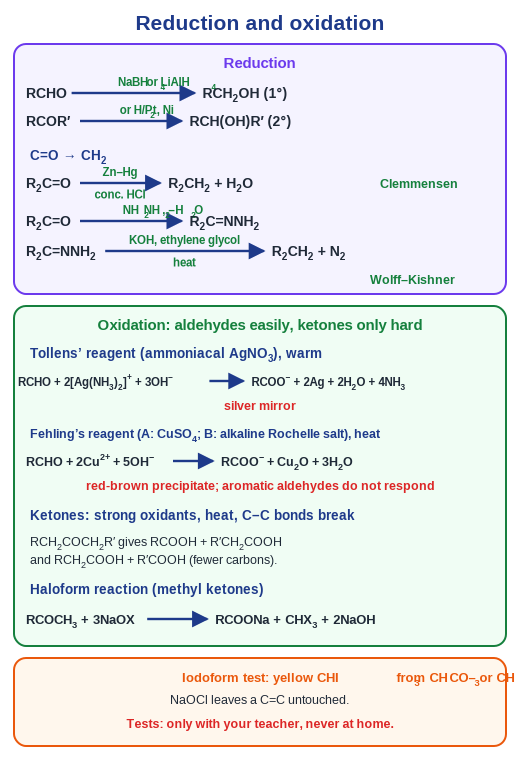
2. Reduction. NaBH₄, LiAlH₄ or H₂ with a catalyst give 1° alcohols from aldehydes and 2° from ketones. Clemmensen (Zn–Hg, conc. HCl) or Wolff–Kishner (NH₂NH₂, then KOH in ethylene glycol on heating) reduce C=O to CH₂.
3. Oxidation. Aldehydes are oxidised to acids by HNO₃, KMnO₄, K₂Cr₂O₇ and even by mild reagents; ketones need strong oxidants and heat, and their carbon chain breaks. The mild reagents tell the two apart:
- Tollens’ test (fresh ammoniacal silver nitrate, warm): RCHO + 2[Ag(NH₃)₂]⁺ + 3OH⁻ → RCOO⁻ + 2Ag + 2H₂O + 4NH₃, a silver mirror.
- Fehling’s test (copper sulphate with alkaline sodium potassium tartrate, heat): RCHO + 2Cu²⁺ + 5OH⁻ → RCOO⁻ + Cu₂O + 3H₂O, a red-brown precipitate. Aromatic aldehydes do not respond.
- Haloform reaction: a methyl ketone with sodium hypohalite gives the acid salt with one carbon less and CHX₃: RCOCH₃ + 3NaOI → RCOONa + CHI₃ + 2NaOH. The iodoform test also detects CH₃CH(OH)– groups, which are first oxidised to CH₃CO–.
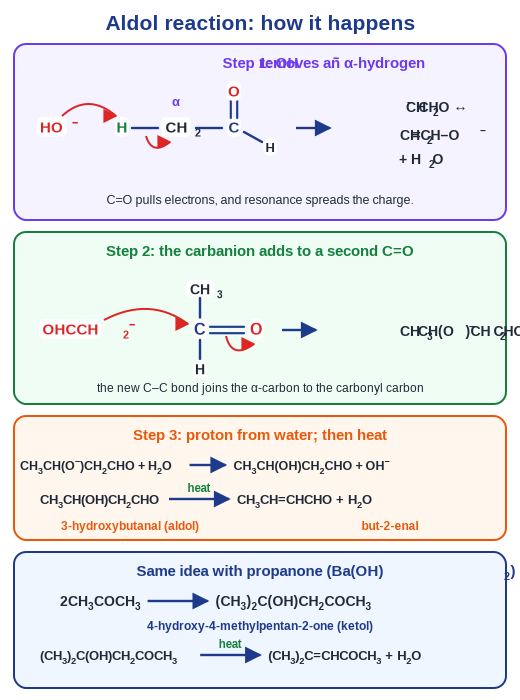
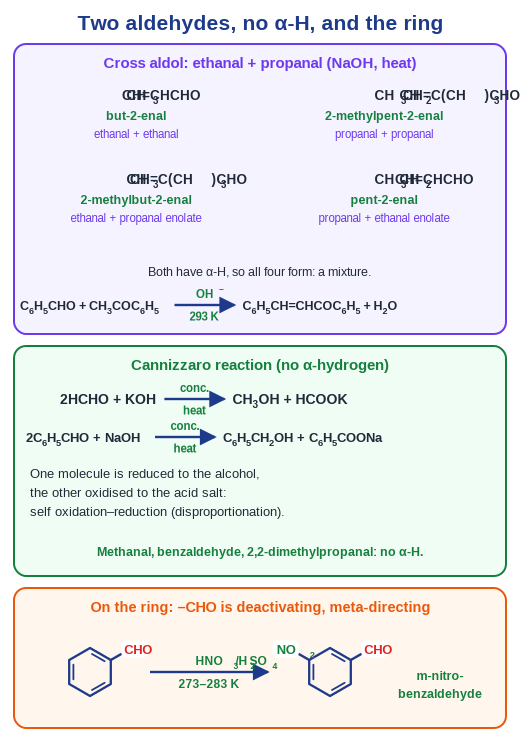
4. Reactions of the α-hydrogen. A hydrogen on the carbon next to C=O is acidic: the carbonyl group pulls electrons, and the anion left behind is stabilised by resonance. With dilute alkali, two molecules join in the aldol reaction: 2CH₃CHO → CH₃CH(OH)CH₂CHO (3-hydroxybutanal), which on heating loses water to give but-2-enal (aldol condensation). The book shows only the first step (removal of the α-H) with curved arrows; the later steps in the diagram below are Extra. Two different carbonyl compounds give a cross aldol mixture; ethanal and propanal give four products.
5. Other reactions. Aldehydes with no α-hydrogen undergo the Cannizzaro reaction with concentrated alkali: 2C₆H₅CHO + NaOH → C₆H₅CH₂OH + C₆H₅COONa. On a benzene ring the carbonyl group is deactivating and meta-directing: nitration of benzaldehyde at 273–283 K gives m-nitrobenzaldehyde.
Where are aldehydes and ketones used?
Industry uses them as solvents, as reagents and as raw materials for other products. Formalin (a 40% solution of formaldehyde) preserves biological specimens, and formaldehyde goes into bakelite and urea–formaldehyde glues. Acetaldehyde is mainly used to make acetic acid, ethyl acetate and vinyl acetate, and also polymers and medicines; benzaldehyde is used in perfumes and dyes; acetone and ethyl methyl ketone are industrial solvents. Butyraldehyde, vanillin, acetophenone and camphor are known for their odours and flavours.
What are carboxylic acids, and how are they made?
Carboxylic acids carry the carboxyl group, –COOH, a carbonyl group joined to an –OH. Many common names recall a natural source: formic acid was first obtained from red ants, acetic acid from vinegar and butyric acid from rancid butter. Acids with 12 to 18 carbons (fatty acids) occur in fats as esters of glycerol. In the carboxyl group the bonds to carbon lie in one plane about 120° apart, and the carbon is less electrophilic than a carbonyl carbon because the –OH lone pair takes part in resonance.
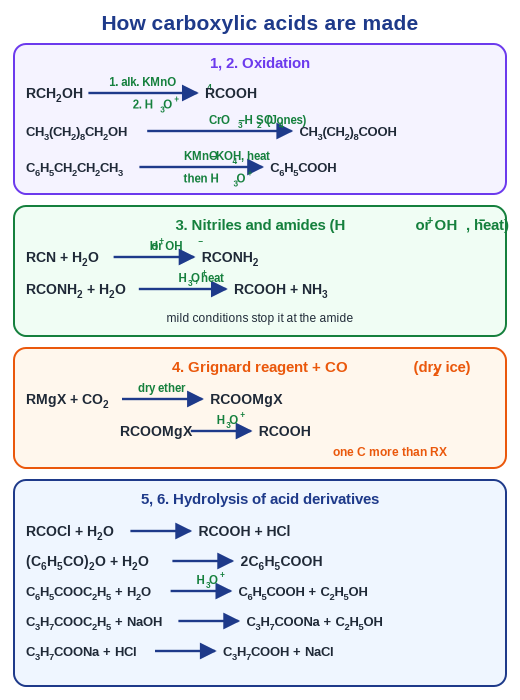
They are made by:
- Oxidising 1° alcohols (KMnO₄, or CrO₃ in H₂SO₄, the Jones reagent) and aldehydes (even mild oxidants).
- Oxidising alkylbenzenes with chromic acid or KMnO₄: the whole side chain becomes –COOH, whatever its length. 1° and 2° alkyl side chains react this way; a 3° group is left as it is.
- Hydrolysing nitriles (through amides) with H⁺ or OH⁻.
- Grignard reagents with dry ice: RMgX + CO₂ → RCOOMgX, then acid. Methods 3 and 4 add one carbon to an alkyl halide.
- Hydrolysing acyl halides, anhydrides and esters.
Physical properties of carboxylic acids
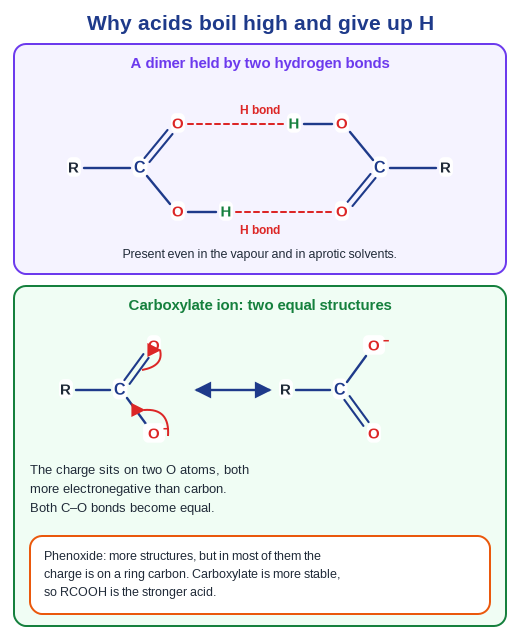
Acids up to nine carbons are colourless liquids; the book notes their unpleasant odours, while the higher, waxy acids are nearly odourless because they barely evaporate. Of all these families, carboxylic acids boil highest for a given mass, above alcohols as well as aldehydes and ketones, because their molecules hydrogen bond strongly; most exist as dimers even in the vapour or in aprotic solvents. Acids with up to four carbons mix with water; higher acids are practically insoluble, and benzoic acid hardly dissolves in cold water.
How acidic are carboxylic acids?
They react with metals (2CH₃COOH + 2Na → 2CH₃COONa + H₂), with alkalis, and, unlike phenols, with carbonates and hydrogencarbonates: CH₃COOH + NaHCO₃ → CH₃COONa + H₂O + CO₂. The fizz of CO₂ is a test for the –COOH group. In water they ionise to a resonance-stabilised carboxylate ion and H₃O⁺; strength is given by pKa = –log Ka, the smaller the stronger. The book’s values: HCl –7.0, CF₃COOH 0.23, benzoic acid 4.19, acetic acid 4.76; ethanol about 16 and phenol about 10.
- Electron-withdrawing groups (halogens, –CN, –NO₂, –CF₃) spread the negative charge of the carboxylate ion and make the acid stronger; electron-donating groups make it weaker.
- The effect grows in the order Ph < I < Br < Cl < F < CN < NO₂ < CF₃, and is larger when the group is nearer the –COOH.
- Phenyl or vinyl on the –COOH raises acidity (sp² carbon). On a ring, 4-nitrobenzoic acid (3.41) is stronger and 4-methoxybenzoic acid (4.46) weaker than benzoic acid (4.19).
Read the acidity of carboxylic acids.
How do carboxylic acids react?
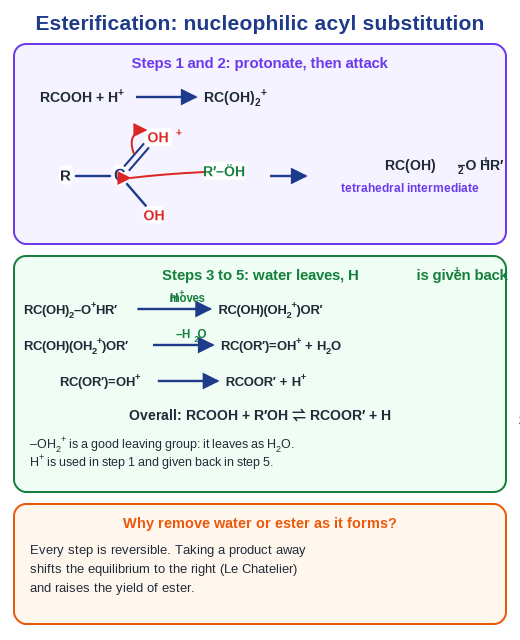
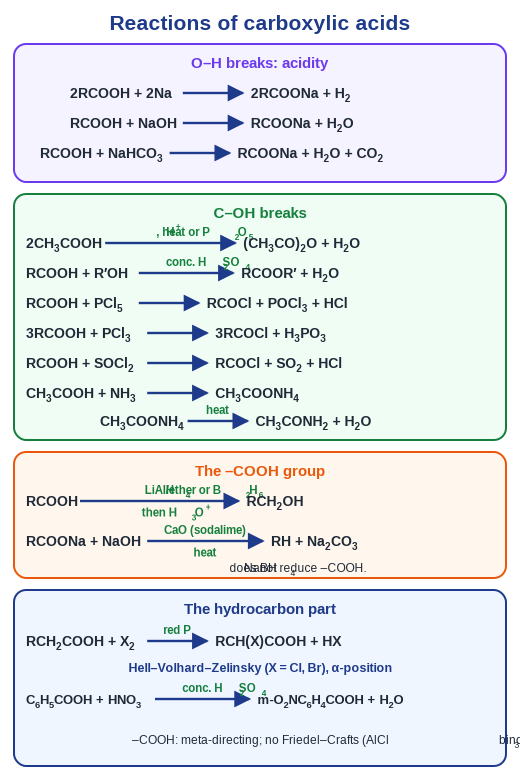
- C–OH cleavage. Heating with H₂SO₄ or P₂O₅ gives an anhydride: 2CH₃COOH → (CH₃CO)₂O + H₂O. With an alcohol and a little conc. H₂SO₄ or HCl gas they form esters (esterification, a nucleophilic acyl substitution). PCl₅, PCl₃ or SOCl₂ give acyl chlorides; SOCl₂ is preferred because its by-products are gases: CH₃COOH + SOCl₂ → CH₃COCl + SO₂ + HCl. Ammonia gives an ammonium salt, which strong heating turns into an amide: CH₃COONH₄ → CH₃CONH₂ + H₂O.
- The –COOH group. LiAlH₄, or better diborane, reduces it to a 1° alcohol (NaBH₄ does not). Heating the sodium salt with sodalime (NaOH and CaO, 3 : 1) removes CO₂: CH₃COONa + NaOH → CH₄ + Na₂CO₃. Electrolysis of the salts (Kolbe electrolysis) gives hydrocarbons with twice the number of carbons of the alkyl group.
- The hydrocarbon part. Cl₂ or Br₂ with a little red phosphorus puts a halogen on the α-carbon (Hell–Volhard–Zelinsky reaction). On a ring, –COOH is deactivating and meta-directing, and the ring does not undergo Friedel–Crafts reactions because AlCl₃ binds to the carboxyl group.
Where are carboxylic acids used?
Methanoic acid in the leather, rubber, textile, dyeing and electroplating industries; ethanoic acid as a solvent and, as vinegar, in food; hexanedioic acid to make nylon-6,6; esters of benzoic acid in perfumes; sodium benzoate as a food preservative; and higher fatty acids to make soaps and detergents.
Stay safe
Concentrated acids, HCN and cyanides, formalin, bromine, sodium and the reagents of the tests are hazardous. Any of these reactions is done only in the school laboratory with your teacher, never at home; never taste or smell a chemical.
Before we move on
Three skills carry this chapter: naming a carbonyl compound from its formula, choosing the reagent for a conversion (Rosenmund, Clemmensen, HVZ and the rest), and explaining an order (boiling points, reactivity towards nucleophiles, acid strength). Every exercise, Intext Question and worked example of the unit is answered in the NCERT solutions for Chapter 8.
Key terms
| Term | Meaning |
|---|---|
| Carbonyl group | The C=O group. Its carbon is sp² hybridised and trigonal planar; the bond is polar, with carbon partly positive (an electrophile) and oxygen partly negative (a nucleophile). |
| Aldehyde, ketone, carboxylic acid | In an aldehyde the C=O carbon carries at least one hydrogen (RCHO); in a ketone it carries two carbon groups (RCOR′); in a carboxylic acid it carries an –OH group (RCOOH). |
| Nucleophilic addition | The typical reaction of aldehydes and ketones: a nucleophile adds to the carbonyl carbon, the carbon becomes sp³, and a proton adds to the oxygen. |
| Cyanohydrin | The product of adding HCN to an aldehyde or ketone, with –OH and –CN on the same carbon, such as CH₃CH(OH)CN from ethanal. |
| Hemiacetal and acetal | An aldehyde with one alcohol molecule (dry HCl) gives a hemiacetal, RCH(OH)OR′; a second alcohol molecule gives an acetal, RCH(OR′)₂. Ketones with ethylene glycol give cyclic ketals. |
| Oxime, hydrazone, semicarbazone | Products of the form >C=N–Z formed from hydroxylamine, hydrazine and semicarbazide. 2,4-DNP derivatives are coloured solids used to identify aldehydes and ketones. |
| Clemmensen and Wolff–Kishner reductions | Two ways of turning C=O into CH₂: zinc amalgam with concentrated HCl, or hydrazine followed by heating with KOH in ethylene glycol. |
| Tollens’ and Fehling’s tests | Mild oxidants that aldehydes reduce and ketones do not: Tollens’ reagent gives a silver mirror, Fehling’s reagent a red-brown precipitate of Cu₂O (aromatic aldehydes do not respond). |
| Haloform reaction | Methyl ketones (CH₃CO–) are oxidised by sodium hypohalite to the salt of an acid with one carbon less and a haloform, CHX₃. The iodoform test gives yellow CHI₃. |
| Aldol condensation | With dilute alkali, an aldehyde or ketone with an α-hydrogen gives a β-hydroxy aldehyde or ketone (aldol or ketol), which loses water on heating to give an α,β-unsaturated carbonyl compound. |
| Cannizzaro reaction | An aldehyde with no α-hydrogen, heated with concentrated alkali, is partly reduced to an alcohol and partly oxidised to the salt of a carboxylic acid. |
| pKa | pKa = –log Ka. A lower pKa means a stronger acid: trifluoroacetic acid 0.23, benzoic acid 4.19, acetic acid 4.76 (book values). |
| Hell–Volhard–Zelinsky reaction | A carboxylic acid with an α-hydrogen, treated with chlorine or bromine and a little red phosphorus, gives an α-halocarboxylic acid. |
Topics in this chapter
Practice
-
The IUPAC name of CH₃CH=CHCHO is:
Show answer
Answer: (a) but-2-enal
-
Which reagent turns an acyl chloride into an aldehyde?
Show answer
Answer: (b) H₂ over Pd–BaSO₄
-
Which of these gives a silver mirror with Tollens’ reagent?
Show answer
Answer: (b) ethanal
-
Which aldehyde undergoes the Cannizzaro reaction?
Show answer
Answer: (c) benzaldehyde
-
Which is the strongest acid?
Show answer
Answer: (c) FCH₂COOH
Questions students ask
What are the main topics of Class 12 Chemistry Chapter 8?
Naming and the structure of the carbonyl group, the preparation of aldehydes and ketones, their physical properties, their reactions (nucleophilic addition, reduction, oxidation and the tests, reactions due to the α-hydrogen, Cannizzaro and ring substitution) and uses, and then the naming, structure, preparation, properties, acidity, reactions and uses of carboxylic acids.
Is Aldehydes, Ketones and Carboxylic Acids in the 2026-27 NCERT Class 12 Chemistry book?
Yes. It is Unit 8, the third unit of Chemistry Part II, the Class 12 textbook marked Reprint 2026-27, on pages 227 to 258. The book calls it a unit; here it is Chapter 8.
How do I tell an aldehyde from a ketone in a test?
Warm the sample with Tollens’ reagent: an aldehyde gives a silver mirror, a ketone does not. Fehling’s reagent also works for aliphatic aldehydes (red-brown precipitate). A methyl ketone can then be picked out by the iodoform test (yellow precipitate). Tests are done in the school laboratory with your teacher.
Why are carboxylic acids stronger acids than phenols?
In the carboxylate ion the negative charge is shared equally by two oxygen atoms through two equivalent resonance structures. In the phenoxide ion most resonance structures put the charge on ring carbons, which are less electronegative. The carboxylate ion is therefore more stable, and the acid gives up its proton more readily.
Stuck on a question?
Take a photo and Lagnever AI explains it step by step. Try it for 7 days for ₹2.
Get it on Google Play Open in browser
For parents: after the trial, the plan renews monthly by UPI or card autopay. You can cancel anytime in the app.