
Why are carboxylic acids acidic, and what makes one stronger?
Answer in short
A carboxylic acid gives up the proton of its –COOH group because two equivalent resonance structures stabilise the carboxylate ion left behind, sharing the charge between two oxygen atoms. Electron-withdrawing groups spread that charge further and strengthen the acid; electron-donating groups weaken it. A smaller pKa means a stronger acid.
Stuck on a question? Take a photo and Lagnever AI explains it step by step. Try it for 7 days for ₹2. Get it on Google Play
What shows that they are acids?
The O–H bond of the carboxyl group breaks and the proton leaves. Three reactions show it, with increasingly weak bases:
2CH₃COOH + 2Na → 2CH₃COONa + H₂ (like alcohols)
CH₃COOH + NaOH → CH₃COONa + H₂O (like phenols)
CH₃COOH + NaHCO₃ → CH₃COONa + H₂O + CO₂ (unlike phenols)
The last one matters most. Hydrogencarbonate is a weak base; only an acid as strong as a carboxylic acid releases carbon dioxide from it. Effervescence with NaHCO₃ is the standard test for a –COOH group.
Ka and pKa
In water a carboxylic acid ionises:
RCOOH + H₂O ⇌ RCOO⁻ + H₃O⁺
The equilibrium constant, with the nearly constant [H₂O] folded in, is the acid dissociation constant, Ka = [H₃O⁺][RCOO⁻]/[RCOOH]. Because Ka values are small and awkward, we use pKa = –log Ka. A smaller pKa means a stronger acid. The book’s rough scale: pKa below 1, strong; 1 to 5, moderately strong; 5 to 15, weak; above 15, extremely weak.
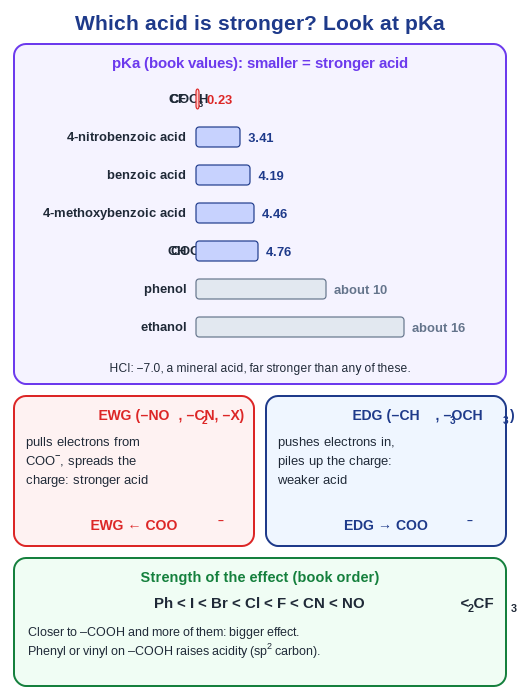
Book values: HCl –7.0; trifluoroacetic acid 0.23 (the strongest carboxylic acid); benzoic acid 4.19; acetic acid 4.76; phenol 10; ethanol about 16.
Why carboxylic acids beat phenols
Both lose a proton to give an anion stabilised by resonance, so compare the anions:
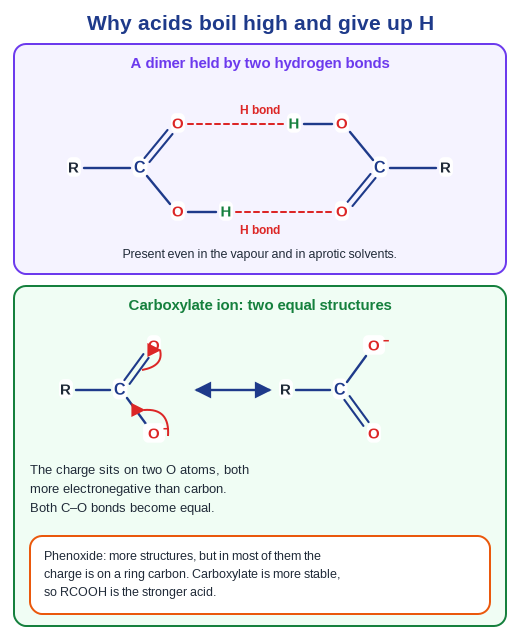
- Carboxylate ion: two equivalent resonance structures, each with the negative charge on an oxygen atom. The charge is shared equally by two electronegative atoms, and both C–O bonds become the same.
- Phenoxide ion: more resonance structures, but they are not equivalent, and in most of them the charge is on a ring carbon, which is less electronegative. Spreading charge onto carbon helps less.
The carboxylate ion is the more stable anion, so the carboxylic acid ionises more readily. That is why the count of resonance structures does not decide the question.
How substituents change acid strength
Anything that stabilises the carboxylate ion makes the acid stronger.
- Electron-withdrawing groups (EWG) such as halogens, –CN, –NO₂ and –CF₃ pull electron density away from –COO⁻ (inductive and/or resonance effects) and spread its charge: stronger acid.
- Electron-donating groups (EDG) such as alkyl groups and –OCH₃ on a ring push electron density in and concentrate the charge: weaker acid.
The book ranks the groups by how much they raise acidity:
Ph < I < Br < Cl < F < CN < NO₂ < CF₃
Three rules follow:
- Stronger pull, stronger acid: FCH₂COOH > ClCH₂COOH > BrCH₂COOH.
- More groups, stronger acid: CF₃COOH > CCl₃COOH > CHCl₂COOH > ClCH₂COOH.
- Nearer groups, stronger acid: ClCH₂COOH is stronger than ClCH₂CH₂COOH, because the inductive effect fades along the chain.
The book’s full list, strongest first: CF₃COOH > CCl₃COOH > CHCl₂COOH > NO₂CH₂COOH > NC–CH₂COOH > FCH₂COOH > ClCH₂COOH > BrCH₂COOH > HCOOH > ClCH₂CH₂COOH > C₆H₅COOH > C₆H₅CH₂COOH > CH₃COOH > CH₃CH₂COOH.
Notice HCOOH above CH₃COOH (no electron-releasing alkyl group) and CH₃COOH above CH₃CH₂COOH (a larger alkyl group releases more).
Aromatic acids
A phenyl or vinyl group joined directly to –COOH makes the acid stronger, even though resonance would push the other way, because the sp² carbon it brings is more electronegative. So benzoic acid (4.19) is stronger than acetic acid (4.76).
Groups on the ring act as on an aliphatic chain:
| Acid | pKa |
|---|---|
| 4-nitrobenzoic acid | 3.41 |
| benzoic acid | 4.19 |
| 4-methoxybenzoic acid | 4.46 |
A difference of 0.78 pKa units between benzoic and 4-nitrobenzoic acid means Ka differs by 10⁰·⁷⁸, about six times.
A worked order
Exercise 8.12 (ii) asks for the increasing acid strength of CH₃CH₂CH(Br)COOH, CH₃CH(Br)CH₂COOH, (CH₃)₂CHCOOH and CH₃CH₂CH₂COOH.
- No bromine: the two butanoic-type acids are weakest. (CH₃)₂CHCOOH has two methyl groups on the α-carbon, pushing more electrons towards –COOH, so it is the weakest.
- With bromine, the acid with Br on the α-carbon (next to –COOH) is stronger than the one with Br on the β-carbon.
Answer: (CH₃)₂CHCOOH < CH₃CH₂CH₂COOH < CH₃CH(Br)CH₂COOH < CH₃CH₂CH(Br)COOH, as in the book’s answer key.
Lab safety
Concentrated acids, trifluoroacetic acid and sodium are hazardous. Any of these reactions is done only in the school laboratory with your teacher, never at home.
Back to the Chapter 8 notes, or see the NCERT solutions.
Practice
-
Which gives CO₂ with sodium hydrogencarbonate?
Show answer
Answer: (c) ethanoic acid
-
Which is the strongest acid?
Show answer
Answer: (d) CF₃COOH
-
Which order of acid strength is right?
Show answer
Answer: (b) HCOOH > C₆H₅COOH > CH₃COOH
-
Ka of an acid is 1.0 × 10⁻⁵. What is its pKa?
Show answer
Answer: pKa = –log Ka = –log(1.0 × 10⁻⁵) = 5.0. On the book’s scale (1 to 5 moderately strong, 5 to 15 weak) it sits at the boundary.
-
Arrange in increasing acid strength: 4-methoxybenzoic acid, benzoic acid, 4-nitrobenzoic acid.
Show answer
Answer: 4-methoxybenzoic acid (pKa 4.46) < benzoic acid (4.19) < 4-nitrobenzoic acid (3.41). –OCH₃ donates electrons and weakens the acid; –NO₂ withdraws them and strengthens it.
Questions students ask
Are carboxylic acids strong acids?
No. They are weaker than mineral acids such as HCl (pKa –7.0), but they are the most acidic organic compounds met so far in the course, far more acidic than alcohols and most simple phenols. On the book’s scale most are moderately strong (pKa 1 to 5).
Why does a phenyl group make benzoic acid stronger than acetic acid?
Resonance with the ring would be expected to push electrons towards the –COOH and weaken the acid, but the –COOH is attached to an sp² carbon, which is more electronegative than the sp³ carbon in acetic acid. That pull wins, so benzoic acid (4.19) is stronger than acetic acid (4.76).
Why is the NaHCO₃ test useful?
Hydrogencarbonate is a weak base. Carboxylic acids are strong enough to react with it and release CO₂ bubbles, while phenols and alcohols are not. So brisk effervescence with NaHCO₃ shows a –COOH group.
Stuck on a question?
Take a photo and Lagnever AI explains it step by step. Try it for 7 days for ₹2.
Get it on Google Play Open in browser
For parents: after the trial, the plan renews monthly by UPI or card autopay. You can cancel anytime in the app.