
What is a nucleophilic addition reaction?
Answer in short
A nucleophile attacks the partly positive carbon of a C=O group, the π electrons move onto oxygen, and the planar sp² carbon becomes a tetrahedral sp³ alkoxide. The oxygen then takes a proton. HCN, NaHSO₃, Grignard reagents, alcohols and ammonia derivatives all add this way, aldehydes faster than ketones.
Stuck on a question? Take a photo and Lagnever AI explains it step by step. Try it for 7 days for ₹2. Get it on Google Play
Why does C=O take nucleophiles?
In an alkene the π electrons attract electrophiles. In a carbonyl group oxygen has pulled the π electrons towards itself, so the carbon is partly positive. A nucleophile (an electron-pair donor such as CN⁻, HSO₃⁻, R⁻ of a Grignard reagent, an alcohol or an amine) is drawn to that carbon. This is why aldehydes and ketones undergo nucleophilic addition.
The mechanism in two steps
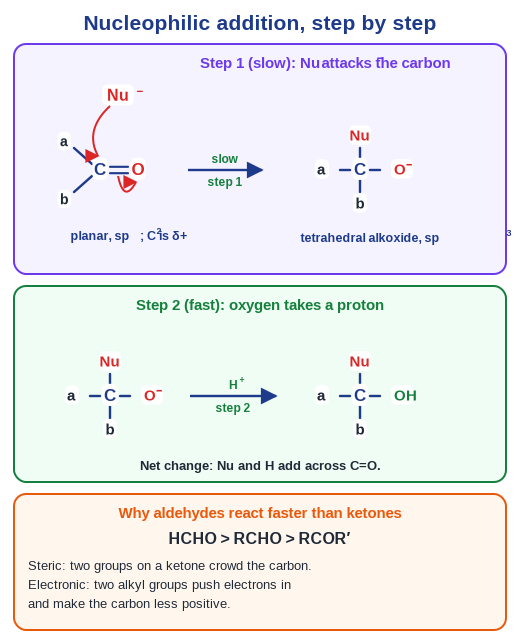
- Attack (slow). The nucleophile approaches the carbonyl carbon at roughly right angles to the plane of its three bonds. A new bond forms to carbon, the π electrons move onto oxygen, and the carbon changes from sp² (planar) to sp³ (tetrahedral). The result is a tetrahedral alkoxide intermediate.
- Protonation (fast). The negatively charged oxygen takes a proton from the medium, giving a neutral product.
Overall, Nu and H add across the C=O bond, with Nu on carbon and H on oxygen.
Why are aldehydes more reactive than ketones?
- Steric reason. A ketone has two fairly large groups on the carbonyl carbon; an aldehyde has one group and a small hydrogen. The nucleophile reaches the aldehyde carbon more easily.
- Electronic reason. Alkyl groups release electrons and reduce the positive charge on the carbonyl carbon. Two alkyl groups do this more than one.
So methanal (two H) is the most reactive, then other aldehydes, then ketones. The book’s Example 8.3 adds an aromatic case: benzaldehyde is less reactive than propanal, because the ring’s π electrons are shared with the C=O by resonance, which makes the carbonyl carbon less electrophilic.
Addition of HCN
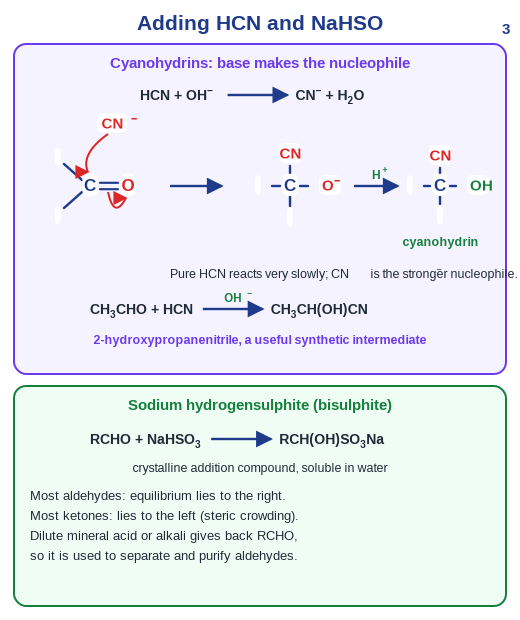
Pure HCN reacts very slowly. A little base turns it into cyanide ion, a much stronger nucleophile:
HCN + OH⁻ ⇌ CN⁻ + H₂O
CN⁻ adds to the carbon and the alkoxide takes a proton (from HCN or water), giving a cyanohydrin:
CH₃CHO + HCN → CH₃CH(OH)CN (2-hydroxypropanenitrile)
CH₃COCH₃ + HCN → (CH₃)₂C(OH)CN (2-hydroxy-2-methylpropanenitrile)
Cyanohydrins are useful intermediates because both the –CN and the –OH can be changed further.
Addition of sodium hydrogensulphite
CH₃CHO + NaHSO₃ ⇌ CH₃CH(OH)SO₃Na
The bisulphite addition compound is crystalline and dissolves in water. For most aldehydes the equilibrium lies to the right; for most ketones it lies to the left, for steric reasons. Dilute mineral acid or alkali gives back the carbonyl compound, so this is a way of separating and purifying aldehydes.
Addition of Grignard reagents and alcohols
Grignard reagents add R to the carbonyl carbon; hydrolysis then gives an alcohol (Unit 7): methanal a 1°, other aldehydes a 2°, ketones a 3° alcohol.
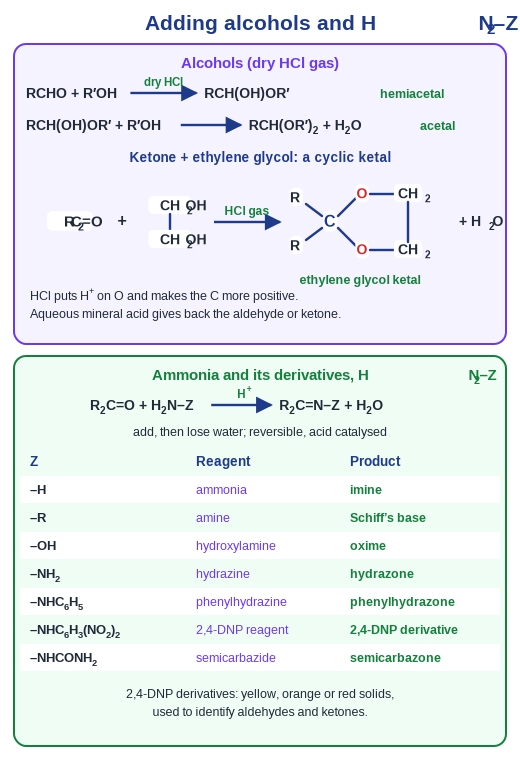
Alcohols. With dry HCl gas an aldehyde adds one alcohol molecule to give a hemiacetal, RCH(OH)OR′, and a second one to give an acetal, RCH(OR′)₂, with loss of water:
CH₃CHO + 2CH₃OH ⇌ CH₃CH(OCH₃)₂ + H₂O (1,1-dimethoxyethane)
Ketones react with ethylene glycol in the same way to give cyclic ethylene glycol ketals. The dry HCl protonates the carbonyl oxygen, which makes the carbon more electrophilic. Aqueous mineral acid hydrolyses acetals and ketals back to the aldehyde or ketone.
Addition of ammonia and its derivatives
Ammonia and compounds H₂N–Z add to the C=O group; the intermediate then loses water quickly to give >C=N–Z. The reaction can run both ways, and acid speeds it up:
CH₃CHO + NH₂OH → CH₃CH=NOH + H₂O (ethanal oxime)
| Z | Reagent | Product |
|---|---|---|
| –H | ammonia | imine |
| –R | amine | substituted imine (Schiff’s base) |
| –OH | hydroxylamine | oxime |
| –NH₂ | hydrazine | hydrazone |
| –NHC₆H₅ | phenylhydrazine | phenylhydrazone |
| –NHC₆H₃(NO₂)₂ | 2,4-dinitrophenylhydrazine | 2,4-DNP derivative |
| –NHCONH₂ | semicarbazide | semicarbazone |
The 2,4-DNP derivatives are solids coloured yellow, orange or red, which makes them handy for identifying aldehydes and ketones.
The same idea in the aldol and Cannizzaro reactions
In the aldol reaction the nucleophile is the carbanion formed when a base removes an α-hydrogen; it adds to the C=O of a second molecule, giving 3-hydroxybutanal from ethanal. In the Cannizzaro reaction an aldehyde with no α-hydrogen is attacked by OH⁻ and then passes a hydride to a second aldehyde molecule (Extra: the book gives only the overall change, one molecule reduced to the alcohol and one oxidised to the acid salt). See the Chapter 8 notes for both.
Lab safety
HCN and cyanides are highly poisonous, and hydrazine and the 2,4-DNP reagent are hazardous. These reactions are described for the exam; any test is done only in the school laboratory with your teacher.
Back to the Chapter 8 notes, or see the NCERT solutions.
Practice
-
Which is most reactive towards HCN?
Show answer
Answer: (d) methanal
-
Hydroxylamine with propanone gives:
Show answer
Answer: (b) an oxime
-
Which product forms when ethanal adds one molecule of methanol in dry HCl?
Show answer
Answer: (c) a hemiacetal
-
Write the cyanohydrin formed from propanone and name the reaction type.
Show answer
Answer: (CH₃)₂C(OH)CN, 2-hydroxy-2-methylpropanenitrile. CN⁻ (from HCN and a little base) adds to the carbonyl carbon and the alkoxide takes a proton: nucleophilic addition.
-
Why does the bisulphite reaction help to purify an aldehyde?
Show answer
Answer: The aldehyde forms a crystalline, water-soluble addition compound that can be separated from the other substances; dilute acid or alkali then gives back the pure aldehyde.
Questions students ask
Why does the nucleophile attack from above the plane?
The carbonyl carbon and its three neighbours lie in one plane, and the π bond sits above and below it. The nucleophile approaches roughly at right angles to that plane, where the carbon is open to attack, and the carbon ends up tetrahedral.
Why is the equilibrium with NaHSO₃ on the right for aldehydes but on the left for ketones?
The book gives steric reasons. In the addition compound the carbon carries four groups; with two large alkyl groups (a ketone) this is crowded, so the reverse reaction wins. An aldehyde has a small hydrogen in place of one group.
Why do ammonia derivatives give C=N compounds and not simple addition products?
The addition is reversible, but the intermediate with –OH and –NHZ on the same carbon quickly loses water to form >C=N–Z. This fast dehydration pulls the equilibrium towards the product.
Stuck on a question?
Take a photo and Lagnever AI explains it step by step. Try it for 7 days for ₹2.
Get it on Google Play Open in browser
For parents: after the trial, the plan renews monthly by UPI or card autopay. You can cancel anytime in the app.