
How are aldehydes and ketones prepared?
Answer in short
Oxidise or dehydrogenate primary alcohols for aldehydes and secondary alcohols for ketones. Aldehydes also come from acyl chlorides (Rosenmund), nitriles (Stephen, DIBAL-H) and, on a ring, from toluene (Etard) or benzene (Gatterman–Koch). Ketones come from acyl chlorides with dialkylcadmium, nitriles with Grignard reagents, and Friedel–Crafts acylation.
Stuck on a question? Take a photo and Lagnever AI explains it step by step. Try it for 7 days for ₹2. Get it on Google Play
Methods that make both
Oxidation of alcohols. A primary alcohol gives an aldehyde and a secondary alcohol a ketone (Unit 7): CH₃(CH₂)₄CH₂OH → CH₃(CH₂)₄CHO with PCC, for example, which the book uses in Example 8.1 for hexan-1-ol to hexanal.
Dehydrogenation. Vapours of volatile alcohols passed over heated copper or silver lose hydrogen. This is an industrial method: CH₃CH₂OH → CH₃CHO + H₂.
From hydrocarbons.
- Ozonolysis of an alkene, followed by zinc dust and water, gives aldehydes, ketones or both, depending on the groups around the C=C: but-2-ene gives two molecules of ethanal.
- Hydration of alkynes with dilute H₂SO₄ and HgSO₄: ethyne gives ethanal, C₂H₂ + H₂O → CH₃CHO, and every other alkyne gives a ketone, such as propanone from propyne.
Aldehydes from acid chlorides, nitriles and esters
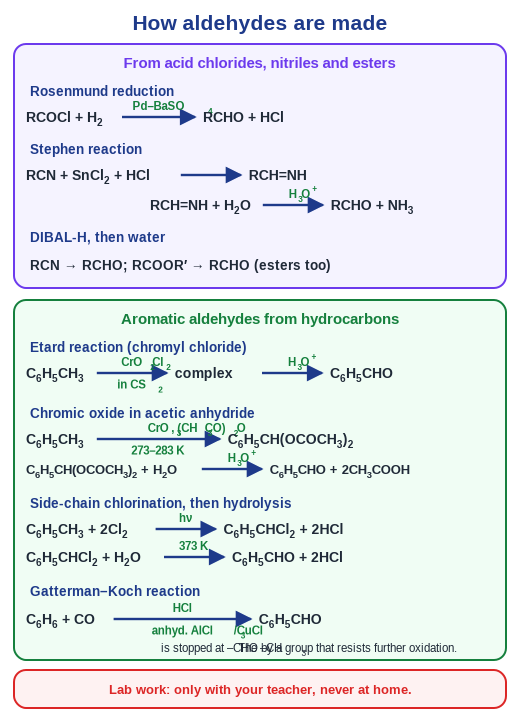
Rosenmund reduction. An acyl chloride is hydrogenated over palladium on barium sulphate:
C₆H₅COCl + H₂ → C₆H₅CHO + HCl (benzoyl chloride → benzaldehyde)
Stephen reaction. Stannous chloride and hydrochloric acid reduce a nitrile to an imine, and water hydrolyses the imine:
RCN + SnCl₂ + HCl → RCH=NH, then RCH=NH + H₂O → RCHO + NH₃
DIBAL-H. Diisobutylaluminium hydride, AlH(i-Bu)₂, reduces nitriles to imines and esters directly to aldehydes; water finishes the job. It leaves a C=C double bond untouched, so CH₃CH=CHCH₂CH₂CN gives CH₃CH=CHCH₂CH₂CHO. The book’s ester example is CH₃(CH₂)₉COOC₂H₅ giving CH₃(CH₂)₉CHO.
Aromatic aldehydes from hydrocarbons
Strong oxidants turn toluene into benzoic acid. To stop at benzaldehyde, the methyl group is first converted into something that resists further oxidation:
- Etard reaction. Chromyl chloride, CrO₂Cl₂, in CS₂ turns the methyl group into a chromium complex, C₆H₅CH(OCrOHCl₂)₂, which H₃O⁺ hydrolyses to benzaldehyde.
- Chromic oxide in acetic anhydride (273–283 K) gives benzylidene diacetate, C₆H₅CH(OCOCH₃)₂, which aqueous acid turns into benzaldehyde: C₆H₅CH(OCOCH₃)₂ + H₂O → C₆H₅CHO + 2CH₃COOH.
- Side-chain chlorination, then hydrolysis. Chlorine in light gives benzal chloride, C₆H₅CH₃ + 2Cl₂ → C₆H₅CHCl₂ + 2HCl, and water at 373 K gives benzaldehyde, C₆H₅CHCl₂ + H₂O → C₆H₅CHO + 2HCl. The book calls this a commercial method.
- Gatterman–Koch reaction. Benzene (or a derivative) with carbon monoxide and HCl, catalysed by anhydrous AlCl₃ or CuCl: C₆H₆ + CO → C₆H₅CHO.
Ketones
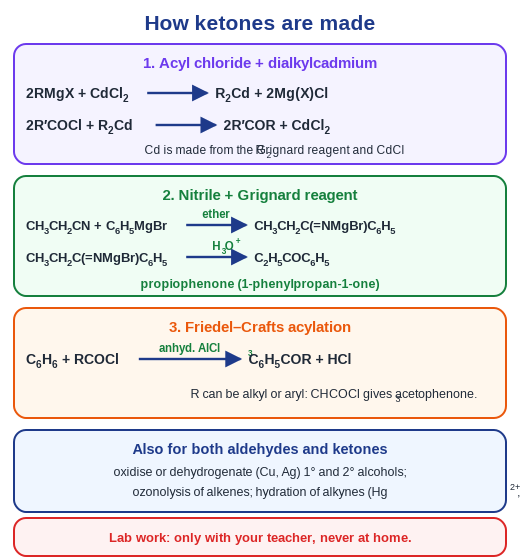
Acyl chloride with a dialkylcadmium. The Grignard reagent and cadmium chloride make R₂Cd, which then reacts with the acyl chloride:
2CH₃MgBr + CdCl₂ → (CH₃)₂Cd + 2Mg(Br)Cl
2CH₃CH₂COCl + (CH₃)₂Cd → 2CH₃CH₂COCH₃ + CdCl₂ (butan-2-one)
Nitrile with a Grignard reagent. The Grignard reagent adds once to C≡N; acid hydrolysis of the imine salt gives the ketone. Propanenitrile and phenylmagnesium bromide give propiophenone (1-phenylpropan-1-one): CH₃CH₂CN + C₆H₅MgBr → CH₃CH₂C(NMgBr)C₆H₅ in ether, then H₃O⁺.
Friedel–Crafts acylation. Benzene or a substituted benzene with an acyl chloride and anhydrous AlCl₃:
C₆H₆ + C₆H₅COCl → C₆H₅COC₆H₅ + HCl (benzophenone)
Choosing the right reagent
The book’s Example 8.1 is good practice. For each change, ask what is there and what must form:
- Hexan-1-ol → hexanal: a 1° alcohol to an aldehyde without going on to the acid, so PCC.
- Cyclohexanol → cyclohexanone: a 2° alcohol; anhydrous CrO₃.
- p-Fluorotoluene → p-fluorobenzaldehyde: CH₃ on a ring to CHO, so CrO₃ in acetic anhydride, or CrO₂Cl₂ then water.
- Ethanenitrile → ethanal: DIBAL-H (or the Stephen reaction).
- Allyl alcohol → propenal: PCC, which leaves the C=C alone.
- But-2-ene → ethanal: ozonolysis, O₃ then H₂O and zinc dust.
Lab safety
Chromium(VI) reagents, mercury salts, acid chlorides, cyanides and chlorine are toxic or corrosive. These preparations are described for the exam; any practical work is done only in the school laboratory with your teacher.
Back to the Chapter 8 notes, or read about nucleophilic addition.
Practice
-
Which reaction turns benzoyl chloride into benzaldehyde?
Show answer
Answer: (b) Rosenmund reduction
-
Benzene with CO and HCl in the presence of anhydrous AlCl₃ gives:
Show answer
Answer: (c) benzaldehyde
-
Hydration of propyne with H₂SO₄ and HgSO₄ gives:
Show answer
Answer: (b) propanone
-
Write the reaction of ethanenitrile with SnCl₂ and HCl, followed by hydrolysis.
Show answer
Answer: CH₃CN + SnCl₂ + HCl gives the imine CH₃CH=NH (as its salt); water then hydrolyses it: CH₃CH=NH + H₂O → CH₃CHO + NH₃. This is the Stephen reaction, and the product is ethanal.
-
How is acetophenone made from benzene?
Show answer
Answer: By Friedel–Crafts acylation: C₆H₆ + CH₃COCl → C₆H₅COCH₃ + HCl, with anhydrous AlCl₃ as the catalyst.
Questions students ask
Why is the Rosenmund catalyst palladium on barium sulphate?
The book gives the catalyst without the reason. Extra: palladium alone would go on to reduce the aldehyde to a primary alcohol; on barium sulphate it is less active (it is said to be poisoned), so the reduction stops at the aldehyde.
What is the difference between the Etard reaction and side-chain chlorination?
In the Etard reaction chromyl chloride oxidises the methyl group of toluene to a chromium complex, which water turns into benzaldehyde. In side-chain chlorination, chlorine in light gives benzal chloride (C₆H₅CHCl₂), which is hydrolysed to benzaldehyde at 373 K; the book calls this a commercial method.
Why does a nitrile and a Grignard reagent give a ketone and not an alcohol?
The Grignard reagent adds once to the C≡N group and forms the magnesium salt of an imine, R–C(=NMgBr)–R′, as the book shows. Extra: this salt does not take a second Grignard molecule. Acid hydrolysis then turns the C=N into C=O, giving the ketone.
Stuck on a question?
Take a photo and Lagnever AI explains it step by step. Try it for 7 days for ₹2.
Get it on Google Play Open in browser
For parents: after the trial, the plan renews monthly by UPI or card autopay. You can cancel anytime in the app.