
NCERT Solutions Class 12 Chemistry Chapter 9: Amines
Answers to all 14 end-of-unit exercises, all 9 Intext Questions and all 5 worked examples of Unit 9, Amines, of Chemistry Part II, the Class 12 NCERT textbook. Page numbers follow the 2026-27 reprint (pages 259–280). The exercises come first, quoted from the book; the Intext Questions and the examples follow, restated in short. Short notes: Chapter 9 notes.
How the answers were checked. Every equation was checked atom by atom and charge by charge with a script. Every IUPAC name was checked twice against its structure: the parent chain, the locants, the N- prefixes, alphabetical order, and the molecular formula worked out from both the name and the structure. Every order of basic strength was checked against the pKb values in the book’s Table 9.3. Our answers were compared with the Answers section at the back of Part II (page 306) and with the Intext answers printed on page 280; where they differ, the notes say so.
How structures are written. Condensed formulas: a group in brackets hangs from the atom written just before it, so CH₃NHCH(CH₃)₂ has two methyl groups on the carbon next to nitrogen. C₆H₅– (Ph) is phenyl, C₆H₄ is a benzene ring with two substituents, and o-, m-, p- mark 1,2-, 1,3- and 1,4- positions. [H] and [O] stand for the hydrogen or oxygen supplied by a reducing or oxidising agent.
Stay safe. Many reactions here use cyanides, bromine, nitrous acid, concentrated acids, chloroform or LiAlH₄, and diazonium salts decompose easily when dry. They are described for the exam only; any test or practical work is done in the school laboratory with your teacher, never at home, and chemicals are never tasted or smelt.
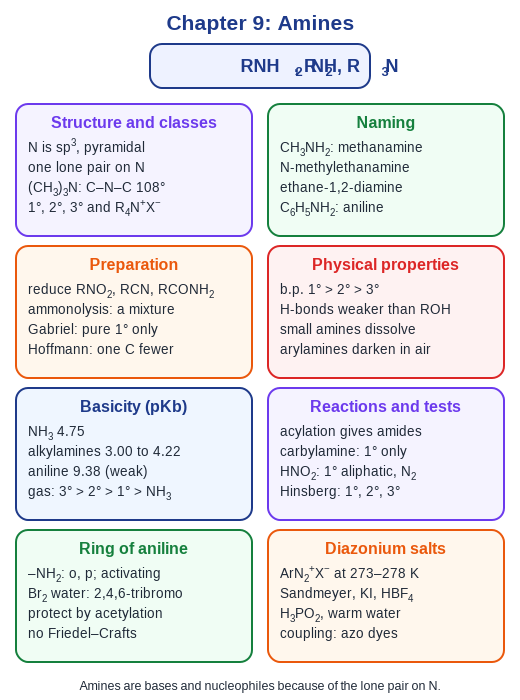
Exercises 9.1 to 9.4: names, tests, reasons and orders
9.1 “Write IUPAC names of the following compounds and classify them into primary, secondary and tertiary amines. (i) (CH₃)₂CHNH₂ (ii) CH₃(CH₂)₂NH₂ (iii) CH₃NHCH(CH₃)₂ (iv) (CH₃)₃CNH₂ (v) C₆H₅NHCH₃ (vi) (CH₃CH₂)₂NCH₃ (vii) m–BrC₆H₄NH₂”
| IUPAC name | Class | Reason | |
|---|---|---|---|
| (i) | propan-2-amine | 1° | –NH₂ on the middle carbon of a three-carbon chain |
| (ii) | propan-1-amine | 1° | –NH₂ at the end of the chain |
| (iii) | N-methylpropan-2-amine | 2° | the longer group, propan-2-yl, is the parent; CH₃ is on N |
| (iv) | 2-methylpropan-2-amine | 1° | –NH₂ and a methyl on C-2 of propane |
| (v) | N-methylaniline (N-methylbenzenamine) | 2° | one phenyl and one methyl on N |
| (vi) | N-ethyl-N-methylethanamine | 3° | ethanamine is the parent; ethyl and methyl on N, in alphabetical order |
| (vii) | 3-bromoaniline (3-bromobenzenamine) | 1° | Br meta to –NH₂ |
All seven agree with the book’s answer key, which also gives the common names 1-methylethylamine for (i) and N-methyl-2-methylethylamine for (iii).
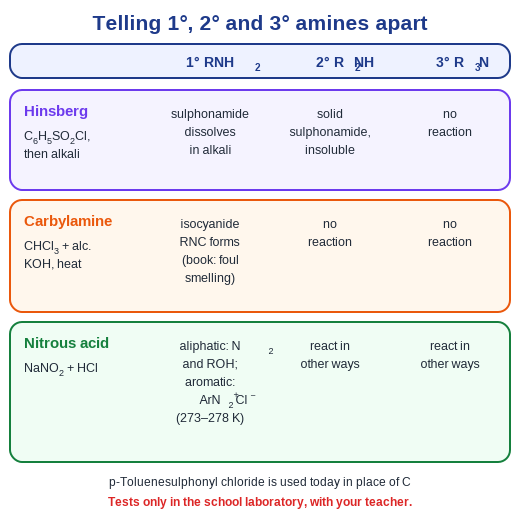
9.2 “Give one chemical test to distinguish between the following pairs of compounds. (i) Methylamine and dimethylamine (ii) Secondary and tertiary amines (iii) Ethylamine and aniline (iv) Aniline and benzylamine (v) Aniline and N-methylaniline.” (All tests: in the school laboratory with your teacher.)
- (i) Hinsberg test. Methylamine (1°) gives N-methylbenzenesulphonamide, which dissolves in aqueous alkali; dimethylamine (2°) gives N,N-dimethylbenzenesulphonamide, which does not. C₆H₅SO₂Cl + CH₃NH₂ → C₆H₅SO₂NHCH₃ + HCl; C₆H₅SO₂Cl + (CH₃)₂NH → C₆H₅SO₂N(CH₃)₂ + HCl. The carbylamine test also works: only methylamine, heated with CHCl₃ and ethanolic KOH, forms an isocyanide, which the book describes as foul smelling.
- (ii) Hinsberg test. A secondary amine gives a solid sulphonamide that is insoluble in alkali; a tertiary amine does not react with benzenesulphonyl chloride at all.
- (iii) Azo dye test. Dissolve each in dilute HCl, cool to 273–278 K and add NaNO₂ solution, then add an alkaline solution of phenol. Aniline forms a diazonium salt, which couples to give an orange dye (p-hydroxyazobenzene). Ethylamine gives bubbles of nitrogen and ethanol, and no dye: C₂H₅NH₂ + HNO₂ → C₂H₅OH + N₂ + H₂O.
- (iv) Nitrous acid. Benzylamine has its –NH₂ on a CH₂ group, so it behaves like an aliphatic primary amine: with cold nitrous acid it gives nitrogen gas and benzyl alcohol, C₆H₅CH₂NH₂ + HNO₂ → C₆H₅CH₂OH + N₂ + H₂O. Aniline gives a diazonium salt instead, which couples with alkaline phenol to an orange dye. (Bromine water also works: aniline at once gives 2,4,6-tribromoaniline as a white solid.)
- (v) Carbylamine test. Aniline, a primary amine, gives phenyl isocyanide: C₆H₅NH₂ + CHCl₃ + 3KOH → C₆H₅NC + 3KCl + 3H₂O. N-Methylaniline, a secondary amine, does not react. (Hinsberg’s reagent also separates them: the sulphonamide of aniline dissolves in alkali, that of N-methylaniline does not.)
9.3 “Account for the following: (i) pKb of aniline is more than that of methylamine. (ii) Ethylamine is soluble in water whereas aniline is not. (iii) Methylamine in water reacts with ferric chloride to precipitate hydrated ferric oxide. (iv) Although amino group is o– and p– directing in aromatic electrophilic substitution reactions, aniline on nitration gives a substantial amount of m-nitroaniline. (v) Aniline does not undergo Friedel-Crafts reaction. (vi) Diazonium salts of aromatic amines are more stable than those of aliphatic amines. (vii) Gabriel phthalimide synthesis is preferred for synthesising primary amines.”
- (i) In aniline the nitrogen lone pair is in conjugation with the ring (five resonance structures), so it is less available for a proton, and the anilinium ion has only two resonance structures. In methylamine the methyl group pushes electrons onto nitrogen (+I effect) and also stabilises the ion. So aniline is the weaker base and has the larger pKb: 9.38 against 3.38.
- (ii) Ethylamine forms hydrogen bonds with water through its –NH₂ group, and its alkyl part is small. Aniline can also hydrogen bond, but its large hydrophobic phenyl group outweighs this, so it is only slightly soluble.
- (iii) Methylamine is a stronger base than water, so its solution contains OH⁻ ions: CH₃NH₂ + H₂O ⇌ CH₃NH₃⁺ + OH⁻. These OH⁻ ions precipitate iron(III) as the hydroxide, which is hydrated ferric oxide (2Fe(OH)₃ = Fe₂O₃·3H₂O): FeCl₃ + 3CH₃NH₂ + 3H₂O → Fe(OH)₃ + 3CH₃NH₃Cl.
- (iv) Nitration uses a strongly acidic mixture. Much of the aniline is protonated to the anilinium ion, C₆H₅NH₃⁺, whose positively charged group withdraws electrons and directs to the meta position. So besides the ortho and para products a lot of meta product forms: the book gives 51% p-, 47% m- and 2% o-nitroaniline.
- (v) The Friedel–Crafts catalyst AlCl₃ is a Lewis acid. Aniline, a Lewis base, forms a salt with it; the nitrogen becomes positively charged and strongly deactivates the ring, so substitution does not take place.
- (vi) In an arenediazonium ion the positive charge is spread over the ring by resonance (the book draws four structures). An alkyl group cannot share the charge, so alkyldiazonium salts break down at once to nitrogen and an alcohol, while arenediazonium salts last for a short time in cold solution (273–278 K).
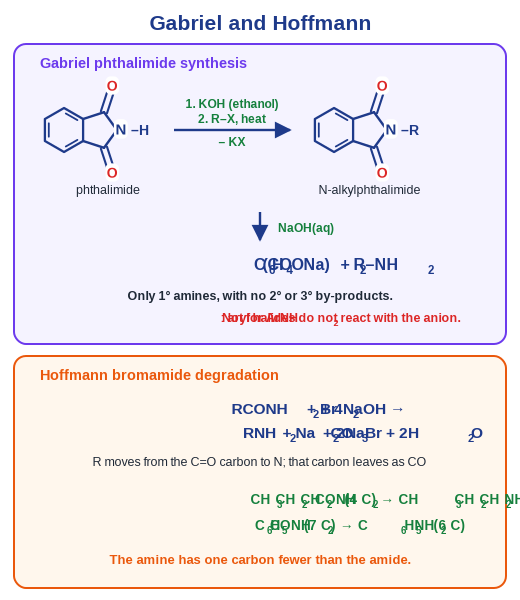
- (vii) It gives only primary amines. The nitrogen of phthalimide can take just one alkyl group, so unlike ammonolysis there is no mixture of secondary and tertiary amines or quaternary salt, and the primary amine is obtained pure. (It does not work for aromatic amines; see 9.12.)
9.4 “Arrange the following: (i) In decreasing order of the pKb values: C₂H₅NH₂, C₆H₅NHCH₃, (C₂H₅)₂NH and C₆H₅NH₂ (ii) In increasing order of basic strength: C₆H₅NH₂, C₆H₅N(CH₃)₂, (C₂H₅)₂NH and CH₃NH₂ (iii) In increasing order of basic strength: (a) Aniline, p-nitroaniline and p-toluidine (b) C₆H₅NH₂, C₆H₅NHCH₃, C₆H₅CH₂NH₂. (iv) In decreasing order of basic strength in gas phase: C₂H₅NH₂, (C₂H₅)₂NH, (C₂H₅)₃N and NH₃ (v) In increasing order of boiling point: C₂H₅OH, (CH₃)₂NH, C₂H₅NH₂ (vi) In increasing order of solubility in water: C₆H₅NH₂, (C₂H₅)₂NH, C₂H₅NH₂.”
- (i) C₆H₅NH₂ (9.38) > C₆H₅NHCH₃ (9.30) > C₂H₅NH₂ (3.29) > (C₂H₅)₂NH (3.00). Note: the book’s answer key prints this sequence with “<” signs, which is the order of increasing basic strength; read as pKb values, the signs must be “>”, because the question asks for decreasing pKb.
- (ii) C₆H₅NH₂ (9.38) < C₆H₅N(CH₃)₂ (8.92) < CH₃NH₂ (3.38) < (C₂H₅)₂NH (3.00), as in the answer key.
- (iii) (a) p-nitroaniline < aniline < p-toluidine: –NO₂ withdraws electrons and –CH₃ releases them. (b) C₆H₅NH₂ (9.38) < C₆H₅NHCH₃ (9.30) < C₆H₅CH₂NH₂ (4.70): in benzylamine the –NH₂ is not on the ring. Both as in the answer key.
- (iv) (C₂H₅)₃N > (C₂H₅)₂NH > C₂H₅NH₂ > NH₃. In the gas phase there is no solvation, so only the +I effect counts. As in the answer key.
- (v) (CH₃)₂NH < C₂H₅NH₂ < C₂H₅OH. The masses are close (45, 45, 46). A primary amine has two N–H hydrogens for hydrogen bonding and a secondary amine one; an alcohol’s O–H forms stronger hydrogen bonds because oxygen is more electronegative. As in the answer key.
- (vi) C₆H₅NH₂ < (C₂H₅)₂NH < C₂H₅NH₂. The larger the hydrophobic part, the less soluble: phenyl is the largest, then two ethyl groups, then one. As in the answer key.
Exercises 9.5 to 9.8: conversions and notes
9.5 “How will you convert: (i) Ethanoic acid into methanamine (ii) Hexanenitrile into 1-aminopentane (iii) Methanol to ethanoic acid (iv) Ethanamine into methanamine (v) Ethanoic acid into propanoic acid (vi) Methanamine into ethanamine (vii) Nitromethane into dimethylamine (viii) Propanoic acid into ethanoic acid?”
- (i) Make the amide, then lose a carbon by the Hoffmann reaction. CH₃COOH + NH₃ → CH₃COONH₄; heat: CH₃COONH₄ → CH₃CONH₂ + H₂O; CH₃CONH₂ + Br₂ + 4NaOH → CH₃NH₂ + Na₂CO₃ + 2NaBr + 2H₂O.
- (ii) Hexanenitrile (6 C) to pentan-1-amine (5 C): partial hydrolysis to the amide, then Hoffmann. CH₃(CH₂)₄CN + H₂O → CH₃(CH₂)₄CONH₂; CH₃(CH₂)₄CONH₂ + Br₂ + 4NaOH → CH₃(CH₂)₄NH₂ + Na₂CO₃ + 2NaBr + 2H₂O.
- (iii) Add a carbon through the nitrile. CH₃OH + SOCl₂ → CH₃Cl + SO₂ + HCl; CH₃Cl + KCN → CH₃CN + KCl; acid hydrolysis: CH₃CN + 2H₂O + HCl → CH₃COOH + NH₄Cl.
- (iv) Remove the nitrogen, oxidise, then lose a carbon. C₂H₅NH₂ + HNO₂ → C₂H₅OH + N₂ + H₂O; with acidified K₂Cr₂O₇ or KMnO₄: CH₃CH₂OH + 2[O] → CH₃COOH + H₂O; then as in (i), CH₃COOH → CH₃CONH₂ → CH₃NH₂.
- (v) Reduce, make the chloride, add a carbon through the nitrile. CH₃COOH + 4[H] → CH₃CH₂OH + H₂O (LiAlH₄); CH₃CH₂OH + SOCl₂ → CH₃CH₂Cl + SO₂ + HCl; CH₃CH₂Cl + KCN → CH₃CH₂CN + KCl; CH₃CH₂CN + 2H₂O + HCl → CH₃CH₂COOH + NH₄Cl.
- (vi) Turn the amine into the chloride, then add a carbon. CH₃NH₂ + HNO₂ → CH₃OH + N₂ + H₂O; CH₃OH + SOCl₂ → CH₃Cl + SO₂ + HCl; CH₃Cl + KCN → CH₃CN + KCl; CH₃CN + 4[H] → CH₃CH₂NH₂ (LiAlH₄ or H₂/Ni).
- (vii) Reduce to methanamine, make the isocyanide, then reduce it. CH₃NO₂ + 6[H] → CH₃NH₂ + 2H₂O (Sn/HCl); CH₃NH₂ + CHCl₃ + 3KOH → CH₃NC + 3KCl + 3H₂O; CH₃NC + 4[H] → CH₃NHCH₃. Extra: the last step, reducing an isocyanide with H₂/Pt or LiAlH₄ to a secondary amine, is not in the book. Within the book, methanamine and one mole of CH₃Cl give dimethylamine, but as part of a mixture (alkylation).
- (viii) Lose a carbon by the Hoffmann reaction, then turn –NH₂ into –OH and oxidise. CH₃CH₂COOH + NH₃ → CH₃CH₂COONH₄; heat: CH₃CH₂COONH₄ → CH₃CH₂CONH₂ + H₂O; CH₃CH₂CONH₂ + Br₂ + 4NaOH → CH₃CH₂NH₂ + Na₂CO₃ + 2NaBr + 2H₂O; CH₃CH₂NH₂ + HNO₂ → CH₃CH₂OH + N₂ + H₂O; CH₃CH₂OH + 2[O] → CH₃COOH + H₂O.
9.6 “Describe a method for the identification of primary, secondary and tertiary amines. Also write chemical equations of the reactions involved.”
Hinsberg test (benzenesulphonyl chloride; today p-toluenesulphonyl chloride). Shake the amine with the reagent and then with aqueous alkali:
- Primary amine: a sulphonamide forms that dissolves in the alkali, because its N–H hydrogen is made acidic by the sulphonyl group. C₆H₅SO₂Cl + C₂H₅NH₂ → C₆H₅SO₂NHC₂H₅ + HCl; C₆H₅SO₂NHC₂H₅ + NaOH → [C₆H₅SO₂NC₂H₅]⁻Na⁺ + H₂O (Extra: the soluble sodium salt, written out).
- Secondary amine: a sulphonamide forms that has no N–H and does not dissolve in alkali. C₆H₅SO₂Cl + (C₂H₅)₂NH → C₆H₅SO₂N(C₂H₅)₂ + HCl.
- Tertiary amine: no reaction.
A primary amine can be confirmed by the carbylamine test: RNH₂ + CHCl₃ + 3KOH → RNC + 3KCl + 3H₂O, which secondary and tertiary amines do not give.
9.7 “Write short notes on the following: (i) Carbylamine reaction (ii) Diazotisation (iii) Hofmann’s bromamide reaction (iv) Coupling reaction (v) Ammonolysis (vi) Acetylation (vii) Gabriel phthalimide synthesis.”
- (i) Carbylamine reaction: when a primary amine, aliphatic or aromatic, is heated with chloroform and ethanolic KOH, an isocyanide (carbylamine) forms, which the book calls foul smelling; 2° and 3° amines give no such product. It is the test for primary amines. C₆H₅NH₂ + CHCl₃ + 3KOH → C₆H₅NC + 3KCl + 3H₂O.
- (ii) Diazotisation: the conversion of a primary aromatic amine into a diazonium salt with nitrous acid (NaNO₂ + HCl) at 273–278 K. C₆H₅NH₂ + NaNO₂ + 2HCl → C₆H₅N₂⁺Cl⁻ + NaCl + 2H₂O. The salt is used at once because it is unstable.
- (iii) Hoffmann bromamide reaction: an amide heated with Br₂ and aqueous or ethanolic NaOH gives a primary amine with one carbon fewer; the alkyl or aryl group migrates from the carbonyl carbon to nitrogen. C₆H₅CONH₂ + Br₂ + 4NaOH → C₆H₅NH₂ + Na₂CO₃ + 2NaBr + 2H₂O.
- (iv) Coupling reaction: a diazonium salt reacts with phenol (in alkali) or aniline (in acid) at the para position, keeping the –N=N– link, to give coloured azo compounds used as dyes. C₆H₅N₂⁺Cl⁻ + C₆H₅OH + OH⁻ → C₆H₅N=NC₆H₄OH + Cl⁻ + H₂O (p-hydroxyazobenzene, orange). It is an electrophilic substitution.
- (v) Ammonolysis: an alkyl or benzyl halide heated with ethanolic ammonia at 373 K, in a sealed tube; NH₃ replaces the halogen. C₂H₅Cl + NH₃ → C₂H₅NH₃⁺Cl⁻, and a base gives the amine. Further alkylation gives secondary and tertiary amines and a quaternary salt; excess ammonia favours the primary amine.
- (vi) Acetylation: replacing an N–H hydrogen of a primary or secondary amine by an acetyl group, CH₃CO–, with acetyl chloride or acetic anhydride, in the presence of a base such as pyridine. C₆H₅NH₂ + (CH₃CO)₂O → C₆H₅NHCOCH₃ + CH₃COOH (acetanilide). It is used to protect –NH₂ and lower its activating effect.
- (vii) Gabriel phthalimide synthesis: phthalimide with ethanolic KOH gives potassium phthalimide; heating with an alkyl halide gives an N-alkylphthalimide; alkaline hydrolysis gives the primary amine. C₆H₄(CO)₂NR + 2NaOH → C₆H₄(COONa)₂ + RNH₂. Only primary aliphatic amines are obtained.
9.8 “Accomplish the following conversions: (i) Nitrobenzene to benzoic acid (ii) Benzene to m-bromophenol (iii) Benzoic acid to aniline (iv) Aniline to 2,4,6-tribromofluorobenzene (v) Benzyl chloride to 2-phenylethanamine (vi) Chlorobenzene to p-chloroaniline (vii) Aniline to p-bromoaniline (viii) Benzamide to toluene (ix) Aniline to benzyl alcohol.”
- (i) Reduce, diazotise, bring in CN, hydrolyse. C₆H₅NO₂ + 6[H] → C₆H₅NH₂ + 2H₂O (Sn/HCl); C₆H₅NH₂ + NaNO₂ + 2HCl → C₆H₅N₂⁺Cl⁻ + NaCl + 2H₂O (273–278 K); C₆H₅N₂Cl + CuCN → C₆H₅CN + N₂ + CuCl; C₆H₅CN + 2H₂O + HCl → C₆H₅COOH + NH₄Cl.
- (ii) Nitrate first, because –NO₂ directs the bromine to the meta position; then turn –NO₂ into –OH. C₆H₆ + HNO₃ → C₆H₅NO₂ + H₂O (conc. H₂SO₄); C₆H₅NO₂ + Br₂ → BrC₆H₄NO₂ + HBr (FeBr₃; m-bromonitrobenzene); BrC₆H₄NO₂ + 6[H] → BrC₆H₄NH₂ + 2H₂O; BrC₆H₄NH₂ + NaNO₂ + 2HCl → BrC₆H₄N₂Cl + NaCl + 2H₂O; warm: BrC₆H₄N₂Cl + H₂O → BrC₆H₄OH + N₂ + HCl.
- (iii) Make benzamide, then Hoffmann. C₆H₅COOH + NH₃ → C₆H₅COONH₄; heat: C₆H₅COONH₄ → C₆H₅CONH₂ + H₂O; C₆H₅CONH₂ + Br₂ + 4NaOH → C₆H₅NH₂ + Na₂CO₃ + 2NaBr + 2H₂O.
- (iv) Brominate all three activated positions, then swap –NH₂ for F through the fluoroborate. C₆H₅NH₂ + 3Br₂ → C₆H₂Br₃NH₂ + 3HBr; C₆H₂Br₃NH₂ + NaNO₂ + 2HCl → C₆H₂Br₃N₂Cl + NaCl + 2H₂O; C₆H₂Br₃N₂Cl + HBF₄ → C₆H₂Br₃N₂BF₄ + HCl; heat: C₆H₂Br₃N₂BF₄ → C₆H₂Br₃F + BF₃ + N₂.
- (v) Add a carbon through the nitrile, then reduce. C₆H₅CH₂Cl + KCN → C₆H₅CH₂CN + KCl (ethanolic); C₆H₅CH₂CN + 4[H] → C₆H₅CH₂CH₂NH₂ (LiAlH₄ or H₂/Ni).
- (vi) Cl is ortho, para-directing; nitrate, separate the para isomer, reduce. C₆H₅Cl + HNO₃ → ClC₆H₄NO₂ + H₂O (conc. H₂SO₄; p-isomer separated from the o-isomer); ClC₆H₄NO₂ + 6[H] → ClC₆H₄NH₂ + 2H₂O (Sn/HCl or Fe/HCl).
- (vii) Protect, brominate, deprotect. C₆H₅NH₂ + (CH₃CO)₂O → C₆H₅NHCOCH₃ + CH₃COOH (pyridine); C₆H₅NHCOCH₃ + Br₂ → BrC₆H₄NHCOCH₃ + HBr (in CH₃COOH; para product major); hydrolysis with OH⁻ or H⁺: BrC₆H₄NHCOCH₃ + H₂O → BrC₆H₄NH₂ + CH₃COOH.
- (viii) Hoffmann to aniline, remove the nitrogen to get benzene, then add a methyl group. C₆H₅CONH₂ + Br₂ + 4NaOH → C₆H₅NH₂ + Na₂CO₃ + 2NaBr + 2H₂O; diazotise; C₆H₅N₂Cl + H₃PO₂ + H₂O → C₆H₆ + N₂ + H₃PO₃ + HCl; C₆H₆ + CH₃Cl → C₆H₅CH₃ + HCl (anhydrous AlCl₃; Friedel–Crafts alkylation, from Class 11).
- (ix) Diazotise, bring in CN, reduce to benzylamine, then nitrous acid. C₆H₅N₂Cl + CuCN → C₆H₅CN + N₂ + CuCl; C₆H₅CN + 4[H] → C₆H₅CH₂NH₂ (LiAlH₄); C₆H₅CH₂NH₂ + HNO₂ → C₆H₅CH₂OH + N₂ + H₂O.
Exercises 9.9 to 9.14: unknowns, reactions and reasons
9.9 “Give the structures of A, B and C in the following reactions:” The book draws six schemes; each is written here in words.
- (i) CH₃CH₂I, NaCN → A, OH⁻ (partial hydrolysis) → B, NaOH + Br₂ → C. A = CH₃CH₂CN (propanenitrile); B = CH₃CH₂CONH₂ (propanamide); C = CH₃CH₂NH₂ (ethanamine). CH₃CH₂I + NaCN → CH₃CH₂CN + NaI; CH₃CH₂CN + H₂O → CH₃CH₂CONH₂; CH₃CH₂CONH₂ + Br₂ + 4NaOH → CH₃CH₂NH₂ + Na₂CO₃ + 2NaBr + 2H₂O.
- (ii) C₆H₅N₂Cl, CuCN → A, H₂O/H⁺ → B, NH₃ and heat → C. A = C₆H₅CN (benzonitrile); B = C₆H₅COOH (benzoic acid); C = C₆H₅CONH₂ (benzamide). C₆H₅N₂Cl + CuCN → C₆H₅CN + N₂ + CuCl; C₆H₅CN + 2H₂O + HCl → C₆H₅COOH + NH₄Cl; C₆H₅COOH + NH₃ → C₆H₅CONH₂ + H₂O (through the ammonium salt, on heating).
- (iii) CH₃CH₂Br, KCN → A, LiAlH₄ → B, HNO₂ at 0 °C → C. A = CH₃CH₂CN (propanenitrile); B = CH₃CH₂CH₂NH₂ (propan-1-amine); C = CH₃CH₂CH₂OH (propan-1-ol), with N₂ given off, because an aliphatic diazonium salt is not stable even at 0 °C (273 K). CH₃CH₂Br + KCN → CH₃CH₂CN + KBr; CH₃CH₂CN + 4[H] → CH₃CH₂CH₂NH₂; CH₃CH₂CH₂NH₂ + HNO₂ → CH₃CH₂CH₂OH + N₂ + H₂O.
- (iv) C₆H₅NO₂, Fe/HCl → A, NaNO₂ + HCl at 273 K → B, H₂O/H⁺ and heat → C. A = C₆H₅NH₂ (aniline); B = C₆H₅N₂⁺Cl⁻ (benzenediazonium chloride); C = C₆H₅OH (phenol). C₆H₅NO₂ + 6[H] → C₆H₅NH₂ + 2H₂O; C₆H₅NH₂ + NaNO₂ + 2HCl → C₆H₅N₂⁺Cl⁻ + NaCl + 2H₂O; C₆H₅N₂Cl + H₂O → C₆H₅OH + N₂ + HCl.
- (v) CH₃COOH, NH₃ and heat → A, NaOBr → B, NaNO₂/HCl → C. A = CH₃CONH₂ (ethanamide); B = CH₃NH₂ (methanamine); C = CH₃OH (methanol). CH₃COOH + NH₃ → CH₃CONH₂ + H₂O (through the ammonium salt); CH₃CONH₂ + NaOBr + 2NaOH → CH₃NH₂ + Na₂CO₃ + NaBr + H₂O; CH₃NH₂ + HNO₂ → CH₃OH + N₂ + H₂O.
- (vi) C₆H₅NO₂, Fe/HCl → A, HNO₂ at 273 K → B, C₆H₅OH → C. A = C₆H₅NH₂ (aniline); B = C₆H₅N₂⁺Cl⁻ (benzenediazonium chloride); C = C₆H₅N=N–C₆H₄–OH with –OH para (p-hydroxyazobenzene, an orange azo dye). C₆H₅N₂Cl + C₆H₅OH → C₆H₅N=NC₆H₄OH + HCl (in alkali, which takes up the HCl).
9.10 “An aromatic compound ‘A’ on treatment with aqueous ammonia and heating forms compound ‘B’ which on heating with Br₂ and KOH forms a compound ‘C’ of molecular formula C₆H₇N. Write the structures and IUPAC names of compounds A, B and C.”
C₆H₇N is C₆H₅NH₂, aniline. Br₂ and KOH is the Hoffmann bromamide reaction, so B is the amide with one carbon more, benzamide, and A, which gives an amide with ammonia and heat, is benzoic acid.
| Structure | IUPAC name | |
|---|---|---|
| A | C₆H₅COOH | benzoic acid (benzenecarboxylic acid) |
| B | C₆H₅CONH₂ | benzamide (benzenecarboxamide) |
| C | C₆H₅NH₂ | aniline (benzenamine) |
C₆H₅COOH + NH₃ → C₆H₅COONH₄; C₆H₅COONH₄ → C₆H₅CONH₂ + H₂O; C₆H₅CONH₂ + Br₂ + 4KOH → C₆H₅NH₂ + K₂CO₃ + 2KBr + 2H₂O.
The answer key does not print this question.
9.11 “Complete the following reactions: (i) C₆H₅NH₂ + CHCl₃ + alc.KOH → (ii) C₆H₅N₂Cl + H₃PO₂ + H₂O → (iii) C₆H₅NH₂ + H₂SO₄ (conc.) → (iv) C₆H₅N₂Cl + C₂H₅OH → (v) C₆H₅NH₂ + Br₂ (aq) → (vi) C₆H₅NH₂ + (CH₃CO)₂O → (vii) C₆H₅N₂Cl → [(i) HBF₄ (ii) NaNO₂/Cu, Δ]” (the reagents in (vii) are written over the arrow in the book).
- (i) C₆H₅NH₂ + CHCl₃ + 3KOH → C₆H₅NC + 3KCl + 3H₂O: phenyl isocyanide (carbylamine reaction).
- (ii) C₆H₅N₂Cl + H₃PO₂ + H₂O → C₆H₆ + N₂ + H₃PO₃ + HCl: benzene.
- (iii) C₆H₅NH₂ + H₂SO₄ → C₆H₅NH₃⁺HSO₄⁻: anilinium hydrogensulphate; heated at 453–473 K it gives sulphanilic acid, C₆H₅NH₃⁺HSO₄⁻ → H₂NC₆H₄SO₃H + H₂O.
- (iv) C₆H₅N₂Cl + C₂H₅OH → C₆H₆ + N₂ + CH₃CHO + HCl: benzene; ethanol is oxidised to ethanal.
- (v) C₆H₅NH₂ + 3Br₂ → C₆H₂Br₃NH₂ + 3HBr: 2,4,6-tribromoaniline, which comes down as a white solid.
- (vi) C₆H₅NH₂ + (CH₃CO)₂O → C₆H₅NHCOCH₃ + CH₃COOH: acetanilide (N-phenylethanamide).
- (vii) C₆H₅N₂Cl + HBF₄ → C₆H₅N₂BF₄ + HCl; C₆H₅N₂BF₄ + NaNO₂ → C₆H₅NO₂ + N₂ + NaBF₄: nitrobenzene.
9.12 “Why cannot aromatic primary amines be prepared by Gabriel phthalimide synthesis?”
The key step is a nucleophilic substitution: the phthalimide anion must replace the halogen of the halide. This anion cannot displace the halogen of an aryl halide (the C–X bond of a haloarene has partial double-bond character and the ring repels the nucleophile, Unit 6), so no N-arylphthalimide forms and no aromatic amine can be obtained.
9.13 “Write the reactions of (i) aromatic and (ii) aliphatic primary amines with nitrous acid.”
Nitrous acid is made in the mixture from NaNO₂ and HCl.
- (i) Aromatic: at 273–278 K a diazonium salt forms. C₆H₅NH₂ + NaNO₂ + 2HCl → C₆H₅N₂⁺Cl⁻ + NaCl + 2H₂O.
- (ii) Aliphatic: the aliphatic diazonium salt is unstable and at once gives nitrogen and an alcohol. RNH₂ + HNO₂ → ROH + N₂ + H₂O, for example CH₃CH₂NH₂ + HNO₂ → CH₃CH₂OH + N₂ + H₂O. The nitrogen comes off quantitatively, which is used to estimate amino acids and proteins.
9.14 “Give plausible explanation for each of the following: (i) Why are amines less acidic than alcohols of comparable molecular masses? (ii) Why do primary amines have higher boiling point than tertiary amines? (iii) Why are aliphatic amines stronger bases than aromatic amines?”
- (i) Losing a proton from an amine gives RNH⁻ and from an alcohol RO⁻. Nitrogen (electronegativity 3.0) holds a negative charge less well than oxygen (3.5), so RNH⁻ is the less stable anion and the N–H proton is given up less readily. Amines are therefore less acidic than alcohols.
- (ii) A primary amine has two hydrogens on nitrogen and its molecules are held together by intermolecular hydrogen bonds. A tertiary amine has no N–H hydrogen and cannot form them, so less energy is needed to separate its molecules. For isomers, the boiling points run 1° > 2° > 3° (Table 9.2: 350.8 K, 329.3 K, 310.5 K).
- (iii) In aliphatic amines alkyl groups push electrons onto nitrogen (+I) and stabilise the ammonium ion, so the lone pair is readily available. In aromatic amines the lone pair is in conjugation with the ring and less available, and the ring withdraws electrons; the amine (five resonance structures) is also more stabilised than its ion (two). So aliphatic amines (pKb about 3 to 4.2) are much stronger bases than aniline (9.38).
Intext Questions
Intext 9.1 (page 262): classify four amines.
- (i) –NH₂ on a naphthalene ring (naphthalen-1-amine): primary.
- (ii) –N(CH₃)₂ on a naphthalene ring (N,N-dimethylnaphthalen-1-amine): tertiary.
- (iii) (C₂H₅)₂CHNH₂ (pentan-3-amine): primary; one carbon group on nitrogen.
- (iv) (C₂H₅)₂NH (N-ethylethanamine): secondary.
Intext 9.2 (page 262): isomeric amines of C₄H₁₁N, their names and the isomerism.
| Structure | IUPAC name | Class | |
|---|---|---|---|
| 1 | CH₃CH₂CH₂CH₂NH₂ | butan-1-amine | 1° |
| 2 | CH₃CH₂CH(NH₂)CH₃ | butan-2-amine | 1° |
| 3 | (CH₃)₂CHCH₂NH₂ | 2-methylpropan-1-amine | 1° |
| 4 | (CH₃)₃CNH₂ | 2-methylpropan-2-amine | 1° |
| 5 | CH₃CH₂CH₂NHCH₃ | N-methylpropan-1-amine | 2° |
| 6 | (CH₃)₂CHNHCH₃ | N-methylpropan-2-amine | 2° |
| 7 | CH₃CH₂NHCH₂CH₃ | N-ethylethanamine | 2° |
| 8 | CH₃CH₂N(CH₃)₂ | N,N-dimethylethanamine | 3° |
(iii) Pairs show chain isomerism (1 and 3: straight and branched chain), position isomerism (1 and 2: –NH₂ at different carbons), metamerism (5 and 7: different groups on the same nitrogen) and functional isomerism (a 1°, a 2° and a 3° amine, such as 1, 5 and 8). Extra: butan-2-amine has a chiral carbon, so it also exists as two optical isomers.
Intext 9.3 (page 265): three conversions.
- (i) Benzene → aniline: C₆H₆ + HNO₃ → C₆H₅NO₂ + H₂O (conc. H₂SO₄); C₆H₅NO₂ + 6[H] → C₆H₅NH₂ + 2H₂O (Sn/HCl or Fe/HCl).
- (ii) Benzene → N,N-dimethylaniline: make aniline as in (i), then alkylate with two moles of CH₃Cl: C₆H₅NH₂ + 2CH₃Cl → C₆H₅N(CH₃)₂ + 2HCl.
- (iii) Cl–(CH₂)₄–Cl → hexane-1,6-diamine: add a carbon at each end through the nitrile, then reduce. Cl(CH₂)₄Cl + 2KCN → NC(CH₂)₄CN + 2KCl (ethanolic); NC(CH₂)₄CN + 8[H] → H₂N(CH₂)₆NH₂ (LiAlH₄ or H₂/Ni). The book prints the name as “hexan-1,6-diamine”; with two –NH₂ groups the e of hexane is kept, as in its own Table 9.1, so hexane-1,6-diamine.
Intext 9.4 (page 274): increasing basic strength.
- (i) C₆H₅NH₂ < NH₃ < C₆H₅CH₂NH₂ < C₂H₅NH₂ < (C₂H₅)₂NH (pKb 9.38, 4.75, 4.70, 3.29, 3.00).
- (ii) C₆H₅NH₂ < C₂H₅NH₂ < (C₂H₅)₃N < (C₂H₅)₂NH (9.38, 3.29, 3.25, 3.00).
- (iii) C₆H₅NH₂ < C₆H₅CH₂NH₂ < (CH₃)₃N < CH₃NH₂ < (CH₃)₂NH (9.38, 4.70, 4.22, 3.38, 3.27).
All three match the answers printed on page 280.
Intext 9.5 (page 274): complete and name.
- (i) CH₃CH₂CH₂NH₂ + HCl → CH₃CH₂CH₂NH₃⁺Cl⁻: propylammonium chloride (propan-1-aminium chloride).
- (ii) (C₂H₅)₃N + HCl → (C₂H₅)₃NH⁺Cl⁻: triethylammonium chloride (N,N-diethylethanaminium chloride).
Intext 9.6 (page 274): aniline with excess methyl iodide and sodium carbonate. Methylation goes all the way to the quaternary salt, N,N,N-trimethylanilinium iodide; sodium carbonate removes the HI formed in the first two steps.
C₆H₅NH₂ + CH₃I → C₆H₅NHCH₃ + HI; C₆H₅NHCH₃ + CH₃I → C₆H₅N(CH₃)₂ + HI; C₆H₅N(CH₃)₂ + CH₃I → C₆H₅N(CH₃)₃⁺I⁻; Na₂CO₃ + 2HI → 2NaI + H₂O + CO₂.
Intext 9.7 (page 274): aniline with benzoyl chloride. C₆H₅NH₂ + C₆H₅COCl → C₆H₅NHCOC₆H₅ + HCl. The product is N-phenylbenzamide (benzanilide); this is benzoylation.
Intext 9.8 (page 274): isomers of C₃H₉N, and which give nitrogen with nitrous acid.
| Structure | IUPAC name | Class |
|---|---|---|
| CH₃CH₂CH₂NH₂ | propan-1-amine | 1° |
| (CH₃)₂CHNH₂ | propan-2-amine | 1° |
| CH₃CH₂NHCH₃ | N-methylethanamine | 2° |
| (CH₃)₃N | N,N-dimethylmethanamine | 3° |
Only the primary aliphatic amines, propan-1-amine and propan-2-amine, liberate nitrogen: CH₃CH₂CH₂NH₂ + HNO₂ → CH₃CH₂CH₂OH + N₂ + H₂O; (CH₃)₂CHNH₂ + HNO₂ → (CH₃)₂CHOH + N₂ + H₂O.
Intext 9.9 (page 277): two conversions.
- (i) 3-Methylaniline → 3-nitrotoluene: diazotise, make the fluoroborate, then replace by –NO₂. CH₃C₆H₄NH₂ + NaNO₂ + 2HCl → CH₃C₆H₄N₂Cl + NaCl + 2H₂O; CH₃C₆H₄N₂Cl + HBF₄ → CH₃C₆H₄N₂BF₄ + HCl; CH₃C₆H₄N₂BF₄ + NaNO₂ → CH₃C₆H₄NO₂ + N₂ + NaBF₄ (Cu, heat).
- (ii) Aniline → 1,3,5-tribromobenzene: brominate, diazotise, then remove the nitrogen. C₆H₅NH₂ + 3Br₂ → C₆H₂Br₃NH₂ + 3HBr; C₆H₂Br₃NH₂ + NaNO₂ + 2HCl → C₆H₂Br₃N₂Cl + NaCl + 2H₂O; C₆H₂Br₃N₂Cl + H₃PO₂ + H₂O → C₆H₃Br₃ + N₂ + H₃PO₃ + HCl.
Worked examples
Example 9.1 (page 263): ammonolysis equations. (i) Chloroethane with ethanolic ammonia gives ethanamine, which reacts on with more chloroethane: C₂H₅NH₂ → N-ethylethanamine → N,N-diethylethanamine → (C₂H₅)₄N⁺Cl⁻. First step: C₂H₅Cl + NH₃ → C₂H₅NH₂ + HCl (the HCl stays with the amine as its salt). (ii) Benzyl chloride gives benzylamine, and two moles of CH₃Cl then give N,N-dimethylphenylmethanamine: C₆H₅CH₂NH₂ + 2CH₃Cl → C₆H₅CH₂N(CH₃)₂ + 2HCl.
Example 9.2 (page 264): chain lengthening. (i) CH₃CH₂Cl + NaCN → CH₃CH₂CN + NaCl, then reduction to propan-1-amine. (ii) C₆H₅CH₂Cl + NaCN → C₆H₅CH₂CN + NaCl, then H₂/Ni to 2-phenylethanamine.
Example 9.3 (page 265): Hoffmann reaction. (i) Propanamine has three carbons, so the amide has four: butanamide, CH₃CH₂CH₂CONH₂. (ii) Benzamide (7 C) gives aniline, C₆H₅NH₂ (6 C).
Example 9.4 (page 270): decreasing basic strength. (C₂H₅)₂NH > C₂H₅NH₂ > NH₃ > C₆H₅NH₂ (pKb 3.00, 3.29, 4.75, 9.38).
Example 9.5 (page 277): 4-nitrotoluene → 2-bromobenzoic acid. Br₂ puts bromine next to –CH₃ (2-bromo-4-nitrotoluene); Sn/HCl reduces –NO₂ to –NH₂; NaNO₂/HCl at 273–278 K diazotises it; H₃PO₂ and water remove the diazonium group (2-bromotoluene); alkaline KMnO₄ oxidises –CH₃ to –COOH (2-bromobenzoic acid). The amino group is used only to place the bromine and is then removed.
Practice
-
The IUPAC name of (CH₃)₂CHCH₂NH₂ is:
Show answer
Answer: (a) 2-methylpropan-1-amine
-
Which compound gives an alkali-insoluble product with benzenesulphonyl chloride?
Show answer
Answer: (b) (CH₃)₂NH
-
Which amide gives butan-1-amine by the Hoffmann bromamide reaction?
Show answer
Answer: (b) pentanamide
-
Benzenediazonium chloride warmed with water gives:
Show answer
Answer: (c) phenol
-
Arrange in increasing basic strength: C₆H₅NH₂, NH₃, CH₃NH₂.
Show answer
Answer: C₆H₅NH₂ (pKb 9.38) < NH₃ (4.75) < CH₃NH₂ (3.38). Aniline’s lone pair is shared with the ring, while the methyl group pushes electrons onto nitrogen.
Stuck on a question?
Take a photo and Lagnever AI explains it step by step. Try it for 7 days for ₹2.
Get it on Google Play Open in browser
For parents: after the trial, the plan renews monthly by UPI or card autopay. You can cancel anytime in the app.