
Class 12 Chemistry Chapter 9: Amines Notes
This chapter in five lines
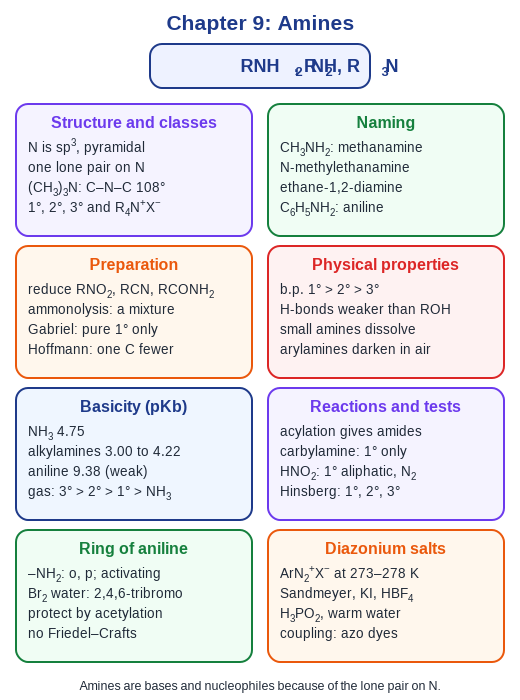
Amines are ammonia with one, two or three hydrogens replaced by alkyl or aryl groups. The lone pair on their pyramidal nitrogen makes them bases and nucleophiles. They are made by reducing nitro compounds, nitriles and amides, by ammonolysis, Gabriel synthesis and Hoffmann degradation. Aniline gives diazonium salts, which turn into aryl halides, phenols and azo dyes.
What is this chapter about?
Take ammonia, NH₃, and swap one or more of its hydrogen atoms for carbon groups. The result is an amine. Methylamine, CH₃NH₂, aniline, C₆H₅NH₂, dimethylamine, (CH₃)₂NH, and trimethylamine, (CH₃)₃N, are all amines. Amines occur in proteins, vitamins, alkaloids and hormones, and many dyes, polymers and medicines are made from them. The book’s examples: adrenaline and ephedrine (both with a secondary amino group) are used to raise blood pressure, novocain is an anaesthetic used by dentists, and the antihistamine benadryl has a tertiary amino group. Quaternary ammonium salts are surfactants. The second part of the chapter is about diazonium salts, which are made from aromatic amines and lead to a whole set of aromatic compounds, including azo dyes. This chapter is Unit 9, the fourth unit of Chemistry Part II.
How structures are written on this site. Condensed formulas: a group in brackets hangs from the atom written just before it, so CH₃CH(NH₂)CH₃ has the –NH₂ on the middle carbon. C₆H₅– (Ph) is phenyl, Ar is any aryl group, and o-, m-, p- mark 1,2-, 1,3- and 1,4- positions on a ring. In the mechanism drawings, red curved arrows show where an electron pair moves.
What does an amine look like?
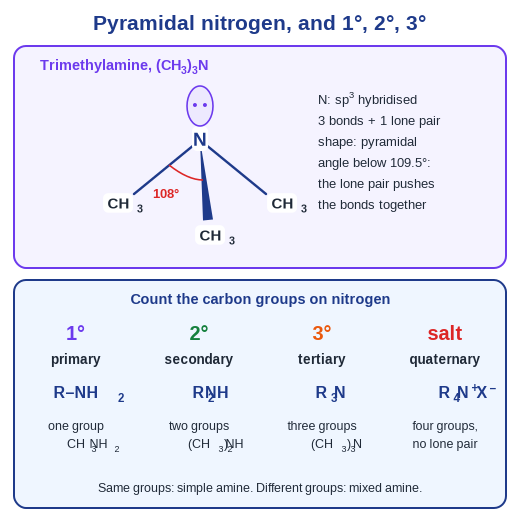
Like ammonia, the nitrogen of an amine makes three bonds and keeps one lone pair. Its orbitals are sp³ hybridised: three form bonds with hydrogen or carbon, and the fourth holds the lone pair. The shape is pyramidal. The lone pair pushes the bonds a little closer together, so the C–N–C angle is less than the tetrahedral 109.5°: the book gives 108° for trimethylamine.
Classification. Count the carbon groups on nitrogen:
- primary (1°): one group, RNH₂ or ArNH₂;
- secondary (2°): two groups, R₂NH or RNHR′;
- tertiary (3°): three groups, R₃N, R₂NR′ or RNR′R″.
An amine whose groups are all alike is called simple; one with different groups is mixed. A fourth group on nitrogen gives a quaternary ammonium salt, R₄N⁺X⁻.
How are amines named?
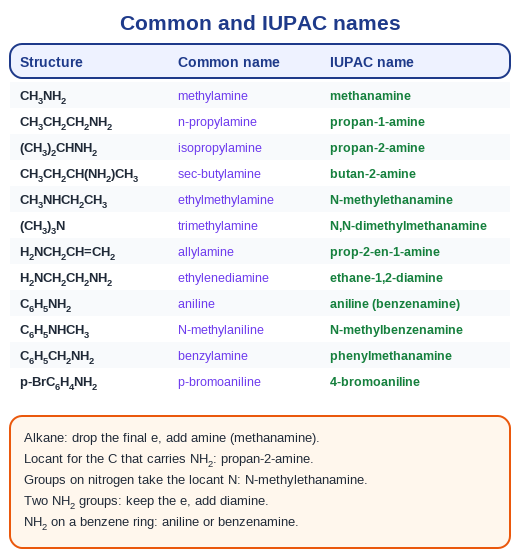
Common names. Write the alkyl group and add amine, as one word: methylamine, ethylmethylamine. Identical groups take di- or tri-: trimethylamine.
IUPAC names. Replace the final e of the alkane by amine: CH₃NH₂ is methanamine, CH₃CH₂CH₂NH₂ propan-1-amine. With two –NH₂ groups the e stays and the locants come first: H₂NCH₂CH₂NH₂ is ethane-1,2-diamine. For secondary and tertiary amines, the longest carbon chain on nitrogen is the parent, and the other groups on nitrogen get the locant N: CH₃NHCH₂CH₃ is N-methylethanamine and (CH₃CH₂)₃N is N,N-diethylethanamine.
Arylamines. When –NH₂ sits directly on a benzene ring the compound is an arylamine. C₆H₅NH₂ is aniline, which IUPAC accepts; its systematic name is benzenamine. p-Bromoaniline is 4-bromobenzenamine or 4-bromoaniline, and o-toluidine is 2-methylaniline.
How are amines prepared?
- Reduction of nitro compounds: H₂ over finely divided Ni, Pd or Pt, or a metal in acid. Iron scrap and HCl is preferred: the FeCl₂ formed is hydrolysed and gives back HCl, so only a little acid is needed to start. C₆H₅NO₂ + 3H₂ → C₆H₅NH₂ + 2H₂O
- Ammonolysis of alkyl halides: ethanolic NH₃ at 373 K, in a sealed tube, replaces X by –NH₂. The amine formed reacts again, so a mixture of 1°, 2°, 3° amines and the quaternary salt results; a large excess of ammonia favours the primary amine. Reactivity: RI > RBr > RCl.
- Reduction of nitriles (LiAlH₄, H₂/Ni, or Na(Hg) in ethanol): RCN + 4[H] → RCH₂NH₂. The amine has one carbon more than the alkyl halide that gave the nitrile, a way to step up a series.
- Reduction of amides with LiAlH₄, then water: RCONH₂ + 4[H] → RCH₂NH₂ + H₂O.
- Gabriel phthalimide synthesis: phthalimide → potassium phthalimide (ethanolic KOH) → N-alkylphthalimide (heat with RX) → primary amine (alkaline hydrolysis). Only primary amines form, and aromatic ones cannot, because aryl halides do not react with the phthalimide anion.
- Hoffmann bromamide degradation: RCONH₂ + Br₂ + 4NaOH → RNH₂ + Na₂CO₃ + 2NaBr + 2H₂O. The alkyl or aryl group moves from the carbonyl carbon to nitrogen, and the amine has one carbon fewer than the amide.
Read how amines are prepared.
What are their physical properties?
The lower aliphatic amines are gases; the book notes their fishy odour. Primary amines with three carbons or more are liquids, and higher ones solids. Pure aniline and other arylamines have no colour, but they darken on storage as air oxidises them.
Solubility. Small amines dissolve in water because they hydrogen bond with it; solubility falls as the hydrophobic alkyl part grows, and higher amines are essentially insoluble. Nitrogen (electronegativity 3.0) is less electronegative than oxygen (3.5), so amines hydrogen bond less strongly than alcohols: butan-1-ol is more soluble in water than butan-1-amine. Amines dissolve in alcohol, ether and benzene.
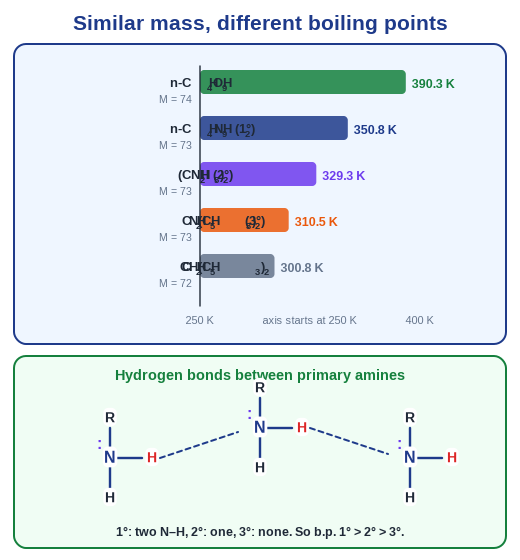
Boiling points. Primary amines have two N–H hydrogens for hydrogen bonding, secondary amines one and tertiary amines none, so for isomers the order is 1° > 2° > 3°. The book’s Table 9.2 compares compounds of mass 72 to 74: n-C₄H₉NH₂ 350.8 K, (C₂H₅)₂NH 329.3 K, C₂H₅N(CH₃)₂ 310.5 K, the alkane C₂H₅CH(CH₃)₂ 300.8 K and n-C₄H₉OH 390.3 K.
How basic are amines?
The lone pair on nitrogen takes a proton, so amines are bases (Lewis bases, as they donate an electron pair). They form salts with acids, and a strong base gives the amine back:
C₆H₅NH₂ + HCl ⇌ C₆H₅NH₃⁺Cl⁻ (anilinium chloride)
RNH₃⁺X⁻ + OH⁻ → RNH₂ + H₂O + X⁻
Amine salts dissolve in water but not in ether, which is how amines are separated from non-basic organic compounds. In water, RNH₂ + H₂O ⇌ RNH₃⁺ + OH⁻, and Kb = [RNH₃⁺][OH⁻]/[RNH₂], pKb = –log Kb. A smaller pKb means a stronger base.
- Alkylamines are stronger bases than ammonia (pKb 3.00 to 4.22 against 4.75). Alkyl groups push electrons towards nitrogen (+I effect), making the lone pair more available and spreading the positive charge of the ion formed.
- In the gas phase the order follows the +I effect: 3° > 2° > 1° > NH₃.
- In water the ammonium ion is also stabilised by hydrogen bonding with water. More N–H hydrogens mean more solvation, which favours 1° over 3°; bigger groups also block hydrogen bonding. The balance of the inductive effect, solvation and steric hindrance gives (C₂H₅)₂NH > (C₂H₅)₃N > C₂H₅NH₂ > NH₃ and (CH₃)₂NH > CH₃NH₂ > (CH₃)₃N > NH₃.
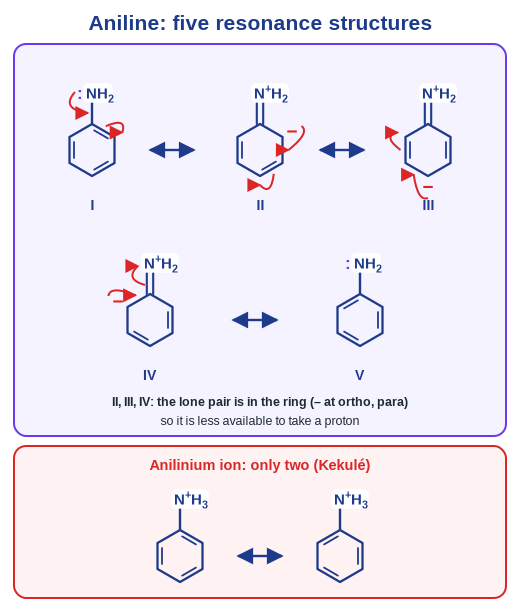
- Arylamines are much weaker bases (aniline 9.38). The lone pair is shared with the ring: aniline has five resonance structures, the anilinium ion only two, so taking a proton costs stability. Electron-releasing groups (–OCH₃, –CH₃) on the ring raise the basic strength; electron-withdrawing groups (–NO₂, –SO₃H, –COOH, –X) lower it.
Read the basicity of amines.
How do amines react?
Alkylation. Amines react with alkyl halides (Unit 6), going on to the quaternary salt.
Acylation. Primary and secondary amines (aliphatic or aromatic) react by nucleophilic substitution with acid chlorides, anhydrides and esters; an N–H hydrogen is replaced by an acyl group and an amide forms. A base stronger than the amine, such as pyridine, removes the HCl and pushes the equilibrium forward.
C₂H₅NH₂ + CH₃COCl → C₂H₅NHCOCH₃ + HCl (N-ethylethanamide)
C₆H₅NH₂ + (CH₃CO)₂O → C₆H₅NHCOCH₃ + CH₃COOH (acetanilide)
With benzoyl chloride the reaction is called benzoylation: CH₃NH₂ + C₆H₅COCl → CH₃NHCOC₆H₅ + HCl (N-methylbenzamide). With carboxylic acids at room temperature, amines simply form salts.
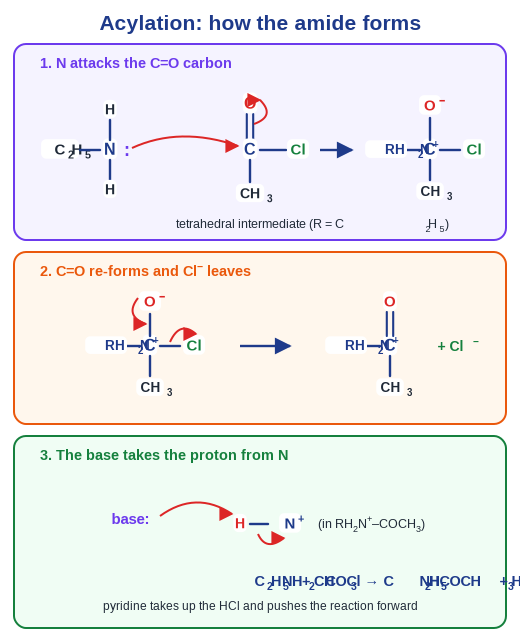
(Extra: the drawing splits the attack into two steps through a tetrahedral intermediate, the usual way of showing nucleophilic acyl substitution; the book shows the attack and the loss of HCl in one scheme.)
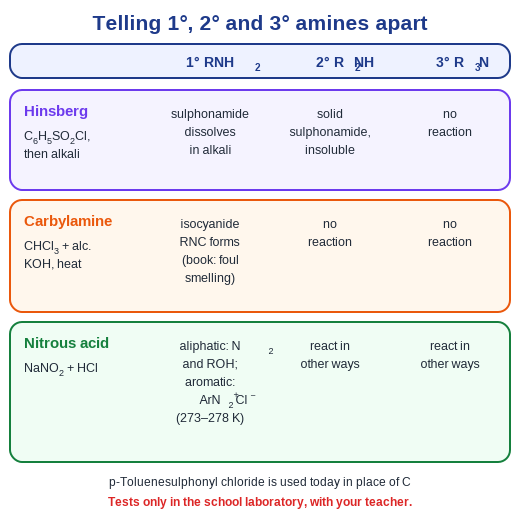
Carbylamine reaction. Only primary amines (aliphatic and aromatic), heated with chloroform and ethanolic KOH, give isocyanides (carbylamines), which the book describes as foul-smelling substances. It is a test for primary amines:
RNH₂ + CHCl₃ + 3KOH → RNC + 3KCl + 3H₂O
Nitrous acid (made in the mixture from NaNO₂ and a mineral acid):
- Primary aliphatic amines give unstable diazonium salts that at once lose nitrogen and give alcohols: RNH₂ + HNO₂ → ROH + N₂ + H₂O. The nitrogen comes off quantitatively, which is used to estimate amino acids and proteins.
- Primary aromatic amines at 273–278 K give diazonium salts: C₆H₅NH₂ + NaNO₂ + 2HCl → C₆H₅N₂⁺Cl⁻ + NaCl + 2H₂O.
- Secondary and tertiary amines react in other ways, which the book does not detail.
Hinsberg’s reagent (benzenesulphonyl chloride):
- 1°: C₆H₅SO₂Cl + C₂H₅NH₂ → C₆H₅SO₂NHC₂H₅ + HCl. The N–H hydrogen of the sulphonamide is strongly acidic (the sulphonyl group pulls electrons), so it dissolves in alkali.
- 2°: C₆H₅SO₂Cl + (C₂H₅)₂NH → C₆H₅SO₂N(C₂H₅)₂ + HCl. No N–H, so it is not acidic and does not dissolve in alkali.
- 3°: no reaction.
This distinguishes and separates the three classes. Today p-toluenesulphonyl chloride is used instead.
How does the ring of aniline react?
–NH₂ is a powerful activating, ortho- and para-directing group: the resonance structures put extra electron density at those positions.
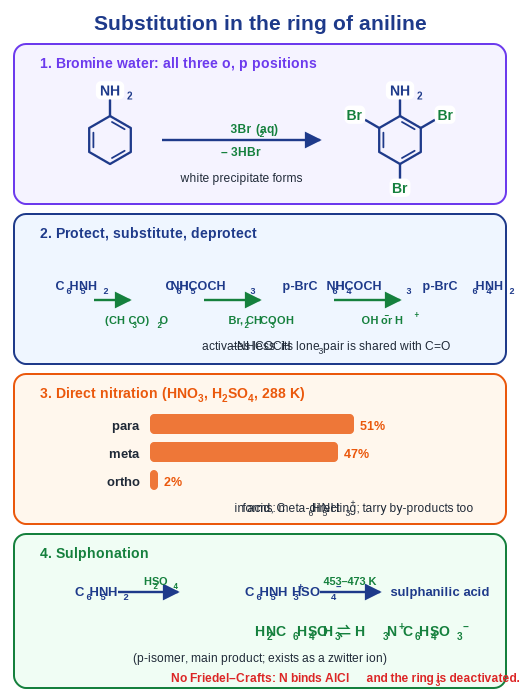
- Bromination: with bromine water at room temperature, 2,4,6-tribromoaniline separates at once as a white solid: C₆H₅NH₂ + 3Br₂ → C₆H₂Br₃NH₂ + 3HBr.
- Taming the –NH₂ group: acetylate it with acetic anhydride first. In acetanilide the nitrogen lone pair is also shared with the C=O oxygen by resonance, so –NHCOCH₃ activates the ring less. After the substitution, hydrolysis gives back the –NH₂. This is how p-bromoaniline and p-nitroaniline are made as the main products.
- Nitration: direct nitration gives tarry oxidation products as well as nitro compounds, and in strong acid much of the aniline becomes the meta-directing anilinium ion. With HNO₃ and H₂SO₄ at 288 K the book gives 51% para, 47% meta and 2% ortho product.
- Sulphonation: with concentrated H₂SO₄, aniline gives anilinium hydrogensulphate, which at 453–473 K gives sulphanilic acid (4-aminobenzenesulphonic acid), the main product; it exists as a zwitter ion.
- No Friedel–Crafts reaction: aniline forms a salt with the AlCl₃ catalyst, and the positively charged nitrogen strongly deactivates the ring.
What are diazonium salts?
Their general formula is RN₂⁺X⁻, where R is an aryl group and X⁻ is Cl⁻, Br⁻, HSO₄⁻, BF₄⁻ and so on. The name is the parent hydrocarbon + diazonium + the anion: C₆H₅N₂⁺Cl⁻ is benzenediazonium chloride. Alkyldiazonium salts are highly unstable; arenediazonium salts last a short time in solution at 273–278 K, because the positive charge is spread over the ring by resonance.
Preparation (diazotisation). Aniline with nitrous acid (from NaNO₂ and HCl) at 273–278 K. The salt is not usually stored; it is used straight after it is made.
Physical properties. Benzenediazonium chloride forms colourless crystals, readily soluble in water, stable in the cold but reacting with water when warmed, and it decomposes easily when dry. Benzenediazonium fluoroborate is insoluble in water and stable at room temperature.
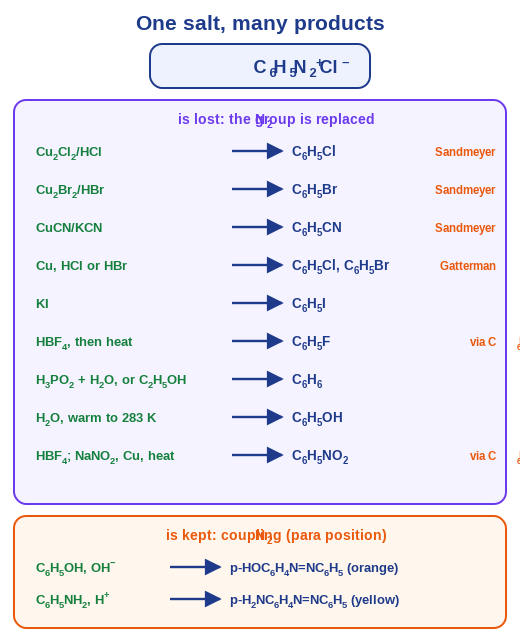
Reactions that replace the nitrogen (N₂ escapes as a gas):
- Cl, Br, CN with Cu(I): Sandmeyer reaction, e.g. C₆H₅N₂Cl + CuCN → C₆H₅CN + N₂ + CuCl; Cl or Br with copper powder and HX: Gatterman reaction (lower yield).
- I: C₆H₅N₂Cl + KI → C₆H₅I + KCl + N₂.
- F: C₆H₅N₂Cl + HBF₄ → C₆H₅N₂BF₄ + HCl, then heat: C₆H₅N₂BF₄ → C₆H₅F + BF₃ + N₂.
- H: C₆H₅N₂Cl + H₃PO₂ + H₂O → C₆H₆ + N₂ + H₃PO₃ + HCl, or with ethanol, which becomes ethanal.
- OH: let the solution warm to 283 K: C₆H₅N₂Cl + H₂O → C₆H₅OH + N₂ + HCl.
- NO₂: heat the fluoroborate with aqueous NaNO₂ and copper.
Reactions that keep the nitrogen (coupling). With phenol in alkali, p-hydroxyazobenzene (orange dye); with aniline in acid, p-aminoazobenzene (yellow dye). These are electrophilic substitutions at the para position.
Why they matter. Through diazonium salts, –F, –Cl, –Br, –I, –CN, –OH and –NO₂ can be put on a ring in positions and ways that direct substitution cannot manage: direct halogenation cannot give aryl fluorides and iodides, and the cyano group cannot be put in by substituting the Cl of chlorobenzene.
Read what diazonium salts are and how they react.
Stay safe
Many amines, aniline, chloroform, bromine, nitrous acid and the cyanides of the Sandmeyer reaction are toxic or corrosive, and diazonium salts decompose easily when dry. Any of these reactions is done only in the school laboratory with your teacher, never at home; never taste or smell a chemical.
Before we move on
Three skills carry this chapter: naming an amine and saying whether it is 1°, 2° or 3°, ranking amines by basic strength with reasons, and planning a conversion with the right reagent (Gabriel, Hoffmann, diazotisation, Sandmeyer and the rest). Every exercise, Intext Question and worked example of the unit is answered in the NCERT solutions for Chapter 9.
Key terms
| Term | Meaning |
|---|---|
| Amine | A compound made by replacing one, two or all three hydrogen atoms of ammonia by alkyl or aryl groups. The nitrogen is sp³ hybridised and pyramidal, with one lone pair. |
| Primary, secondary, tertiary amine | One, two or three hydrogens of NH₃ replaced: RNH₂ (1°), R₂NH or RNHR′ (2°), R₃N (3°). Simple amines carry identical groups, mixed amines different ones. |
| Quaternary ammonium salt | A salt R₄N⁺X⁻ with four carbon groups on nitrogen, the last product when an amine is alkylated again and again. |
| Ammonolysis | Breaking the C–X bond of an alkyl or benzyl halide with ethanolic ammonia (sealed tube, 373 K). It gives a mixture of 1°, 2° and 3° amines and the quaternary salt. |
| Gabriel phthalimide synthesis | Potassium phthalimide is heated with an alkyl halide and the product is hydrolysed with alkali. It gives only primary amines, and does not work for aromatic ones. |
| Hoffmann bromamide degradation | An amide heated with Br₂ and NaOH gives a primary amine with one carbon fewer: RCONH₂ → RNH₂. |
| Kb and pKb | Kb measures how far an amine takes a proton from water; pKb = –log Kb. A smaller pKb means a stronger base. NH₃ 4.75, CH₃NH₂ 3.38, aniline 9.38 (book values). |
| Acylation | Replacing an N–H hydrogen of a 1° or 2° amine by an acyl group (RCO–) using an acid chloride, anhydride or ester. The product is an amide; with benzoyl chloride it is called benzoylation. |
| Carbylamine (isocyanide) test | A primary amine heated with chloroform and ethanolic KOH gives an isocyanide, RNC, which the book describes as foul smelling. Secondary and tertiary amines do not react. |
| Hinsberg’s reagent | Benzenesulphonyl chloride, C₆H₅SO₂Cl. It gives an alkali-soluble sulphonamide with 1° amines, an alkali-insoluble one with 2° amines, and nothing with 3° amines. |
| Diazotisation | Converting a primary aromatic amine into a diazonium salt with NaNO₂ and HCl (nitrous acid made in the mixture) at 273–278 K. |
| Diazonium salt | A salt ArN₂⁺X⁻, such as benzenediazonium chloride, C₆H₅N₂⁺Cl⁻. The –N₂⁺ group is a very good leaving group. |
| Sandmeyer and Gatterman reactions | Replacing –N₂⁺ by Cl, Br or CN with Cu(I) salts (Sandmeyer), or by Cl or Br with copper powder and the halogen acid (Gatterman). The book notes the Sandmeyer yield is better. |
| Coupling reaction | A diazonium salt attacks the para position of phenol or aniline and joins the two rings through –N=N–. The products, azo compounds, are coloured and used as dyes. |
Topics in this chapter
Practice
-
The IUPAC name of CH₃NHCH₂CH₃ is:
Show answer
Answer: (a) N-methylethanamine
-
Which method gives a primary amine with one carbon atom fewer than the starting compound?
Show answer
Answer: (c) Hoffmann bromamide degradation
-
Which is the strongest base in water (book pKb values)?
Show answer
Answer: (c) (C₂H₅)₂NH
-
Which amine gives the carbylamine test?
Show answer
Answer: (d) C₆H₅NH₂
-
Benzenediazonium chloride with KI gives:
Show answer
Answer: (b) iodobenzene
Questions students ask
What are the main topics of Class 12 Chemistry Chapter 9, Amines?
The structure, classification and naming of amines, their preparation, their physical properties and their reactions (basic character, alkylation, acylation, the carbylamine reaction, nitrous acid, Hinsberg’s reagent and ring substitution in aniline), and then diazonium salts: their preparation, properties, reactions and use in making aromatic compounds.
Is Amines in the 2026-27 NCERT Class 12 Chemistry book?
Yes. It is Unit 9, the fourth unit of Chemistry Part II, the Class 12 textbook marked Reprint 2026-27, on pages 259 to 280. The book calls it a unit; here it is Chapter 9.
Why is aniline a weaker base than ammonia?
In aniline the nitrogen lone pair is in conjugation with the benzene ring, so it is less available to take a proton. Aniline has five resonance structures but the anilinium ion only two, so protonation costs aniline its extra stability. Its pKb is 9.38, against 4.75 for ammonia.
How do you tell primary, secondary and tertiary amines apart?
With Hinsberg’s reagent (benzenesulphonyl chloride): a primary amine gives a sulphonamide that dissolves in alkali, a secondary amine one that does not, and a tertiary amine does not react. The carbylamine test also picks out primary amines. These tests are done only in the school laboratory with your teacher.
Stuck on a question?
Take a photo and Lagnever AI explains it step by step. Try it for 7 days for ₹2.
Get it on Google Play Open in browser
For parents: after the trial, the plan renews monthly by UPI or card autopay. You can cancel anytime in the app.