
How are amines prepared?
Answer in short
Amines are made by reducing nitro compounds, nitriles or amides, by ammonolysis of alkyl halides, by the Gabriel phthalimide synthesis and by the Hoffmann bromamide degradation of amides. Ammonolysis gives a mixture; Gabriel gives only primary amines; nitrile reduction adds a carbon to the chain, and Hoffmann degradation removes one.
Stuck on a question? Take a photo and Lagnever AI explains it step by step. Try it for 7 days for ₹2. Get it on Google Play
1. Reduction of nitro compounds
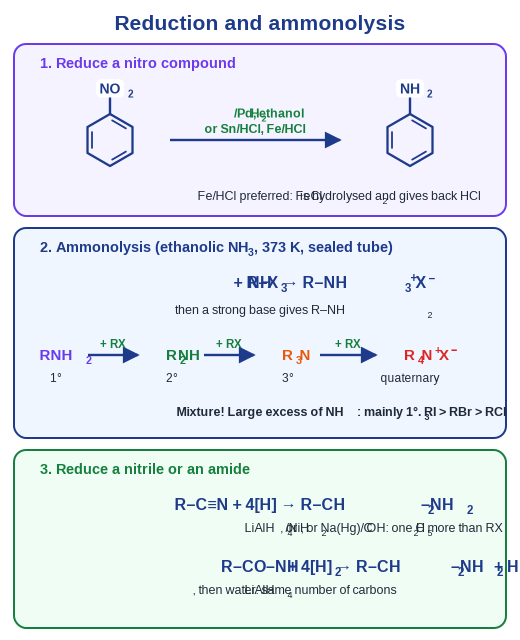
A nitro group, –NO₂, is reduced all the way to –NH₂. Two kinds of reagent do it:
- hydrogen gas over finely divided nickel, palladium or platinum (the book shows H₂/Pd in ethanol);
- a metal in acid, such as Sn and HCl or Fe and HCl.
C₆H₅NO₂ + 3H₂ → C₆H₅NH₂ + 2H₂O (H₂/Pd, ethanol)
C₆H₅NO₂ + 6[H] → C₆H₅NH₂ + 2H₂O (Sn/HCl or Fe/HCl)
Iron scrap and HCl is the preferred choice. The FeCl₂ formed is hydrolysed and gives back HCl as the reaction runs, so a small amount of acid is enough to start it. Nitroalkanes are reduced the same way to alkanamines: CH₃NO₂ + 6[H] → CH₃NH₂ + 2H₂O.
2. Ammonolysis of alkyl halides
The C–X bond of an alkyl or benzyl halide is easily broken by a nucleophile (Unit 6). Heating the halide with an ethanolic solution of ammonia at 373 K, in a sealed tube, replaces the halogen by an amino group. Breaking the C–X bond with ammonia is called ammonolysis.
NH₃ + C₂H₅Cl → C₂H₅NH₃⁺Cl⁻
A strong base releases the amine from its salt: C₂H₅NH₃⁺Cl⁻ + NaOH → C₂H₅NH₂ + H₂O + NaCl.
The catch is that the new amine still has a lone pair, so it attacks more alkyl halide:
RNH₂ → R₂NH → R₃N → R₄N⁺X⁻ (each step with RX)
Ammonolysis therefore gives a mixture: primary, secondary and tertiary amines plus the quaternary ammonium salt. A large excess of ammonia makes the primary amine the main product. Iodides react fastest: RI > RBr > RCl.
The book’s Example 9.1 shows both ideas: chloroethane with ethanolic ammonia gives ethanamine, then N-ethylethanamine, N,N-diethylethanamine and finally the quaternary salt (C₂H₅)₄N⁺Cl⁻; benzyl chloride gives benzylamine, which with two moles of CH₃Cl gives N,N-dimethylphenylmethanamine, C₆H₅CH₂N(CH₃)₂.
3. Reduction of nitriles
Lithium aluminium hydride, or catalytic hydrogenation (H₂/Ni, or sodium amalgam in ethanol), reduces a nitrile to a primary amine:
RCN + 4[H] → RCH₂NH₂
The nitrile itself comes from an alkyl halide and cyanide, so this is a way of making an amine with one carbon more than the starting alkyl group (ascent of the series). The book’s Example 9.2: CH₃CH₂Cl with ethanolic NaCN gives propanenitrile, and reduction gives propan-1-amine; benzyl chloride gives benzyl cyanide (phenylethanenitrile), and H₂/Ni gives 2-phenylethanamine.
C₆H₅CH₂Cl + NaCN → C₆H₅CH₂CN + NaCl
C₆H₅CH₂CN + 2H₂ → C₆H₅CH₂CH₂NH₂
4. Reduction of amides
LiAlH₄, followed by water, reduces the C=O of an amide to CH₂:
RCONH₂ + 4[H] → RCH₂NH₂ + H₂O
The carbon count stays the same: ethanamide, CH₃CONH₂, gives ethanamine.
5. Gabriel phthalimide synthesis
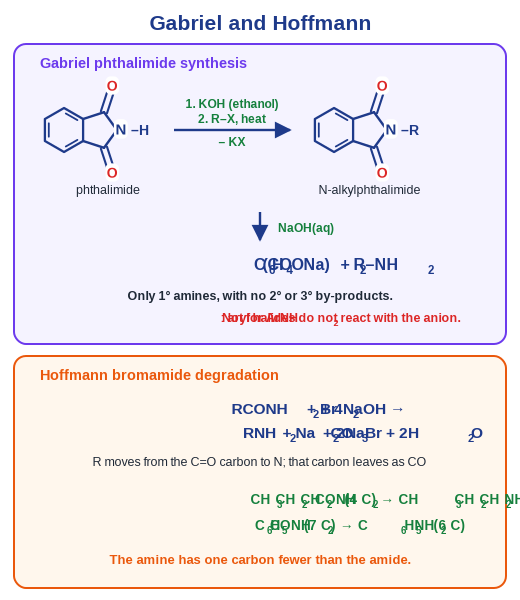
Phthalimide has an N–H between two C=O groups, which makes that hydrogen acidic.
- Ethanolic KOH gives potassium phthalimide: C₆H₄(CO)₂NH + KOH → C₆H₄(CO)₂NK + H₂O.
- Heating with an alkyl halide gives N-alkylphthalimide: C₆H₄(CO)₂NK + RX → C₆H₄(CO)₂NR + KX.
- Alkaline hydrolysis releases the primary amine: C₆H₄(CO)₂NR + 2NaOH → C₆H₄(COONa)₂ + RNH₂.
Because nitrogen carries only one alkyl group at the end, only primary amines form, with no secondary or tertiary by-products. Aromatic primary amines cannot be made this way: the phthalimide anion cannot displace the halogen of an aryl halide.
6. Hoffmann bromamide degradation
An amide heated with bromine in aqueous or ethanolic NaOH gives a primary amine:
RCONH₂ + Br₂ + 4NaOH → RNH₂ + Na₂CO₃ + 2NaBr + 2H₂O
During the reaction the alkyl or aryl group moves from the carbonyl carbon to the nitrogen, and the carbonyl carbon leaves as carbonate. So the amine has one carbon fewer than the amide. Book Example 9.3: propanamine (3 C) comes from butanamide, CH₃CH₂CH₂CONH₂ (4 C), and benzamide (7 C) gives aniline (6 C).
Choosing a method
| You want | Use |
|---|---|
| an aromatic primary amine (aniline) | reduce the nitro compound, or Hoffmann on the aryl amide |
| a pure aliphatic primary amine | Gabriel synthesis |
| one carbon more than RX | RX → RCN → RCH₂NH₂ |
| one carbon fewer than the acid or amide | RCONH₂ → RNH₂ (Hoffmann) |
| the same carbon count as an amide | LiAlH₄ reduction |
Lab safety
Cyanides, bromine, concentrated acids and alkalis, and LiAlH₄ are dangerous, and sealed-tube reactions are under pressure. These methods are described for the exam; any practical work is done only in the school laboratory with your teacher.
Back to the Chapter 9 notes, or read about the basicity of amines.
Practice
-
Which reagent is preferred for reducing nitrobenzene on a large scale?
Show answer
Answer: (b) Fe scrap and HCl
-
Benzamide treated with Br₂ and NaOH gives:
Show answer
Answer: (b) aniline
-
Which method cannot give aniline?
Show answer
Answer: (c) Gabriel phthalimide synthesis
-
How is propan-1-amine made from chloroethane?
Show answer
Answer: Heat chloroethane with ethanolic NaCN: CH₃CH₂Cl + NaCN → CH₃CH₂CN + NaCl. Then reduce the nitrile with LiAlH₄ or H₂/Ni: CH₃CH₂CN + 4[H] → CH₃CH₂CH₂NH₂. The chain grows from two carbons to three, as in the book’s Example 9.2.
-
Which amide gives ethanamine by the Hoffmann reaction?
Show answer
Answer: Propanamide, CH₃CH₂CONH₂. It has three carbons, and the Hoffmann reaction removes the carbonyl carbon: CH₃CH₂CONH₂ + Br₂ + 4NaOH → CH₃CH₂NH₂ + Na₂CO₃ + 2NaBr + 2H₂O.
Questions students ask
Why is Fe and HCl preferred for reducing nitro compounds?
The book explains that the FeCl₂ formed is hydrolysed and releases hydrochloric acid again during the reaction. So only a small amount of acid is needed to start the reduction.
Why does ammonolysis give a mixture?
The primary amine formed is itself a nucleophile, often a better one than ammonia, so it reacts with more alkyl halide to give a secondary amine, then a tertiary amine and finally a quaternary ammonium salt. A large excess of ammonia makes the primary amine the main product.
What is the difference between nitrile reduction and Hoffmann degradation?
Both give primary amines, but they change the chain in opposite directions. Making a nitrile from RX and reducing it gives RCH₂NH₂, one carbon more than the alkyl group (ascent of the series). Hoffmann degradation turns RCONH₂ into RNH₂, one carbon fewer (descent).
Stuck on a question?
Take a photo and Lagnever AI explains it step by step. Try it for 7 days for ₹2.
Get it on Google Play Open in browser
For parents: after the trial, the plan renews monthly by UPI or card autopay. You can cancel anytime in the app.