
Why are amines basic, and which amine is the strongest base?
Answer in short
Amines are bases because the lone pair on nitrogen accepts a proton. Alkyl groups push electrons to nitrogen, so alkylamines are stronger bases than ammonia; in water, solvation and steric hindrance also count. In aniline the lone pair is spread into the ring, so it is a much weaker base. A smaller pKb means a stronger base.
Stuck on a question? Take a photo and Lagnever AI explains it step by step. Try it for 7 days for ₹2. Get it on Google Play
Where does the basic character come from?
Every amine has a lone pair on nitrogen. A proton attaches to that pair, so an amine is a base. With acids it forms salts, and an alkali gives the amine back:
CH₃CH₂NH₂ + HCl → CH₃CH₂NH₃⁺Cl⁻ (ethylammonium chloride)
RNH₃⁺X⁻ + OH⁻ → RNH₂ + H₂O + X⁻
Amine salts dissolve in water but not in ether. Shake a mixture with dilute acid and the amine moves into the water layer as its salt; that is how amines are separated from non-basic organic compounds.
Kb and pKb
In water an amine takes a proton from water:
RNH₂ + H₂O ⇌ RNH₃⁺ + OH⁻
The water concentration is nearly constant and is folded into the constant, which gives the base dissociation constant:
Kb = [RNH₃⁺][OH⁻] / [RNH₂], pKb = –log Kb
The larger Kb, or the smaller pKb, the stronger the base. Ammonia has pKb 4.75. The book’s Table 9.3:
| Amine | pKb |
|---|---|
| N-ethylethanamine, (C₂H₅)₂NH | 3.00 |
| N,N-diethylethanamine, (C₂H₅)₃N | 3.25 |
| N-methylmethanamine, (CH₃)₂NH | 3.27 |
| ethanamine, C₂H₅NH₂ | 3.29 |
| methanamine, CH₃NH₂ | 3.38 |
| N,N-dimethylmethanamine, (CH₃)₃N | 4.22 |
| phenylmethanamine, C₆H₅CH₂NH₂ | 4.70 |
| N,N-dimethylaniline, C₆H₅N(CH₃)₂ | 8.92 |
| N-methylaniline, C₆H₅NHCH₃ | 9.30 |
| benzenamine (aniline), C₆H₅NH₂ | 9.38 |
(The rows are sorted here from strongest to weakest base; the book lists them in a different order.)
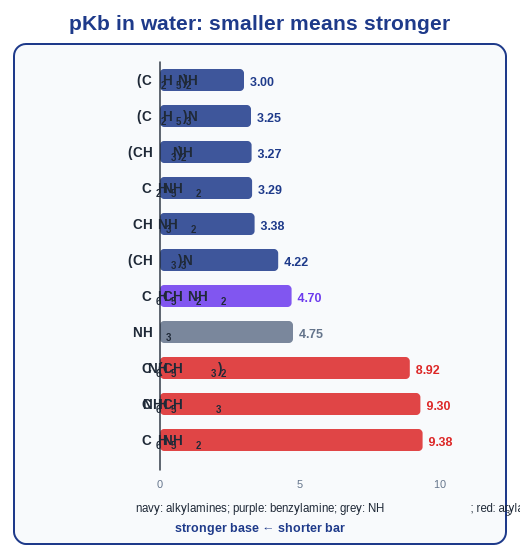
Alkylamines against ammonia
The basic strength depends on how easily the amine forms its cation, and how stable that cation is compared with the amine.
- An alkyl group releases electrons (+I effect). It pushes electron density towards nitrogen, so the lone pair is more ready to bond to a proton.
- The same push spreads the positive charge of the substituted ammonium ion, which stabilises it.
So alkylamines are stronger bases than ammonia: their pKb values lie between 3.00 and 4.22.
Why the order in water is not regular
If the +I effect were the only factor, more alkyl groups would always mean a stronger base. That is what happens in the gas phase: 3° > 2° > 1° > NH₃.
In water a second factor enters. The ammonium ion is stabilised by hydrogen bonds between its N–H hydrogens and water molecules (solvation). A primary ion, RNH₃⁺, has three such hydrogens, a secondary ion two and a tertiary ion one; bigger ions are also solvated less. Solvation alone would give 1° > 2° > 3°, the opposite of the inductive order.
A third factor is steric hindrance. A methyl group is small and does not get in the way of hydrogen bonding; an ethyl group is bigger and does. That is why the methyl and ethyl series end up in different orders:
- (C₂H₅)₂NH > (C₂H₅)₃N > C₂H₅NH₂ > NH₃
- (CH₃)₂NH > CH₃NH₂ > (CH₃)₃N > NH₃
The secondary amine wins in both series. Among the methylamines the tertiary one falls to third; among the ethylamines it stays second.
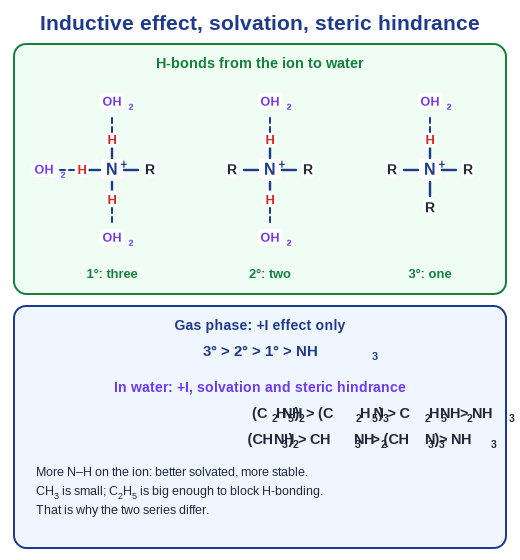
Arylamines against ammonia
Aniline’s pKb, 9.38, is much higher than ammonia’s. The –NH₂ is attached directly to the ring, so the nitrogen lone pair is in conjugation with the ring π electrons. Five resonance structures contribute to aniline: two Kekulé structures and three in which the lone pair has moved into the ring, leaving N positive and placing a negative charge at an ortho or the para carbon. The anilinium ion, C₆H₅NH₃⁺, has no lone pair and only the two Kekulé structures. More resonance means more stability, so aniline is stabilised more than its ion, and it accepts a proton reluctantly.
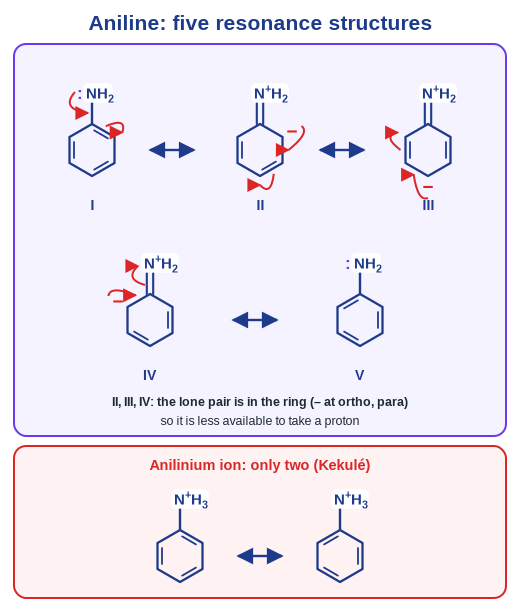
Groups on the ring. Electron-releasing groups such as –OCH₃ and –CH₃ raise the basic strength of aniline; electron-withdrawing groups such as –NO₂, –SO₃H, –COOH and halogens lower it. So p-nitroaniline < aniline < p-toluidine (Exercise 9.4).
Groups on nitrogen. Methyl groups on the nitrogen of aniline help a little: N-methylaniline 9.30 and N,N-dimethylaniline 8.92 are slightly stronger than aniline. Moving the –NH₂ off the ring onto a CH₂, as in benzylamine (4.70), removes the conjugation, and the base becomes almost as strong as ammonia.
A worked order
The book’s Example 9.4 asks for the decreasing basic strength of C₆H₅NH₂, C₂H₅NH₂, (C₂H₅)₂NH and NH₃.
- The arylamine is weakest: aniline’s lone pair is shared with the ring (9.38).
- Ammonia (4.75) is weaker than the alkylamines.
- Of the two ethylamines, the secondary one is stronger in water (3.00 against 3.29).
Answer: (C₂H₅)₂NH > C₂H₅NH₂ > NH₃ > C₆H₅NH₂.
Lab safety
Amines and mineral acids are corrosive, and many amines are toxic. Any acid–base work with them is done only in the school laboratory with your teacher, never at home.
Back to the Chapter 9 notes, or see the NCERT solutions.
Practice
-
Which has the smallest pKb in water?
Show answer
Answer: (b) (CH₃)₂NH
-
Which is the weakest base?
Show answer
Answer: (c) p-nitroaniline
-
In the gas phase, which order is correct?
Show answer
Answer: (b) 3° > 2° > 1° > NH₃
-
The pKb of an amine is 3.38. What is its Kb?
Show answer
Answer: Kb = 10^(–pKb) = 10^(–3.38) ≈ 4.2 × 10⁻⁴. This is methanamine in the book’s Table 9.3.
-
Why is N,N-dimethylaniline (8.92) slightly more basic than aniline (9.38)?
Show answer
Answer: The two methyl groups push electron density onto nitrogen by the +I effect, so the lone pair is a little more available, but it is still shared with the ring. So the base is only a little stronger than aniline and far weaker than ammonia.
Questions students ask
Why are amines basic?
The nitrogen atom has an unshared pair of electrons that it can give to a proton (or another electron-pair acceptor). So amines are Lewis bases; they react with acids to give ammonium salts, and in water they take a proton from water and produce OH⁻ ions.
Why is diethylamine a stronger base than triethylamine in water?
Three ethyl groups give more +I push, but the triethylammonium ion has only one N–H to hydrogen bond with water, and its bulky groups get in the way of solvation. The diethylammonium ion is better solvated. The balance makes (C₂H₅)₂NH (3.00) stronger than (C₂H₅)₃N (3.25).
Why is aniline a weaker base than ammonia?
In aniline the lone pair on nitrogen is in conjugation with the benzene ring, giving five resonance structures. The anilinium ion has no lone pair to share and only two resonance structures. So aniline is more stabilised than its ion, gives up that stability when it is protonated, and takes a proton less readily than ammonia (pKb 9.38 against 4.75).
Stuck on a question?
Take a photo and Lagnever AI explains it step by step. Try it for 7 days for ₹2.
Get it on Google Play Open in browser
For parents: after the trial, the plan renews monthly by UPI or card autopay. You can cancel anytime in the app.