
What are diazonium salts, and what can they make?
Answer in short
Diazonium salts, ArN₂⁺X⁻, are made by treating a primary aromatic amine with sodium nitrite and hydrochloric acid at 273–278 K (diazotisation). The –N₂⁺ group leaves easily as nitrogen gas, so it can be replaced by Cl, Br, CN, I, F, H, OH or NO₂. With phenol or aniline the salt couples instead, giving coloured azo dyes.
Stuck on a question? Take a photo and Lagnever AI explains it step by step. Try it for 7 days for ₹2. Get it on Google Play
Formula and names
A diazonium salt has the general formula RN₂⁺X⁻, where R is an aryl group and X⁻ is an anion such as Cl⁻, Br⁻, HSO₄⁻ or BF₄⁻. The –N₂⁺ group is the diazonium group. The name joins the parent hydrocarbon, the word diazonium and the anion:
- C₆H₅N₂⁺Cl⁻: benzenediazonium chloride
- C₆H₅N₂⁺HSO₄⁻: benzenediazonium hydrogensulphate
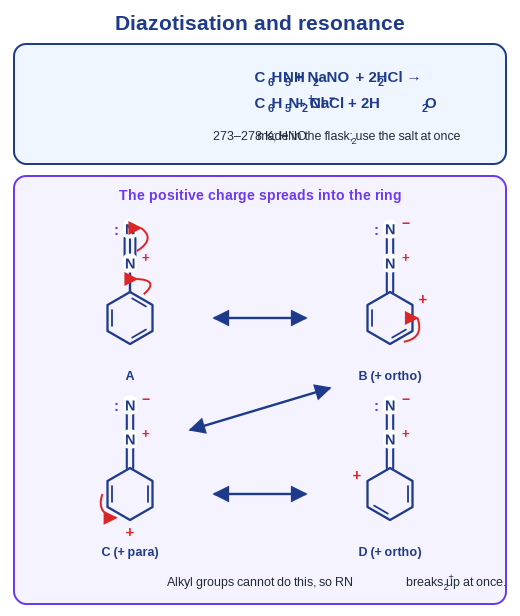
Primary aliphatic amines also give diazonium salts, but they are highly unstable and break up at once. Arenediazonium salts survive for a short time in cold solution (273–278 K). The ring explains the difference: the positive charge can spread onto the ortho and para carbons by resonance.
Preparation: diazotisation
Aniline is treated with nitrous acid at 273–278 K. Nitrous acid does not keep, so it is made in the flask from sodium nitrite and hydrochloric acid:
C₆H₅NH₂ + NaNO₂ + 2HCl → C₆H₅N₂⁺Cl⁻ + NaCl + 2H₂O
Turning a primary aromatic amine into a diazonium salt is called diazotisation. Because the salt is unstable, it is generally not stored but used right after it is made.
Physical properties
Benzenediazonium chloride forms colourless crystals. It dissolves readily in water and is stable in the cold, but it reacts with water when warmed and decomposes easily when dry. Benzenediazonium fluoroborate, by contrast, is insoluble in water and stable at room temperature, which is why the fluoride and nitro routes go through it.
Reactions that replace the nitrogen
N₂ is a very stable molecule, so –N₂⁺ is an excellent leaving group. It is replaced and escapes as nitrogen gas.
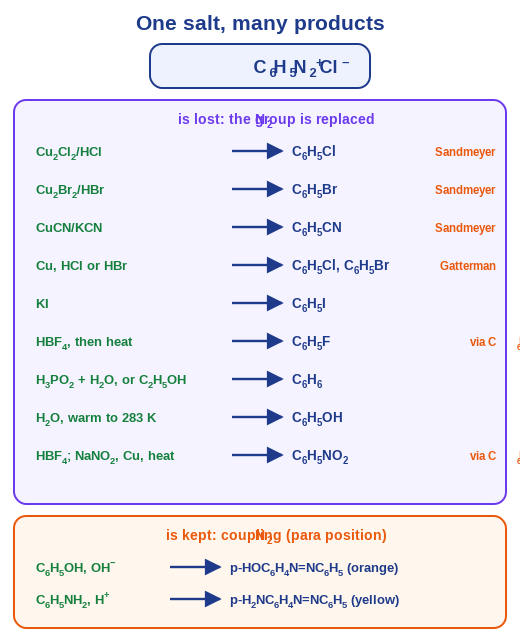
1. Halide or cyanide: Sandmeyer reaction. Cu(I) salts bring in Cl⁻, Br⁻ or CN⁻:
C₆H₅N₂Cl → C₆H₅Cl + N₂ (Cu₂Cl₂/HCl)
C₆H₅N₂Br → C₆H₅Br + N₂ (Cu₂Br₂/HBr; X⁻ written as Br⁻)
C₆H₅N₂Cl + CuCN → C₆H₅CN + N₂ + CuCl (CuCN/KCN)
Gatterman reaction. Copper powder and the halogen acid do the same for Cl and Br, but the book notes that the Sandmeyer reaction gives the better yield.
2. Iodide. Iodine is hard to put on a ring directly, but potassium iodide does it easily:
C₆H₅N₂Cl + KI → C₆H₅I + KCl + N₂
3. Fluoride. Fluoroboric acid precipitates the fluoroborate, which gives the aryl fluoride on heating:
C₆H₅N₂Cl + HBF₄ → C₆H₅N₂BF₄ + HCl
C₆H₅N₂BF₄ → C₆H₅F + BF₃ + N₂
4. Hydrogen. Mild reducing agents remove the group altogether; they are themselves oxidised, to phosphorous acid and ethanal:
C₆H₅N₂Cl + H₃PO₂ + H₂O → C₆H₆ + N₂ + H₃PO₃ + HCl
C₆H₅N₂Cl + CH₃CH₂OH → C₆H₆ + N₂ + CH₃CHO + HCl
5. Hydroxyl. If the solution is allowed to warm up to 283 K, the salt is hydrolysed to phenol:
C₆H₅N₂Cl + H₂O → C₆H₅OH + N₂ + HCl
6. Nitro group. The fluoroborate heated with aqueous sodium nitrite and copper gives the nitro compound:
C₆H₅N₂BF₄ + NaNO₂ → C₆H₅NO₂ + N₂ + NaBF₄
Reactions that keep the nitrogen: coupling
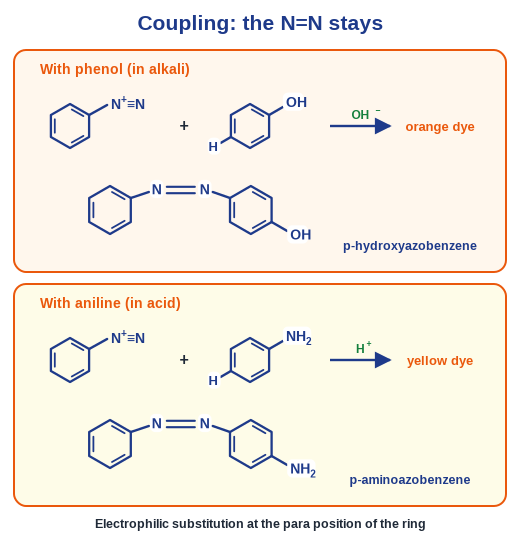
Here the –N=N– stays in the product. The diazonium ion acts as an electrophile and attacks the para position of a strongly activated ring:
C₆H₅N₂⁺Cl⁻ + C₆H₅OH + OH⁻ → C₆H₅N=NC₆H₄OH + Cl⁻ + H₂O (p-hydroxyazobenzene, orange)
C₆H₅N₂⁺Cl⁻ + C₆H₅NH₂ → C₆H₅N=NC₆H₄NH₂ + HCl (p-aminoazobenzene, yellow; in acid)
The two rings joined through –N=N– form an extended conjugated system. Azo compounds of this kind are usually coloured, which is why many of them serve as dyes. Coupling is an electrophilic substitution reaction.
Why chemists value diazonium salts
- They bring –F, –Cl, –Br, –I, –CN, –OH and –NO₂ onto a ring.
- Direct halogenation cannot give aryl fluorides or aryl iodides.
- A cyano group cannot be put in by substituting the chlorine of chlorobenzene, but benzonitrile comes easily from the diazonium salt.
- Replacing the group by H lets an –NH₂ steer substitution and then vanish.
The book’s Example 9.5, 4-nitrotoluene to 2-bromobenzoic acid, uses the last idea. Bromine goes next to the methyl group (2-bromo-4-nitrotoluene); Sn/HCl reduces –NO₂ to –NH₂; diazotisation at 273–278 K and then H₃PO₂ and water remove the nitrogen, leaving 2-bromotoluene; alkaline KMnO₄ then oxidises –CH₃ to –COOH, giving 2-bromobenzoic acid.
Lab safety
Diazonium salts decompose easily when dry, and the reagents include cyanides, nitrous acid and fluoroboric acid. These reactions are described for the exam; any practical work is done only in the school laboratory with your teacher.
Back to the Chapter 9 notes, or see the NCERT solutions.
Practice
-
Which reagent converts benzenediazonium chloride into benzonitrile?
Show answer
Answer: (b) CuCN/KCN
-
Benzenediazonium chloride with phenol in alkali gives:
Show answer
Answer: (c) p-hydroxyazobenzene
-
Which product forms when benzenediazonium chloride is warmed with ethanol?
Show answer
Answer: (b) benzene
-
Name the salt C₆H₅N₂⁺HSO₄⁻ and say why it is used at once.
Show answer
Answer: Benzenediazonium hydrogensulphate. Arenediazonium salts are stable only for a short time in cold solution (273–278 K) and decompose easily, so they are generally not stored but used straight after they are made.
-
How is fluorobenzene made from aniline?
Show answer
Answer: Diazotise aniline (NaNO₂, HCl, 273–278 K) to C₆H₅N₂⁺Cl⁻. Add fluoroboric acid: C₆H₅N₂Cl + HBF₄ → C₆H₅N₂BF₄ + HCl, which precipitates. Heat the dry fluoroborate: C₆H₅N₂BF₄ → C₆H₅F + BF₃ + N₂.
Questions students ask
Why are arenediazonium salts more stable than alkyldiazonium salts?
In an arenediazonium ion the positive charge is spread over the benzene ring by resonance (the book draws four structures, three with the positive charge on ring carbons). An alkyl group cannot do this, so alkyldiazonium salts lose nitrogen at once and give alcohols.
What is the difference between the Sandmeyer and Gatterman reactions?
Both replace –N₂⁺ by a halogen. The Sandmeyer reaction uses copper(I) salts (Cu₂Cl₂/HCl, Cu₂Br₂/HBr, and CuCN/KCN for the cyano group); the Gatterman reaction uses copper powder with HCl or HBr. The book notes that the Sandmeyer reaction gives the better yield.
Why are azo compounds coloured?
In an azo compound two aromatic rings are joined through –N=N–, which gives one long conjugated system of π electrons. The book links this extended conjugation to their colour and their use as dyes; p-hydroxyazobenzene is orange and p-aminoazobenzene yellow.
Stuck on a question?
Take a photo and Lagnever AI explains it step by step. Try it for 7 days for ₹2.
Get it on Google Play Open in browser
For parents: after the trial, the plan renews monthly by UPI or card autopay. You can cancel anytime in the app.