
NCERT Solutions Class 12 Maths Chapter 1: Relations and Functions
Answers to every question of Exercises 1.1 and 1.2 and the Miscellaneous Exercise, and to all 26 worked examples, of Chapter 1, Relations and Functions, of Mathematics Part I, the Class 12 NCERT textbook. Page numbers follow the 2026-27 reprint (pages 1–17). The exercise questions are quoted from the book; the examples and the two “Why?” questions inside them are restated in short and labelled by number and page. Every answer was checked: the finite relations and functions by listing all cases with a computer, and every counterexample by computing it again. Short notes: Chapter 1 notes.
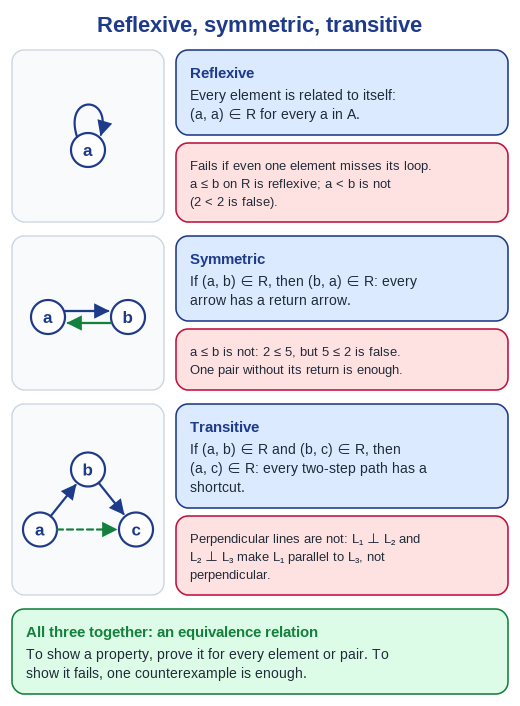
The method behind almost every answer: to prove that a relation or function has a property, argue for a general element or pair; to show that it fails, one counterexample is enough. A counterexample is a single case, with actual numbers, where the property breaks.
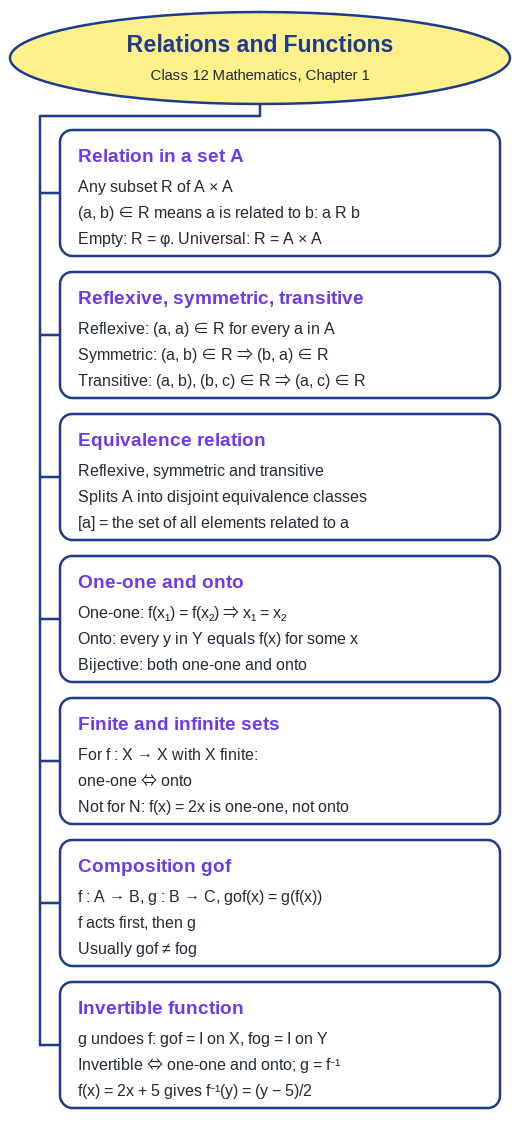
Examples 1 to 6: types of relations (pages 2–5)
Example 1 (page 2): in a boys’ school, “a is a sister of b” is empty and “the heights of a and b differ by less than 3 m” is universal. Every student of a boys’ school is a boy, so no student is anyone’s sister: no pair belongs to R, and R = φ. The heights of any two students differ by far less than 3 metres, so every pair belongs to R′, and R′ = A × A.
Example 2 (page 3): congruence of triangles in a plane is an equivalence relation.
- Reflexive: every triangle T is congruent to itself.
- Symmetric: if T₁ is congruent to T₂, then T₂ is congruent to T₁.
- Transitive: if T₁ ≅ T₂ and T₂ ≅ T₃, then T₁ ≅ T₃.
Example 3 (page 3): perpendicularity of lines is symmetric, but neither reflexive nor transitive.
- Not reflexive: no line is perpendicular to itself.
- Symmetric: if L₁ ⊥ L₂, then L₂ ⊥ L₁.
- Not transitive: take L₁ the x-axis, L₂ the y-axis and L₃ the line y = 1. Then L₁ ⊥ L₂ and L₂ ⊥ L₃, but L₁ and L₃ are parallel, not perpendicular.
Example 4 (page 3): R = {(1, 1), (2, 2), (3, 3), (1, 2), (2, 3)} in {1, 2, 3} is reflexive, but neither symmetric nor transitive.
- Reflexive: (1, 1), (2, 2) and (3, 3) are all in R.
- Not symmetric: (1, 2) ∈ R but (2, 1) ∉ R.
- Not transitive: (1, 2) ∈ R and (2, 3) ∈ R, but (1, 3) ∉ R.
Example 5 (page 3): in Z, R = {(a, b) : 2 divides a − b} is an equivalence relation.
- Reflexive: a − a = 0 = 2 × 0, so 2 divides a − a.
- Symmetric: if a − b = 2k for an integer k, then b − a = 2(−k), so 2 divides b − a.
- Transitive: if a − b = 2k and b − c = 2m, then a − c = (a − b) + (b − c) = 2k + 2m = 2(k + m).
Example 5, the book’s “Why?”: why is a − c even? Because a − c is the sum of two even numbers, 2k + 2m, and this equals 2(k + m), which is 2 times an integer.
The book then notes (page 4) that this relation splits Z into two classes: the even integers [0] and the odd integers [1]. In the same way, “3 divides a − b” splits Z into [0], [1] and [2], the integers that leave remainder 0, 1 and 2 when divided by 3.
Example 6 (pages 4–5): in A = {1, 2, …, 7}, “a and b are both odd or both even” is an equivalence relation, with {1, 3, 5, 7} and {2, 4, 6} as the two groups.
- Reflexive: a and a are the same number, so both are odd or both are even.
- Symmetric: the condition does not care about order.
- Transitive: if a has the same parity as b, and b the same parity as c, then a, b and c all share one parity.
Any two of 1, 3, 5, 7 are both odd, so they are related; any two of 2, 4, 6 are both even, so they are related; an odd number and an even number are never related.
Exercise 1.1 (pages 5–7)
1. “Determine whether each of the following relations are reflexive, symmetric and transitive:”
(i) “Relation R in the set A = {1, 2, 3, …, 13, 14} defined as R = {(x, y) : 3x − y = 0}”
3x − y = 0 means y = 3x, and y ≤ 14 forces x ≤ 4. So R = {(1, 3), (2, 6), (3, 9), (4, 12)}.
- Not reflexive: (1, 1) ∉ R, since 3 × 1 − 1 = 2 ≠ 0.
- Not symmetric: (1, 3) ∈ R, but (3, 1) ∉ R, since 3 × 3 − 1 = 8 ≠ 0.
- Not transitive: (1, 3) ∈ R and (3, 9) ∈ R, but (1, 9) ∉ R, since 3 × 1 − 9 = −6 ≠ 0.
R is neither reflexive nor symmetric nor transitive.
(ii) “Relation R in the set N of natural numbers defined as R = {(x, y) : y = x + 5 and x < 4}”
x can only be 1, 2 or 3, so R = {(1, 6), (2, 7), (3, 8)}.
- Not reflexive: (1, 1) ∉ R.
- Not symmetric: (1, 6) ∈ R, but (6, 1) ∉ R (6 is not less than 4).
- Transitive: a failure would need (x, y) ∈ R and (y, z) ∈ R. But every y here is 6, 7 or 8, and no pair of R starts with 6, 7 or 8. There is no such chain, so the condition can never fail.
R is transitive but neither reflexive nor symmetric.
(iii) “Relation R in the set A = {1, 2, 3, 4, 5, 6} as R = {(x, y) : y is divisible by x}”
- Reflexive: every x divides itself, x = 1 × x.
- Not symmetric: (2, 4) ∈ R since 4 = 2 × 2, but (4, 2) ∉ R since 4 does not divide 2.
- Transitive: if y = kx and z = my for natural numbers k, m, then z = (mk)x, so x divides z.
R is reflexive and transitive but not symmetric.
(iv) “Relation R in the set Z of all integers defined as R = {(x, y) : x − y is an integer}”
- Reflexive: x − x = 0, an integer.
- Symmetric: if x − y is an integer, so is y − x = −(x − y).
- Transitive: x − z = (x − y) + (y − z), a sum of two integers, is an integer.
R is reflexive, symmetric and transitive, an equivalence relation. (In fact x − y is an integer for every pair of integers, so R = Z × Z, the universal relation.)
(v) “Relation R in the set A of human beings in a town at a particular time given by”
(a) “R = {(x, y) : x and y work at the same place}”
Take each person to work at exactly one place, as the book’s answer does.
- Reflexive: x works at the same place as x.
- Symmetric: if x works where y works, then y works where x works.
- Transitive: if x and y share a workplace, and y and z share one, then x and z both work at y’s workplace.
Reflexive, symmetric and transitive. (If some people had no workplace, or two, reflexivity or transitivity could fail.)
(b) “R = {(x, y) : x and y live in the same locality}”
In the same way, with each person living in exactly one locality: reflexive, symmetric and transitive.
(c) “R = {(x, y) : x is exactly 7 cm taller than y}”
- Not reflexive: nobody is 7 cm taller than himself or herself.
- Not symmetric: if x is 7 cm taller than y, then y is 7 cm shorter than x, not taller.
- Not transitive: if x is 7 cm taller than y and y is 7 cm taller than z, then x is 14 cm taller than z, not 7 cm.
Neither reflexive nor symmetric nor transitive.
(d) “R = {(x, y) : x is wife of y}”
- Not reflexive: nobody is his or her own wife.
- Not symmetric: if x is the wife of y, then y is the husband of x, not the wife.
- Transitive: a chain (x, y), (y, z) in R would need y to be a husband (of x) and also a wife (of z), which cannot happen, taking marriage as the book does. With no such chain, transitivity cannot fail.
Transitive but neither reflexive nor symmetric.
(e) “R = {(x, y) : x is father of y}”
- Not reflexive: nobody is his own father.
- Not symmetric: if x is the father of y, then y is a child of x, not the father.
- Not transitive: if x is the father of y and y is the father of z, then x is the grandfather of z, not the father.
Neither reflexive nor symmetric nor transitive.
2. “Show that the relation R in the set R of real numbers, defined as R = {(a, b) : a ≤ b²} is neither reflexive nor symmetric nor transitive.”
- Not reflexive: take a = 1/2. Then a² = 1/4, and 1/2 ≤ 1/4 is false, so (1/2, 1/2) ∉ R.
- Not symmetric: (1, 4) ∈ R, since 1 ≤ 16. But (4, 1) ∉ R, since 4 ≤ 1 is false.
- Not transitive: (3, 2) ∈ R, since 3 ≤ 4, and (2, 1.5) ∈ R, since 2 ≤ 2.25. But (3, 1.5) ∉ R, since 3 ≤ 2.25 is false.
So R is neither reflexive nor symmetric nor transitive.
3. “Check whether the relation R defined in the set {1, 2, 3, 4, 5, 6} as R = {(a, b) : b = a + 1} is reflexive, symmetric or transitive.”
R = {(1, 2), (2, 3), (3, 4), (4, 5), (5, 6)}.
- Not reflexive: (1, 1) ∉ R, since 1 ≠ 1 + 1.
- Not symmetric: (1, 2) ∈ R, but (2, 1) ∉ R.
- Not transitive: (1, 2) ∈ R and (2, 3) ∈ R, but (1, 3) ∉ R.
R is neither reflexive nor symmetric nor transitive.
4. “Show that the relation R in R defined as R = {(a, b) : a ≤ b}, is reflexive and transitive but not symmetric.”
- Reflexive: a ≤ a for every real number a.
- Transitive: if a ≤ b and b ≤ c, then a ≤ c.
- Not symmetric: (1, 2) ∈ R, since 1 ≤ 2, but (2, 1) ∉ R, since 2 ≤ 1 is false.
5. “Check whether the relation R in R defined by R = {(a, b) : a ≤ b³} is reflexive, symmetric or transitive.”
- Not reflexive: (1/2)³ = 1/8, and 1/2 ≤ 1/8 is false, so (1/2, 1/2) ∉ R.
- Not symmetric: (1, 2) ∈ R, since 1 ≤ 8, but (2, 1) ∉ R, since 2 ≤ 1 is false.
- Not transitive: (3, 3/2) ∈ R, since (3/2)³ = 27/8 = 3.375 ≥ 3. And (3/2, 4/3) ∈ R, since (4/3)³ = 64/27 ≈ 2.37 ≥ 1.5. But (3, 4/3) ∉ R, since 3 ≤ 64/27 is false.
R is neither reflexive nor symmetric nor transitive.
6. “Show that the relation R in the set {1, 2, 3} given by R = {(1, 2), (2, 1)} is symmetric but neither reflexive nor transitive.”
- Symmetric: R has only two pairs, (1, 2) and (2, 1), and each one’s reverse is the other.
- Not reflexive: (1, 1) ∉ R.
- Not transitive: (1, 2) ∈ R and (2, 1) ∈ R, but (1, 1) ∉ R.
7. “Show that the relation R in the set A of all the books in a library of a college, given by R = {(x, y) : x and y have same number of pages} is an equivalence relation.”
Write n(x) for the number of pages of book x. Then x R y means n(x) = n(y).
- Reflexive: n(x) = n(x).
- Symmetric: n(x) = n(y) gives n(y) = n(x).
- Transitive: n(x) = n(y) and n(y) = n(z) give n(x) = n(z).
So R is an equivalence relation. (This is the pattern of Example 21: “f(a) = f(b)” is always an equivalence relation.)
8. “Show that the relation R in the set A = {1, 2, 3, 4, 5} given by R = {(a, b) : |a − b| is even}, is an equivalence relation. Show that all the elements of {1, 3, 5} are related to each other and all the elements of {2, 4} are related to each other. But no element of {1, 3, 5} is related to any element of {2, 4}.”
- Reflexive: |a − a| = 0, which is even.
- Symmetric: |b − a| = |a − b|.
- Transitive: |a − b| is even exactly when a − b is even. If a − b and b − c are even, then a − c = (a − b) + (b − c) is even.
So R is an equivalence relation. Among 1, 3, 5 the differences are 2, 4 and 2, all even, so every two of them are related. Between 2 and 4 the difference is 2, even, so they are related. An odd number minus an even number is odd, so |a − b| is odd for a in {1, 3, 5} and b in {2, 4}: no such pair is related.
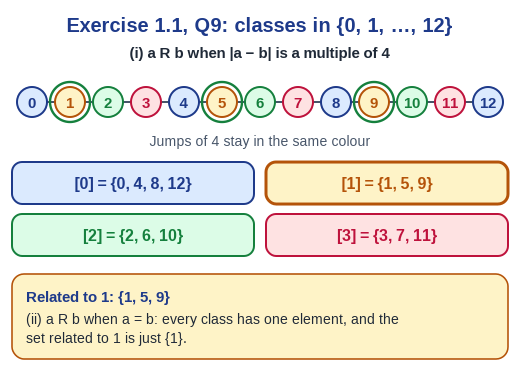
9. “Show that each of the relation R in the set A = {x ∈ Z : 0 ≤ x ≤ 12}, given by (i) R = {(a, b) : |a − b| is a multiple of 4} (ii) R = {(a, b) : a = b} is an equivalence relation. Find the set of all elements related to 1 in each case.”
(i)
- Reflexive: |a − a| = 0 = 4 × 0, a multiple of 4.
- Symmetric: |b − a| = |a − b|.
- Transitive: if a − b = 4k and b − c = 4m, then a − c = 4(k + m), so |a − c| is a multiple of 4.
So R is an equivalence relation.
The elements related to 1 are the b in A with |1 − b| equal to 0, 4, 8 or 12, that is, b = 1, 5, 9 (13 is not in A). The set is {1, 5, 9}.
(ii)
- Reflexive: a = a.
- Symmetric: a = b gives b = a.
- Transitive: a = b and b = c give a = c.
So R is an equivalence relation. Only 1 equals 1, so the set is {1}.
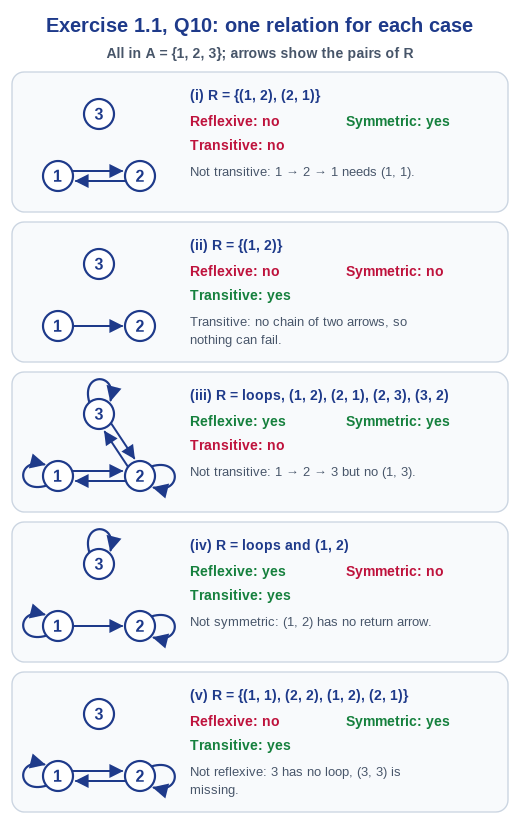
10. “Give an example of a relation. Which is (i) Symmetric but neither reflexive nor transitive. (ii) Transitive but neither reflexive nor symmetric. (iii) Reflexive and symmetric but not transitive. (iv) Reflexive and transitive but not symmetric. (v) Symmetric and transitive but not reflexive.”
All five examples are in A = {1, 2, 3}; each was checked against all three properties.
(i) R = {(1, 2), (2, 1)}. Symmetric. Not reflexive: (1, 1) ∉ R. Not transitive: (1, 2), (2, 1) ∈ R but (1, 1) ∉ R. (Another example: “is perpendicular to” for lines, Example 3.)
(ii) R = {(1, 2)}. Transitive, since there is no chain (a, b), (b, c) at all. Not reflexive: (1, 1) ∉ R. Not symmetric: (2, 1) ∉ R. (Another example: “a < b” in R.)
(iii) R = {(1, 1), (2, 2), (3, 3), (1, 2), (2, 1), (2, 3), (3, 2)}. Reflexive and symmetric. Not transitive: (1, 2), (2, 3) ∈ R but (1, 3) ∉ R. (Another example: “|a − b| ≤ 1” in R, with 0, 1 and 2.)
(iv) R = {(1, 1), (2, 2), (3, 3), (1, 2)}. Reflexive. Transitive: every chain uses a pair (a, a), so the shortcut is already in R. Not symmetric: (2, 1) ∉ R. (Another example: “a ≤ b” in R, Question 4.)
(v) R = {(1, 1), (2, 2), (1, 2), (2, 1)}. Symmetric, and transitive since all pairs of elements from {1, 2} are in R. Not reflexive: (3, 3) ∉ R. Why 3 has to be left out completely: if (a, b) ∈ R for some b, symmetry gives (b, a), and then transitivity with (a, b) and (b, a) gives (a, a). So any element with even one arrow gets its loop. To break reflexivity, some element must be related to nothing at all.
11. “Show that the relation R in the set A of points in a plane given by R = {(P, Q) : distance of the point P from the origin is same as the distance of the point Q from the origin}, is an equivalence relation. Further, show that the set of all points related to a point P ≠ (0, 0) is the circle passing through P with origin as centre.”
Let O be the origin. P R Q means OP = OQ.
- Reflexive: OP = OP.
- Symmetric: OP = OQ gives OQ = OP.
- Transitive: OP = OQ and OQ = OS give OP = OS.
So R is an equivalence relation. Now let P ≠ O, so r = OP > 0. A point Q is related to P exactly when OQ = r, that is, when Q lies on the circle with centre O and radius r. This circle passes through P, since OP = r. So the set of points related to P is the circle through P with the origin as centre.

12. “Show that the relation R defined in the set A of all triangles as R = {(T₁, T₂) : T₁ is similar to T₂}, is equivalence relation. Consider three right angle triangles T₁ with sides 3, 4, 5, T₂ with sides 5, 12, 13 and T₃ with sides 6, 8, 10. Which triangles among T₁, T₂ and T₃ are related?”
- Reflexive: every triangle is similar to itself (all sides in ratio 1).
- Symmetric: if T₁ ~ T₂ with the sides of T₂ equal to k times those of T₁, then the sides of T₁ are 1/k times those of T₂, so T₂ ~ T₁.
- Transitive: if T₂ = k × T₁ and T₃ = m × T₂ (side by side), then T₃ = km × T₁, so T₁ ~ T₃.
So R is an equivalence relation. Compare the sides in order:
- T₁ and T₃: 6/3 = 8/4 = 10/5 = 2, so they are similar (SSS).
- T₁ and T₂: 5/3, 12/4 = 3 and 13/5 are not equal, so they are not similar.
- T₂ and T₃: 6/5, 8/12 and 10/13 are not equal, so they are not similar.
T₁ and T₃ are related (and each triangle is related to itself).
13. “Show that the relation R defined in the set A of all polygons as R = {(P₁, P₂) : P₁ and P₂ have same number of sides}, is an equivalence relation. What is the set of all elements in A related to the right angle triangle T with sides 3, 4 and 5?”
Write s(P) for the number of sides of polygon P; then P₁ R P₂ means s(P₁) = s(P₂). Equality is reflexive, symmetric and transitive, exactly as in Question 7, so R is an equivalence relation. The triangle T has 3 sides, so the polygons related to it are those with 3 sides: the set of all triangles.
14. “Let L be the set of all lines in XY plane and R be the relation in L defined as R = {(L₁, L₂) : L₁ is parallel to L₂}. Show that R is an equivalence relation. Find the set of all lines related to the line y = 2x + 4.”
Two lines in the XY plane are parallel when they have the same slope (or are both vertical); here a line counts as parallel to itself, as the book’s answer takes it.
- Reflexive: every line has the same slope as itself.
- Symmetric: if L₁ has the same slope as L₂, then L₂ has the same slope as L₁.
- Transitive: if L₁ and L₂ have the same slope, and L₂ and L₃ have the same slope, then L₁ and L₃ have the same slope.
So R is an equivalence relation. The line y = 2x + 4 has slope 2, so the lines related to it are all the lines with slope 2: the set of lines y = 2x + c, c ∈ R.

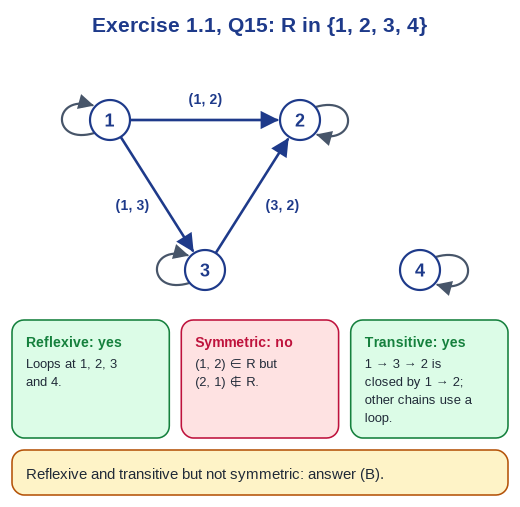
15. “Let R be the relation in the set {1, 2, 3, 4} given by R = {(1, 2), (2, 2), (1, 1), (4,4), (1, 3), (3, 3), (3, 2)}. Choose the correct answer. (A) R is reflexive and symmetric but not transitive. (B) R is reflexive and transitive but not symmetric. (C) R is symmetric and transitive but not reflexive. (D) R is an equivalence relation.”
- Reflexive: (1, 1), (2, 2), (3, 3) and (4, 4) are all in R.
- Not symmetric: (1, 2) ∈ R but (2, 1) ∉ R.
- Transitive: the only chain through two different arrows is (1, 3), (3, 2), and (1, 2) ∈ R. Every other chain uses a pair (a, a), so its shortcut is already in R.
Answer: (B).
16. “Let R be the relation in the set N given by R = {(a, b) : a = b − 2, b > 6}. Choose the correct answer. (A) (2, 4) ∈ R (B) (3, 8) ∈ R (C) (6, 8) ∈ R (D) (8, 7) ∈ R”
Check each pair:
- (2, 4): 2 = 4 − 2, but b = 4 is not greater than 6. Not in R.
- (3, 8): 8 − 2 = 6 ≠ 3. Not in R.
- (6, 8): 8 − 2 = 6 and 8 > 6. In R.
- (8, 7): 7 − 2 = 5 ≠ 8. Not in R.
Answer: (C).
Examples 7 to 14: types of functions (pages 8–10)
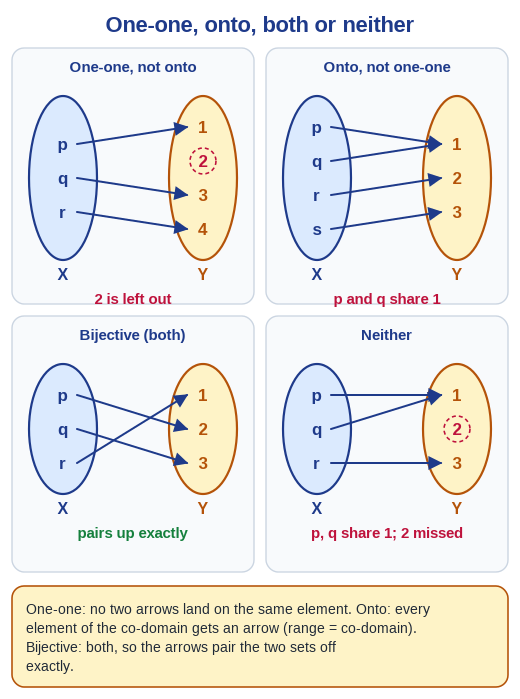
Example 7 (page 8): f(x) = roll number of student x, from the 50 students of a class to N, is one-one but not onto. Two different students never have the same roll number, so f is one-one. Taking the roll numbers to be 1 to 50, the number 51 in N is nobody’s roll number, so f is not onto.
Example 8 (page 8): f(x) = 2x from N to N is one-one but not onto. If 2x₁ = 2x₂, then x₁ = x₂. But 1 ∈ N is not 2x for any natural number x (x would be 1/2); in fact no odd number is reached.
Example 9 (page 9): f(x) = 2x from R to R is one-one and onto. One-one as in Example 8. For any real y, x = y/2 is real and f(y/2) = y.
Example 10 (page 9): f(1) = f(2) = 1 and f(x) = x − 1 for x > 2, from N to N, is onto but not one-one. Not one-one: f(1) = f(2). Onto: for y ≥ 2, x = y + 1 > 2 and f(y + 1) = y; and 1 = f(1).
Example 11 (page 9): f(x) = x² from R to R is neither one-one nor onto. Not one-one: f(−1) = 1 = f(1). Not onto: −2 is not an image.
Example 11, the book’s “Why?”: why is −2 not an image? For every real x, x² ≥ 0, so x² can never equal −2. No real x is sent to −2.
Example 12 (pages 9–10): f(x) = x + 1 for odd x and x − 1 for even x, from N to N, is one-one and onto. The function swaps 1 and 2, 3 and 4, 5 and 6, and so on.
- One-one: suppose f(x₁) = f(x₂). If x₁ is odd and x₂ even, then x₁ + 1 = x₂ − 1, so x₂ − x₁ = 2. But an even number minus an odd number is odd, so this is impossible; the case x₁ even, x₂ odd is the same. If both are odd, x₁ + 1 = x₂ + 1; if both are even, x₁ − 1 = x₂ − 1. Either way x₁ = x₂.
- Onto: an odd number 2r + 1 is f(2r + 2), and an even number 2r is f(2r − 1).
Example 13 (page 10): an onto function from {1, 2, 3} to {1, 2, 3} is one-one. Suppose two of the three elements had the same image. Then the three elements would have at most two different images, so some element of the co-domain would be missed, and f would not be onto. That contradicts the given, so f is one-one.
Example 14 (page 10): a one-one function from {1, 2, 3} to {1, 2, 3} is onto. One-one means the three elements have three different images. The co-domain has exactly three elements, so all of them are images: f is onto.
The Remark (page 10). When X is finite, any function from X to itself is one-one exactly when it is onto. For infinite sets this breaks down: Example 8 is one-one but not onto, and Example 10 is onto but not one-one. Checking all 27 functions from {1, 2, 3} to itself confirms it: exactly 6 are one-one, and they are exactly the 6 that are onto.
Exercise 1.2 (pages 10–11)
1. “Show that the function f : R∗ → R∗ defined by f(x) = 1/x is one-one and onto, where R∗ is the set of all non-zero real numbers. Is the result true, if the domain R∗ is replaced by N with co-domain being same as R∗?”
- One-one: if 1/x₁ = 1/x₂, then cross-multiplying gives x₂ = x₁.
- Onto: take any y in R∗. Then y ≠ 0, so x = 1/y is a non-zero real number, that is, x ∈ R∗, and f(x) = 1/(1/y) = y.
So f is one-one and onto. Now let g : N → R∗, g(x) = 1/x. It is still one-one, by the same argument. But it is not onto: 2 ∈ R∗, and 1/x = 2 needs x = 1/2, which is not a natural number (no negative number is reached either). So the result is not true with domain N: g is one-one but not onto.
2. “Check the injectivity and surjectivity of the following functions: (i) f : N → N given by f(x) = x² (ii) f : Z → Z given by f(x) = x² (iii) f : R → R given by f(x) = x² (iv) f : N → N given by f(x) = x³ (v) f : Z → Z given by f(x) = x³”
(i) Injective: if x₁² = x₂², then (x₁ − x₂)(x₁ + x₂) = 0. Since x₁ + x₂ > 0 for natural numbers, x₁ = x₂. Not surjective: 2 is not a square of a natural number (1² = 1 and 2² = 4). Injective but not surjective.
(ii) Not injective: f(−1) = 1 = f(1). Not surjective: x² ≥ 0, so −1 is never reached. Neither injective nor surjective.
(iii) Not injective: f(−1) = f(1). Not surjective: −1 is never reached, since x² ≥ 0 for real x. Neither injective nor surjective.
(iv) Injective: if x₁³ = x₂³, then x₁ = x₂, since for natural numbers a larger number has a larger cube. Not surjective: 2 is not a cube (1³ = 1 and 2³ = 8). Injective but not surjective.
(v) Injective: if x₁³ = x₂³, then x₁ = x₂ (proved for all real numbers in Miscellaneous Exercise Q2 below). Not surjective: 2 is not the cube of an integer, since 1³ = 1 < 2 < 8 = 2³ and the cubes of 0 and negative integers are not positive. Injective but not surjective.
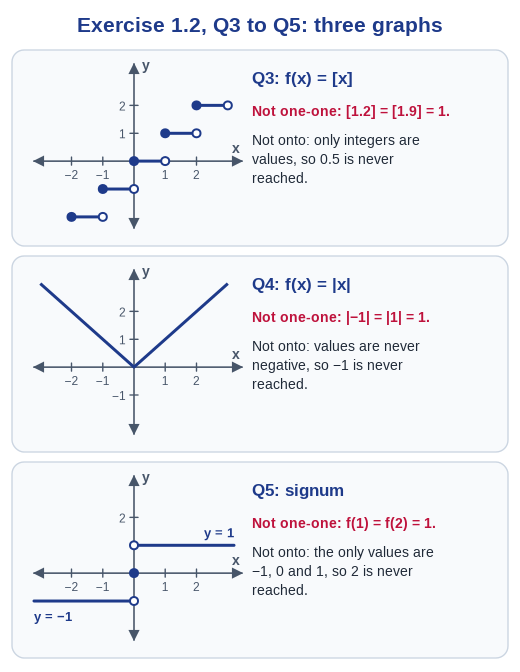
3. “Prove that the Greatest Integer Function f : R → R, given by f(x) = [x], is neither one-one nor onto, where [x] denotes the greatest integer less than or equal to x.”
- Not one-one: [1.2] = 1 and [1.9] = 1, so two different numbers have the same image.
- Not onto: [x] is always an integer, so 0.5 ∈ R is the image of no x.
4. “Show that the Modulus Function f : R → R, given by f(x) = |x|, is neither one-one nor onto, where |x| is x, if x is positive or 0 and |x| is − x, if x is negative.”
- Not one-one: |−1| = 1 = |1|.
- Not onto: |x| ≥ 0 for every x, so −1 is the image of no x.
5. “Show that the Signum Function f : R → R, given by f(x) = 1, if x > 0; 0, if x = 0; −1, if x < 0 is neither one-one nor onto.”
- Not one-one: f(1) = 1 = f(2).
- Not onto: the only values are −1, 0 and 1, so 2 is the image of no x.
6. “Let A = {1, 2, 3}, B = {4, 5, 6, 7} and let f = {(1, 4), (2, 5), (3, 6)} be a function from A to B. Show that f is one-one.”
f(1) = 4, f(2) = 5 and f(3) = 6. The three different elements of A have three different images, so f is one-one. (It is not onto, since 7 ∈ B is not an image; with 3 elements in A and 4 in B, no function from A to B can be onto.)
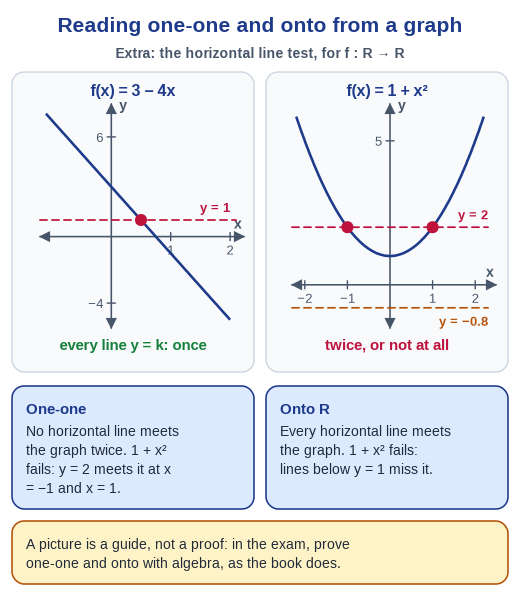
7. “In each of the following cases, state whether the function is one-one, onto or bijective. Justify your answer. (i) f : R → R defined by f(x) = 3 − 4x (ii) f : R → R defined by f(x) = 1 + x²”
(i) One-one: 3 − 4x₁ = 3 − 4x₂ gives −4x₁ = −4x₂, so x₁ = x₂. Onto: for any real y, x = (3 − y)/4 is real and f(x) = 3 − (3 − y) = y. So f is bijective (one-one and onto).
(ii) Not one-one: f(−1) = 2 = f(1). Not onto: 1 + x² ≥ 1 for every real x, so 0 is never reached. So f is neither one-one nor onto.
8. “Let A and B be sets. Show that f : A × B → B × A such that f(a, b) = (b, a) is bijective function.”
- One-one: if f(a₁, b₁) = f(a₂, b₂), then (b₁, a₁) = (b₂, a₂). Ordered pairs are equal only when their entries are equal, so b₁ = b₂ and a₁ = a₂, that is, (a₁, b₁) = (a₂, b₂).
- Onto: take any (b, a) in B × A. Then (a, b) ∈ A × B and f(a, b) = (b, a).
So f is bijective. (Swapping back, (b, a) → (a, b), is its inverse.)
9. “Let f : N → N be defined by f(n) = (n + 1)/2, if n is odd; n/2, if n is even for all n ∈ N. State whether the function f is bijective. Justify your answer.”
f(1) = (1 + 1)/2 = 1 and f(2) = 2/2 = 1. Two different numbers have the same image, so f is not one-one, and therefore f is not bijective. (It is onto: every n ∈ N is f(2n). The values run 1, 1, 2, 2, 3, 3, …)
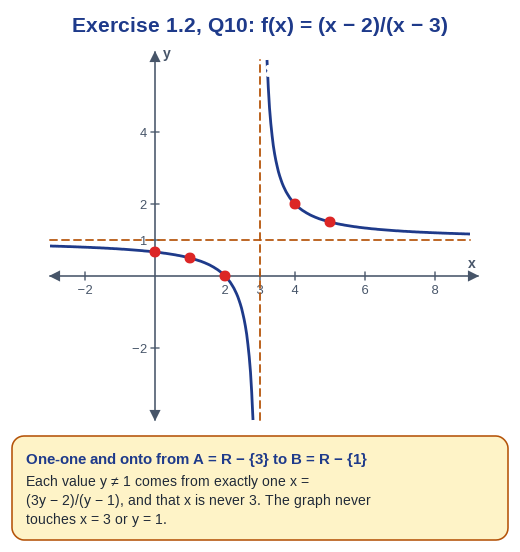
10. “Let A = R − {3} and B = R − {1}. Consider the function f : A → B defined by f(x) = ((x − 2)/(x − 3)). Is f one-one and onto? Justify your answer.”
First, f really maps into B: f(x) = 1 would need x − 2 = x − 3, which is impossible.
One-one: suppose f(x₁) = f(x₂) for x₁, x₂ in A. Cross-multiplying,
(x₁ − 2)(x₂ − 3) = (x₂ − 2)(x₁ − 3)
x₁x₂ − 3x₁ − 2x₂ + 6 = x₁x₂ − 3x₂ − 2x₁ + 6
−3x₁ − 2x₂ = −3x₂ − 2x₁, so −x₁ = −x₂ and x₁ = x₂.
Onto: take any y in B, so y ≠ 1. Solve y = (x − 2)/(x − 3):
y(x − 3) = x − 2, so xy − x = 3y − 2, so x = (3y − 2)/(y − 1)
This x is defined because y ≠ 1, and it is not 3, since (3y − 2)/(y − 1) = 3 would give 3y − 2 = 3y − 3, that is, −2 = −3. So x ∈ A. Check: x − 2 = y/(y − 1) and x − 3 = 1/(y − 1), so f(x) = y.
Yes, f is one-one and onto. For example, f(4) = 2 and (3 × 2 − 2)/(2 − 1) = 4.
11. “Let f : R → R be defined as f(x) = x⁴. Choose the correct answer. (A) f is one-one onto (B) f is many-one onto (C) f is one-one but not onto (D) f is neither one-one nor onto.”
f(−1) = 1 = f(1), so f is many-one (not one-one). x⁴ ≥ 0, so −1 is never reached: f is not onto. Answer: (D).
12. “Let f : R → R be defined as f(x) = 3x. Choose the correct answer. (A) f is one-one onto (B) f is many-one onto (C) f is one-one but not onto (D) f is neither one-one nor onto.”
3x₁ = 3x₂ gives x₁ = x₂, so f is one-one. For any real y, f(y/3) = y, so f is onto. Answer: (A).
Examples 15 to 17: composition and invertible functions (pages 12–13)
The rationalised book has no exercise on Section 1.4; these three examples teach it.
Example 15 (page 12): f : {2, 3, 4, 5} → {3, 4, 5, 9} with f(2) = 3, f(3) = 4, f(4) = f(5) = 5, and g : {3, 4, 5, 9} → {7, 11, 15} with g(3) = g(4) = 7, g(5) = g(9) = 11. Find gof.
gof(2) = g(3) = 7, gof(3) = g(4) = 7, gof(4) = g(5) = 11, gof(5) = g(5) = 11.
So gof = {(2, 7), (3, 7), (4, 11), (5, 11)}.
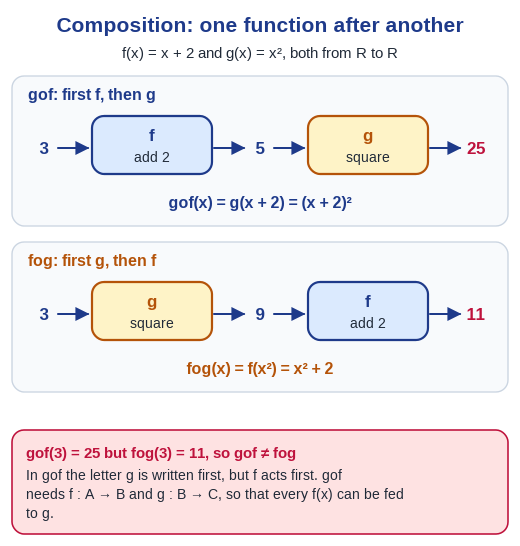
Example 16 (page 12): f(x) = cos x and g(x) = 3x² on R. Find gof and fog and show they differ.
gof(x) = g(cos x) = 3cos²x and fog(x) = f(3x²) = cos(3x²). At x = 0: gof(0) = 3 × 1 = 3, but fog(0) = cos 0 = 1. So gof ≠ fog.
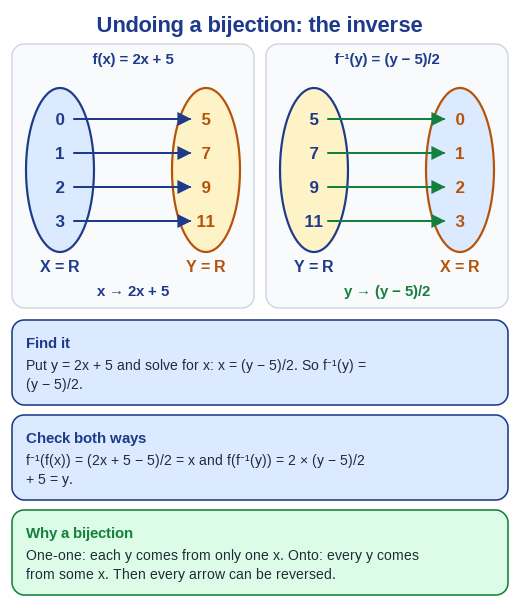
Definition 9 (page 12). f : X → Y is invertible if some g : Y → X has gof equal to the identity on X and fog equal to the identity on Y; g is then f⁻¹. The book notes that f is invertible exactly when it is one-one and onto, which is often the quickest way to show that a function is invertible.
Example 17 (pages 12–13): f(x) = 4x + 3 from N to Y = {y ∈ N : y = 4x + 3 for some x ∈ N}. Show f is invertible and find the inverse.
Y = {7, 11, 15, …}, the range of f, so f is onto Y by the way Y is chosen. Each y in Y is 4x + 3 for some natural x, so x = (y − 3)/4. Define g : Y → N by g(y) = (y − 3)/4, a natural number for every y in Y. Then
gof(x) = g(4x + 3) = (4x + 3 − 3)/4 = x
fog(y) = f((y − 3)/4) = 4 × (y − 3)/4 + 3 = y
So f is invertible and f⁻¹(y) = (y − 3)/4.
Miscellaneous Examples 18 to 26 (pages 13–15)
Example 18 (page 13): if R₁ and R₂ are equivalence relations in A, so is R₁ ∩ R₂.
- Reflexive: (a, a) is in R₁ and in R₂, so in R₁ ∩ R₂.
- Symmetric: (a, b) ∈ R₁ ∩ R₂ puts (a, b) in both; each is symmetric, so (b, a) is in both, hence in R₁ ∩ R₂.
- Transitive: (a, b) and (b, c) in R₁ ∩ R₂ lie in both relations, so (a, c) lies in both, hence in R₁ ∩ R₂.
Example 19 (page 13): on ordered pairs of positive integers, (x, y) R (u, v) if and only if xv = yu, is an equivalence relation.
- Reflexive: xy = yx.
- Symmetric: xv = yu gives uy = vx, which says (u, v) R (x, y).
- Transitive: let xv = yu and ub = va. Multiplying these, xv × ub = yu × va, that is, (xb)(uv) = (ya)(uv). Since u and v are positive, uv ≠ 0, and cancelling gives xb = ya, so (x, y) R (a, b).
In words: (x, y) R (u, v) says that the fractions x/y and u/v are equal.
Example 20 (pages 13–14): in X = {1, 2, …, 9}, R₁ = “3 divides x − y” and R₂ = “x and y both lie in {1, 4, 7}, or both in {2, 5, 8}, or both in {3, 6, 9}”. Show R₁ = R₂. The three sets are exactly the numbers of X that leave remainder 1, 2 and 0 when divided by 3. Now 3 divides x − y exactly when x and y leave the same remainder, that is, exactly when they lie in the same one of the three sets. So the two relations contain the same pairs: R₁ = R₂. (A check of all 81 pairs agrees.)
Example 21 (page 14): for a function f : X → Y, R = {(a, b) : f(a) = f(b)} is an equivalence relation. Equality is reflexive, symmetric and transitive: f(a) = f(a); f(a) = f(b) gives f(b) = f(a); f(a) = f(b) and f(b) = f(c) give f(a) = f(c). Its classes are the groups of elements with the same image. Exercise 1.1 Q7 and Q13 are this pattern.
Example 22 (page 14): the number of one-one functions from {1, 2, 3} to itself. f(1) can be any of 3 elements, f(2) any of the 2 others, and f(3) the last one: 3 × 2 × 1 = 3! = 6. Each is a permutation of 1, 2, 3.
Example 23 (page 14): in A = {1, 2, 3}, exactly three relations contain (1, 2) and (2, 3) and are reflexive and transitive but not symmetric. Reflexive needs (1, 1), (2, 2), (3, 3); transitive with (1, 2), (2, 3) needs (1, 3). So the smallest one is R₁ = {(1, 1), (2, 2), (3, 3), (1, 2), (2, 3), (1, 3)}. Only (2, 1), (3, 2) and (3, 1) can still be added.
- Adding (2, 1) alone gives R₂, still transitive and not symmetric, since (3, 2) is missing.
- Adding (3, 2) alone gives R₃, still transitive and not symmetric, since (2, 1) is missing.
- Adding (3, 1), or both (2, 1) and (3, 2), forces the other pairs for transitivity and gives the universal relation, which is symmetric.
So there are 3 such relations. (Listing all 512 relations in A confirms it.)
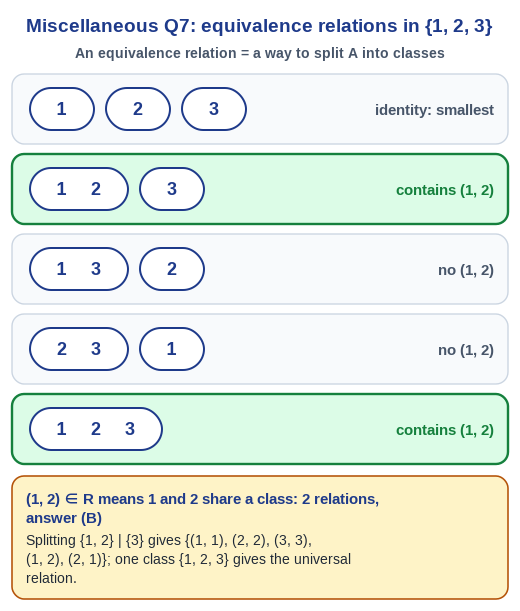
Example 24 (page 14): in {1, 2, 3}, exactly two equivalence relations contain (1, 2) and (2, 1). The smallest is R₁ = {(1, 1), (2, 2), (3, 3), (1, 2), (2, 1)}. Adding any pair with 3 and another element forces, by symmetry and transitivity, all the remaining pairs, giving the universal relation. So there are 2. (The same question is Miscellaneous Exercise Q7.)
Example 25 (page 14): the identity function I(x) = x on N is onto, but I + I, which sends x to 2x, is not. Every natural number x is I(x), so I is onto. But 3 is not 2x for any natural number x, so I + I is not onto: a sum of onto functions need not be onto.
Example 26 (page 15): sin x and cos x are one-one on [0, π/2], but sin x + cos x is not. On [0, π/2], sin x increases from 0 to 1 and cos x decreases from 1 to 0, so neither takes the same value twice. But (f + g)(0) = 0 + 1 = 1 and (f + g)(π/2) = 1 + 0 = 1, so f + g is not one-one: a sum of one-one functions need not be one-one.
Miscellaneous Exercise on Chapter 1 (pages 15–16)
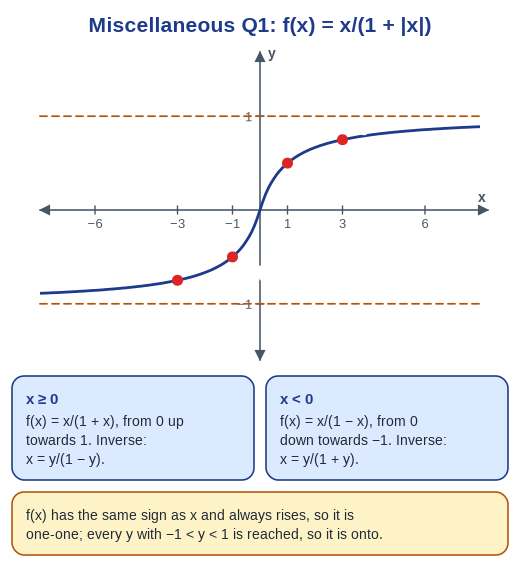
1. “Show that the function f : R → {x ∈ R : − 1 < x < 1} defined by f(x) = x/(1 + |x|), x ∈ R is one one and onto function.”
First, f really lands in the interval: |f(x)| = |x|/(1 + |x|) < 1, since the denominator is larger than the numerator. Also f(x) has the same sign as x: it is positive for x > 0, zero at 0 and negative for x < 0.
So f(x) = x/(1 + x) for x ≥ 0, and f(x) = x/(1 − x) for x < 0.
One-one: suppose f(x₁) = f(x₂). Then x₁ and x₂ have the same sign.
- If both are ≥ 0: x₁/(1 + x₁) = x₂/(1 + x₂) gives x₁ + x₁x₂ = x₂ + x₁x₂, so x₁ = x₂.
- If both are < 0: x₁/(1 − x₁) = x₂/(1 − x₂) gives x₁ − x₁x₂ = x₂ − x₁x₂, so x₁ = x₂.
Onto: take any y with −1 < y < 1.
- If 0 ≤ y < 1, let x = y/(1 − y) ≥ 0. Then f(x) = x/(1 + x) = [y/(1 − y)] ÷ [1/(1 − y)] = y.
- If −1 < y < 0, let x = y/(1 + y) < 0. Then f(x) = x/(1 − x) = [y/(1 + y)] ÷ [1/(1 + y)] = y.
So f is one-one and onto. For example, f(3) = 3/4 and 3/4 ÷ (1 − 3/4) = 3.
2. “Show that the function f : R → R given by f(x) = x³ is injective.”
Injective means one-one: different inputs give different outputs.
Step 1. Suppose x₁³ = x₂³. Then
0 = x₁³ − x₂³ = (x₁ − x₂)(x₁² + x₁x₂ + x₂²)
Step 2. The second factor can be written as (x₁ + x₂/2)² + 3x₂²/4. This is a sum of two squares, so it is never negative. It is 0 only when both squares are 0, that is, x₂ = 0 and x₁ = 0.
Step 3. If x₁ = x₂ = 0, we are done. Otherwise the second factor is positive, so the first factor must be 0: x₁ − x₂ = 0.
Either way x₁ = x₂, so f is injective.
3. “Given a non empty set X, consider P(X) which is the set of all subsets of X. Define the relation R in P(X) as follows: For subsets A, B in P(X), ARB if and only if A ⊂ B. Is R an equivalence relation on P(X)? Justify your answer.”
Here A ⊂ B means that A is a subset of B, possibly equal to B.
- Reflexive: every set is a subset of itself, A ⊂ A.
- Transitive: if A ⊂ B and B ⊂ C, every element of A is in B and so in C, so A ⊂ C.
- Not symmetric: X is non-empty, so φ ⊂ X but X ⊄ φ. So (φ, X) ∈ R but (X, φ) ∉ R.
No, R is not an equivalence relation, because it is not symmetric.
4. “Find the number of all onto functions from the set {1, 2, 3,…, n} to itself.”
The set is finite, so a function from it to itself is onto exactly when it is one-one (the Remark on page 10). The one-one functions are the arrangements of 1, 2, …, n: f(1) has n choices, f(2) has n − 1, and so on down to 1. So the number of onto functions is n × (n − 1) × … × 2 × 1 = n!. (Counting by computer for n = 1 to 5 gives 1, 2, 6, 24 and 120.)
5. “Let A = {− 1, 0, 1, 2}, B = {− 4, − 2, 0, 2} and f, g : A → B be functions defined by f(x) = x² − x, x ∈ A and g(x) = 2|x − 1/2| − 1, x ∈ A. Are f and g equal? Justify your answer. (Hint: One may note that two functions f : A → B and g : A → B such that f(a) = g(a) ∀ a ∈ A, are called equal functions).”
Compute both at every element of A:
- x = −1: f = 1 + 1 = 2; g = 2 × 3/2 − 1 = 2.
- x = 0: f = 0; g = 2 × 1/2 − 1 = 0.
- x = 1: f = 1 − 1 = 0; g = 2 × 1/2 − 1 = 0.
- x = 2: f = 4 − 2 = 2; g = 2 × 3/2 − 1 = 2.
f(a) = g(a) for every a ∈ A, so yes, f and g are equal. (They are not equal as functions on all of R: at x = 1/2, f gives −1/4 and g gives −1. Equality of functions depends on the domain.)
6. “Let A = {1, 2, 3}. Then number of relations containing (1, 2) and (1, 3) which are reflexive and symmetric but not transitive is (A) 1 (B) 2 (C) 3 (D) 4”
Reflexive and symmetric with (1, 2) and (1, 3) forces R = {(1, 1), (2, 2), (3, 3), (1, 2), (2, 1), (1, 3), (3, 1)}. It is not transitive: (2, 1), (1, 3) ∈ R but (2, 3) ∉ R. The only pairs left are (2, 3) and (3, 2), and symmetry means they go in together; then R is the universal relation, which is transitive. So exactly one relation works. Answer: (A).
7. “Let A = {1, 2, 3}. Then number of equivalence relations containing (1, 2) is (A) 1 (B) 2 (C) 3 (D) 4”
An equivalence relation containing (1, 2) also contains (2, 1), so 1 and 2 must be in the same class. The set can then be split as {1, 2} and {3}, giving {(1, 1), (2, 2), (3, 3), (1, 2), (2, 1)}, or kept as one class {1, 2, 3}, giving the universal relation. So there are 2. Answer: (B).
A note on this edition
The introduction (page 1) and the summary (page 16) still say the chapter covers binary operations, but the rationalised book has no section or exercise on them; nothing on this page depends on that topic. In Miscellaneous Exercise Q3 the book writes A ⊂ B for “A is a subset of B”, equality allowed, which is why the relation is reflexive.
Practice
-
How many relations are there in a set with 2 elements?
Show answer
Answer: (a) 16
-
Which pair is in R = {(a, b) : b = a²} in N?
Show answer
Answer: (a) (2, 4)
-
The number of one-one functions from {1, 2} to {1, 2, 3} is:
Show answer
Answer: (a) 6
-
Show that f : R → R, f(x) = x³ + 1, is one-one and onto.
Show answer
Answer: One-one: x₁³ + 1 = x₂³ + 1 gives x₁³ = x₂³, so x₁ = x₂, as in Miscellaneous Exercise Q2. Onto: for any real y, x = ∛(y − 1) is real and f(x) = (y − 1) + 1 = y.
-
Find gof and fog for f(x) = 2x + 1 and g(x) = x² on R. Are they equal?
Show answer
Answer: gof(x) = g(2x + 1) = (2x + 1)² = 4x² + 4x + 1, and fog(x) = f(x²) = 2x² + 1. At x = 1 they give 9 and 3, so gof ≠ fog.
Stuck on a question?
Take a photo and Lagnever AI explains it step by step. Try it for 7 days for ₹2.
Get it on Google Play Open in browser
For parents: after the trial, the plan renews monthly by UPI or card autopay. You can cancel anytime in the app.