
Class 12 Maths Chapter 1: Relations and Functions Notes
This chapter in five lines
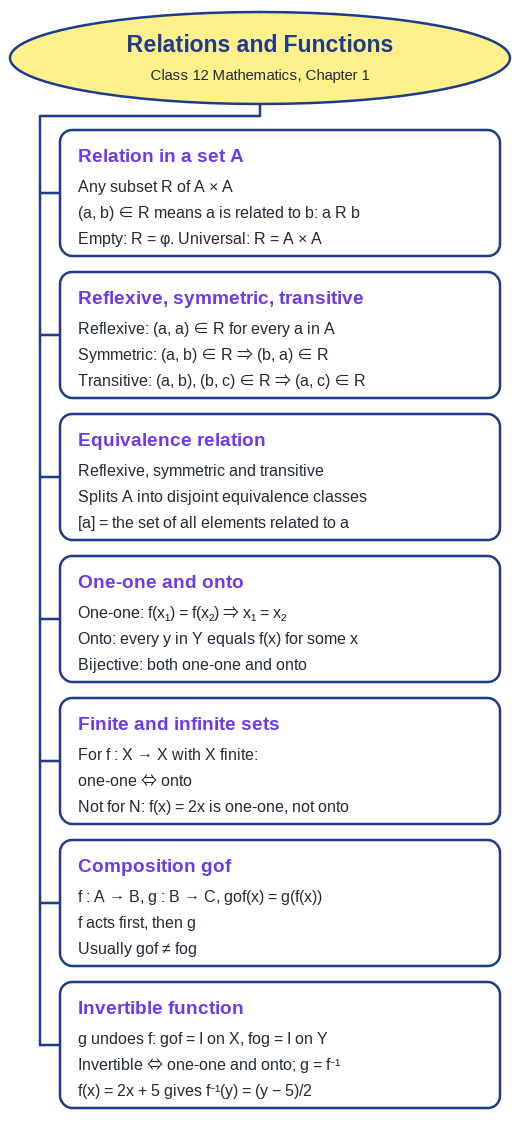
A relation in a set A is any subset of A × A. It can be reflexive, symmetric or transitive; with all three it is an equivalence relation, which splits A into disjoint equivalence classes. A function is one-one if different inputs give different outputs and onto if every element of the co-domain is an output. A function has an inverse exactly when it is both, that is, bijective; gof means f first, then g.
What is this chapter about?
In Class 11 you met relations, functions, domain, co-domain and range. This chapter, 17 pages long, studies them more closely. It sorts relations by three properties and sorts functions by two, and then joins functions one after another and reverses them. Almost every exercise asks you to prove a property or to disprove it with a counterexample, so the chapter is good training for writing short, exact arguments for the board exam.
What is a relation in a set?
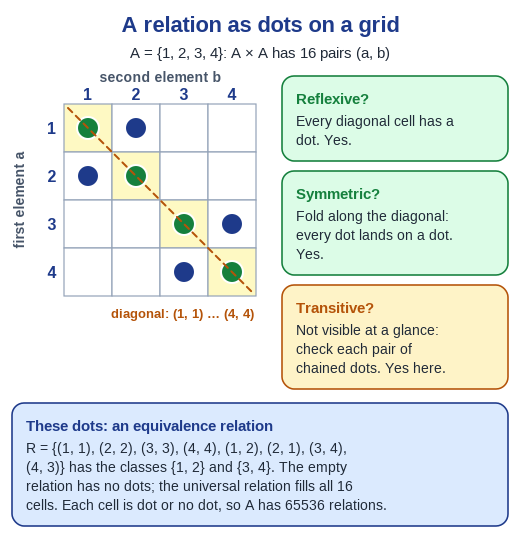
A relation R in a set A is any subset of A × A. If (a, b) ∈ R, we say a is related to b. At one extreme is the empty relation, R = φ, where nothing is related to anything; at the other, the universal relation, R = A × A, where everything is related to everything. In a set of 4 elements there are 16 pairs, and each pair is either in R or not, so the set has 65536 different relations.
When is a relation reflexive, symmetric or transitive?
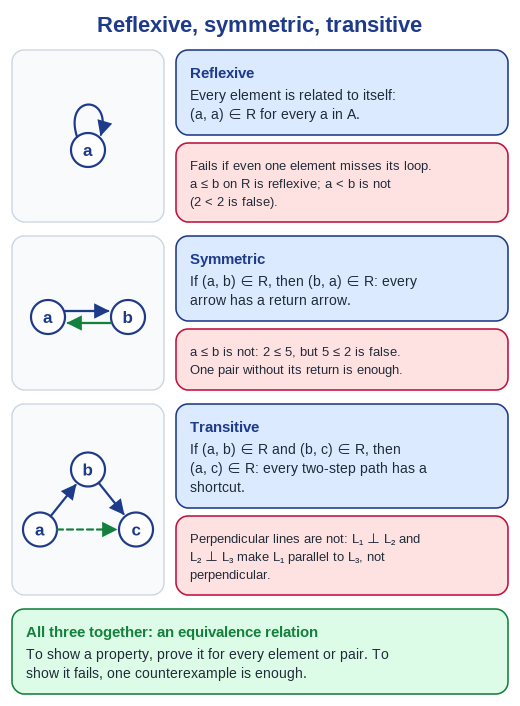
- Reflexive: (a, a) ∈ R for every a in A.
- Symmetric: whenever (a, b) ∈ R, also (b, a) ∈ R.
- Transitive: whenever (a, b) ∈ R and (b, c) ∈ R, also (a, c) ∈ R.
To prove a property you must argue for every element or every pair. To disprove it, one example is enough. “Is less than or equal to” on R is reflexive and transitive but not symmetric, since 2 ≤ 5 but 5 ≤ 2 is false. “Is perpendicular to” for lines is symmetric only: the x-axis is perpendicular to the y-axis, the y-axis to the line y = 1, but the x-axis is parallel to y = 1.
What is an equivalence relation?
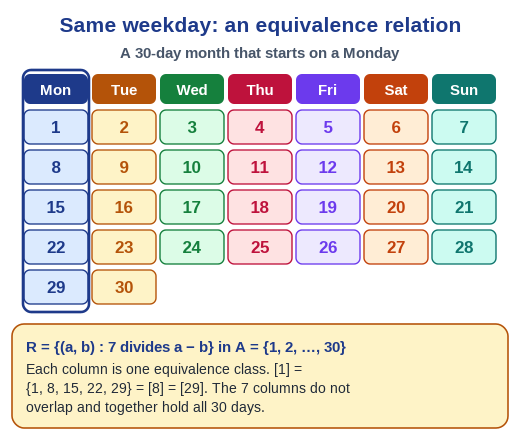
A relation that is reflexive, symmetric and transitive is an equivalence relation. Congruence of triangles, “has the same number of pages” for books, and “2 divides a − b” in the integers are examples. Each one sorts the set into equivalence classes: [a] is the set of elements related to a. Two classes are either the same or have nothing in common, and together they cover the whole set. For “2 divides a − b” the classes are the even integers [0] and the odd integers [1]. Read more on the types of relations.
When is a function one-one or onto?
A function f : X → Y is one-one (injective) if different elements of X always have different images: f(x₁) = f(x₂) forces x₁ = x₂. It is onto (surjective) if each element of Y equals f(x) for at least one x in X, that is, the range is all of Y. A function that is both is bijective. For example, f(x) = 2x is one-one and onto from R to R, one-one but not onto from N to N (no natural number doubles to 1), and f(x) = x² from R to R is neither.
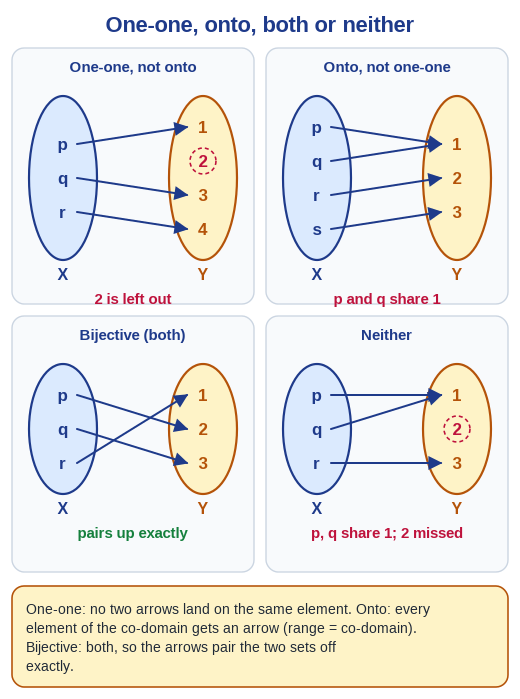
When X is finite, a function from X to itself is one-one exactly when it is onto: n different inputs must fill n places. This fails for infinite sets, which is a real difference between finite and infinite sets. Read one-one and onto functions.
What is the composition gof?
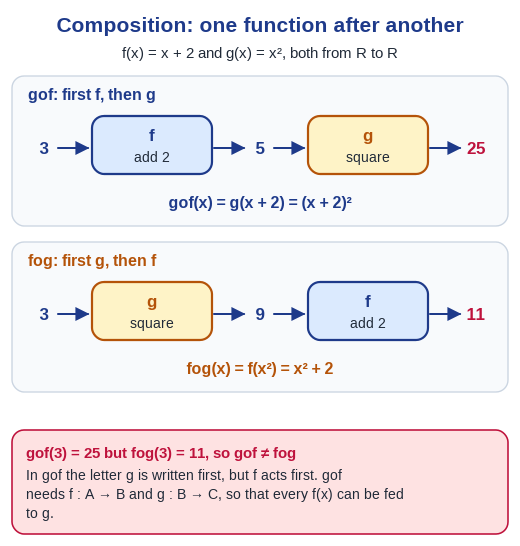
If f : A → B and g : B → C, the composition gof : A → C is gof(x) = g(f(x)). Although g is written first, f acts first. The order matters: with f(x) = x + 2 and g(x) = x², gof(x) = (x + 2)² but fog(x) = x² + 2, so gof(3) = 25 and fog(3) = 11.
When does a function have an inverse?
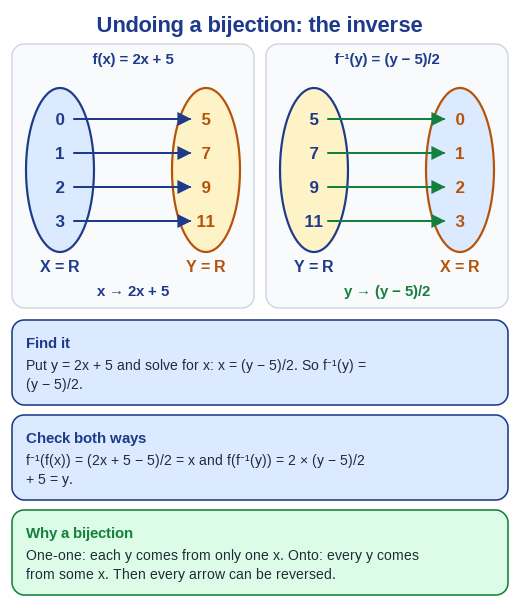
A function f : X → Y is invertible if there is a function g : Y → X that undoes it from both sides: g(f(x)) = x for every x in X and f(g(y)) = y for every y in Y. Then g is written f⁻¹. The book states the key fact: f is invertible exactly when it is one-one and onto. To find the inverse, solve y = f(x) for x. For f(x) = 2x + 5, x = (y − 5)/2, so f⁻¹(y) = (y − 5)/2.
Before we move on
The rationalised book has no exercise on composition or inverses; Section 1.4 is taught through Examples 15 to 17. The introduction and the summary still mention binary operations, which the 2022 revision removed. Every example, both exercises and the Miscellaneous Exercise are worked out in the NCERT solutions for Chapter 1.
Key terms
| Term | Meaning |
|---|---|
| Relation in a set A | Any subset R of A × A. If (a, b) ∈ R, we say a is related to b and write a R b. |
| Empty and universal relation | Empty: no element is related to any element, R = φ. Universal: every element is related to every element, R = A × A. |
| Reflexive | (a, a) ∈ R for every a in A: every element is related to itself. |
| Symmetric | (a, b) ∈ R implies (b, a) ∈ R, for all a, b in A. |
| Transitive | (a, b) ∈ R and (b, c) ∈ R imply (a, c) ∈ R, for all a, b, c in A. |
| Equivalence relation | A relation that is reflexive, symmetric and transitive, such as congruence of triangles or “2 divides a − b” in Z. |
| Equivalence class [a] | The set of all elements related to a. Two classes are either equal or disjoint, and together they cover A. |
| One-one (injective) | f(x₁) = f(x₂) implies x₁ = x₂: different elements have different images. Otherwise f is many-one. |
| Onto (surjective) | Every y in the co-domain is f(x) for some x in the domain, that is, range = co-domain. |
| Bijective | Both one-one and onto: the function pairs the elements of the two sets exactly. |
| Composition gof | For f : A → B and g : B → C, gof : A → C is gof(x) = g(f(x)): first f, then g. |
| Identity function | The function on a set X that sends every element to itself, x → x. The book writes it as I with the subscript X. |
| Invertible function | f : X → Y is invertible if some g : Y → X undoes it both ways: g(f(x)) = x and f(g(y)) = y. Then g is the inverse, f⁻¹. |
Topics in this chapter
Practice
-
A relation R in A = {1, 2, 3} is reflexive. Which pairs must R contain?
Show answer
Answer: (a) (1, 1), (2, 2) and (3, 3)
-
The relation R = {(a, b) : a < b} in R is:
Show answer
Answer: (c) transitive
-
Which function from R to R is one-one and onto?
Show answer
Answer: (b) f(x) = 5 − 2x
-
If f(x) = x + 2 and g(x) = x², then gof(1) is:
Show answer
Answer: (a) 9
-
The inverse of f : R → R, f(x) = 3x − 4, is:
Show answer
Answer: (a) f⁻¹(y) = (y + 4)/3
Questions students ask
What are the main topics of Class 12 Maths Chapter 1?
Types of relations (empty, universal, reflexive, symmetric, transitive and equivalence relations, with equivalence classes), types of functions (one-one, onto and bijective), and the composition of functions and invertible functions. The exercises ask for many short proofs and counterexamples.
Are binary operations in the 2026-27 Class 12 Maths book?
No. In the rationalised book (Revised Edition October 2022, marked Reprint 2026-27) the chapter has four sections: the introduction, types of relations, types of functions, and composition and invertible functions. The introduction and the summary still mention binary operations, but no section on them is left.
What is the difference between a relation and a function?
A relation from A to B is any subset of A × B, so one element may be related to many elements or to none. A function from A to B is a special relation in which every element of A has exactly one image in B.
How do I prove that a function is one-one and onto?
For one-one, start from f(x₁) = f(x₂) and reach x₁ = x₂. For onto, take any y in the co-domain, solve y = f(x) for x, and check that this x lies in the domain. To show that either property fails, one counterexample is enough.
Stuck on a question?
Take a photo and Lagnever AI explains it step by step. Try it for 7 days for ₹2.
Get it on Google Play Open in browser
For parents: after the trial, the plan renews monthly by UPI or card autopay. You can cancel anytime in the app.