
What are the types of relations?
Answer in short
A relation R in a set A is any subset of A × A. It is empty if R = φ, universal if R = A × A, reflexive if every (a, a) is in R, symmetric if (a, b) brings (b, a), and transitive if (a, b) and (b, c) bring (a, c). All three make an equivalence relation.
Stuck on a question? Take a photo and Lagnever AI explains it step by step. Try it for 7 days for ₹2. Get it on Google Play
What is a relation in a set?
In everyday language two things are related if there is some link between them. In mathematics we drop the need for a link. A relation R in a set A is simply a subset of A × A, the set of all ordered pairs (a, b) with a and b in A. If (a, b) ∈ R, we say a is related to b and write a R b.
A good way to see a relation is a grid. List the elements of A down the side and across the top; each cell is one pair (a, b). A relation is any choice of cells. For A = {1, 2, 3, 4} there are 16 cells, so there are 65536 possible relations.
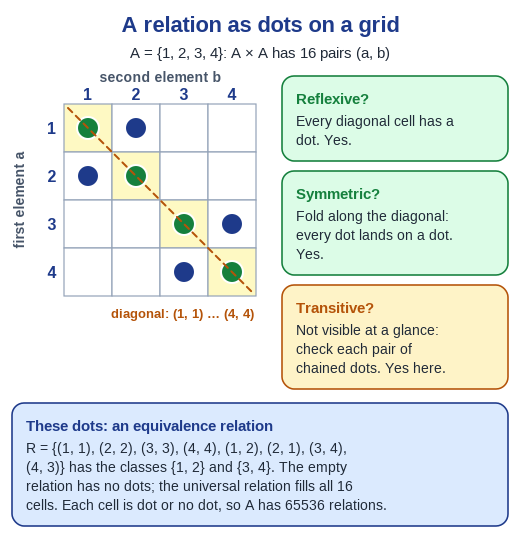
What are the empty and universal relations?
They are the two extremes. The empty relation is R = φ: no element is related to any element. In A = {1, 2, 3}, R = {(a, b) : a × b = 100} is empty, because the largest product is 3 × 3 = 9. The universal relation is R = A × A: every element is related to every element. In the same set, R = {(a, b) : a + b ≤ 6} is universal, because the largest sum is 3 + 3 = 6. Both are called trivial relations.
When is a relation reflexive?
R is reflexive if (a, a) ∈ R for every a in A. On the grid, every cell of the diagonal is filled. “a ≤ b” on the real numbers is reflexive, since a ≤ a always. “a < b” is not: 2 < 2 is false, and one such element is enough to fail.
When is a relation symmetric?
R is symmetric if (a, b) ∈ R always brings (b, a) ∈ R. On the grid, the dots are a mirror image across the diagonal. “Is in the same section as”, for the students of a school, is symmetric. “a ≤ b” is not: (2, 5) is in it, but (5, 2) is not.
When is a relation transitive?
R is transitive if (a, b) ∈ R and (b, c) ∈ R always bring (a, c) ∈ R: every two-step path has a shortcut. “a ≤ b” is transitive. “Is perpendicular to” for lines is not: the x-axis is perpendicular to the y-axis, the y-axis is perpendicular to the line y = 1, but the x-axis and y = 1 are parallel.
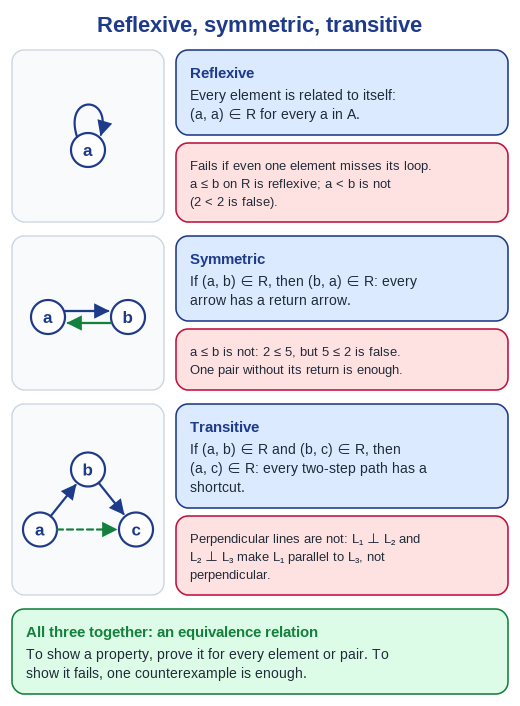
How do you prove or disprove these properties?
To prove a property, take a general element or pair and argue with letters, not numbers. To disprove it, give one particular counterexample with numbers. For R = {(a, b) : 5 divides a − b} in Z:
- Reflexive: a − a = 0 = 5 × 0, so (a, a) ∈ R.
- Symmetric: if a − b = 5k, then b − a = 5(−k), so (b, a) ∈ R.
- Transitive: if a − b = 5k and b − c = 5m, then a − c = (a − b) + (b − c) = 5(k + m), so (a, c) ∈ R.
Now take R = {(a, b) : a ≤ b + 1} in R. It is reflexive, since a ≤ a + 1 for every a. It is not symmetric: (0, 5) ∈ R because 0 ≤ 6, but (5, 0) ∉ R because 5 > 1. It is not transitive: (2, 1) and (1, 0) are in R, since 2 ≤ 2 and 1 ≤ 1, but (2, 0) is not, since 2 > 1.
What is an equivalence relation?
A relation that is reflexive, symmetric and transitive is an equivalence relation. It behaves like “is the same as” in some respect: “is in the same section as” for students, “was born in the same month as” for people, and “5 divides a − b” in Z are all equivalence relations.
What are equivalence classes?
An equivalence relation sorts the set into groups. The equivalence class [a] is the set of all elements related to a. Two classes are either equal or disjoint, and together they cover the set. Take the days of a month and call two days related when they fall on the same weekday, that is, when 7 divides their difference. Each column of the calendar is then one class: [1] = {1, 8, 15, 22, 29}, and [1] = [8] = [29].
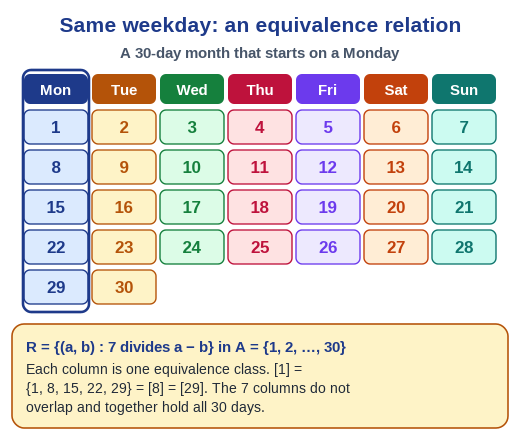
It also works the other way: split a set into disjoint pieces that cover it, call two elements related when they share a piece, and you get an equivalence relation whose classes are those pieces. That is why {1, 2, 3} has exactly 5 equivalence relations: it can be split in exactly 5 ways.
Read next: one-one and onto functions, the chapter notes and the NCERT solutions.
Practice
-
In A = {1, 2, 3}, the relation R = {(1, 1), (2, 2), (3, 3), (1, 3), (3, 1)} is:
Show answer
Answer: (c) an equivalence relation
-
Which relation in the set of all lines in a plane is an equivalence relation?
Show answer
Answer: (b) L₁ is parallel to L₂
-
In Z, a R b when 5 divides a − b. The equivalence class [2] is:
Show answer
Answer: (a) {…, −8, −3, 2, 7, 12, …}
-
Show that R = {(a, b) : a − b is a multiple of 3} in Z is an equivalence relation.
Show answer
Answer: Reflexive: a − a = 0 = 3 × 0. Symmetric: if a − b = 3k, then b − a = 3(−k). Transitive: if a − b = 3k and b − c = 3m, then a − c = 3(k + m). So R is an equivalence relation, with the classes [0], [1] and [2].
-
Give a counterexample to show that R = {(a, b) : |a − b| ≤ 1} in R is not transitive.
Show answer
Answer: (0, 1) ∈ R and (1, 2) ∈ R, since both differences are 1. But (0, 2) ∉ R, since |0 − 2| = 2 > 1. So R is not transitive (it is reflexive and symmetric).
Questions students ask
What is the difference between reflexive and symmetric relations?
Reflexive is about each element on its own: every a must be related to itself. Symmetric is about pairs: whenever a is related to b, b must be related to a. “Is less than or equal to” is reflexive but not symmetric; “is perpendicular to” is symmetric but not reflexive.
Can a relation be symmetric and transitive but not reflexive?
Yes. In {1, 2, 3}, R = {(1, 1), (2, 2), (1, 2), (2, 1)} is symmetric and transitive, but (3, 3) is missing. This can happen only when some element is related to nothing at all.
Is the empty relation transitive?
Yes, and symmetric too: there is no pair in it that could break either rule. It is not reflexive, because no (a, a) is in it (for a non-empty set). So the empty relation is not an equivalence relation.
What is an equivalence class?
For an equivalence relation R in A, the class [a] is the set of all elements of A related to a. Different classes never overlap and together they make up A. For “2 divides a − b” in Z, the classes are the even integers and the odd integers.
Stuck on a question?
Take a photo and Lagnever AI explains it step by step. Try it for 7 days for ₹2.
Get it on Google Play Open in browser
For parents: after the trial, the plan renews monthly by UPI or card autopay. You can cancel anytime in the app.