
NCERT Solutions Class 12 Maths Chapter 10: Vector Algebra
Answers to every question of Exercises 10.1 to 10.4 and the Miscellaneous Exercise, and to all 30 worked examples, of Chapter 10, Vector Algebra, of Mathematics Part II, the Class 12 NCERT textbook. Page numbers follow the 2026-27 reprint (pages 338–376). The exercise questions are quoted from the book; the examples are restated in short and labelled by number and page. Every number below was checked by a script (sympy): each magnitude, unit vector, dot and cross product, projection, angle, area, collinearity test and section-formula point, and every MCQ option. The answers agree with the book’s answer key except in three places, each marked where it comes: Exercise 10.1 Question 4(i), Exercise 10.2 Question 18 and Miscellaneous Question 12. Short notes: Chapter 10 notes.
How the maths is typed here. The book puts an arrow over every vector; here small letters a, b, c, d, r and x stand for vectors, and AB means the vector from A to B. |a| is the magnitude of a, â = a/|a| the unit vector along a, and î, ĵ, k̂ the unit vectors along the axes. a · b is the dot product and a × b the cross product. Fractions use a slash. The quoted questions use the same layout.
Four facts carry most of the answers:
- |a₁î + a₂ĵ + a₃k̂| = √(a₁² + a₂² + a₃²); â = a/|a|; the vector from P to Q is (position vector of Q) − (position vector of P).
- Section formula: (mb + na)/(m + n) internally, (mb − na)/(m − n) externally.
- a · b = a₁b₁ + a₂b₂ + a₃b₃ = |a||b| cos θ; projection of a on b = a · b/|b|.
- a × b = (a₂b₃ − a₃b₂)î − (a₁b₃ − a₃b₁)ĵ + (a₁b₂ − a₂b₁)k̂ = |a||b| sin θ n̂; area of parallelogram |a × b|, of triangle ½|a × b|.
Examples 1 to 3 (pages 341–342)
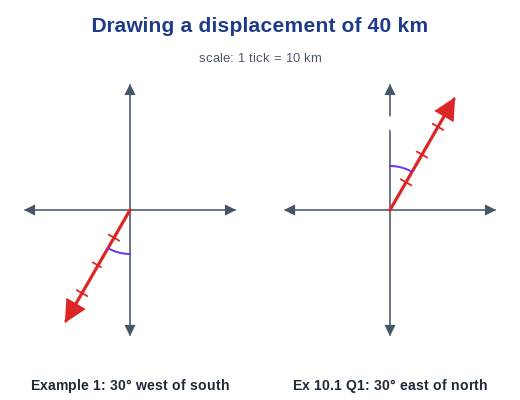
Example 1 (page 341): draw a 40 km displacement pointing 30° west of south. Draw the north–south and east–west lines through O. Turn 30° from south towards west and draw OP of 4 units on a scale of 1 unit = 10 km. OP is the required displacement. In components (east as î, north as ĵ) it is −20î − 20√3ĵ km.
Example 2 (page 341): classify 5 seconds, 1000 cm³, 10 newton, 30 km/hr, 10 g/cm³ and 20 m/s towards north. Time, volume, speed and density need only a size: scalars. 10 newton is a force and 20 m/s towards north is a velocity: vectors.
Example 3 (page 342): read collinear, equal and coinitial vectors from the book’s Fig 10.5. In that figure a, c and d lie along parallel lines, so they are collinear; a and c have the same length and the same sense, so they are equal; b, c and d start from one point, so they are coinitial.
Exercise 10.1 (page 342)
1. “Represent graphically a displacement of 40 km, 30° east of north.” Draw the compass lines through O. Turn 30° from north towards east and draw OP, 4 units long on a scale of 1 unit = 10 km, with the arrow at P. OP is the required displacement (20î + 20√3ĵ km with east as î and north as ĵ).
2. “Classify the following measures as scalars and vectors. (i) 10 kg (ii) 2 meters north-west (iii) 40° (iv) 40 watt (v) 10⁻¹⁹ coulomb (vi) 20 m/s²” (i) Mass: scalar. (ii) A displacement with a direction: vector. (iii) An angle: scalar. (iv) Power: scalar. (v) Charge: scalar. (vi) m/s² is the unit of acceleration, a vector quantity: vector.
3. “Classify the following as scalar and vector quantities. (i) time period (ii) distance (iii) force (iv) velocity (v) work done” (i) Scalar. (ii) Scalar. (iii) Vector. (iv) Vector. (v) Scalar.
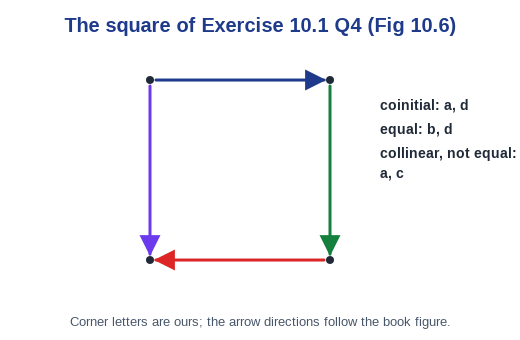
4. “In Fig 10.6 (a square), identify the following vectors. (i) Coinitial (ii) Equal (iii) Collinear but not equal” In the book’s square, a runs along the top from left to right, b down the right side, c along the bottom from right to left, and d down the left side from the top-left corner. (i) a and d both start at the top-left corner: a and d are coinitial. (ii) b and d have the same length and both point down: b and d are equal. (iii) a and c are parallel but point opposite ways: a and c are collinear but not equal.
Answer key note: the key gives “a and b” for (i). In Fig 10.6 as printed, b starts where a ends, so a and b are not coinitial; a and d are. (ii) and (iii) agree with the key.
5. “Answer the following as true or false. (i) a and −a are collinear. (ii) Two collinear vectors are always equal in magnitude. (iii) Two vectors having same magnitude are collinear. (iv) Two collinear vectors having the same magnitude are equal.” (i) True: −a = (−1)a lies along the same line. (ii) False: a and 2a are collinear with different lengths. (iii) False: î and ĵ both have length 1 but are perpendicular. (iv) False: a and −a are collinear with equal lengths but opposite directions.
Examples 4 to 12 (pages 349–353)
Example 4 (page 349): find x, y, z so that xî + 2ĵ + zk̂ = 2î + yĵ + k̂. Equal vectors have equal components: x = 2, y = 2, z = 1.
Example 5 (page 350): a = î + 2ĵ, b = 2î + ĵ. Is |a| = |b|? Are they equal? |a| = √(1 + 4) = √5 and |b| = √(4 + 1) = √5, so |a| = |b|. But the components differ (1 ≠ 2), so a ≠ b.
Example 6 (page 350): unit vector along a = 2î + 3ĵ + k̂. |a| = √14, so â = (2/√14)î + (3/√14)ĵ + (1/√14)k̂.
Example 7 (page 350): a vector of magnitude 7 along a = î − 2ĵ. â = (î − 2ĵ)/√5, so the vector is 7â = (7/√5)î − (14/√5)ĵ.
Example 8 (page 350): unit vector along the sum of a = 2î + 2ĵ − 5k̂ and b = 2î + ĵ + 3k̂. c = a + b = 4î + 3ĵ − 2k̂, |c| = √(16 + 9 + 4) = √29. ĉ = (4/√29)î + (3/√29)ĵ − (2/√29)k̂.
Example 9 (page 351): direction ratios and direction cosines of a = î + ĵ − 2k̂. Direction ratios are the components: 1, 1, −2. |a| = √6, so the direction cosines are 1/√6, 1/√6, −2/√6.
Example 10 (page 352): vector from P(2, 3, 0) to Q(−1, −2, −4). PQ = (−1 − 2)î + (−2 − 3)ĵ + (−4 − 0)k̂ = −3î − 5ĵ − 4k̂.
Example 11 (page 353): OP = 3a − 2b and OQ = a + b. Find R dividing PQ in the ratio 2 : 1, first internally and then externally. (i) OR = [2(a + b) + 1(3a − 2b)]/(2 + 1) = 5a/3. (ii) OR = [2(a + b) − 1(3a − 2b)]/(2 − 1) = 4b − a.
Example 12 (pages 353–354): show that A(2î − ĵ + k̂), B(î − 3ĵ − 5k̂), C(3î − 4ĵ − 4k̂) form a right-angled triangle. AB = −î − 2ĵ − 6k̂, BC = 2î − ĵ + k̂, CA = −î + 3ĵ + 5k̂. |AB|² = 41, |BC|² = 6, |CA|² = 35, and 41 = 6 + 35. By the converse of Pythagoras’ theorem, the triangle is right-angled at C.
Exercise 10.2 (pages 354–355)
1. “Compute the magnitude of the following vectors: a = î + ĵ + k̂; b = 2î − 7ĵ − 3k̂; c = (1/√3)î + (1/√3)ĵ − (1/√3)k̂” |a| = √(1 + 1 + 1) = √3. |b| = √(4 + 49 + 9) = √62. |c| = √(1/3 + 1/3 + 1/3) = 1.
2. “Write two different vectors having same magnitude.” For example, a = 2î + 3ĵ + 6k̂ and b = 6î + 2ĵ + 3k̂: |a| = |b| = √49 = 7, but a ≠ b. (Many answers are possible.)
3. “Write two different vectors having same direction.” For example, a = î + 2ĵ + 2k̂ and b = 2î + 4ĵ + 4k̂ = 2a. Both have direction cosines 1/3, 2/3, 2/3. (Many answers are possible.)
4. “Find the values of x and y so that the vectors 2î + 3ĵ and xî + yĵ are equal.” Equal vectors have equal components: x = 2, y = 3.
5. “Find the scalar and vector components of the vector with initial point (2, 1) and terminal point (– 5, 7).” The vector is (−5 − 2)î + (7 − 1)ĵ = −7î + 6ĵ. Scalar components −7 and 6; vector components −7î and 6ĵ.
6. “Find the sum of the vectors a = î − 2ĵ + k̂, b = −2î + 4ĵ + 5k̂ and c = î − 6ĵ − 7k̂.” Add the components: (1 − 2 + 1)î + (−2 + 4 − 6)ĵ + (1 + 5 − 7)k̂ = −4ĵ − k̂.
7. “Find the unit vector in the direction of the vector a = î + ĵ + 2k̂.” |a| = √6, so â = (1/√6)î + (1/√6)ĵ + (2/√6)k̂.
8. “Find the unit vector in the direction of vector PQ, where P and Q are the points (1, 2, 3) and (4, 5, 6), respectively.” PQ = 3î + 3ĵ + 3k̂, |PQ| = 3√3. Unit vector (1/√3)î + (1/√3)ĵ + (1/√3)k̂.
9. “For given vectors, a = 2î − ĵ + 2k̂ and b = −î + ĵ − k̂, find the unit vector in the direction of the vector a + b.” a + b = î + k̂, of length √2. Unit vector (1/√2)î + (1/√2)k̂.
10. “Find a vector in the direction of vector 5î − ĵ + 2k̂ which has magnitude 8 units.” The length is √(25 + 1 + 4) = √30. The vector is 8(5î − ĵ + 2k̂)/√30 = (40/√30)î − (8/√30)ĵ + (16/√30)k̂.
11. “Show that the vectors 2î − 3ĵ + 4k̂ and −4î + 6ĵ − 8k̂ are collinear.” −4î + 6ĵ − 8k̂ = −2(2î − 3ĵ + 4k̂). One is a scalar multiple of the other, so they are collinear (opposite in direction, one twice as long).
12. “Find the direction cosines of the vector î + 2ĵ + 3k̂.” |a| = √14. Direction cosines 1/√14, 2/√14, 3/√14.
13. “Find the direction cosines of the vector joining the points A (1, 2, –3) and B (–1, –2, 1), directed from A to B.” AB = −2î − 4ĵ + 4k̂, |AB| = √36 = 6. Direction cosines −1/3, −2/3, 2/3.
14. “Show that the vector î + ĵ + k̂ is equally inclined to the axes OX, OY and OZ.” |a| = √3, so the direction cosines are 1/√3, 1/√3, 1/√3. Then cos α = cos β = cos γ, and as each angle is between 0 and π, α = β = γ. The vector is equally inclined to the three axes.
15. “Find the position vector of a point R which divides the line joining two points P and Q whose position vectors are î + 2ĵ − k̂ and −î + ĵ + k̂ respectively, in the ratio 2 : 1 (i) internally (ii) externally” Let a = î + 2ĵ − k̂ and b = −î + ĵ + k̂. (i) OR = (2b + a)/3 = (−î + 4ĵ + k̂)/3 = −(1/3)î + (4/3)ĵ + (1/3)k̂. (ii) OR = (2b − a)/(2 − 1) = −3î + 3k̂.
16. “Find the position vector of the mid point of the vector joining the points P(2, 3, 4) and Q(4, 1, –2).” Midpoint = [(2î + 3ĵ + 4k̂) + (4î + ĵ − 2k̂)]/2 = 3î + 2ĵ + k̂.
17. “Show that the points A, B and C with position vectors, a = 3î − 4ĵ − 4k̂, b = 2î − ĵ + k̂ and c = î − 3ĵ − 5k̂, respectively form the vertices of a right angled triangle.” AB = b − a = −î + 3ĵ + 5k̂, BC = c − b = −î − 2ĵ − 6k̂, CA = a − c = 2î − ĵ + k̂. |AB|² = 35, |BC|² = 41, |CA|² = 6, and 35 + 6 = 41. So |BC|² = |AB|² + |CA|², and the triangle is right-angled at A.
18. “In triangle ABC (Fig 10.18), which of the following is not true: (A) AB + BC + CA = 0 (B) AB + BC − AC = 0 (C) AB + BC − AC = 0 (D) AB − CB + CA = 0” By the triangle law AB + BC = AC, so AB + BC + CA = 0. (A) is true. (B) is true, since AB + BC − AC = AC − AC = 0. (D) is true, since −CB = BC, which turns it into (A).
Book note: options (B) and (C) are printed exactly alike, and as printed all four statements are true. The answer key gives (C). Read (C) as AB + BC − CA = 0: then AB + BC − CA = AC + AC = 2AC ≠ 0, so (C) is the false one. Answer (C), with that reading.
19. “If a and b are two collinear vectors, then which of the following are incorrect: (A) b = λa, for some scalar λ (B) a = ±b (C) the respective components of a and b are not proportional (D) both the vectors a and b have same direction, but different magnitudes.” (A) is correct: collinear means one is a scalar multiple of the other. (B) is incorrect: a and 2a are collinear but a ≠ ±2a. (C) is incorrect: b = λa makes the components proportional. (D) is incorrect: collinear vectors may point opposite ways, or have equal lengths. Answer (B), (C) and (D).
Examples 13 to 21 (pages 358–361)
Example 13 (page 358): angle between a and b with |a| = 1, |b| = 2 and a · b = 1. cos θ = 1/(1 × 2) = 1/2, so θ = π/3.
Example 14 (page 359): angle between a = î + ĵ − k̂ and b = î − ĵ + k̂. a · b = 1 − 1 − 1 = −1 and |a||b| = √3 × √3 = 3. cos θ = −1/3, so θ = cos⁻¹(−1/3).
Example 15 (page 359): with a = 5î − ĵ − 3k̂ and b = î + 3ĵ − 5k̂, show a + b ⊥ a − b. a + b = 6î + 2ĵ − 8k̂ and a − b = 4î − 4ĵ + 2k̂. Their dot product is 24 − 8 − 16 = 0, so they are perpendicular.
Example 16 (page 359): projection of a = 2î + 3ĵ + 2k̂ on b = î + 2ĵ + k̂. a · b = 2 + 6 + 2 = 10 and |b| = √6. Projection = 10/√6 = (5/3)√6.
Example 17 (pages 359–360): |a − b| when |a| = 2, |b| = 3 and a · b = 4. |a − b|² = |a|² − 2a · b + |b|² = 4 − 8 + 9 = 5, so |a − b| = √5.
Example 18 (page 360): a is a unit vector and (x − a) · (x + a) = 8. Find |x|. Expanding, x · x + x · a − a · x − a · a = |x|² − 1 = 8, so |x|² = 9 and |x| = 3.
Example 19 (page 360): prove |a · b| ≤ |a||b| (Cauchy–Schwarz inequality). If a or b is 0, both sides are 0. Otherwise |a · b|/(|a||b|) = |cos θ| ≤ 1, which gives |a · b| ≤ |a||b|.
Example 20 (pages 360–361): prove |a + b| ≤ |a| + |b| (triangle inequality). If a or b is 0, both sides are equal, so it holds. Otherwise:
- Expand: |a + b|² = (a + b) · (a + b) = |a|² + 2a · b + |b|².
- A number is never more than its absolute value, so a · b ≤ |a · b|. By Example 19, |a · b| ≤ |a||b|.
- So |a + b|² ≤ |a|² + 2|a||b| + |b|² = (|a| + |b|)².
- Both sides are lengths (not negative), so take square roots: |a + b| ≤ |a| + |b|.
If equality holds for AB, BC and AC, then |AC| = |AB| + |BC| and A, B, C are collinear.
Example 21 (page 361): show A(−2î + 3ĵ + 5k̂), B(î + 2ĵ + 3k̂), C(7î − k̂) are collinear. AB = 3î − ĵ − 2k̂, BC = 6î − 2ĵ − 4k̂, AC = 9î − 3ĵ − 6k̂, with lengths √14, 2√14 and 3√14. Since |AC| = |AB| + |BC|, A, B and C are collinear. (Here AB + BC + CA = 0 too, but the three points do not form a triangle.)
Exercise 10.3 (pages 361–362)
1. “Find the angle between two vectors a and b with magnitudes √3 and 2, respectively having a · b = √6.” cos θ = √6/(√3 × 2) = √2/2 = 1/√2, so θ = π/4.
2. “Find the angle between the vectors î − 2ĵ + 3k̂ and 3î − 2ĵ + k̂” a · b = 3 + 4 + 3 = 10 and |a| = |b| = √14. cos θ = 10/14 = 5/7, so θ = cos⁻¹(5/7).
3. “Find the projection of the vector î − ĵ on the vector î + ĵ.” (î − ĵ) · (î + ĵ) = 1 − 1 = 0, so the projection is 0/√2 = 0. The two vectors are perpendicular.
4. “Find the projection of the vector î + 3ĵ + 7k̂ on the vector 7î − ĵ + 8k̂.” a · b = 7 − 3 + 56 = 60 and |b| = √(49 + 1 + 64) = √114. Projection = 60/√114.
5. “Show that each of the given three vectors is a unit vector: (1/7)(2î + 3ĵ + 6k̂), (1/7)(3î − 6ĵ + 2k̂), (1/7)(6î + 2ĵ − 3k̂) Also, show that they are mutually perpendicular to each other.” Lengths: √(4 + 9 + 36)/7 = 7/7 = 1, √(9 + 36 + 4)/7 = 1 and √(36 + 4 + 9)/7 = 1, so each is a unit vector. Dot products: (6 − 18 + 12)/49 = 0, (18 − 12 − 6)/49 = 0 and (12 + 6 − 18)/49 = 0, so they are mutually perpendicular.
6. “Find |a| and |b|, if (a + b) · (a − b) = 8 and |a| = 8|b|.” (a + b) · (a − b) = |a|² − |b|² = 8. With |a| = 8|b|: 64|b|² − |b|² = 63|b|² = 8, so |b|² = 8/63. |b| = 2√2/(3√7) and |a| = 16√2/(3√7).
7. “Evaluate the product (3a − 5b) · (2a + 7b).” Expand: 6a · a + 21a · b − 10b · a − 35b · b = 6|a|² + 11a · b − 35|b|².
8. “Find the magnitude of two vectors a and b, having the same magnitude and such that the angle between them is 60° and their scalar product is 1/2.” a · b = |a|² cos 60° = |a|²/2 = 1/2, so |a|² = 1. |a| = |b| = 1.
9. “Find |x|, if for a unit vector a, (x − a) · (x + a) = 12.” |x|² − |a|² = 12 and |a| = 1, so |x|² = 13 and |x| = √13.
10. “If a = 2î + 2ĵ + 3k̂, b = −î + 2ĵ + k̂ and c = 3î + ĵ are such that a + λb is perpendicular to c, then find the value of λ.” a + λb = (2 − λ)î + (2 + 2λ)ĵ + (3 + λ)k̂. Dot with c: 3(2 − λ) + (2 + 2λ) + 0 = 8 − λ = 0, so λ = 8.
11. “Show that |a|b + |b|a is perpendicular to |a|b − |b|a, for any two nonzero vectors a and b.” Two vectors are perpendicular when their dot product is 0. So find the dot product.
- Multiply out like (x + y)(x − y): (|a|b + |b|a) · (|a|b − |b|a) = |a|²(b · b) − |a||b|(b · a) + |b||a|(a · b) − |b|²(a · a).
- The middle two terms cancel, because a · b = b · a.
- Use b · b = |b|² and a · a = |a|²: the result is |a|²|b|² − |b|²|a|² = 0.
The dot product is 0, so |a|b + |b|a is perpendicular to |a|b − |b|a.
12. “If a · a = 0 and a · b = 0, then what can be concluded about the vector b?” a · a = |a|² = 0 means a = 0. Then a · b = 0 for every b. b can be any vector.
13. “If a, b, c are unit vectors such that a + b + c = 0, find the value of a · b + b · c + c · a.” 0 = |a + b + c|² = |a|² + |b|² + |c|² + 2(a · b + b · c + c · a) = 3 + 2(a · b + b · c + c · a). So a · b + b · c + c · a = −3/2.
14. “If either vector a = 0 or b = 0, then a · b = 0. But the converse need not be true. Justify your answer with an example.” Take a = î + ĵ and b = î − ĵ. Neither is zero, yet a · b = 1 − 1 = 0. Any two non-zero perpendicular vectors show that the converse fails.
15. “If the vertices A, B, C of a triangle ABC are (1, 2, 3), (–1, 0, 0), (0, 1, 2), respectively, then find ∠ABC. [∠ABC is the angle between the vectors BA and BC].” BA = 2î + 2ĵ + 3k̂ and BC = î + ĵ + 2k̂. BA · BC = 2 + 2 + 6 = 10, |BA| = √17, |BC| = √6. cos ∠ABC = 10/√102, so ∠ABC = cos⁻¹(10/√102).
16. “Show that the points A(1, 2, 7), B(2, 6, 3) and C(3, 10, –1) are collinear.” AB = î + 4ĵ − 4k̂ and BC = î + 4ĵ − 4k̂. AB = BC, so the lines AB and BC are parallel and share B. Also |AC| = 2√33 = |AB| + |BC|. A, B and C are collinear.
17. “Show that the vectors 2î − ĵ + k̂, î − 3ĵ − 5k̂ and 3î − 4ĵ − 4k̂ form the vertices of a right angled triangle.” Call the points A, B, C. AB = −î − 2ĵ − 6k̂, BC = 2î − ĵ + k̂, CA = −î + 3ĵ + 5k̂. BC · CA = −2 − 3 + 5 = 0, so BC ⊥ CA. Also |AB|² = 41 = 6 + 35 = |BC|² + |CA|². The triangle is right-angled at C.
18. “If a is a nonzero vector of magnitude ‘a’ and λ a nonzero scalar, then λa is unit vector if (A) λ = 1 (B) λ = – 1 (C) a = |λ| (D) a = 1/|λ|” |λa| = |λ| a = 1 exactly when a = 1/|λ|. Answer (D).
Examples 22 to 25 (pages 366–368)
Example 22 (page 366): |a × b| for a = 2î + ĵ + 3k̂, b = 3î + 5ĵ − 2k̂. a × b = (1(−2) − 3·5)î − (2(−2) − 3·3)ĵ + (2·5 − 1·3)k̂ = −17î + 13ĵ + 7k̂. |a × b| = √(289 + 169 + 49) = √507.
Example 23 (page 367): unit vector perpendicular to a + b and a − b, where a = î + ĵ + k̂, b = î + 2ĵ + 3k̂. a + b = 2î + 3ĵ + 4k̂ and a − b = −ĵ − 2k̂. Their cross product is (−6 + 4)î − (−4 − 0)ĵ + (−2 − 0)k̂ = −2î + 4ĵ − 2k̂, of length 2√6. Unit vector (−î + 2ĵ − k̂)/√6; its negative (î − 2ĵ + k̂)/√6 also works.
Example 24 (page 367): area of the triangle A(1, 1, 1), B(1, 2, 3), C(2, 3, 1). AB = ĵ + 2k̂ and AC = î + 2ĵ. AB × AC = (0 − 4)î − (0 − 2)ĵ + (0 − 1)k̂ = −4î + 2ĵ − k̂, of length √21. Area = √21/2.
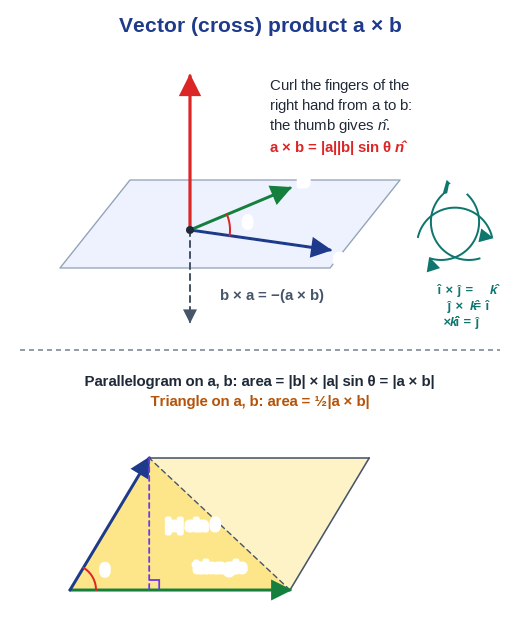
Example 25 (page 368): area of the parallelogram with sides a = 3î + ĵ + 4k̂ and b = î − ĵ + k̂. a × b = (1 + 4)î − (3 − 4)ĵ + (−3 − 1)k̂ = 5î + ĵ − 4k̂. Area = |a × b| = √42.
Exercise 10.4 (pages 368–369)
1. “Find |a × b|, if a = î − 7ĵ + 7k̂ and b = 3î − 2ĵ + 2k̂.” a × b = (−14 + 14)î − (2 − 21)ĵ + (−2 + 21)k̂ = 19ĵ + 19k̂. |a × b| = 19√2.
2. “Find a unit vector perpendicular to each of the vector a + b and a − b, where a = 3î + 2ĵ + 2k̂ and b = î + 2ĵ − 2k̂.” a + b = 4î + 4ĵ and a − b = 2î + 4k̂. (a + b) × (a − b) = (16 − 0)î − (16 − 0)ĵ + (0 − 8)k̂ = 16î − 16ĵ − 8k̂, of length 24. Unit vector ±((2/3)î − (2/3)ĵ − (1/3)k̂).
3. “If a unit vector a makes angles π/3 with î, π/4 with ĵ and an acute angle θ with k̂, then find θ and hence, the components of a.” cos²(π/3) + cos²(π/4) + cos²θ = 1 gives 1/4 + 1/2 + cos²θ = 1, so cos²θ = 1/4. θ is acute, so cos θ = 1/2 and θ = π/3. A unit vector’s components are its direction cosines: a = (1/2)î + (1/√2)ĵ + (1/2)k̂, components 1/2, 1/√2, 1/2.
4. “Show that (a − b) × (a + b) = 2(a × b)” Expand: a × a + a × b − b × a − b × b = 0 + a × b + a × b − 0 = 2(a × b), using a × a = 0 and −b × a = a × b.
5. “Find λ and μ if (2î + 6ĵ + 27k̂) × (î + λĵ + μk̂) = 0.” The cross product is (6μ − 27λ)î − (2μ − 27)ĵ + (2λ − 6)k̂ = 0. So 2λ − 6 = 0 gives λ = 3, 2μ − 27 = 0 gives μ = 27/2, and 6μ − 27λ = 81 − 81 = 0 checks. λ = 3, μ = 27/2.
6. “Given that a · b = 0 and a × b = 0. What can you conclude about the vectors a and b?” If both were non-zero, a · b = 0 would make them perpendicular and a × b = 0 would make them parallel, which cannot both hold. So |a| = 0 or |b| = 0: at least one of them is the zero vector.
7. “Let the vectors a, b, c be given as a₁î + a₂ĵ + a₃k̂, b₁î + b₂ĵ + b₃k̂, c₁î + c₂ĵ + c₃k̂. Then show that a × (b + c) = a × b + a × c.” We compare the two sides one component at a time.
- b + c = (b₁ + c₁)î + (b₂ + c₂)ĵ + (b₃ + c₃)k̂.
- î-component of a × (b + c): a₂(b₃ + c₃) − a₃(b₂ + c₂) = (a₂b₃ − a₃b₂) + (a₂c₃ − a₃c₂). This is the î-component of a × b plus the î-component of a × c.
- ĵ-component: −[a₁(b₃ + c₃) − a₃(b₁ + c₁)] = −(a₁b₃ − a₃b₁) − (a₁c₃ − a₃c₁), again the sum of the two ĵ-components.
- k̂-component: a₁(b₂ + c₂) − a₂(b₁ + c₁) = (a₁b₂ − a₂b₁) + (a₁c₂ − a₂c₁), the sum of the two k̂-components.
All three components match, so a × (b + c) = a × b + a × c.
8. “If either a = 0 or b = 0, then a × b = 0. Is the converse true? Justify your answer with an example.” No. Take a = î + 2ĵ + 3k̂ and b = 2î + 4ĵ + 6k̂ = 2a. Both are non-zero, but a × b = 2(a × a) = 0. Any two non-zero collinear vectors show this.
9. “Find the area of the triangle with vertices A(1, 1, 2), B(2, 3, 5) and C(1, 5, 5).” AB = î + 2ĵ + 3k̂ and AC = 4ĵ + 3k̂. AB × AC = (6 − 12)î − (3 − 0)ĵ + (4 − 0)k̂ = −6î − 3ĵ + 4k̂, of length √61. Area = √61/2.
10. “Find the area of the parallelogram whose adjacent sides are determined by the vectors a = î − ĵ + 3k̂ and b = 2î − 7ĵ + k̂.” a × b = (−1 + 21)î − (1 − 6)ĵ + (−7 + 2)k̂ = 20î + 5ĵ − 5k̂. Area = √450 = 15√2.
11. “Let the vectors a and b be such that |a| = 3 and |b| = √2/3, then a × b is a unit vector, if the angle between a and b is (A) π/6 (B) π/4 (C) π/3 (D) π/2” |a × b| = 3 × (√2/3) × sin θ = √2 sin θ = 1, so sin θ = 1/√2 and θ = π/4. Answer (B).
12. “Area of a rectangle having vertices A, B, C and D with position vectors −î + (1/2)ĵ + 4k̂, î + (1/2)ĵ + 4k̂, î − (1/2)ĵ + 4k̂ and −î − (1/2)ĵ + 4k̂, respectively is (A) 1/2 (B) 1 (C) 2 (D) 4” AB = 2î and BC = −ĵ. Area = |AB × BC| = |2î × (−ĵ)| = |−2k̂| = 2. Answer (C).
Miscellaneous Examples 26 to 30 (pages 369–371)
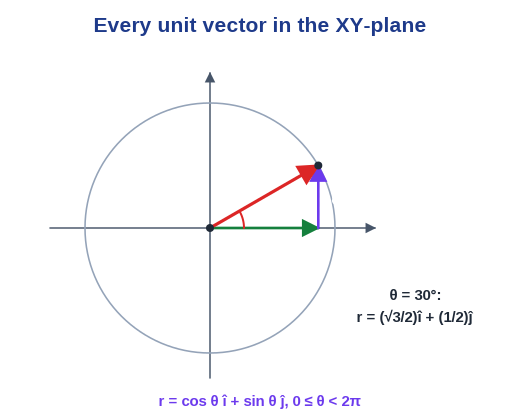
Example 26 (page 369): all unit vectors in the XY-plane. A unit vector r = xî + yĵ in that plane ends on the circle x² + y² = 1, so x = cos θ and y = sin θ for some θ. r = cos θ î + sin θ ĵ, 0 ≤ θ < 2π, and as θ goes from 0 to 2π every direction in the plane is covered.
Example 27 (page 370): A, B, C, D have position vectors î + ĵ + k̂, 2î + 5ĵ, 3î + 2ĵ − 3k̂, î − 6ĵ − k̂. Find the angle between AB and CD. AB = î + 4ĵ − k̂ (length 3√2) and CD = −2î − 8ĵ + 2k̂ (length 6√2). cos θ = (−2 − 32 − 2)/36 = −1, so θ = π: AB and CD are collinear and opposite. Directly, AB = −(1/2)CD.
Example 28 (page 370): |a| = 3, |b| = 4, |c| = 5, and each one is perpendicular to the sum of the remaining two. Find |a + b + c|. a · (b + c) = b · (c + a) = c · (a + b) = 0, so in |a + b + c|² all the cross terms add to 0. Then |a + b + c|² = 9 + 16 + 25 = 50 and |a + b + c| = 5√2.
Example 29 (page 371): a + b + c = 0 with |a| = 3, |b| = 4, |c| = 2. Find μ = a · b + b · c + c · a. Dot a + b + c = 0 with a, b and c in turn: a · b + a · c = −9, a · b + b · c = −16, a · c + b · c = −4. Adding, 2μ = −29, so μ = −29/2.
Example 30 (page 371): α = 3î − ĵ, β = 2î + ĵ − 3k̂. Write β = β₁ + β₂ with β₁ ∥ α and β₂ ⊥ α. Let β₁ = λα = 3λî − λĵ. Then β₂ = (2 − 3λ)î + (1 + λ)ĵ − 3k̂ and α · β₂ = 3(2 − 3λ) − (1 + λ) = 5 − 10λ = 0, so λ = 1/2. β₁ = (3/2)î − (1/2)ĵ and β₂ = (1/2)î + (3/2)ĵ − 3k̂.
Miscellaneous Exercise on Chapter 10 (pages 372–373)
1. “Write down a unit vector in XY-plane, making an angle of 30° with the positive direction of x-axis.” With θ = 30° in r = cos θ î + sin θ ĵ: r = (√3/2)î + (1/2)ĵ.
2. “Find the scalar components and magnitude of the vector joining the points P(x₁, y₁, z₁) and Q(x₂, y₂, z₂).” PQ = (x₂ − x₁)î + (y₂ − y₁)ĵ + (z₂ − z₁)k̂. Scalar components x₂ − x₁, y₂ − y₁, z₂ − z₁; magnitude √((x₂ − x₁)² + (y₂ − y₁)² + (z₂ − z₁)²).
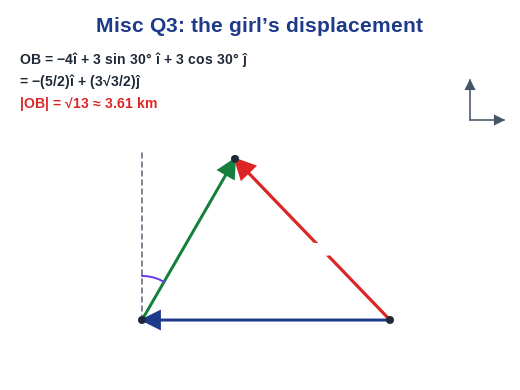
3. “A girl walks 4 km towards west, then she walks 3 km in a direction 30° east of north and stops. Determine the girl’s displacement from her initial point of departure.” Take î towards east and ĵ towards north. The first walk is −4î. The second is 3 km at 30° from north towards east: 3 sin 30° î + 3 cos 30° ĵ = (3/2)î + (3√3/2)ĵ. The displacement is the sum: −(5/2)î + (3√3/2)ĵ, of size √(25/4 + 27/4) = √13 ≈ 3.61 km.
4. “If a = b + c, then is it true that |a| = |b| + |c|? Justify your answer.” No, not in general. If b and c are two sides of a triangle and a = b + c the third side, then |a| < |b| + |c| (triangle inequality). For example b = î, c = ĵ gives |a| = √2, but |b| + |c| = 2. Equality holds only when b and c point the same way.
5. “Find the value of x for which x(î + ĵ + k̂) is a unit vector.” |x(î + ĵ + k̂)| = |x|√3 = 1, so x = ±1/√3.
6. “Find a vector of magnitude 5 units, and parallel to the resultant of the vectors a = 2î + 3ĵ − k̂ and b = î − 2ĵ + k̂.” a + b = 3î + ĵ, of length √10. The vector is 5(3î + ĵ)/√10 = (3√10/2)î + (√10/2)ĵ (its negative is also parallel).
7. “If a = î + ĵ + k̂, b = 2î − ĵ + 3k̂ and c = î − 2ĵ + k̂, find a unit vector parallel to the vector 2a − b + 3c.” 2a − b + 3c = (2 − 2 + 3)î + (2 + 1 − 6)ĵ + (2 − 3 + 3)k̂ = 3î − 3ĵ + 2k̂, of length √22. Unit vector (3/√22)î − (3/√22)ĵ + (2/√22)k̂.
8. “Show that the points A (1, – 2, – 8), B (5, 0, –2) and C (11, 3, 7) are collinear, and find the ratio in which B divides AC.” AB = 4î + 2ĵ + 6k̂ = 2(2î + ĵ + 3k̂) and BC = 6î + 3ĵ + 9k̂ = 3(2î + ĵ + 3k̂). They are parallel and share B, so A, B, C are collinear. Also |AB| : |BC| = 2√14 : 3√14, so B divides AC internally in the ratio 2 : 3.
9. “Find the position vector of a point R which divides the line joining two points P and Q whose position vectors are (2a + b) and (a – 3b) externally in the ratio 1 : 2. Also, show that P is the mid point of the line segment RQ.” OR = [1(a − 3b) − 2(2a + b)]/(1 − 2) = (−3a − 5b)/(−1) = 3a + 5b. The midpoint of RQ is [(3a + 5b) + (a − 3b)]/2 = (4a + 2b)/2 = 2a + b = OP. So P is the midpoint of RQ.
10. “The two adjacent sides of a parallelogram are 2î − 4ĵ + 5k̂ and î − 2ĵ − 3k̂. Find the unit vector parallel to its diagonal. Also, find its area.” The diagonal is a + b = 3î − 6ĵ + 2k̂, of length 7. Unit vector (1/7)(3î − 6ĵ + 2k̂). a × b = (12 + 10)î − (−6 − 5)ĵ + (−4 + 4)k̂ = 22î + 11ĵ. Area = √(484 + 121) = √605 = 11√5.
11. “Show that the direction cosines of a vector equally inclined to the axes OX, OY and OZ are ±(1/√3, 1/√3, 1/√3).” Equal angles mean l = m = n. Then l² + m² + n² = 3l² = 1, so l = ±1/√3. The direction cosines are ±(1/√3, 1/√3, 1/√3).
12. “Let a = î + 4ĵ + 2k̂, b = 3î − 2ĵ + 7k̂ and c = 2î − ĵ + 4k̂. Find a vector d which is perpendicular to both a and b, and c · d = 15.” d is parallel to a × b = (28 + 4)î − (7 − 6)ĵ + (−2 − 12)k̂ = 32î − ĵ − 14k̂. Let d = λ(32î − ĵ − 14k̂). Then c · d = λ(64 + 1 − 56) = 9λ = 15, so λ = 5/3. d = (1/3)(160î − 5ĵ − 70k̂). Check: d · a = (160 − 20 − 140)/3 = 0, d · b = (480 + 10 − 490)/3 = 0, c · d = 15.
Answer key note: the key prints (1/3)(160î − 5ĵ + 70k̂). That vector gives c · d = 605/3, not 15, and is not perpendicular to a or b; the k̂ term should be −70/3.
13. “The scalar product of the vector î + ĵ + k̂ with a unit vector along the sum of vectors 2î + 4ĵ − 5k̂ and λî + 2ĵ + 3k̂ is equal to one. Find the value of λ.” The sum is (2 + λ)î + 6ĵ − 2k̂, of length √((2 + λ)² + 40). The condition is (2 + λ + 6 − 2)/√((2 + λ)² + 40) = 1, so (λ + 6)² = (λ + 2)² + 40. That gives 8λ + 32 = 40, so λ = 1.
14. “If a, b, c are mutually perpendicular vectors of equal magnitudes, show that the vector c · d = 15 is equally inclined to a, b and c.” Book note: the words “c · d = 15” here are a printing slip (they come from Question 12); the vector meant is a + b + c.
- Let |a| = |b| = |c| = k. Mutually perpendicular means a · b = b · c = c · a = 0.
- |a + b + c|² = |a|² + |b|² + |c|² + 2(a · b + b · c + c · a) = 3k² + 0, so |a + b + c| = √3 k.
- Angle α with a: (a + b + c) · a = a · a + b · a + c · a = k². So cos α = k²/(√3 k × k) = 1/√3.
- In the same way, the angles β with b and γ with c also have cos β = cos γ = 1/√3.
So a + b + c is equally inclined to a, b and c, each at the angle cos⁻¹(1/√3).
15. “Prove that (a + b) · (a + b) = |a|² + |b|², if and only if a, b are perpendicular, given a ≠ 0, b ≠ 0.” (a + b) · (a + b) = |a|² + 2a · b + |b|². This equals |a|² + |b|² exactly when a · b = 0, and for non-zero vectors that means a ⊥ b. Both directions of the “if and only if” follow from this one line.
The book’s instruction for Questions 16 to 19: “Choose the correct answer in Exercises 16 to 19.”
16. “If θ is the angle between two vectors a and b, then a · b ≥ 0 only when (A) 0 < θ < π/2 (B) 0 ≤ θ ≤ π/2 (C) 0 < θ < π (D) 0 ≤ θ ≤ π” a · b = |a||b| cos θ ≥ 0 when cos θ ≥ 0, that is 0 ≤ θ ≤ π/2. Answer (B).
17. “Let a and b be two unit vectors and θ is the angle between them. Then a + b is a unit vector if (A) θ = π/4 (B) θ = π/3 (C) θ = π/2 (D) θ = 2π/3” |a + b|² = 1 + 1 + 2 cos θ = 1 gives cos θ = −1/2, so θ = 2π/3. Answer (D).
18. “The value of î · (ĵ × k̂) + ĵ · (î × k̂) + k̂ · (î × ĵ) is (A) 0 (B) –1 (C) 1 (D) 3” ĵ × k̂ = î, î × k̂ = −ĵ and î × ĵ = k̂. The sum is 1 − 1 + 1 = 1. Answer (C).
19. “If θ is the angle between any two vectors a and b, then |a · b| = |a × b| when θ is equal to (A) 0 (B) π/4 (C) π/2 (D) π” |a||b| |cos θ| = |a||b| sin θ gives |cos θ| = sin θ; between 0 and π this holds at θ = π/4 (and 3π/4, which is not an option). Answer (B).
Practice
-
The unit vector along 6î − 2ĵ + 3k̂ is:
Show answer
Answer: (a) (6î − 2ĵ + 3k̂)/7
-
If a = î + 2ĵ − 3k̂ and b = 3î − ĵ + 2k̂, then a · b is:
Show answer
Answer: (a) −5
-
The value of λ for which 2î + λĵ + k̂ is perpendicular to î − 2ĵ + 3k̂ is:
Show answer
Answer: (a) 5/2
-
Find (î + ĵ) × (ĵ + k̂).
Show answer
Answer: Using î × ĵ = k̂, î × k̂ = −ĵ, ĵ × ĵ = 0 and ĵ × k̂ = î: (î + ĵ) × (ĵ + k̂) = k̂ − ĵ + 0 + î = î − ĵ + k̂.
-
Find the area of triangle OAB, where O = (0, 0, 0), A = (2, 0, 0) and B = (0, 3, 0).
Show answer
Answer: OA = 2î and OB = 3ĵ, so OA × OB = 6k̂ and the area is ½ × 6 = 3 square units (a right triangle with legs 2 and 3, as expected).
Stuck on a question?
Take a photo and Lagnever AI explains it step by step. Try it for 7 days for ₹2.
Get it on Google Play Open in browser
For parents: after the trial, the plan renews monthly by UPI or card autopay. You can cancel anytime in the app.