
Class 12 Maths Chapter 10: Vector Algebra Notes
This chapter in five lines
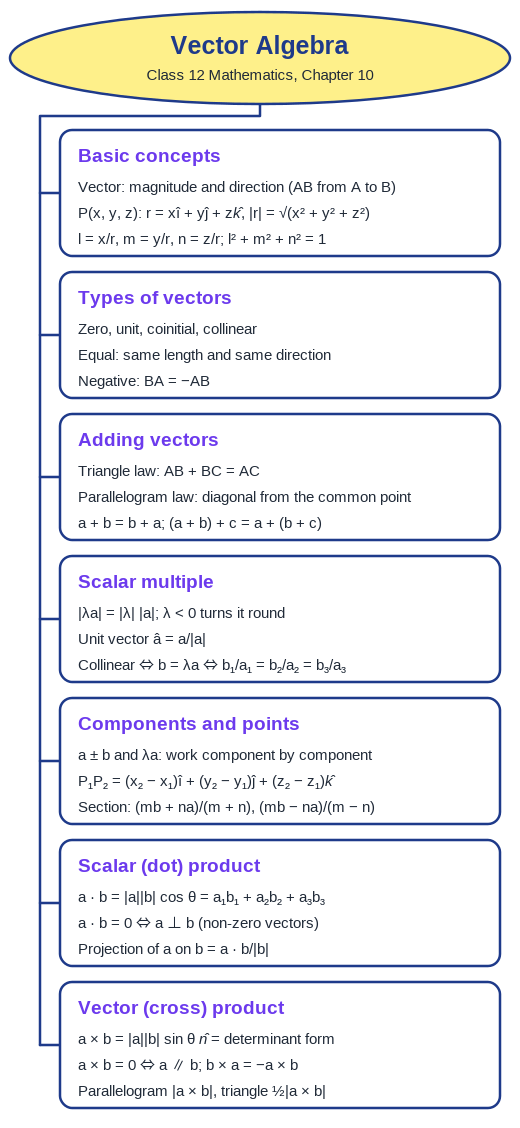
A vector has a magnitude and a direction. In component form a = a₁î + a₂ĵ + a₃k̂, with |a| = √(a₁² + a₂² + a₃²). Vectors add by the triangle or parallelogram law, component by component. The dot product a · b = |a||b| cos θ is a number; the cross product a × b = |a||b| sin θ n̂ is a vector, and its size is the area of the parallelogram on a and b.
What is this chapter about?
Some quantities are fully described by one number: a height of 1.6 m, a mass of 10 kg, a temperature. These are scalars. Others need a direction too: a push on a football, a displacement of 40 km towards the north-east, a velocity. These are vectors. This chapter builds the algebra of vectors: how to name them, add them, stretch them, break them into parts along the axes, and multiply two of them in two different ways.
The chapter covers book pages 338–376: 10.2 basic concepts, 10.3 types of vectors, 10.4 addition, 10.5 multiplication by a scalar (with components, the vector joining two points and the section formula), and 10.6 the two products. It has Exercises 10.1 to 10.4, a Miscellaneous Exercise and 30 worked examples.
Vectors, position vectors and direction cosines
A vector is drawn as an arrow, a directed line segment. Vector AB starts at A (initial point) and ends at B (terminal point); its length |AB| is its magnitude, which can never be negative.
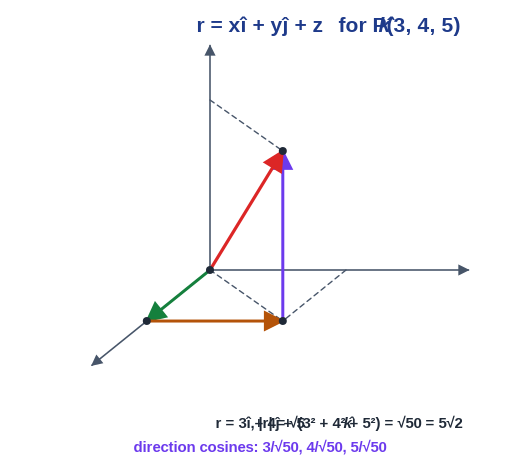
For a point P(x, y, z), the vector OP from the origin is its position vector, with |OP| = √(x² + y² + z²). If OP makes angles α, β, γ with the positive x, y and z-axes, then l = cos α = x/r, m = cos β = y/r and n = cos γ = z/r (r = |OP|) are its direction cosines, and l² + m² + n² = 1. Numbers in the same proportion, such as x, y, z themselves, are direction ratios.
Types of vectors and addition
The book names six kinds: the zero vector (start and end coincide, no fixed direction), unit vectors (length 1), coinitial vectors (same starting point), collinear vectors (parallel to one line), equal vectors (same length and direction) and the negative of a vector (same length, opposite direction: BA = −AB).
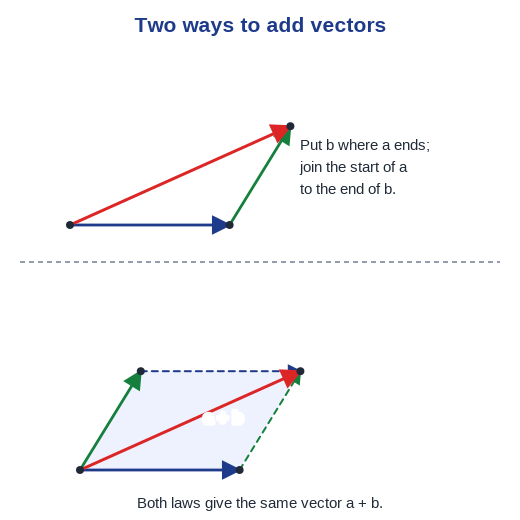
Vectors add by the triangle law: place b so that it starts where a ends; then a + b runs from the start of a to the end of b, so AB + BC = AC. The parallelogram law says the same thing for coinitial vectors: a + b is the diagonal from the common point. Addition is commutative and associative, and the sides of a triangle taken in order add up to the zero vector. Details: types of vectors and vector addition.
Scalar multiples and unit vectors
λa is a vector along the same line as a, with |λa| = |λ| |a|. For λ > 0 it points the same way, for λ < 0 the opposite way. Taking λ = 1/|a| gives the unit vector â = a/|a|. Two non-zero vectors are collinear exactly when one is a scalar multiple of the other.
Components, two points and the section formula
With î, ĵ, k̂ the unit vectors along the axes, every vector can be written a = a₁î + a₂ĵ + a₃k̂. Then sums, differences and scalar multiples are found term by term, and |a| = √(a₁² + a₂² + a₃²).
- The vector from P₁(x₁, y₁, z₁) to P₂(x₂, y₂, z₂) is (x₂ − x₁)î + (y₂ − y₁)ĵ + (z₂ − z₁)k̂: the end point minus the start point.
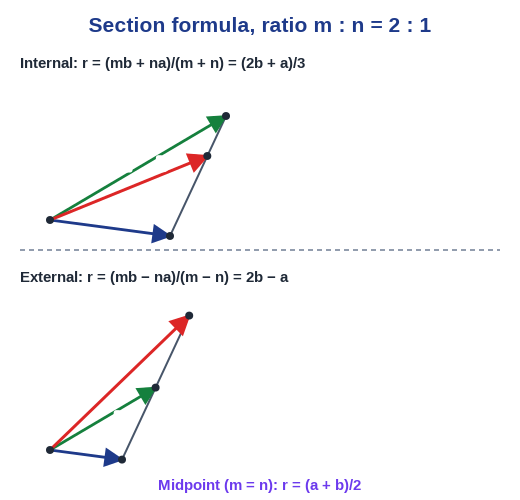
- If R divides PQ in the ratio m : n, with OP = a and OQ = b, then OR = (mb + na)/(m + n) internally and (mb − na)/(m − n) externally. The midpoint is (a + b)/2.
Worked out with examples: components of a vector and the section formula.
The scalar (dot) product
a · b = |a||b| cos θ, where θ (0 ≤ θ ≤ π) is the angle between them. In components, a · b = a₁b₁ + a₂b₂ + a₃b₃. The result is a number. It is 0 for perpendicular non-zero vectors, equals |a|² when b = a, and gives the angle: cos θ = a · b/(|a||b|). The projection of a on b is a · b/|b|.
The vector (cross) product
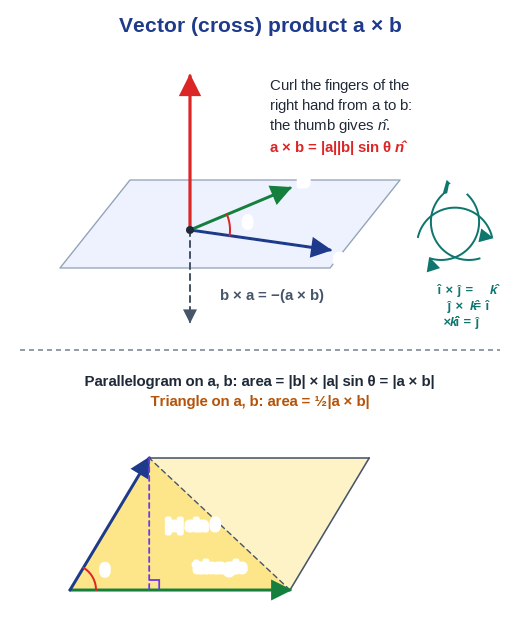
a × b = |a||b| sin θ n̂, where n̂ is the unit vector perpendicular to the plane of a and b, pointing the way a right-handed screw moves when turned from a to b. In components it is the determinant with rows î ĵ k̂, a₁ a₂ a₃ and b₁ b₂ b₃. It is 0 for parallel vectors, b × a = −(a × b), and |a × b| is the area of the parallelogram with sides a and b; half of it is the area of the triangle. Both products are worked out in scalar and vector products.
Before we move on
This is the rationalised book (marked Reprint 2026-27). The chapter keeps sections 10.1 to 10.6, with Exercise 10.1 (5 questions), 10.2 (19), 10.3 (18), 10.4 (12) and a Miscellaneous Exercise of 19 questions, plus 30 worked examples. Every one of them is worked out in the NCERT solutions for Chapter 10, and every number there was checked by a script. Chapter 9, Differential Equations, comes just before this chapter, and Chapter 11, Three Dimensional Geometry, uses these vectors to describe lines in space.
Key terms
| Term | Meaning |
|---|---|
| Vector | A quantity with both magnitude and direction, drawn as a directed line segment. Vector AB starts at its initial point A and ends at its terminal point B. |
| Position vector | The vector OP from the origin O to a point P(x, y, z): OP = xî + yĵ + zk̂, with |OP| = √(x² + y² + z²). |
| Direction cosines | l = cos α, m = cos β, n = cos γ, where α, β, γ are the angles a vector makes with the positive x, y and z-axes. Always l² + m² + n² = 1. |
| Direction ratios | Any three numbers proportional to the direction cosines. For a = a₁î + a₂ĵ + a₃k̂, the components a₁, a₂, a₃ are direction ratios. |
| Unit vector | A vector of magnitude 1. The unit vector along a is â = a/|a|. |
| Collinear vectors | Vectors parallel to the same line, whatever their sizes and senses. a and b (non-zero) are collinear exactly when b = λa for some scalar λ. |
| Equal vectors | Vectors with the same magnitude and the same direction; their starting points may differ. |
| Section formula | The point R dividing PQ (position vectors a and b) internally in the ratio m : n has position vector (mb + na)/(m + n); externally, (mb − na)/(m − n). |
| Scalar (dot) product | a · b = |a||b| cos θ = a₁b₁ + a₂b₂ + a₃b₃, a real number. For non-zero vectors it is 0 exactly when a ⊥ b. |
| Projection | The projection of a on b is a · b/|b|, the length of the shadow of a on the line of b (negative if the angle is obtuse). |
| Vector (cross) product | a × b = |a||b| sin θ n̂, where n̂ is the unit vector perpendicular to both, chosen by the right-hand rule. b × a = −(a × b). |
Topics in this chapter
Practice
-
The magnitude of 2î − 3ĵ + 6k̂ is:
Show answer
Answer: (b) 7
-
The unit vector along 3î + 4k̂ is:
Show answer
Answer: (c) (3î + 4k̂)/5
-
If a · b = 0 for two non-zero vectors, the angle between them is:
Show answer
Answer: (c) π/2
-
ĵ × î equals:
Show answer
Answer: (b) −k̂
-
The midpoint of the points with position vectors 2î + 4ĵ and 4î − 2ĵ + 6k̂ is:
Show answer
Answer: (a) 3î + ĵ + 3k̂
Questions students ask
What are the main topics of Class 12 Maths Chapter 10?
Vectors and scalars, position vectors and direction cosines, types of vectors, addition by the triangle and parallelogram laws, multiplying by a scalar, components, the vector joining two points, the section formula, and the two products of vectors: the scalar (dot) product with projection, and the vector (cross) product with the area of a triangle and a parallelogram.
What is the difference between the dot product and the cross product?
The dot product a · b = |a||b| cos θ is a number, is the same as b · a, and is 0 for perpendicular vectors. The cross product a × b = |a||b| sin θ n̂ is a vector perpendicular to both, changes sign when the order changes, and is 0 for parallel vectors.
How do I check that three points are collinear with vectors?
Find AB and BC. If one is a scalar multiple of the other (or |AC| = |AB| + |BC|), A, B and C lie on one line. For A(1, 2, 7), B(2, 6, 3), C(3, 10, −1), AB = BC = î + 4ĵ − 4k̂, so they are collinear.
Are direction cosines and direction ratios the same?
No. Direction cosines l, m, n satisfy l² + m² + n² = 1. Direction ratios are any numbers proportional to them, so their squares need not add to 1. For î + ĵ − 2k̂ the direction ratios are 1, 1, −2 and the direction cosines are 1/√6, 1/√6, −2/√6.
Stuck on a question?
Take a photo and Lagnever AI explains it step by step. Try it for 7 days for ₹2.
Get it on Google Play Open in browser
For parents: after the trial, the plan renews monthly by UPI or card autopay. You can cancel anytime in the app.