
What are the scalar (dot) and vector (cross) products of two vectors?
Answer in short
The dot product a · b = |a||b| cos θ = a₁b₁ + a₂b₂ + a₃b₃ is a number that gives angles and projections, 0 for perpendicular vectors. The cross product a × b = |a||b| sin θ n̂ is a vector perpendicular to both, 0 for parallel vectors; |a × b| is their parallelogram's area.
Stuck on a question? Take a photo and Lagnever AI explains it step by step. Try it for 7 days for ₹2. Get it on Google Play
The scalar (dot) product
For non-zero vectors a and b with angle θ between them (0 ≤ θ ≤ π),
a · b = |a||b| cos θ.
If a = 0 or b = 0, we set a · b = 0. The result is a real number, which is why it is called the scalar product. Facts that follow straight from the definition:
- a · b = b · a (commutative).
- For non-zero vectors, a · b = 0 exactly when a ⊥ b.
- θ = 0 gives a · b = |a||b|; in particular a · a = |a|². θ = π gives a · b = −|a||b|.
- î · î = ĵ · ĵ = k̂ · k̂ = 1 and î · ĵ = ĵ · k̂ = k̂ · î = 0.
- The angle: cos θ = a · b/(|a||b|).
The dot product also distributes over addition, a · (b + c) = a · b + a · c, and (λa) · b = λ(a · b) = a · (λb). Expanding (a₁î + a₂ĵ + a₃k̂) · (b₁î + b₂ĵ + b₃k̂) with fact 4 leaves only three terms:
a · b = a₁b₁ + a₂b₂ + a₃b₃.
Example. The angle between a = î + ĵ − k̂ and b = î − ĵ + k̂: a · b = 1 − 1 − 1 = −1 and |a| = |b| = √3, so cos θ = −1/3 and θ = cos⁻¹(−1/3), an obtuse angle.
Example. For a = 5î − ĵ − 3k̂ and b = î + 3ĵ − 5k̂, a + b = 6î + 2ĵ − 8k̂ and a − b = 4î − 4ĵ + 2k̂. Their dot product is 24 − 8 − 16 = 0, so a + b ⊥ a − b.
Projection of a vector
The projection of a on the line of b is the length of the shadow of a on that line:
projection of a on b = |a| cos θ = a · b/|b| = a · b̂.
It is negative when θ is obtuse. The scalar components a₁, a₂, a₃ of a are its projections on the x, y and z-axes, and a₁/|a|, a₂/|a|, a₃/|a| are its direction cosines.
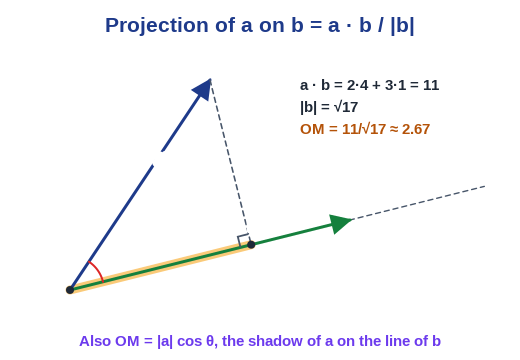
Example. The projection of 2î + 3ĵ + 2k̂ on î + 2ĵ + k̂ is (2 + 6 + 2)/√6 = 10/√6 = (5/3)√6.
Lengths from dot products. |a − b|² = (a − b) · (a − b) = |a|² − 2a · b + |b|². With |a| = 2, |b| = 3 and a · b = 4 this gives |a − b|² = 4 − 8 + 9 = 5, so |a − b| = √5.
The vector (cross) product
For non-zero a and b with angle θ,
a × b = |a||b| sin θ n̂,
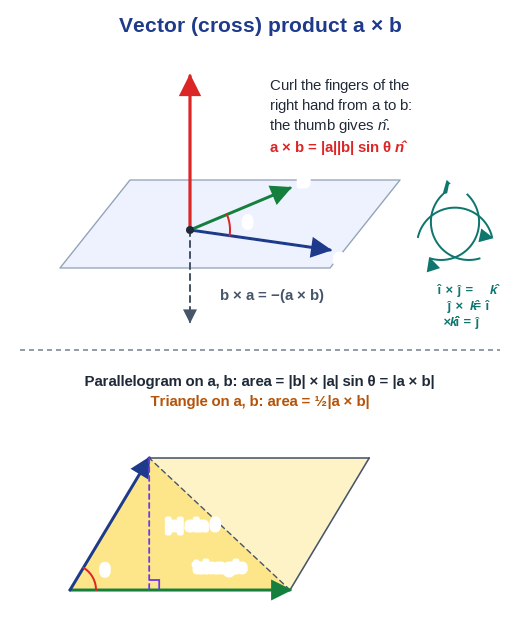
where n̂ is the unit vector perpendicular to both a and b chosen so that a, b, n̂ form a right-handed system: curl the fingers of your right hand from a towards b, and the thumb points along n̂. If a = 0 or b = 0, a × b = 0.
Properties:
- a × b is a vector.
- For non-zero vectors, a × b = 0 exactly when a ∥ b; so a × a = 0 and a × (−a) = 0.
- b × a = −(a × b): reversing the order reverses n̂.
- î × ĵ = k̂, ĵ × k̂ = î, k̂ × î = ĵ, and ĵ × î = −k̂, k̂ × ĵ = −î, î × k̂ = −ĵ.
- sin θ = |a × b|/(|a||b|).
- a × (b + c) = a × b + a × c and λ(a × b) = (λa) × b = a × (λb).
Using these rules on the components gives the determinant form
a × b = (a₂b₃ − a₃b₂)î − (a₁b₃ − a₃b₁)ĵ + (a₁b₂ − a₂b₁)k̂,
the expansion of the determinant with rows î ĵ k̂, a₁ a₂ a₃ and b₁ b₂ b₃.
Example. For a = 2î + ĵ + 3k̂ and b = 3î + 5ĵ − 2k̂: a × b = (−2 − 15)î − (−4 − 9)ĵ + (10 − 3)k̂ = −17î + 13ĵ + 7k̂, and |a × b| = √(289 + 169 + 49) = √507.
Areas from the cross product
A parallelogram with adjacent sides a and b has base |b| and height |a| sin θ, so
area of parallelogram = |a||b| sin θ = |a × b|, area of triangle = ½|a × b|.
Example. For the triangle A(1, 1, 1), B(1, 2, 3), C(2, 3, 1): AB = ĵ + 2k̂ and AC = î + 2ĵ. AB × AC = −4î + 2ĵ − k̂, of length √21, so the area is √21/2 square units.
Example. A unit vector perpendicular to both a + b and a − b, where a = î + ĵ + k̂ and b = î + 2ĵ + 3k̂: (2î + 3ĵ + 4k̂) × (−ĵ − 2k̂) = −2î + 4ĵ − 2k̂, of length 2√6. One answer is (−î + 2ĵ − k̂)/√6; its negative is the other.
Read next: components of a vector and the section formula, the Chapter 10 notes and the NCERT solutions for Exercises 10.3 and 10.4.
Practice
-
(î + 2ĵ − k̂) · (3î − ĵ + 2k̂) equals:
Show answer
Answer: (a) −1
-
The projection of 4î + 3ĵ on î is:
Show answer
Answer: (b) 4
-
k̂ × ĵ equals:
Show answer
Answer: (b) −î
-
Find the area of the parallelogram with adjacent sides a = î + ĵ and b = 2ĵ + k̂.
Show answer
Answer: a × b = (1·1 − 0·2)î − (1·1 − 0·0)ĵ + (1·2 − 1·0)k̂ = î − ĵ + 2k̂, so the area is |a × b| = √(1 + 1 + 4) = √6 square units.
Questions students ask
Why is the dot product of perpendicular vectors zero?
a · b = |a||b| cos θ and cos 90° = 0. Conversely, if a · b = 0 and neither vector is zero, then cos θ = 0, so θ = π/2. This is the quickest test for perpendicular vectors.
How do I find a unit vector perpendicular to two vectors?
Find c = a × b, which is perpendicular to both, and divide by its length: ĉ = c/|c|. The vector −ĉ is also perpendicular to both, so there are always two answers.
If a · b = 0, must a or b be the zero vector?
No. a · b = 0 can happen with both vectors non-zero, for example î · ĵ = 0. In the same way a × b = 0 for non-zero parallel vectors such as î and 2î.
Stuck on a question?
Take a photo and Lagnever AI explains it step by step. Try it for 7 days for ₹2.
Get it on Google Play Open in browser
For parents: after the trial, the plan renews monthly by UPI or card autopay. You can cancel anytime in the app.