
How do you write a vector in components and use the section formula?
Answer in short
Write a = a₁î + a₂ĵ + a₃k̂; then |a| = √(a₁² + a₂² + a₃²) and â = a/|a|. The vector from P₁ to P₂ is end minus start. A point dividing PQ in the ratio m : n has position vector (mb + na)/(m + n) internally and (mb − na)/(m − n) externally.
Stuck on a question? Take a photo and Lagnever AI explains it step by step. Try it for 7 days for ₹2. Get it on Google Play
The unit vectors î, ĵ and k̂
Take the points A(1, 0, 0), B(0, 1, 0) and C(0, 0, 1) on the three axes. The vectors OA, OB and OC each have length 1 and point along the positive x, y and z-axes. They are written î, ĵ and k̂.
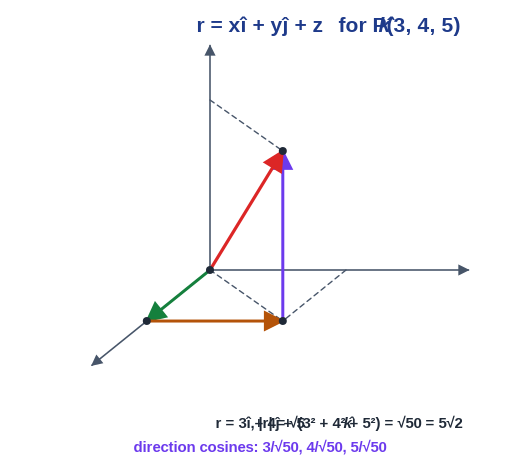
For any point P(x, y, z), walk x units along the x-axis, then y units parallel to the y-axis, then z units straight up. By the triangle law,
OP = xî + yĵ + zk̂.
This is the component form of the position vector. The numbers x, y, z are its scalar components and xî, yĵ, zk̂ are its vector components. Using Pythagoras’ theorem twice (first in the horizontal plane, then upwards) gives the length
|OP| = √(x² + y² + z²).
Working in components
For a = a₁î + a₂ĵ + a₃k̂ and b = b₁î + b₂ĵ + b₃k̂:
- a + b = (a₁ + b₁)î + (a₂ + b₂)ĵ + (a₃ + b₃)k̂
- a − b = (a₁ − b₁)î + (a₂ − b₂)ĵ + (a₃ − b₃)k̂
- λa = (λa₁)î + (λa₂)ĵ + (λa₃)k̂
- a = b exactly when a₁ = b₁, a₂ = b₂ and a₃ = b₃
Collinear vectors. b = λa means b₁ = λa₁, b₂ = λa₂, b₃ = λa₃, that is b₁/a₁ = b₂/a₂ = b₃/a₃. For example, −4î + 6ĵ − 8k̂ = −2(2î − 3ĵ + 4k̂), so these two are collinear.
Unit vectors, direction ratios and direction cosines
The unit vector along a is â = a/|a|.
Example. a = 2î + 3ĵ + k̂ has |a| = √(4 + 9 + 1) = √14, so â = (2/√14)î + (3/√14)ĵ + (1/√14)k̂.
To get a vector of a given length along a, multiply â by that length. A vector of length 7 along î − 2ĵ is 7(î − 2ĵ)/√5 = (7/√5)î − (14/√5)ĵ.
The components a₁, a₂, a₃ are direction ratios of a. Dividing by |a| gives the direction cosines: l = a₁/|a|, m = a₂/|a|, n = a₃/|a|. For î + ĵ − 2k̂, |a| = √6, so l, m, n = 1/√6, 1/√6, −2/√6. If l, m, n are known, lî + mĵ + nk̂ is itself the unit vector in that direction.
The vector joining two points
Let P₁(x₁, y₁, z₁) and P₂(x₂, y₂, z₂) be two points. By the triangle law, OP₁ + P₁P₂ = OP₂, so
P₁P₂ = OP₂ − OP₁ = (x₂ − x₁)î + (y₂ − y₁)ĵ + (z₂ − z₁)k̂,
and its length is √((x₂ − x₁)² + (y₂ − y₁)² + (z₂ − z₁)²), the distance formula.
Example. From P(2, 3, 0) to Q(−1, −2, −4): PQ = (−1 − 2)î + (−2 − 3)ĵ + (−4 − 0)k̂ = −3î − 5ĵ − 4k̂.
The section formula
Let P and Q have position vectors a and b.
Internal division. If R lies on PQ with PR : RQ = m : n, then m RQ = n PR, that is m(b − r) = n(r − a). Solving for r,
r = (mb + na)/(m + n).
External division. If R lies on PQ extended with PR : QR = m : n, then
r = (mb − na)/(m − n).
Midpoint. With m = n the internal formula gives r = (a + b)/2.
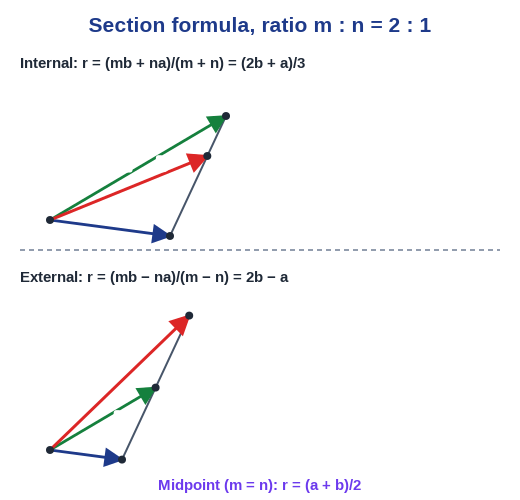
Example. P and Q have position vectors 3a − 2b and a + b. The point dividing PQ internally in the ratio 2 : 1 is [2(a + b) + (3a − 2b)]/3 = 5a/3. Externally it is [2(a + b) − (3a − 2b)]/(2 − 1) = 4b − a.
Using components to test a triangle
With the vertices as position vectors, find the side vectors as end minus start and compare squared lengths. For A(2, −1, 1), B(1, −3, −5), C(3, −4, −4): AB = −î − 2ĵ − 6k̂, BC = 2î − ĵ + k̂, CA = −î + 3ĵ + 5k̂. Then |AB|² = 41 = 6 + 35 = |BC|² + |CA|², so the triangle has a right angle at C.
Read next: scalar and vector products, the Chapter 10 notes and the NCERT solutions for Exercise 10.2.
Practice
-
The magnitude of î − 2ĵ + 2k̂ is:
Show answer
Answer: (b) 3
-
The vector from A(1, 0, 2) to B(4, 4, 2) is:
Show answer
Answer: (a) 3î + 4ĵ
-
R divides the join of P(a) and Q(b) internally in the ratio 1 : 3. Its position vector is:
Show answer
Answer: (b) (3a + b)/4
-
Find the direction cosines of 2î − ĵ + 2k̂.
Show answer
Answer: |a| = √(4 + 1 + 4) = 3, so the direction cosines are 2/3, −1/3, 2/3. Check: 4/9 + 1/9 + 4/9 = 1.
Questions students ask
What are the scalar and vector components of a vector?
For a = a₁î + a₂ĵ + a₃k̂, the numbers a₁, a₂, a₃ are its scalar components and a₁î, a₂ĵ, a₃k̂ are its vector components along the axes. The scalar components are also direction ratios of a.
Why is the vector joining two points 'end minus start'?
By the triangle law OP₁ + P₁P₂ = OP₂, so P₁P₂ = OP₂ − OP₁. Writing both position vectors in components and subtracting gives (x₂ − x₁)î + (y₂ − y₁)ĵ + (z₂ − z₁)k̂.
How is external division different from internal division?
In internal division R lies between P and Q, and OR = (mb + na)/(m + n). In external division R lies on PQ extended, with PR : QR = m : n, and OR = (mb − na)/(m − n). The minus signs come from R being outside the segment.
Stuck on a question?
Take a photo and Lagnever AI explains it step by step. Try it for 7 days for ₹2.
Get it on Google Play Open in browser
For parents: after the trial, the plan renews monthly by UPI or card autopay. You can cancel anytime in the app.