
What are the types of vectors, and how do we add them?
Answer in short
Vectors can be zero, unit, coinitial, collinear, equal or negative. Two vectors are added by the triangle law: start the second where the first ends, and the sum runs from the first start to the last end. The parallelogram law gives the same sum as the diagonal. Multiplying by λ scales the length by |λ|.
Stuck on a question? Take a photo and Lagnever AI explains it step by step. Try it for 7 days for ₹2. Get it on Google Play
Scalars and vectors
A scalar is fixed by one real number: time, distance, speed, mass, volume, density, work, temperature. A vector needs a direction as well: displacement, velocity, acceleration, force, weight, momentum. So “20 m/s” is a speed (scalar), while “20 m/s towards north” is a velocity (vector).
We draw a vector as an arrow from an initial point A to a terminal point B and call it vector AB. Its magnitude |AB| is the length of the arrow. A magnitude is never negative.
The six types of vectors
| Type | What it means | Example |
|---|---|---|
| Zero (null) vector | Initial and terminal points coincide; length 0, no definite direction | AA, BB |
| Unit vector | Length exactly 1 | î, ĵ, k̂, or a/|a| |
| Coinitial vectors | Same initial point | OA, OB, OC |
| Collinear vectors | Parallel to one line, any lengths and senses | a, 2a, −a |
| Equal vectors | Same length and same direction, wherever they start | opposite sides of a parallelogram taken the same way |
| Negative of a vector | Same length, opposite direction | BA = −AB |
All vectors in this chapter may be slid parallel to themselves without changing them. That is why two arrows in different places can be equal.
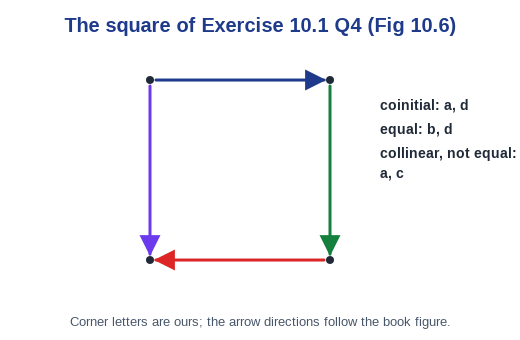
Example. In a square PQRS, let a run along the top from P to Q, b down the right side from Q to R, c along the bottom from R to S, and d down the left side from P to S. Then a and d are coinitial (both start at P), b and d are equal (same length, both downwards), and a and c are collinear but not equal (they point opposite ways).
Adding vectors: the triangle law
Walk from A to B, then on to C. The net displacement is from A to C, so
AB + BC = AC.
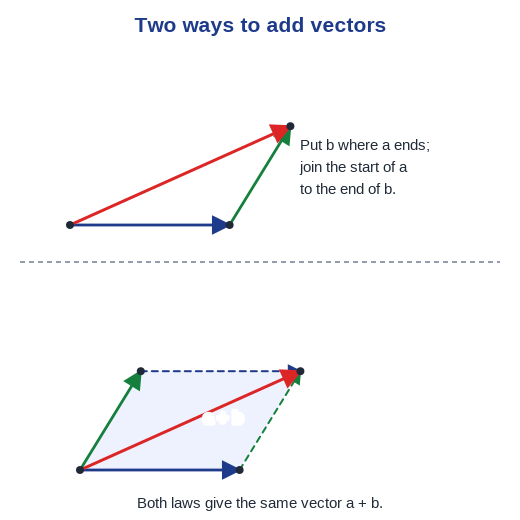
This is the triangle law. To add any two vectors a and b, slide b until its initial point sits on the terminal point of a. The sum a + b is the third side, from the start of a to the end of b.
Going all the way round a triangle brings you back to the start: AB + BC + CA = AA = 0. So the sides of a triangle, taken in order, add up to the zero vector.
Subtraction. a − b means a + (−b): reverse b and add. In a triangle with AB = a and BC = b, the vector a − b is the diagonal you get by adding −b at B.
The parallelogram law
If a and b start at the same point O and are the sides OA and OB of a parallelogram OACB, then a + b is the diagonal OC through O. This is the parallelogram law. It agrees with the triangle law, because AC is the same vector as OB:
OA + OB = OA + AC = OC.
A boat crossing a river is a good picture: its velocity from the engine and the velocity of the current act together, and the actual velocity is their sum.
Properties of addition
- Commutative: a + b = b + a (go round the parallelogram either way).
- Associative: (a + b) + c = a + (b + c), so a + b + c needs no brackets.
- Additive identity: a + 0 = 0 + a = a.
- Additive inverse: a + (−a) = 0.
Multiplying a vector by a scalar
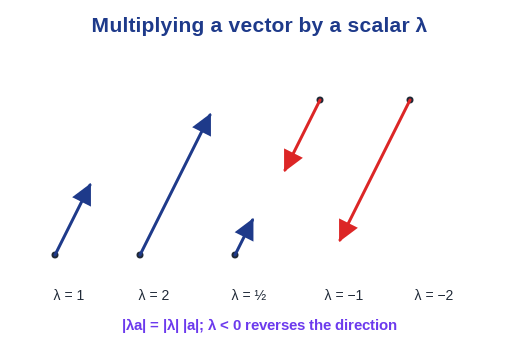
For a scalar λ, the vector λa lies along the same line as a and has length |λ| |a|. It points the same way as a when λ > 0 and the opposite way when λ < 0; 0a = 0. So 2a is twice as long as a, ½a half as long, and −2a twice as long the other way.
Two useful facts follow.
- Unit vector. If a ≠ 0, take λ = 1/|a|. Then |λa| = 1, so â = a/|a| is the unit vector in the direction of a.
- Collinearity test. Non-zero vectors a and b are collinear exactly when b = λa for some scalar λ.
Scalar multiples obey three rules: ka + ma = (k + m)a, k(ma) = (km)a and k(a + b) = ka + kb.
Example. A vector b has length 6 and points opposite to a unit vector û. Then b = −6û, and b is collinear with û but not equal to it.
Read next: components of a vector and the section formula, the Chapter 10 notes and the NCERT solutions for Exercise 10.1.
Practice
-
Speed 30 km/h is a scalar. Which of these is a vector?
Show answer
Answer: (c) 20 m/s towards north
-
In triangle PQR, PQ + QR + RP equals:
Show answer
Answer: (b) 0
-
The vectors a and −2a are:
Show answer
Answer: (b) collinear but not equal
-
If |a| = 4, find |−3a| and the unit vector along a.
Show answer
Answer: |−3a| = |−3| × 4 = 12. The unit vector along a is â = a/|a| = a/4.
Questions students ask
What is the difference between collinear and equal vectors?
Collinear vectors only need to be parallel to the same line; they may have different lengths and opposite senses. Equal vectors must have the same length and the same direction. Every pair of equal vectors is collinear, but not the other way round.
Are the triangle law and the parallelogram law different rules?
No. In parallelogram OACB, the side AC is the same vector as OB, so OA + OB = OA + AC = OC by the triangle law. The parallelogram picture just keeps both vectors starting from one point.
What does it mean that vectors in this chapter can be moved?
A vector is fixed only by its length and direction. Sliding it parallel to itself does not change it, so we may move b to start at the end of a when adding. The book calls such vectors free vectors and uses only these.
Stuck on a question?
Take a photo and Lagnever AI explains it step by step. Try it for 7 days for ₹2.
Get it on Google Play Open in browser
For parents: after the trial, the plan renews monthly by UPI or card autopay. You can cancel anytime in the app.