
Class 12 Maths Chapter 10: Vector Algebra Notes Hinglish mein
Ye chapter 5 lines mein
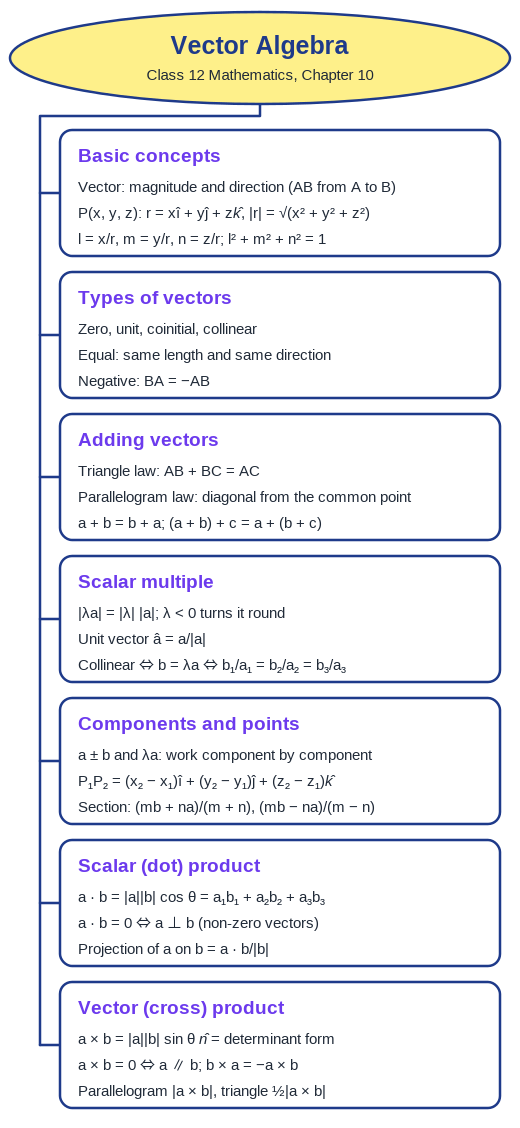
Vector ki magnitude aur direction dono hoti hain. Component form mein a = a₁î + a₂ĵ + a₃k̂, aur |a| = √(a₁² + a₂² + a₃²). Vectors triangle ya parallelogram law se, component by component jodte hain. Dot product a · b = |a||b| cos θ ek number hai; cross product a × b = |a||b| sin θ n̂ ek vector hai, aur iska size a aur b par bane parallelogram ka area hai.
Ye chapter kis baare mein hai?
Kuch quantities ek number se poori bata di jaati hain: 1.6 m ki height, 10 kg ka mass, ek temperature. Ye scalars hain. Kuch ko disha bhi chahiye: football par lagaya dhakka, north-east ki taraf 40 km ka displacement, ek velocity. Ye vectors hain. Ye chapter vectors ka algebra banata hai: unhe naam kaise dein, kaise jodein, kaise khinchein, axes ke saath tukdon mein kaise todein, aur do vectors ko do alag tareekon se guna kaise karein.
Chapter book ke pages 338–376 mein hai: 10.2 basic concepts, 10.3 vectors ke types, 10.4 addition, 10.5 scalar se guna (components, do points ko jodne wala vector aur section formula ke saath), aur 10.6 do products. Isme Exercises 10.1 se 10.4, ek Miscellaneous Exercise aur 30 worked examples hain.
Vectors, position vectors aur direction cosines
Vector ko ek teer se banate hain, ek directed line segment. Vector AB, A (initial point) se shuru hokar B (terminal point) par khatam hota hai; uski lambai |AB| uski magnitude hai, jo kabhi negative nahi hoti.
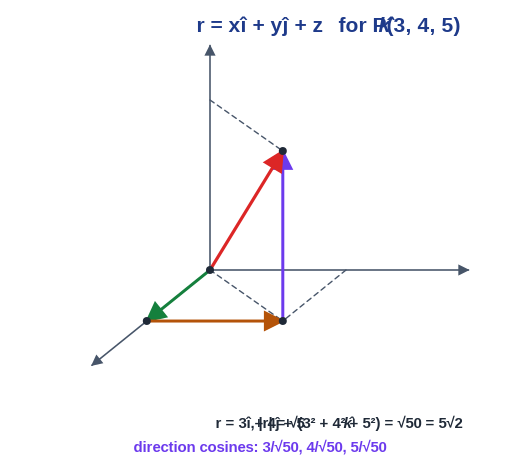
Point P(x, y, z) ke liye origin se vector OP uska position vector hai, aur |OP| = √(x² + y² + z²). Agar OP positive x, y aur z-axes ke saath angles α, β, γ banaye, to l = cos α = x/r, m = cos β = y/r aur n = cos γ = z/r (r = |OP|) uske direction cosines hain, aur l² + m² + n² = 1. Isi proportion wale numbers, jaise khud x, y, z, direction ratios hain.
Vectors ke types aur addition
Book chhe tarah ke vectors batati hai: zero vector (start aur end ek, koi fix disha nahi), unit vectors (lambai 1), coinitial vectors (same starting point), collinear vectors (ek line ke parallel), equal vectors (same lambai aur disha) aur kisi vector ka negative (same lambai, ulti disha: BA = −AB).
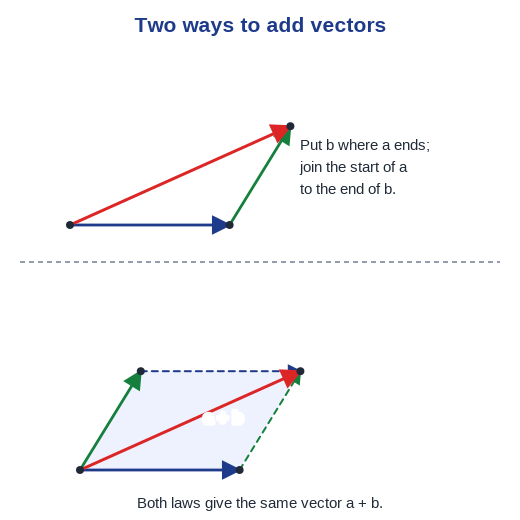
Vectors triangle law se judte hain: b ko wahan rakho jahan a khatam hota hai; tab a + b, a ke start se b ke end tak jaata hai, yaani AB + BC = AC. Parallelogram law coinitial vectors ke liye yahi baat kehta hai: a + b common point se jaane wala diagonal hai. Addition commutative aur associative hai, aur triangle ki sides kram se jodne par zero vector milta hai. Details: vectors ke types aur addition.
Scalar multiples aur unit vectors
λa, a wali line par hi ek vector hai, aur |λa| = |λ| |a|. λ > 0 par wo usi taraf, λ < 0 par ulti taraf point karta hai. λ = 1/|a| lene par unit vector â = a/|a| milta hai. Do non-zero vectors tabhi collinear hain jab ek doosre ka scalar multiple ho.
Components, do points aur section formula
î, ĵ, k̂ axes ke saath unit vectors hain, to har vector a = a₁î + a₂ĵ + a₃k̂ likha ja sakta hai. Tab jod, antar aur scalar multiples term by term nikalte hain, aur |a| = √(a₁² + a₂² + a₃²).
- P₁(x₁, y₁, z₁) se P₂(x₂, y₂, z₂) tak vector (x₂ − x₁)î + (y₂ − y₁)ĵ + (z₂ − z₁)k̂ hai: end point minus start point.
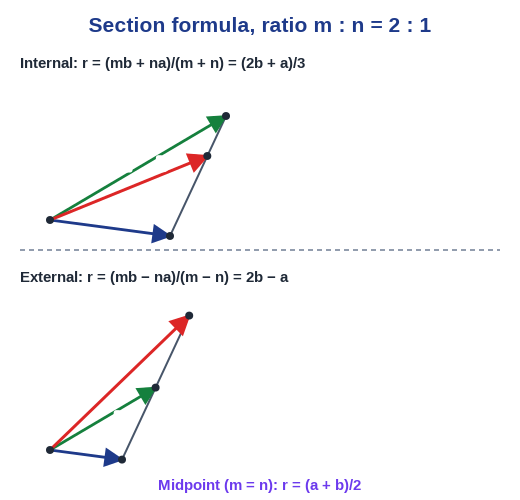
- Agar R, PQ ko m : n mein baante, jahan OP = a aur OQ = b, to internally OR = (mb + na)/(m + n) aur externally (mb − na)/(m − n). Midpoint (a + b)/2 hai.
Examples ke saath: vector ke components aur section formula.
Scalar (dot) product
a · b = |a||b| cos θ, jahan θ (0 ≤ θ ≤ π) dono ke beech ka angle hai. Components mein a · b = a₁b₁ + a₂b₂ + a₃b₃. Jawab ek number hai. Perpendicular non-zero vectors ke liye ye 0 hai, b = a par |a|² hai, aur angle deta hai: cos θ = a · b/(|a||b|). a ka b par projection a · b/|b| hai.
Vector (cross) product
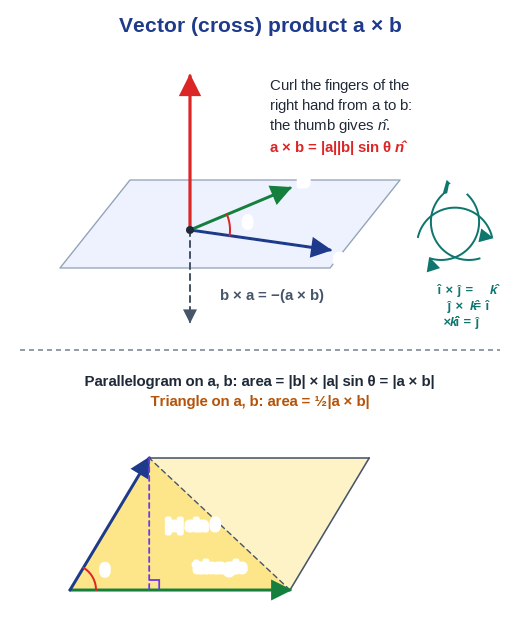
a × b = |a||b| sin θ n̂, jahan n̂, a aur b ke plane ke perpendicular unit vector hai, us taraf jidhar right-handed screw a se b ki taraf ghumane par badhta hai. Components mein ye wo determinant hai jiski rows î ĵ k̂, a₁ a₂ a₃ aur b₁ b₂ b₃ hain. Parallel vectors ke liye ye 0 hai, b × a = −(a × b), aur |a × b| sides a aur b wale parallelogram ka area hai; uska aadha triangle ka area. Dono products yahan hal kiye gaye hain: dot product aur cross product.
Aage badhne se pehle
Ye rationalised book hai (Reprint 2026-27 marked). Chapter mein sections 10.1 se 10.6 hain, Exercise 10.1 (5 sawal), 10.2 (19), 10.3 (18), 10.4 (12) aur 19 sawalon ki Miscellaneous Exercise, saath mein 30 worked examples. Har ek Chapter 10 ke NCERT solutions mein hal kiya gaya hai, aur wahan ka har number script se jaancha gaya. Chapter 9, Differential Equations, is chapter se theek pehle aata hai, aur Chapter 11, Three Dimensional Geometry, in vectors se space mein lines ko describe karta hai.
Key terms (zaroori shabd)
| Term | Matlab |
|---|---|
| Vector | Aisi quantity jiski magnitude aur direction dono hon, directed line segment se banayi jaati hai. Vector AB apne initial point A se shuru hokar terminal point B par khatam hota hai. |
| Position vector | Origin O se point P(x, y, z) tak ka vector OP: OP = xî + yĵ + zk̂, aur |OP| = √(x² + y² + z²). |
| Direction cosines | l = cos α, m = cos β, n = cos γ, jahan α, β, γ wo angles hain jo vector positive x, y aur z-axes ke saath banata hai. Hamesha l² + m² + n² = 1. |
| Direction ratios | Direction cosines ke proportional koi bhi teen numbers. a = a₁î + a₂ĵ + a₃k̂ ke components a₁, a₂, a₃ uske direction ratios hain. |
| Unit vector | Magnitude 1 wala vector. a ki disha mein unit vector â = a/|a| hai. |
| Collinear vectors | Ek hi line ke parallel vectors, size aur disha kuch bhi ho. Non-zero a aur b tabhi collinear hain jab kisi scalar λ ke liye b = λa ho. |
| Equal vectors | Same magnitude aur same direction wale vectors; unke shuru hone ke points alag ho sakte hain. |
| Section formula | PQ (position vectors a aur b) ko m : n mein internally baantne wale point R ka position vector (mb + na)/(m + n) hai; externally (mb − na)/(m − n). |
| Scalar (dot) product | a · b = |a||b| cos θ = a₁b₁ + a₂b₂ + a₃b₃, ek real number. Non-zero vectors ke liye ye tabhi 0 hai jab a ⊥ b. |
| Projection | a ka b par projection a · b/|b| hai, yaani b ki line par a ki parchhai ki lambai (angle obtuse ho to negative). |
| Vector (cross) product | a × b = |a||b| sin θ n̂, jahan n̂ dono ke perpendicular unit vector hai, right-hand rule se chuna gaya. b × a = −(a × b). |
Is chapter ke topics
Practice karo
-
2î − 3ĵ + 6k̂ ki magnitude hai:
Jawab dekho
Jawab: (b) 7
-
3î + 4k̂ ki disha mein unit vector hai:
Jawab dekho
Jawab: (c) (3î + 4k̂)/5
-
Agar do non-zero vectors ke liye a · b = 0 ho, to unke beech ka angle hai:
Jawab dekho
Jawab: (c) π/2
-
ĵ × î barabar hai:
Jawab dekho
Jawab: (b) −k̂
-
Position vectors 2î + 4ĵ aur 4î − 2ĵ + 6k̂ wale points ka midpoint hai:
Jawab dekho
Jawab: (a) 3î + ĵ + 3k̂
Students ke sawal
Class 12 Maths Chapter 10 ke main topics kya hain?
Vectors aur scalars, position vectors aur direction cosines, vectors ke types, triangle aur parallelogram law se addition, scalar se guna, components, do points ko jodne wala vector, section formula, aur vectors ke do products: projection ke saath scalar (dot) product, aur triangle aur parallelogram ke area ke saath vector (cross) product.
Dot product aur cross product mein kya fark hai?
Dot product a · b = |a||b| cos θ ek number hai, b · a ke barabar hai, aur perpendicular vectors ke liye 0 hai. Cross product a × b = |a||b| sin θ n̂ dono ke perpendicular ek vector hai, order badalne par sign badalta hai, aur parallel vectors ke liye 0 hai.
Vectors se teen points collinear kaise check karein?
AB aur BC nikaalo. Agar ek doosre ka scalar multiple ho (ya |AC| = |AB| + |BC|), to A, B aur C ek line par hain. A(1, 2, 7), B(2, 6, 3), C(3, 10, −1) ke liye AB = BC = î + 4ĵ − 4k̂, to ye collinear hain.
Kya direction cosines aur direction ratios ek hi cheez hain?
Nahi. Direction cosines l, m, n ke liye l² + m² + n² = 1. Direction ratios unke proportional koi bhi numbers hain, unke squares ka jod 1 hona zaroori nahi. î + ĵ − 2k̂ ke direction ratios 1, 1, −2 hain aur direction cosines 1/√6, 1/√6, −2/√6.
Koi sawal atak gaya?
Photo lo, Lagnever AI step-by-step samjhayega. 7 din ka trial sirf ₹2.
Google Play se app lo Browser mein kholo
Parents ke liye: trial ke baad plan har mahine UPI ya card autopay se renew hota hai. App mein kabhi bhi cancel kar sakte hain.