
What are the direction cosines and direction ratios of a line?
Answer in short
If a line makes angles α, β, γ with the x, y and z-axes, its direction cosines are l = cos α, m = cos β, n = cos γ, and l² + m² + n² = 1. Direction ratios are any three numbers proportional to them. For the line through P and Q, x₂ − x₁, y₂ − y₁, z₂ − z₁ are direction ratios.
Stuck on a question? Take a photo and Lagnever AI explains it step by step. Try it for 7 days for ₹2. Get it on Google Play
Direction angles and direction cosines
Take a line through the origin O and choose a direction on it. The angles it makes with the positive x, y and z-axes are written α, β and γ. Their cosines
l = cos α, m = cos β, n = cos γ
are the direction cosines of the line. If a line does not pass through O, take the parallel line through O: parallel lines share direction cosines.
Why l² + m² + n² = 1. Let P(x, y, z) be a point on the line with OP = r. Dropping perpendiculars from P on the axes gives x = r cos α, y = r cos β and z = r cos γ. So
x² + y² + z² = r²(l² + m² + n²), and since x² + y² + z² = r², l² + m² + n² = 1.
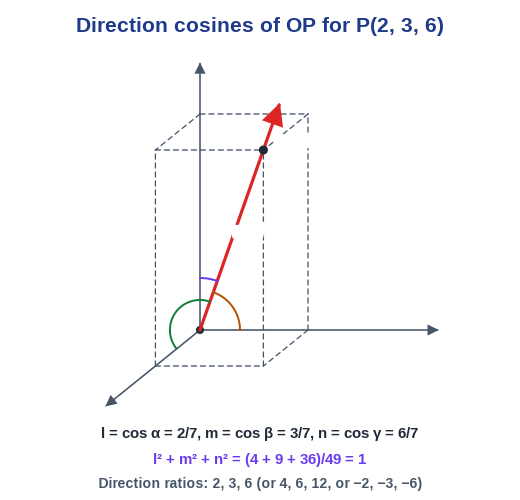
Example. For P(2, 3, 6), OP = √(4 + 9 + 36) = 7, so the line OP has l = 2/7, m = 3/7, n = 6/7. Check: (4 + 9 + 36)/49 = 1.
Reversing the direction. If you follow the line the other way, each angle α becomes π − α. Since cos(π − α) = −cos α, the new direction cosines are −l, −m, −n. A line without a chosen direction therefore has two sets.
The axes. The x-axis makes angles 0°, 90°, 90° with the three axes, so its direction cosines are 1, 0, 0. In the same way the y-axis has 0, 1, 0 and the z-axis 0, 0, 1.
Direction ratios
Any three numbers a, b, c proportional to l, m, n are called direction ratios (some books say direction numbers). If l, m, n are 2/7, 3/7, 6/7, then 2, 3, 6 and 4, 6, 12 and −2, −3, −6 are all direction ratios of that line.
From direction ratios to direction cosines. Write l = ka, m = kb, n = kc. Then k²(a² + b² + c²) = 1, so k = ±1/√(a² + b² + c²) and
l = ±a/√(a² + b² + c²), m = ±b/√(a² + b² + c²), n = ±c/√(a² + b² + c²),
with the same sign for all three.
Example. Direction ratios 2, −1, −2: √(4 + 1 + 4) = 3, so the direction cosines are 2/3, −1/3, −2/3.
Example. A line makes angles 90°, 60° and 30° with the axes. Then l = cos 90° = 0, m = cos 60° = 1/2 and n = cos 30° = √3/2. Check: 0 + 1/4 + 3/4 = 1.
The line through two points
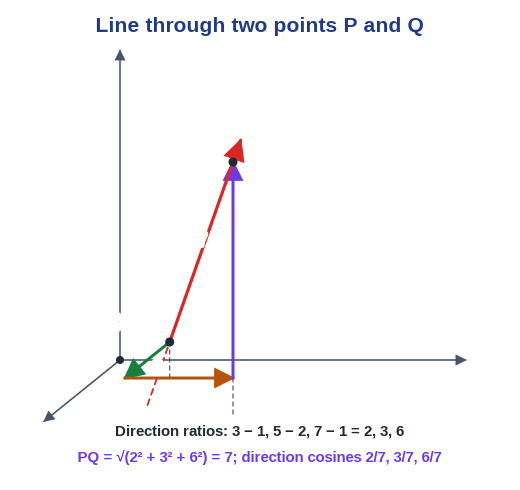
Let the line pass through P(x₁, y₁, z₁) and Q(x₂, y₂, z₂). To go from P to Q you move x₂ − x₁ along the x-axis, y₂ − y₁ along the y-axis and z₂ − z₁ along the z-axis, so these three differences are direction ratios of PQ. Dividing by the length
PQ = √((x₂ − x₁)² + (y₂ − y₁)² + (z₂ − z₁)²)
gives the direction cosines (x₂ − x₁)/PQ, (y₂ − y₁)/PQ, (z₂ − z₁)/PQ. Taking the differences the other way round, x₁ − x₂ and so on, gives the opposite direction.
Example. Through (−2, 4, −5) and (1, 2, 3): the differences are 3, −2, 8, PQ = √(9 + 4 + 64) = √77, and the direction cosines are 3/√77, −2/√77, 8/√77.
Testing three points for collinearity
Points A, B and C lie on one line when AB and BC point the same way (or opposite ways). In terms of direction ratios: those of AB and BC must be proportional. As B is on both, AB and BC are then parts of one line.
Example. A(2, 3, −4), B(1, −2, 3), C(3, 8, −11). AB has direction ratios −1, −5, 7 and BC has 2, 10, −14 = −2 × (−1, −5, 7). They are proportional, so A, B and C are collinear.
Read next: equation of a line in space and angle between two lines, the Chapter 11 notes and the NCERT solutions for Exercise 11.1.
Practice
-
If l = 1/2 and m = 1/2 for a line, then n² equals:
Show answer
Answer: (c) 1/2
-
Direction ratios of the line through (1, 0, 2) and (4, 2, −4) are:
Show answer
Answer: (a) 3, 2, −6
-
A line makes angles 60°, 45° and 60° with the axes. Its direction cosines are:
Show answer
Answer: (b) 1/2, 1/√2, 1/2
-
Find the direction cosines of the line with direction ratios 6, −2, 3.
Show answer
Answer: √(36 + 4 + 9) = 7, so the direction cosines are 6/7, −2/7, 3/7 (or −6/7, 2/7, −3/7 for the opposite direction). Check: (36 + 4 + 9)/49 = 1.
Questions students ask
Why does a line have two sets of direction cosines?
A line can be followed in either of two directions. Going the other way turns each direction angle into its supplement, and cos(π − α) = −cos α. So l, m, n and −l, −m, −n describe the same line; fixing a direction picks one set.
Why is l² + m² + n² always 1?
Take P(x, y, z) on the line through the origin with OP = r. Then x = lr, y = mr and z = nr. Adding the squares, r²(l² + m² + n²) = x² + y² + z² = r², so l² + m² + n² = 1.
Can three numbers like 1, 1, 1 be direction cosines?
No, since 1 + 1 + 1 = 3, not 1. But 1, 1, 1 can be direction ratios: they give the direction cosines 1/√3, 1/√3, 1/√3, the line equally inclined to the three axes.
Stuck on a question?
Take a photo and Lagnever AI explains it step by step. Try it for 7 days for ₹2.
Get it on Google Play Open in browser
For parents: after the trial, the plan renews monthly by UPI or card autopay. You can cancel anytime in the app.