
Class 12 Maths Chapter 11: Three Dimensional Geometry Notes
This chapter in five lines
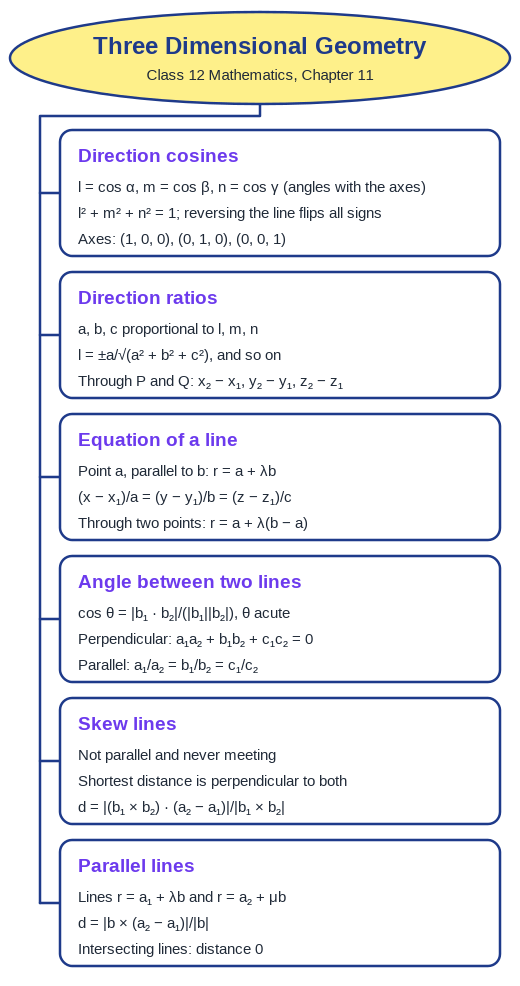
A line in space has direction cosines l, m, n with l² + m² + n² = 1 and direction ratios proportional to them. Through a point a parallel to b it is r = a + λb, or (x − x₁)/a = (y − y₁)/b = (z − z₁)/c. The angle between two lines comes from cos θ = |b₁ · b₂|/(|b₁||b₂|); skew lines are d = |(b₁ × b₂) · (a₂ − a₁)|/|b₁ × b₂| apart.
What is this chapter about?
In Class 11 you placed points in space with three coordinates. This chapter uses the vectors of Chapter 10 to describe lines in space: which way a line points, how to write its equation, the angle between two lines, and how far apart two lines are when they never meet.
The chapter covers book pages 377–393: 11.2 direction cosines and direction ratios, 11.3 the equation of a line, 11.4 the angle between two lines and 11.5 the shortest distance between two lines. It has Exercise 11.1 (5 questions), Exercise 11.2 (15), a Miscellaneous Exercise (5) and 10 worked examples.
Direction cosines and direction ratios
Draw a directed line through the origin. The angles α, β, γ it makes with the positive x, y and z-axes are its direction angles, and l = cos α, m = cos β, n = cos γ are its direction cosines. For a line not through the origin, use the parallel line through the origin. Since OP = r gives x = lr, y = mr, z = nr, squaring and adding gives
l² + m² + n² = 1.
Turning the line round replaces each angle by its supplement, so all three cosines change sign. Direction ratios are any numbers a, b, c in the same proportion as l, m, n. To go back, divide by √(a² + b² + c²).
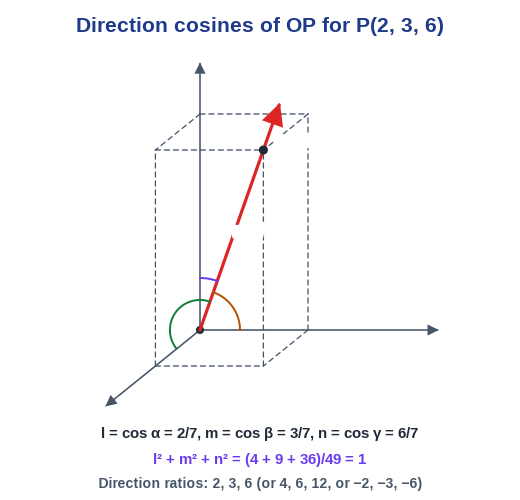
For the line through P(x₁, y₁, z₁) and Q(x₂, y₂, z₂), the differences x₂ − x₁, y₂ − y₁, z₂ − z₁ are direction ratios, and dividing them by PQ gives the direction cosines. If AB and BC have proportional direction ratios, the points A, B, C are collinear. Worked out in direction cosines and direction ratios.
Equation of a line in space
Two things fix a line: a point on it and a direction, or two of its points.
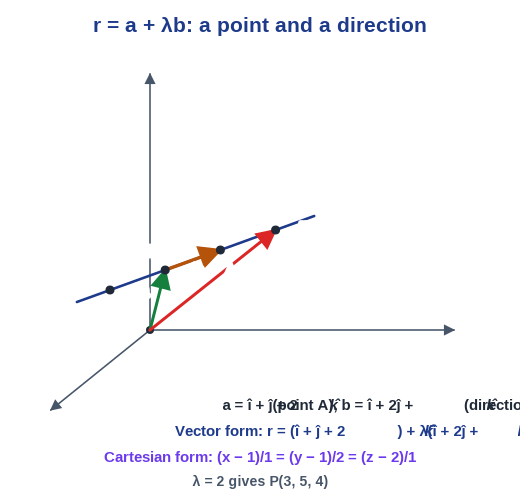
- Through the point A (position vector a) parallel to b: r = a + λb, λ real.
- With A(x₁, y₁, z₁) and b = aî + bĵ + ck̂, comparing components gives x = x₁ + λa, y = y₁ + λb, z = z₁ + λc, and removing λ gives the Cartesian form (x − x₁)/a = (y − y₁)/b = (z − z₁)/c.
- Through two points with position vectors a and b: r = a + λ(b − a).
Angle between two lines
The angle between two lines is the acute angle between their directions. With direction vectors b₁ and b₂ (direction ratios a₁, b₁, c₁ and a₂, b₂, c₂),
cos θ = |b₁ · b₂|/(|b₁||b₂|) = |a₁a₂ + b₁b₂ + c₁c₂|/(√(a₁² + b₁² + c₁²) √(a₂² + b₂² + c₂²)).
The lines are perpendicular when a₁a₂ + b₁b₂ + c₁c₂ = 0 and parallel when a₁/a₂ = b₁/b₂ = c₁/c₂. Both forms of the line equation and the angle are in equation of a line in space and angle between two lines.
Shortest distance between two lines
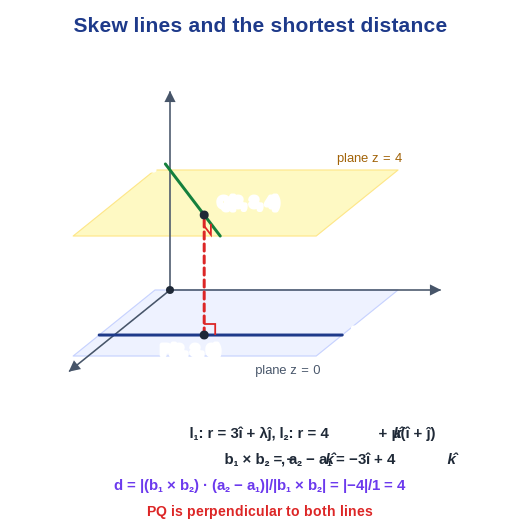
Two lines in space can meet, be parallel, or be skew: not parallel and never meeting. The shortest distance between skew lines is along the segment perpendicular to both, which lies along b₁ × b₂. Projecting the join of any two points of the lines on this direction gives
d = |(b₁ × b₂) · (a₂ − a₁)|/|b₁ × b₂|
for r = a₁ + λb₁ and r = a₂ + μb₂. In Cartesian form the numerator is the determinant with rows x₂ − x₁, y₂ − y₁, z₂ − z₁; a₁, b₁, c₁; a₂, b₂, c₂. For parallel lines r = a₁ + λb and r = a₂ + μb, the distance is d = |b × (a₂ − a₁)|/|b|. Details and examples: shortest distance between two lines.
Before we move on
This is the rationalised book (marked Reprint 2026-27). The chapter keeps sections 11.1 to 11.5, Exercises 11.1 and 11.2, a Miscellaneous Exercise of 5 questions and 10 worked examples; planes are not part of it. Every question is worked out in the NCERT solutions for Chapter 11, and every number there was checked by a script. The dot and cross products used here come from Chapter 10, Vector Algebra; Chapter 12, Linear Programming, comes next.
Key terms
| Term | Meaning |
|---|---|
| Direction angles | The angles α, β, γ that a directed line makes with the positive x, y and z-axes. |
| Direction cosines | l = cos α, m = cos β, n = cos γ. For every line l² + m² + n² = 1. Reversing the direction of the line changes the sign of all three. |
| Direction ratios | Any three numbers a, b, c proportional to l, m, n. A line has infinitely many sets of them; for the line through P and Q, x₂ − x₁, y₂ − y₁, z₂ − z₁ is one set. |
| Vector equation of a line | r = a + λb: the line through the point with position vector a, parallel to the vector b. Each real λ gives one point of the line. |
| Cartesian equation of a line | (x − x₁)/a = (y − y₁)/b = (z − z₁)/c: the line through (x₁, y₁, z₁) with direction ratios a, b, c. |
| Angle between two lines | The acute angle θ between their directions: cos θ = |a₁a₂ + b₁b₂ + c₁c₂|/(√(a₁² + b₁² + c₁²) √(a₂² + b₂² + c₂²)). |
| Skew lines | Lines in space that are not parallel and do not meet. They do not lie in one plane. |
| Shortest distance | The length of the segment joining the two lines that is perpendicular to both. It is 0 for intersecting lines. |
| Parametric equations | x = x₁ + λa, y = y₁ + λb, z = z₁ + λc: the coordinates of a point on the line written in terms of the parameter λ. |
Topics in this chapter
Practice
-
The direction cosines of the z-axis are:
Show answer
Answer: (c) 0, 0, 1
-
The direction ratios of a line are 2, −1, −2. Its direction cosines (with a positive first value) are:
Show answer
Answer: (b) 2/3, −1/3, −2/3
-
The lines with direction ratios 1, 2, 3 and 3, 0, −1 are:
Show answer
Answer: (b) perpendicular
-
The vector equation of the line through (1, 0, 2) parallel to î + ĵ − k̂ is:
Show answer
Answer: (b) r = (î + 2k̂) + λ(î + ĵ − k̂)
-
The distance between the lines r = λî and r = 3ĵ + μî is:
Show answer
Answer: (c) 3
Questions students ask
What are the main topics of Class 12 Maths Chapter 11?
Direction cosines and direction ratios of a line (also of the line through two points), the equation of a line in vector and Cartesian form, the angle between two lines with the tests for perpendicular and parallel lines, and the shortest distance between two skew lines and between two parallel lines.
What is the difference between direction cosines and direction ratios?
Direction cosines are the cosines of the angles with the axes, so their squares add to 1 and they are fixed for a directed line. Direction ratios are any three numbers in the same proportion, such as 2, 3, 6 for the direction cosines 2/7, 3/7, 6/7.
Does the rationalised Chapter 11 still have planes?
No. The chapter in the Reprint 2026-27 book stops at section 11.5, the shortest distance between two lines. The equation of a plane, the angle between planes and the distance of a point from a plane are not in it, and neither are its exercises.
How do I know whether two lines are skew?
First compare the direction ratios: if they are proportional, the lines are parallel. If not, find d = |(b₁ × b₂) · (a₂ − a₁)|/|b₁ × b₂|. If d = 0 the lines meet; if d > 0 they are skew.
Stuck on a question?
Take a photo and Lagnever AI explains it step by step. Try it for 7 days for ₹2.
Get it on Google Play Open in browser
For parents: after the trial, the plan renews monthly by UPI or card autopay. You can cancel anytime in the app.