
Class 12 Maths Chapter 11: Three Dimensional Geometry Notes Hinglish mein
Ye chapter 5 lines mein
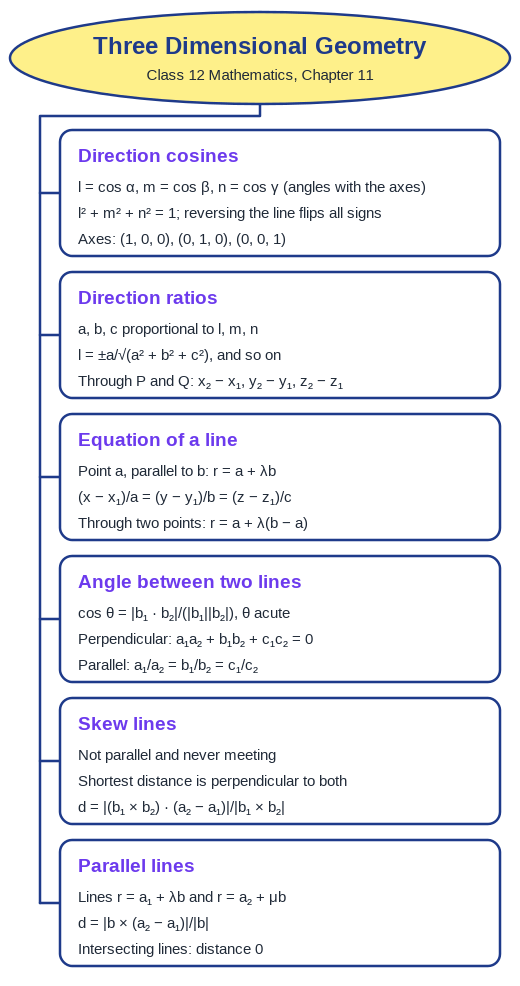
Space mein line ke direction cosines l, m, n hote hain, jahan l² + m² + n² = 1, aur direction ratios inke proportional numbers hain. Point a se b ke parallel line r = a + λb hai, ya (x − x₁)/a = (y − y₁)/b = (z − z₁)/c. Do lines ka angle cos θ = |b₁ · b₂|/(|b₁||b₂|) se milta hai; skew lines ke beech doori d = |(b₁ × b₂) · (a₂ − a₁)|/|b₁ × b₂| hai.
Ye chapter kis baare mein hai?
Class 11 mein aapne space mein points ko teen coordinates se rakha tha. Ye chapter Chapter 10 ke vectors se space mein lines ko describe karta hai: line kis taraf point karti hai, uska equation kaise likhein, do lines ke beech angle, aur kabhi na milne wali do lines kitni door hain.
Chapter book ke pages 377–393 mein hai: 11.2 direction cosines aur direction ratios, 11.3 line ka equation, 11.4 do lines ke beech angle aur 11.5 do lines ke beech shortest distance. Isme Exercise 11.1 (5 sawal), Exercise 11.2 (15), Miscellaneous Exercise (5) aur 10 worked examples hain.
Direction cosines aur direction ratios
Origin se ek directed line banao. Ye positive x, y aur z-axes ke saath jo angles α, β, γ banati hai wo uske direction angles hain, aur l = cos α, m = cos β, n = cos γ uske direction cosines. Jo line origin se nahi guzarti, uske liye origin se uski parallel line lo. OP = r se x = lr, y = mr, z = nr milta hai; squares jodne par
l² + m² + n² = 1.
Line ko ulta ghumane par har angle apne supplement se badal jaata hai, to teeno cosines ka sign badal jaata hai. Direction ratios l, m, n ke anupaat wale koi bhi numbers a, b, c hain. Wapas jaane ke liye √(a² + b² + c²) se bhaag do.
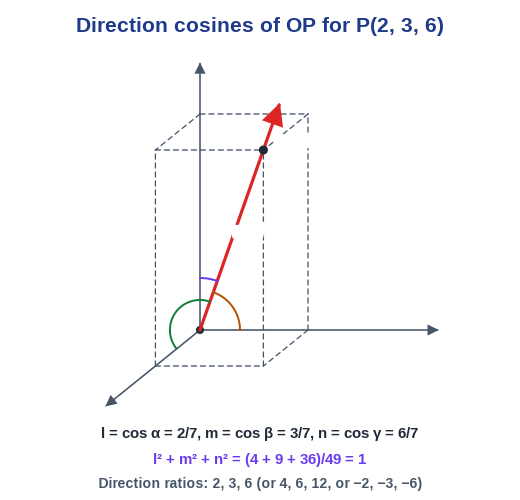
P(x₁, y₁, z₁) aur Q(x₂, y₂, z₂) se jaane wali line ke liye antar x₂ − x₁, y₂ − y₁, z₂ − z₁ direction ratios hain, aur inhe PQ se bhaag dene par direction cosines milte hain. Agar AB aur BC ke direction ratios proportional hon, to points A, B, C collinear hain. Detail mein: direction cosines aur direction ratios.
Space mein line ka equation
Line ek point aur ek disha se, ya apne do points se, tay hoti hai.
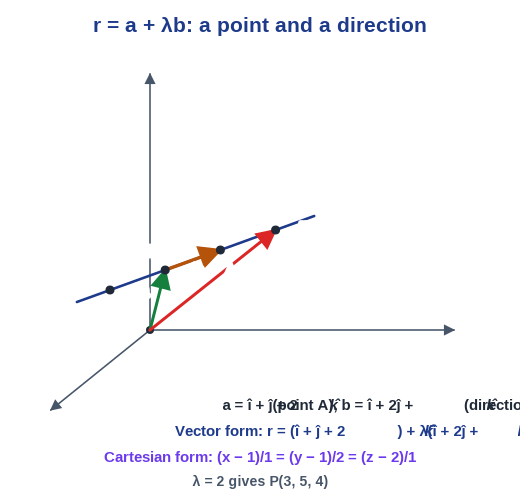
- Point A (position vector a) se, b ke parallel: r = a + λb, λ real.
- A(x₁, y₁, z₁) aur b = aî + bĵ + ck̂ ke saath components milane par x = x₁ + λa, y = y₁ + λb, z = z₁ + λc, aur λ hatane par Cartesian form (x − x₁)/a = (y − y₁)/b = (z − z₁)/c.
- Position vectors a aur b wale do points se: r = a + λ(b − a).
Do lines ke beech angle
Do lines ke beech angle unki dishaon ke beech ka acute angle hai. Direction vectors b₁ aur b₂ (direction ratios a₁, b₁, c₁ aur a₂, b₂, c₂) ke saath
cos θ = |b₁ · b₂|/(|b₁||b₂|) = |a₁a₂ + b₁b₂ + c₁c₂|/(√(a₁² + b₁² + c₁²) √(a₂² + b₂² + c₂²)).
Lines perpendicular hain jab a₁a₂ + b₁b₂ + c₁c₂ = 0, aur parallel jab a₁/a₂ = b₁/b₂ = c₁/c₂. Line ke dono forms aur angle yahan hain: space mein line ka equation aur do lines ke beech angle.
Do lines ke beech shortest distance
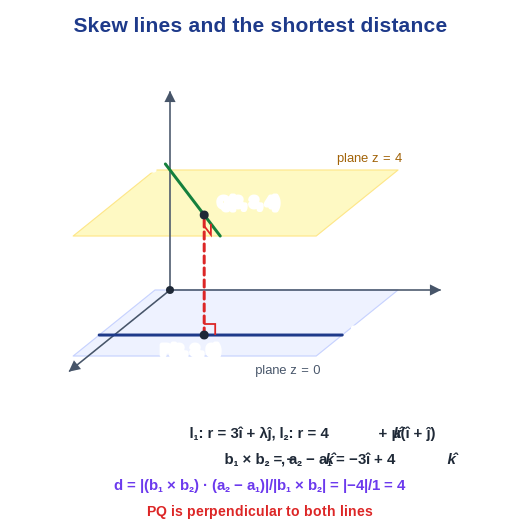
Space mein do lines mil sakti hain, parallel ho sakti hain, ya skew ho sakti hain: na parallel, na kabhi milein. Skew lines ke beech shortest distance us segment ke saath hai jo dono ke perpendicular hai, yaani b₁ × b₂ ki disha mein. Dono lines ke kinhi do points ko jodne wale vector ka is disha par projection lene se
d = |(b₁ × b₂) · (a₂ − a₁)|/|b₁ × b₂|
milta hai, lines r = a₁ + λb₁ aur r = a₂ + μb₂ ke liye. Cartesian form mein numerator wo determinant hai jiski rows x₂ − x₁, y₂ − y₁, z₂ − z₁; a₁, b₁, c₁; a₂, b₂, c₂ hain. Parallel lines r = a₁ + λb aur r = a₂ + μb ke liye doori d = |b × (a₂ − a₁)|/|b| hai. Detail aur examples: do lines ke beech shortest distance.
Aage badhne se pehle
Ye rationalised book hai (Reprint 2026-27 marked). Chapter mein sections 11.1 se 11.5, Exercises 11.1 aur 11.2, 5 sawalon ki Miscellaneous Exercise aur 10 worked examples hain; planes isme nahi hain. Har sawal Chapter 11 ke NCERT solutions mein hal kiya gaya hai, aur wahan ka har number script se jaancha gaya. Yahan istemaal hone wale dot aur cross products Chapter 10, Vector Algebra se aate hain; agla chapter, Chapter 12, Linear Programming hai.
Key terms (zaroori shabd)
| Term | Matlab |
|---|---|
| Direction angles | Wo angles α, β, γ jo ek directed line positive x, y aur z-axes ke saath banati hai. |
| Direction cosines | l = cos α, m = cos β, n = cos γ. Har line ke liye l² + m² + n² = 1. Line ki disha ulti karo to teeno ka sign badal jaata hai. |
| Direction ratios | l, m, n ke proportional koi bhi teen numbers a, b, c. Ek line ke anginat sets hote hain; P aur Q se jaane wali line ke liye x₂ − x₁, y₂ − y₁, z₂ − z₁ ek set hai. |
| Line ka vector equation | r = a + λb: position vector a wale point se guzarne wali, vector b ke parallel line. Har real λ line ka ek point deta hai. |
| Line ka Cartesian equation | (x − x₁)/a = (y − y₁)/b = (z − z₁)/c: (x₁, y₁, z₁) se guzarne wali line jiske direction ratios a, b, c hain. |
| Do lines ke beech angle | Unki dishaon ke beech ka acute angle θ: cos θ = |a₁a₂ + b₁b₂ + c₁c₂|/(√(a₁² + b₁² + c₁²) √(a₂² + b₂² + c₂²)). |
| Skew lines | Space ki aisi lines jo na parallel hain aur na kabhi milti hain. Ye ek plane mein nahi hotin. |
| Shortest distance | Dono lines ko jodne wale us segment ki lambai jo dono ke perpendicular ho. Milne wali lines ke liye ye 0 hai. |
| Parametric equations | x = x₁ + λa, y = y₁ + λb, z = z₁ + λc: line ke point ke coordinates parameter λ ke roop mein. |
Is chapter ke topics
Practice karo
-
z-axis ke direction cosines hain:
Jawab dekho
Jawab: (c) 0, 0, 1
-
Ek line ke direction ratios 2, −1, −2 hain. Uske direction cosines (pehli value positive) hain:
Jawab dekho
Jawab: (b) 2/3, −1/3, −2/3
-
Direction ratios 1, 2, 3 aur 3, 0, −1 wali lines hain:
Jawab dekho
Jawab: (b) perpendicular
-
(1, 0, 2) se guzarne wali aur î + ĵ − k̂ ke parallel line ka vector equation hai:
Jawab dekho
Jawab: (b) r = (î + 2k̂) + λ(î + ĵ − k̂)
-
Lines r = λî aur r = 3ĵ + μî ke beech doori hai:
Jawab dekho
Jawab: (c) 3
Students ke sawal
Class 12 Maths Chapter 11 ke main topics kya hain?
Line ke direction cosines aur direction ratios (do points se jaane wali line ke bhi), line ke vector aur Cartesian equations, do lines ke beech angle aur perpendicular ya parallel hone ki jaanch, aur do skew lines aur do parallel lines ke beech shortest distance.
Direction cosines aur direction ratios mein kya fark hai?
Direction cosines axes ke saath bane angles ke cosines hain, isliye unke squares ka jod 1 hota hai aur directed line ke liye ye fixed hain. Direction ratios usi anupaat mein koi bhi teen numbers hain, jaise direction cosines 2/7, 3/7, 6/7 ke liye 2, 3, 6.
Kya rationalised Chapter 11 mein planes abhi bhi hain?
Nahi. Reprint 2026-27 book ka chapter section 11.5, do lines ke beech shortest distance, par khatam hota hai. Plane ka equation, planes ke beech angle aur point ki plane se doori isme nahi hain, na unki exercises.
Kaise pata karein ki do lines skew hain?
Pehle direction ratios milao: proportional hon to lines parallel hain. Nahi to d = |(b₁ × b₂) · (a₂ − a₁)|/|b₁ × b₂| nikaalo. d = 0 ho to lines milti hain; d > 0 ho to skew hain.
Koi sawal atak gaya?
Photo lo, Lagnever AI step-by-step samjhayega. 7 din ka trial sirf ₹2.
Google Play se app lo Browser mein kholo
Parents ke liye: trial ke baad plan har mahine UPI ya card autopay se renew hota hai. App mein kabhi bhi cancel kar sakte hain.