
How do you solve a linear programming problem graphically?
Answer in short
Shade the feasible region, find each corner point by solving the two lines that meet there, and evaluate Z = ax + by at every corner. On a bounded region the largest value is the maximum and the smallest the minimum. On an unbounded region, first check that the open half-plane beyond that value misses the region.
Stuck on a question? Take a photo and Lagnever AI explains it step by step. Try it for 7 days for ₹2. Get it on Google Play
Step 1: draw the feasible region
Draw each constraint as a straight line by joining two easy points, usually where it meets the axes. Then decide which side to keep: put a test point (the origin, if the line does not pass through it) into the inequality. If it is true, keep the side with the origin.
The region common to all the constraints, including x ≥ 0 and y ≥ 0, is the feasible region. Points inside it or on its boundary are feasible solutions; points outside are infeasible. A feasible point where Z is optimal is an optimal solution.
Step 2: find the corner points
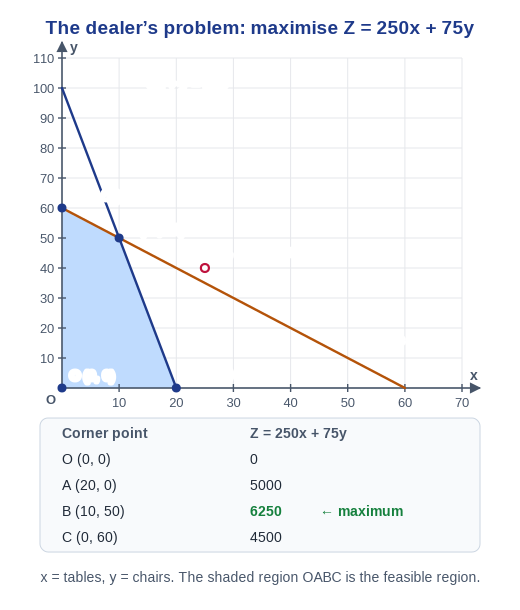
The corner points (vertices) are where two boundary lines meet on the region. Some can be read straight off an axis, such as (20, 0) for 5x + y = 100. Others must be solved: for 5x + y = 100 and x + y = 60, subtracting gives 4x = 40, so the corner is (10, 50).
Step 3: evaluate Z at every corner
Two theorems tell us that the corners are enough:
- Theorem 1. If Z = ax + by has an optimal value (maximum or minimum) on the feasible region, it occurs at a corner point.
- Theorem 2. If the feasible region is bounded, both the maximum and the minimum of Z exist, and each sits at a corner point.
Make a table of Z at the corners. Call the largest value M and the smallest m.
Step 4: bounded or unbounded?
A feasible region is bounded if some circle can enclose it, and unbounded if it runs on without end in some direction.
- Bounded: M is the maximum of Z and m is the minimum. For the dealer, Z = 0, 5000, 6250 and 4500 at the corners, so the maximum is 6250 at (10, 50).
- Unbounded: M is the maximum only if the open half-plane ax + by > M shares no point with the region; otherwise Z has no maximum. In the same way, m is the minimum only if ax + by < m has no common point; otherwise Z has no minimum.
Worked example: an unbounded region
Minimise Z = 3x + 2y subject to x + y ≥ 4, x + 3y ≥ 6, x ≥ 0, y ≥ 0.
Both constraints are “at least”, so the region lies above both lines and is unbounded. Its corners are (0, 4) on the y-axis, (6, 0) on the x-axis, and the meeting point of x + y = 4 and x + 3y = 6: subtracting gives 2y = 2, so (3, 1).
| Corner point | Z = 3x + 2y |
|---|---|
| (0, 4) | 8 |
| (3, 1) | 11 |
| (6, 0) | 18 |
The smallest value is m = 8 at (0, 4). Now the check: is there a feasible point with 3x + 2y < 8? In the region, 3x + 2y = 2(x + y) + x ≥ 2 × 4 + 0 = 8. So the half-plane 3x + 2y < 8 shares no point with the region, and the minimum is 8 at (0, 4). Z has no maximum here: the half-plane 3x + 2y > 18 contains feasible points such as (10, 0).
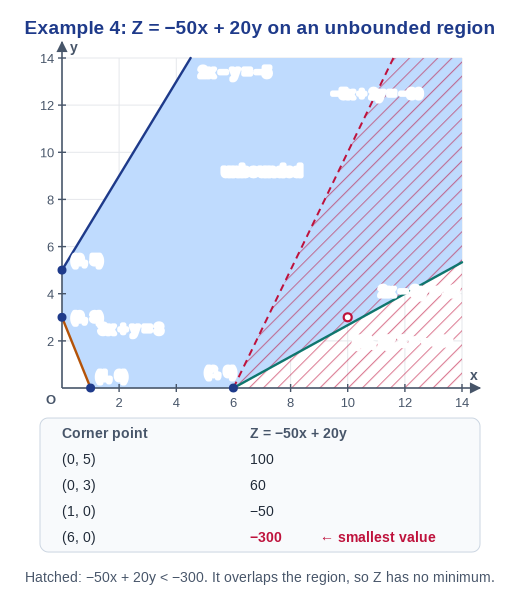
The book’s Example 4 shows the other outcome. There the smallest corner value of Z = −50x + 20y is −300 at (6, 0), but the half-plane −50x + 20y < −300 does meet the region, so Z has no minimum at all.
Two special cases
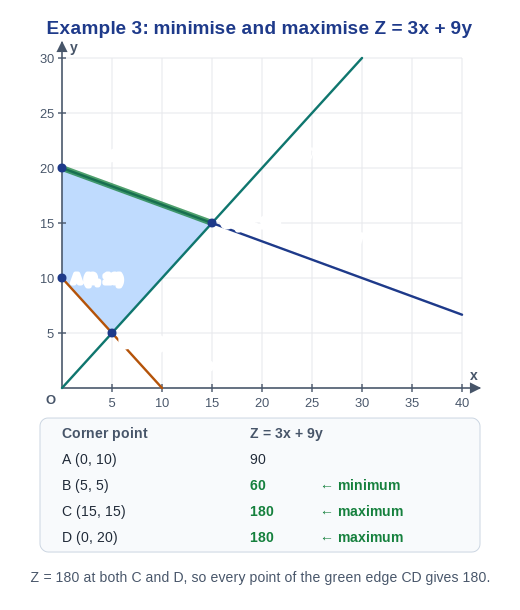
Multiple optimal solutions. If two corner points give the same maximum (or minimum), every point of the segment joining them gives that value too. In the book’s Example 3, Z = 3x + 9y is 180 at both C(15, 15) and D(0, 20), so the maximum 180 is reached all along CD.
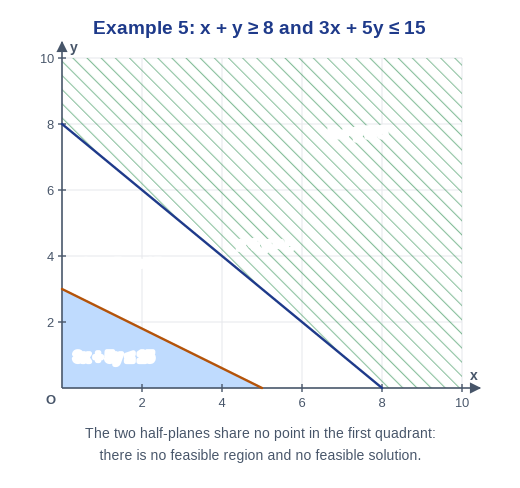
No feasible region. If the half-planes have no common point, there is no feasible solution. In Example 5, the first-quadrant points with x + y ≥ 8 all lie beyond the line through (8, 0) and (0, 8), while 3x + 5y ≤ 15 keeps only a small triangle near the origin. They never meet.
The book sums up two general features: the feasible region is always convex, and the maximum or minimum of Z always occurs at a corner (or along a whole edge when two corners tie).
A quick checklist
- Shade the correct side of every line, and include x ≥ 0, y ≥ 0.
- List every corner and solve for it exactly; check it satisfies all the constraints.
- Tabulate Z at the corners and mark M and m.
- Bounded: done. Unbounded: test the open half-plane before you write “maximum” or “minimum”.
- If two corners tie, give the whole segment as the answer.
Read next: formulating a linear programming problem, the Chapter 12 notes and the NCERT solutions for all five examples and Exercise 12.1.
Practice
-
The corner points of a bounded feasible region are (0, 2), (3, 0), (6, 0), (6, 8) and (0, 5). The maximum of Z = 4x + 6y is:
Show answer
Answer: (d) 72
-
For the same region, the minimum of Z = 4x + 6y is 12. It occurs at:
Show answer
Answer: (c) every point of the segment joining (0, 2) and (3, 0)
-
Find the minimum of Z = 2x + 5y subject to x + y ≥ 4, x + 3y ≥ 6, x ≥ 0, y ≥ 0.
Show answer
Answer: The region is unbounded with corners (0, 4), (3, 1) and (6, 0), where Z = 20, 11 and 12. The smallest corner value is 11. In the region, 2x + 5y = ½(x + y) + (3/2)(x + 3y) ≥ 2 + 9 = 11, so the half-plane 2x + 5y < 11 has no common point with it. The minimum is 11 at (3, 1).
-
Does Z = x + y have a maximum on the region x + y ≥ 1, x ≥ 0, y ≥ 0?
Show answer
Answer: No. The corners are (1, 0) and (0, 1), both with Z = 1. The region is unbounded and the half-plane x + y > 1 contains feasible points such as (2, 2), where Z = 4, so Z has no maximum. Its minimum is 1, at every point of the segment joining (1, 0) and (0, 1).
Questions students ask
How do I find a corner point exactly?
Identify the two boundary lines that meet there and solve them as simultaneous equations. For 3x + 5y = 15 and 5x + 2y = 10, multiply and subtract to get x = 20/19 and y = 45/19. Then check that the point satisfies every other constraint.
Why is an unbounded region treated differently?
On a bounded region, Theorem 2 promises that Z has a maximum and a minimum at corner points. On an unbounded region Z may grow or fall without end as you move out along the region, so the largest or smallest corner value is only a candidate. The open half-plane test settles it.
What does it mean when there is no feasible region?
The constraints contradict one another: no point satisfies all of them at once. Then the problem has no feasible solution, so there is nothing to maximise or minimise.
Is the feasible region always a polygon?
When it is bounded, yes: a convex polygon. When it is unbounded it is still convex, but one or more of its sides run on without end. It can also be empty, when the constraints have no common point.
Stuck on a question?
Take a photo and Lagnever AI explains it step by step. Try it for 7 days for ₹2.
Get it on Google Play Open in browser
For parents: after the trial, the plan renews monthly by UPI or card autopay. You can cancel anytime in the app.