
What is conditional probability?
Answer in short
Conditional probability P(E|F) is the chance of E once we know that F has happened: P(E|F) = P(E ∩ F)/P(F), with P(F) ≠ 0. Rearranged, it gives the multiplication rule P(E ∩ F) = P(F) P(E|F). Events with P(E ∩ F) = P(E) P(F) are independent.
Stuck on a question? Take a photo and Lagnever AI explains it step by step. Try it for 7 days for ₹2. Get it on Google Play
The idea: a smaller sample space
A family has two children, and at least one is a boy. What is the chance that both are boys? Of the four equally likely cases bb, bg, gb, gg, the information rules out gg, and only bb of the other three has two boys. So the answer is 1/3, not 1/4 (Example 2 of the book).
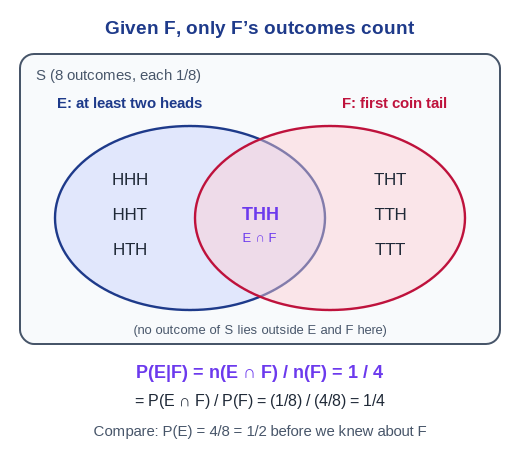
That is all conditional probability does: the event we are told about, F, becomes the new sample space, and we look at the part of E that lies inside it. With equally likely outcomes,
P(E|F) = n(E ∩ F) / n(F).
Dividing the top and bottom by n(S) gives the general definition, which also works when outcomes are not equally likely:
P(E|F) = P(E ∩ F) / P(F), provided P(F) ≠ 0.
Worked examples
Ten cards (Example 3). Cards 1 to 10; we know the number is more than 3. Then F = {4, …, 10} has 7 cards and the even ones among them are 4, 6, 8, 10. P(even | more than 3) = 4/7.
Sum of two dice (Example 6). The sum is 6: F = {(1, 5), (2, 4), (3, 3), (4, 2), (5, 1)}, 5 outcomes. A 4 appears in (2, 4) and (4, 2). So P(a 4 appears | sum 6) = 2/5.
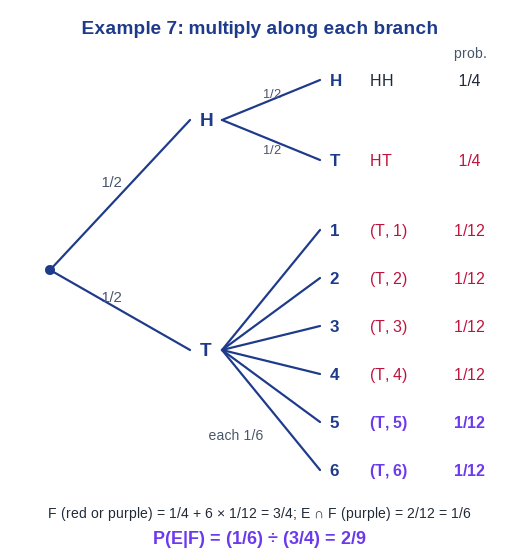
Outcomes that are not equally likely (Example 7). Toss a coin; on a head toss it again, on a tail throw a die. HH and HT each have probability 1/4, and each (T, k) has 1/2 × 1/6 = 1/12. Let F be “at least one tail” and E be “the die shows more than 4”. P(F) = 1/4 + 6/12 = 3/4 and P(E ∩ F) = 2/12 = 1/6, so P(E|F) = (1/6) ÷ (3/4) = 2/9. Counting outcomes would be wrong here; add their probabilities.
Three properties
For any events of S and P(F) ≠ 0:
- P(S|F) = P(F|F) = 1. Given F, F is certain.
- P((A ∪ B)|F) = P(A|F) + P(B|F) − P((A ∩ B)|F). This is the addition rule inside F. For disjoint A and B, drop the last term.
- P(E′|F) = 1 − P(E|F). The complement rule inside F.
Since E ∩ F is a part of F, we always have 0 ≤ P(E|F) ≤ 1.
The multiplication rule
Multiply the definition by P(F):
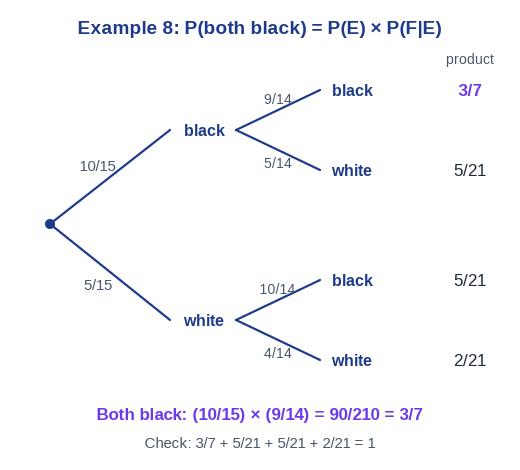
P(E ∩ F) = P(F) · P(E|F) = P(E) · P(F|E) (each form needs its denominator non-zero).
Use it whenever events happen in turn. For three events it extends to P(E ∩ F ∩ G) = P(E) P(F|E) P(G|EF).
- Two balls without replacement (Example 8). 10 black and 5 white: P(black, black) = 10/15 × 9/14 = 3/7.
- Three cards without replacement (Example 9). P(king, king, ace) = 4/52 × 3/51 × 4/50 = 2/5525.
Independent events
E and F are independent if knowing one does not change the chance of the other. The working definition is
P(E ∩ F) = P(E) · P(F).
When P(F) ≠ 0 this is the same as P(E|F) = P(E), and when P(E) ≠ 0 the same as P(F|E) = P(F).
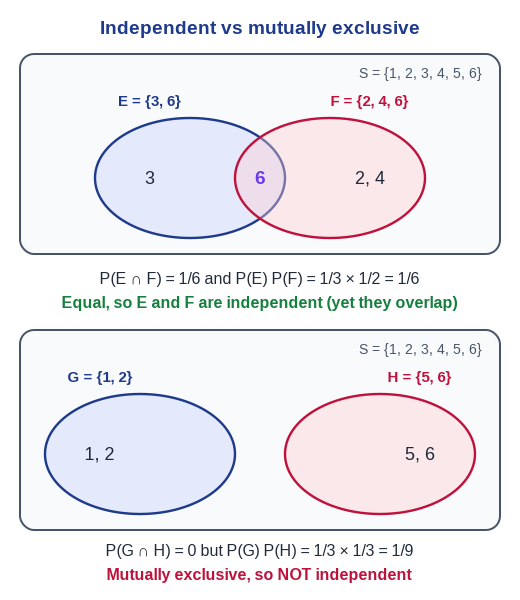
- One die (Example 10). E = multiple of 3 = {3, 6}, F = even = {2, 4, 6}. P(E ∩ F) = P({6}) = 1/6 and P(E) P(F) = 1/3 × 1/2 = 1/6. Independent.
- Three coins (Example 12). E = all three coins alike (HHH or TTT), F = at least two heads, G = at most two heads. P(E ∩ F) = 1/8 = 1/4 × 1/2, so E and F are independent. But P(E ∩ G) = 1/8 ≠ 1/4 × 7/8 and P(F ∩ G) = 3/8 ≠ 1/2 × 7/8, so those pairs are dependent.
Results to know
- Complements stay independent. If E and F are independent, P(E ∩ F′) = P(E) − P(E ∩ F) = P(E) − P(E) P(F) = P(E) P(F′). In the same way E′, F and E′, F′ are independent.
- At least one of two. For independent A and B, P(A ∪ B) = 1 − P(A′) P(B′). For example, if A solves a problem with probability 1/2 and B with 1/3, working independently, the problem is solved with probability 1 − (1/2)(2/3) = 2/3.
- Not the same as exclusive. Exclusive means E ∩ F = φ, a statement about sets. Independent is a statement about probabilities. Two events with non-zero probabilities cannot be both.
- Three events. A, B, C are mutually independent only if P(A ∩ B) = P(A) P(B), P(A ∩ C) = P(A) P(C), P(B ∩ C) = P(B) P(C) and P(A ∩ B ∩ C) = P(A) P(B) P(C).
- Independent experiments. A coin toss and a die throw: P(head and 3) = 1/2 × 1/6 = 1/12.
Quick method
- Find which event is “given”.
- Equally likely outcomes: count inside it. Otherwise use P(E ∩ F)/P(F).
- Events in sequence: multiply along the branch.
- Independence: compare P(E ∩ F) with P(E) P(F), never the wording.
Next: Bayes’ theorem, which turns P(A|cause) into P(cause|A). All exercise questions are worked in the NCERT solutions; back to the Chapter 13 notes.
Practice
-
If P(A) = 0.6, P(B) = 0.5 and P(A ∩ B) = 0.3, then P(B|A) is:
Show answer
Answer: (b) 0.5
-
Two fair dice are thrown and the sum is 4. The probability that both dice show the same number is:
Show answer
Answer: (a) 1/3
-
Two cards are drawn one after the other without replacement from a pack of 52. The probability that both are aces is:
Show answer
Answer: (b) 1/221
-
A coin is tossed twice. Are “head on the first toss” and “at least one head” independent?
Show answer
Answer: No. P(first head) = 1/2, P(at least one head) = 3/4, and the intersection is just “head on the first toss”, with probability 1/2. Since 1/2 ≠ 1/2 × 3/4 = 3/8, the events are dependent.
-
A and B are independent, P(A) = 0.2 and P(B) = 0.5. Find P(A ∩ B′) and P(A ∪ B).
Show answer
Answer: A and B′ are independent too, so P(A ∩ B′) = 0.2 × 0.5 = 0.1. P(A ∪ B) = 0.2 + 0.5 − 0.2 × 0.5 = 0.6.
Questions students ask
Why must P(F) be non-zero?
P(F) is the denominator. If P(F) = 0, the event F cannot happen, so there is nothing to condition on and P(E|F) is not defined. That is why Exercise 13.1 Q16 answers “not defined” when P(B) = 0.
Is P(E|F) the same as P(E ∩ F)?
No. P(E ∩ F) is the chance that both happen, measured on the whole sample space. P(E|F) is measured inside F only, so it is P(E ∩ F) divided by P(F), and it is usually larger.
How do I check whether two events are independent?
Work out P(E), P(F) and P(E ∩ F) from the sample space and compare P(E ∩ F) with P(E) × P(F). Equal means independent; unequal means dependent. Do not guess from the wording.
What is the difference between pairwise and mutual independence of three events?
Pairwise means each pair (A, B), (A, C), (B, C) satisfies the product rule. Mutual independence needs that and also P(A ∩ B ∩ C) = P(A) P(B) P(C). The book defines independence of three events in the second, stronger sense.
Stuck on a question?
Take a photo and Lagnever AI explains it step by step. Try it for 7 days for ₹2.
Get it on Google Play Open in browser
For parents: after the trial, the plan renews monthly by UPI or card autopay. You can cancel anytime in the app.