
NCERT Solutions Class 12 Maths Chapter 2: Inverse Trigonometric Functions
Answers to every question of Exercises 2.1 and 2.2 and the Miscellaneous Exercise, and to all six worked examples, of Chapter 2, Inverse Trigonometric Functions, of Mathematics Part I, the Class 12 NCERT textbook. Page numbers follow the 2026-27 reprint (pages 18−33). The exercise questions are quoted from the book; the examples are restated in short and labelled by number and page. Every value and identity below was checked numerically by computer, and every answer agrees with the book’s answer key. Short notes: Chapter 2 notes.
The method behind almost every answer: an inverse trigonometric function returns only angles in its principal value branch, so each answer ends with a check that the angle lies in that branch. The principal value branch is the one fixed range of angles the book chooses for each function (the table below), so that each input gives exactly one answer.
| Function | Domain | Range (principal value branch) |
|---|---|---|
| sin⁻¹ | [−1, 1] | [−π/2, π/2] |
| cos⁻¹ | [−1, 1] | [0, π] |
| cosec⁻¹ | R − (−1, 1) | [−π/2, π/2] − {0} |
| sec⁻¹ | R − (−1, 1) | [0, π] − {π/2} |
| tan⁻¹ | R | (−π/2, π/2) |
| cot⁻¹ | R | (0, π) |
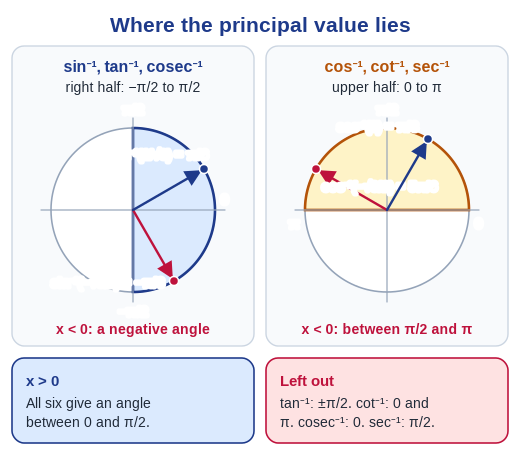
Examples 1 and 2: principal values (page 26)
Example 1 (page 26): the principal value of sin⁻¹(1/√2). Let y = sin⁻¹(1/√2), so sin y = 1/√2 with y in [−π/2, π/2]. Since sin(π/4) = 1/√2 and π/4 lies in that range, the principal value is π/4.
Example 2 (page 26): the principal value of cot⁻¹(−1/√3). Let y = cot⁻¹(−1/√3), so cot y = −1/√3 with y in (0, π). Since cot(π/3) = 1/√3, cot(π − π/3) = −1/√3. The angle 2π/3 lies in (0, π), so the principal value is 2π/3.
Exercise 2.1 (pages 26−27)
The book asks: “Find the principal values of the following:”
1. “sin⁻¹(−1/2)”
Let y = sin⁻¹(−1/2). Then sin y = −1/2, with y in [−π/2, π/2]. Since sin(π/6) = 1/2, sin(−π/6) = −1/2, and −π/6 lies in the range. Answer: −π/6.
2. “cos⁻¹(√3/2)”
cos y = √3/2 with y in [0, π]. cos(π/6) = √3/2 and π/6 lies in [0, π]. Answer: π/6.
3. “cosec⁻¹(2)”
cosec y = 2, that is sin y = 1/2, with y in [−π/2, π/2] − {0}. sin(π/6) = 1/2. Answer: π/6.
4. “tan⁻¹(−√3)”
tan y = −√3 with y in (−π/2, π/2). tan(π/3) = √3, so tan(−π/3) = −√3, and −π/3 lies in the range. Answer: −π/3.
5. “cos⁻¹(−1/2)”
cos y = −1/2 with y in [0, π]. cos(π/3) = 1/2, so cos(π − π/3) = −1/2, and 2π/3 lies in [0, π]. Answer: 2π/3. (4π/3 also has cosine −1/2, but it is outside [0, π].)
6. “tan⁻¹(−1)”
tan y = −1 with y in (−π/2, π/2). tan(π/4) = 1, so tan(−π/4) = −1. Answer: −π/4.
7. “sec⁻¹(2/√3)”
sec y = 2/√3, that is cos y = √3/2, with y in [0, π] − {π/2}. cos(π/6) = √3/2. Answer: π/6.
8. “cot⁻¹(√3)”
cot y = √3 with y in (0, π). cot(π/6) = √3. Answer: π/6.
9. “cos⁻¹(−1/√2)”
cos y = −1/√2 with y in [0, π]. cos(π/4) = 1/√2, so cos(π − π/4) = −1/√2. Answer: 3π/4.
10. “cosec⁻¹(−√2)”
cosec y = −√2, that is sin y = −1/√2, with y in [−π/2, π/2] − {0}. sin(−π/4) = −1/√2. Answer: −π/4.
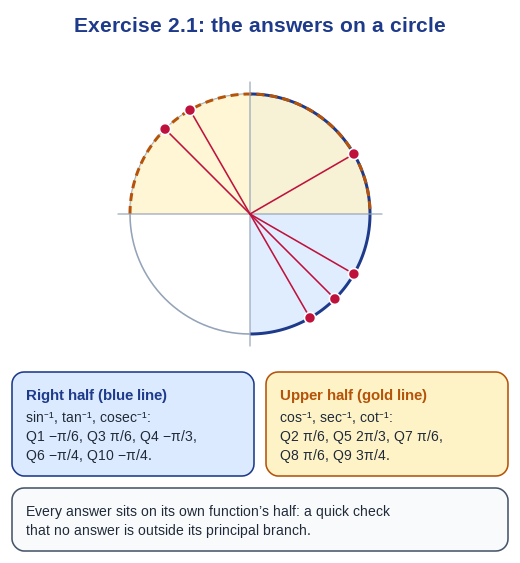
The book then asks: “Find the values of the following:”
11. “tan⁻¹(1) + cos⁻¹(−1/2) + sin⁻¹(−1/2)”
tan⁻¹(1) = π/4, cos⁻¹(−1/2) = 2π/3 (Question 5) and sin⁻¹(−1/2) = −π/6 (Question 1). So the value is
π/4 + 2π/3 − π/6 = (3π + 8π − 2π)/12 = 9π/12 = 3π/4.
12. “cos⁻¹(1/2) + 2 sin⁻¹(1/2)”
cos⁻¹(1/2) = π/3 and sin⁻¹(1/2) = π/6. So the value is π/3 + 2 × π/6 = π/3 + π/3 = 2π/3.
13. “If sin⁻¹ x = y, then (A) 0 ≤ y ≤ π (B) −π/2 ≤ y ≤ π/2 (C) 0 < y < π (D) −π/2 < y < π/2”
y = sin⁻¹ x is a principal value, so it lies in [−π/2, π/2]. Both ends are reached: sin⁻¹(1) = π/2 and sin⁻¹(−1) = −π/2, so the inequalities are not strict. (A) is the range of cos⁻¹ and (C) the range of cot⁻¹. Answer: (B).
14. “tan⁻¹ √3 − sec⁻¹(−2) is equal to (A) π (B) −π/3 (C) π/3 (D) 2π/3”
tan⁻¹ √3 = π/3. For sec⁻¹(−2): cos y = −1/2 with y in [0, π] − {π/2}, so y = 2π/3. The value is π/3 − 2π/3 = −π/3. Answer: (B).
Examples 3 to 5: the simplest form with a substitution (pages 28−29)
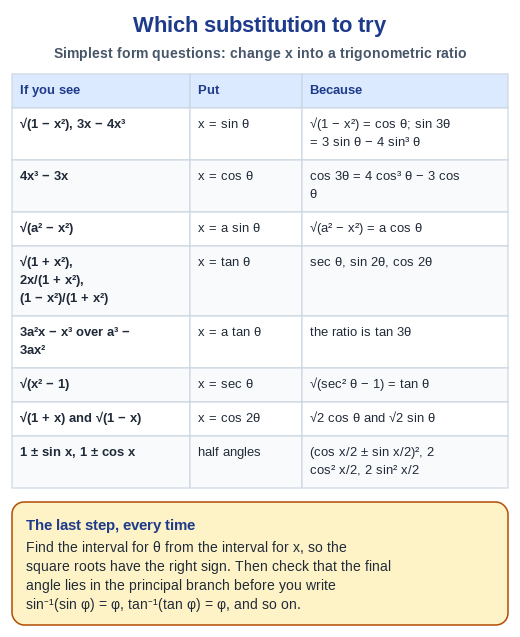
Section 2.3 (page 27) records the basic results sin(sin⁻¹ x) = x for x in [−1, 1] and sin⁻¹(sin x) = x for x in [−π/2, π/2], with similar results for the other functions on their branches. The examples use them after a substitution.
Example 3 (page 28): sin⁻¹(2x√(1 − x²)) equals 2 sin⁻¹ x when −1/√2 ≤ x ≤ 1/√2, and 2 cos⁻¹ x when 1/√2 ≤ x ≤ 1.
(i) Put x = sin θ with θ = sin⁻¹ x. Since |x| ≤ 1/√2, θ lies in [−π/4, π/4], so cos θ > 0 and √(1 − x²) = cos θ. Then
2x√(1 − x²) = 2 sin θ cos θ = sin 2θ
and 2θ lies in [−π/2, π/2], the branch of sin⁻¹. So sin⁻¹(sin 2θ) = 2θ = 2 sin⁻¹ x.
(ii) Put x = cos θ with θ = cos⁻¹ x. Since 1/√2 ≤ x ≤ 1, θ lies in [0, π/4], so √(1 − x²) = sin θ ≥ 0, and 2x√(1 − x²) = sin 2θ with 2θ in [0, π/2]. So the expression is 2θ = 2 cos⁻¹ x.
The conditions on x are what keep 2θ inside [−π/2, π/2]. At x = 0.9, for example, 2 sin⁻¹ x is about 2.24, more than π/2, and the first formula fails.
Example 4 (page 28): write tan⁻¹(cos x/(1 − sin x)), −3π/2 < x < π/2, in the simplest form. Use half angles:
cos x = cos²(x/2) − sin²(x/2) = (cos(x/2) + sin(x/2))(cos(x/2) − sin(x/2))
1 − sin x = cos²(x/2) + sin²(x/2) − 2 sin(x/2) cos(x/2) = (cos(x/2) − sin(x/2))²
So the fraction is (cos(x/2) + sin(x/2))/(cos(x/2) − sin(x/2)). Since cos(x/2) + sin(x/2) = √2 sin(π/4 + x/2) and cos(x/2) − sin(x/2) = √2 cos(π/4 + x/2), the fraction is tan(π/4 + x/2). For −3π/2 < x < π/2, π/4 + x/2 lies in (−π/2, π/2), so the expression equals π/4 + x/2.
Example 5 (page 29): write cot⁻¹(1/√(x² − 1)), x > 1, in the simplest form. Put x = sec θ with θ in (0, π/2), which is possible because x > 1. Then √(x² − 1) = √(sec² θ − 1) = tan θ > 0, so 1/√(x² − 1) = cot θ. θ lies in (0, π), the branch of cot⁻¹, so the expression is θ = sec⁻¹ x.
Exercise 2.2 (pages 29−30)
The book asks: “Prove the following:”
1. “3sin⁻¹ x = sin⁻¹(3x − 4x³), x ∈ [−1/2, 1/2]”
Let θ = sin⁻¹ x, so x = sin θ. Since −1/2 ≤ x ≤ 1/2, θ lies in [−π/6, π/6], and 3θ lies in [−π/2, π/2]. By the triple-angle formula,
sin 3θ = 3 sin θ − 4 sin³ θ = 3x − 4x³
So sin⁻¹(3x − 4x³) = sin⁻¹(sin 3θ) = 3θ = 3 sin⁻¹ x, because 3θ is in the branch of sin⁻¹.
2. “3cos⁻¹ x = cos⁻¹(4x³ − 3x), x ∈ [1/2, 1]”
Let θ = cos⁻¹ x, so x = cos θ. Since 1/2 ≤ x ≤ 1, θ lies in [0, π/3], and 3θ lies in [0, π]. By the triple-angle formula,
cos 3θ = 4 cos³ θ − 3 cos θ = 4x³ − 3x
So cos⁻¹(4x³ − 3x) = cos⁻¹(cos 3θ) = 3θ = 3 cos⁻¹ x, because 3θ is in [0, π].
The book then asks: “Write the following functions in the simplest form:”
3. “tan⁻¹((√(1 + x²) − 1)/x), x ≠ 0”
Put x = tan θ with θ = tan⁻¹ x in (−π/2, π/2), θ ≠ 0. Then cos θ > 0, so √(1 + x²) = sec θ, and
(sec θ − 1)/tan θ = (1 − cos θ)/sin θ = 2 sin²(θ/2)/(2 sin(θ/2) cos(θ/2)) = tan(θ/2)
θ/2 lies in (−π/4, π/4), inside the branch of tan⁻¹. Simplest form: (1/2) tan⁻¹ x.
4. “tan⁻¹(√((1 − cos x)/(1 + cos x))), 0 < x < π”
(1 − cos x)/(1 + cos x) = 2 sin²(x/2)/(2 cos²(x/2)) = tan²(x/2)
For 0 < x < π, x/2 lies in (0, π/2), where tan(x/2) > 0, so the square root is tan(x/2). Since x/2 is in the branch of tan⁻¹, the simplest form is x/2.
5. “tan⁻¹((cos x − sin x)/(cos x + sin x)), −π/4 < x < 3π/4”
cos x − sin x = √2 cos(x + π/4) and cos x + sin x = √2 sin(x + π/4), so the fraction is
cot(x + π/4) = tan(π/2 − x − π/4) = tan(π/4 − x)
(For −π/4 < x < 3π/4, x + π/4 lies in (0, π), so the denominator is not zero.) Also π/4 − x lies in (−π/2, π/2). Simplest form: π/4 − x.
6. “tan⁻¹(x/√(a² − x²)), |x| < a”
Here a > 0. Put x = a sin θ with θ = sin⁻¹(x/a) in (−π/2, π/2). Then √(a² − x²) = a cos θ > 0, and the fraction is tan θ. θ is in the branch of tan⁻¹. Simplest form: sin⁻¹(x/a).
7. “tan⁻¹((3a²x − x³)/(a³ − 3ax²)), a > 0; −a/√3 < x < a/√3”
Put x = a tan θ with θ = tan⁻¹(x/a). Since |x/a| < 1/√3, θ lies in (−π/6, π/6), and 3θ lies in (−π/2, π/2). Dividing the top and bottom by a³,
(3a²x − x³)/(a³ − 3ax²) = (3 tan θ − tan³ θ)/(1 − 3 tan² θ) = tan 3θ
(the denominator is not zero, as tan² θ < 1/3). Simplest form: 3 tan⁻¹(x/a).
The book then asks: “Find the values of each of the following:”
8. “tan⁻¹[2 cos(2 sin⁻¹(1/2))]”
sin⁻¹(1/2) = π/6, so 2 sin⁻¹(1/2) = π/3 and cos(π/3) = 1/2. The bracket is 2 × 1/2 = 1, and tan⁻¹(1) = π/4.
9. “tan (1/2)[sin⁻¹(2x/(1 + x²)) + cos⁻¹((1 − y²)/(1 + y²))], |x| < 1, y > 0 and xy < 1”
Put x = tan α with α in (−π/4, π/4), since |x| < 1. Then 2x/(1 + x²) = 2 tan α/(1 + tan² α) = sin 2α, and 2α lies in (−π/2, π/2), so sin⁻¹(2x/(1 + x²)) = 2α.
Put y = tan β with β in (0, π/2), since y > 0. Then (1 − y²)/(1 + y²) = cos 2β, and 2β lies in (0, π), so cos⁻¹((1 − y²)/(1 + y²)) = 2β.
So the expression is tan[(1/2)(2α + 2β)] = tan(α + β) = (tan α + tan β)/(1 − tan α tan β) = (x + y)/(1 − xy), which exists because xy < 1.
The book’s next line reads: “Find the values of each of the expressions in Exercises 16 to 18.” It refers to Questions 10 to 12 below; the numbers 16 to 18 are left over from an older numbering.
10. “sin⁻¹(sin 2π/3)”
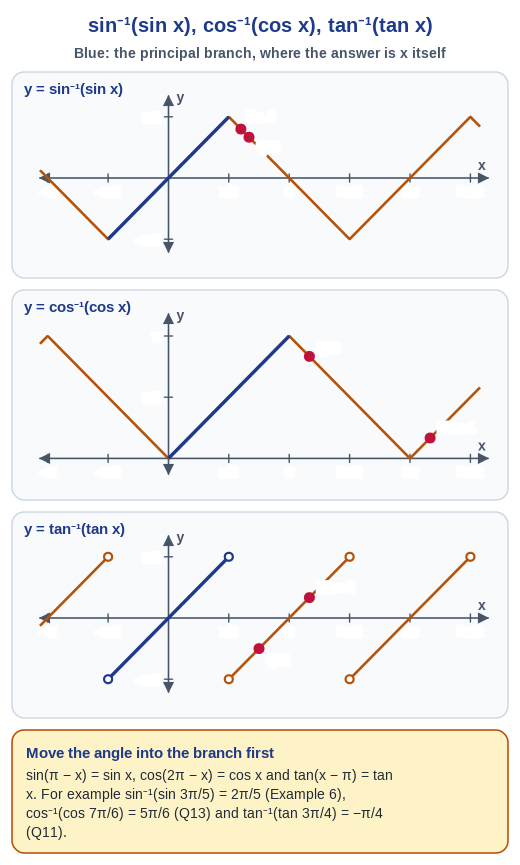
2π/3 is not in [−π/2, π/2]. But sin(2π/3) = sin(π − 2π/3) = sin(π/3), and π/3 is in the branch. So the value is π/3.
11. “tan⁻¹(tan 3π/4)”
3π/4 is not in (−π/2, π/2). Tangent repeats every π, so tan(3π/4) = tan(3π/4 − π) = tan(−π/4), and −π/4 is in the branch. So the value is −π/4.
12. “tan(sin⁻¹ 3/5 + cot⁻¹ 3/2)”
Let α = sin⁻¹(3/5): α is in (0, π/2) with sin α = 3/5, so cos α = 4/5 and tan α = 3/4. Let β = cot⁻¹(3/2): β is in (0, π/2) with cot β = 3/2, so tan β = 2/3. Then
tan(α + β) = (3/4 + 2/3)/(1 − 3/4 × 2/3) = (17/12)/(1/2) = 17/6
13. “cos⁻¹(cos 7π/6) is equal to (A) 7π/6 (B) 5π/6 (C) π/3 (D) π/6”
7π/6 is not in [0, π]. But cos(7π/6) = cos(2π − 7π/6) = cos(5π/6), and 5π/6 is in [0, π]. So the value is 5π/6. Answer: (B).
14. “sin(π/3 − sin⁻¹(−1/2)) is equal to (A) 1/2 (B) 1/3 (C) 1/4 (D) 1”
sin⁻¹(−1/2) = −π/6, so the angle is π/3 + π/6 = π/2, and sin(π/2) = 1. Answer: (D).
15. “tan⁻¹ √3 − cot⁻¹(−√3) is equal to (A) π (B) −π/2 (C) 0 (D) 2√3”
tan⁻¹ √3 = π/3. For cot⁻¹(−√3): cot(π/6) = √3, so the angle in (0, π) with cotangent −√3 is π − π/6 = 5π/6. The value is π/3 − 5π/6 = −π/2. Answer: (B).
Miscellaneous Example 6 (page 30)
Example 6 (page 30): the value of sin⁻¹(sin 3π/5). It is tempting to answer 3π/5, but 3π/5 is not in [−π/2, π/2], so it cannot be a value of sin⁻¹. Since sin(3π/5) = sin(π − 3π/5) = sin(2π/5), and 2π/5 lies in [−π/2, π/2], the value is 2π/5.
Miscellaneous Exercise on Chapter 2 (page 31)
The book asks: “Find the value of the following:”
1. “cos⁻¹(cos 13π/6)”
13π/6 = 2π + π/6 is not in [0, π]. Cosine repeats every 2π, so cos(13π/6) = cos(π/6), and π/6 is in [0, π]. The value is π/6.
2. “tan⁻¹(tan 7π/6)”
7π/6 is not in (−π/2, π/2). Tangent repeats every π, so tan(7π/6) = tan(7π/6 − π) = tan(π/6), and π/6 is in the branch. The value is π/6.
The book then asks: “Prove that”
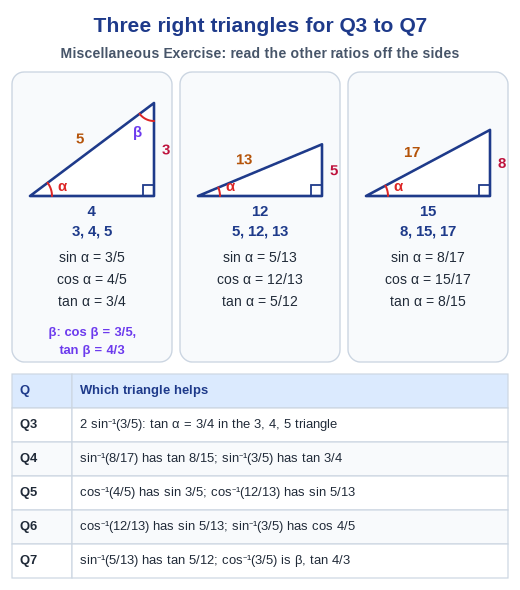
3. “2sin⁻¹(3/5) = tan⁻¹(24/7)”
Let α = sin⁻¹(3/5): α is in (0, π/2) with sin α = 3/5, cos α = 4/5 and tan α = 3/4. Then
tan 2α = 2 tan α/(1 − tan² α) = (3/2)/(1 − 9/16) = (3/2)/(7/16) = 24/7
Since tan α = 3/4 < 1, α < π/4, so 2α lies in (0, π/2), inside the branch of tan⁻¹. Hence tan⁻¹(24/7) = 2α = 2 sin⁻¹(3/5).
4. “sin⁻¹(8/17) + sin⁻¹(3/5) = tan⁻¹(77/36)”
Let α = sin⁻¹(8/17) and β = sin⁻¹(3/5), both in (0, π/2). Then cos α = 15/17, so tan α = 8/15; and tan β = 3/4. So
tan(α + β) = (8/15 + 3/4)/(1 − 8/15 × 3/4) = (77/60)/(36/60) = 77/36
α + β lies in (0, π), and its tangent is positive, so it lies in (0, π/2), inside the branch of tan⁻¹. Hence α + β = tan⁻¹(77/36).
5. “cos⁻¹(4/5) + cos⁻¹(12/13) = cos⁻¹(33/65)”
Let α = cos⁻¹(4/5) and β = cos⁻¹(12/13), both in (0, π/2). Then sin α = 3/5 and sin β = 5/13. So
cos(α + β) = cos α cos β − sin α sin β = 4/5 × 12/13 − 3/5 × 5/13 = 48/65 − 15/65 = 33/65
α + β lies in (0, π), the branch of cos⁻¹, so α + β = cos⁻¹(33/65).
6. “cos⁻¹(12/13) + sin⁻¹(3/5) = sin⁻¹(56/65)”
Let α = cos⁻¹(12/13) and β = sin⁻¹(3/5), both in (0, π/2). Then sin α = 5/13 and cos β = 4/5. So
sin(α + β) = sin α cos β + cos α sin β = 5/13 × 4/5 + 12/13 × 3/5 = 20/65 + 36/65 = 56/65
Also cos(α + β) = 12/13 × 4/5 − 5/13 × 3/5 = 33/65 > 0, so α + β lies in (0, π/2), inside the branch of sin⁻¹. Hence α + β = sin⁻¹(56/65).
7. “tan⁻¹(63/16) = sin⁻¹(5/13) + cos⁻¹(3/5)”
Let α = sin⁻¹(5/13) and β = cos⁻¹(3/5), both in (0, π/2). Then tan α = 5/12, and sin β = 4/5, so tan β = 4/3. So
tan(α + β) = (5/12 + 4/3)/(1 − 5/12 × 4/3) = (21/12)/(4/9) = 63/16
α + β lies in (0, π) with a positive tangent, so it lies in (0, π/2). Hence sin⁻¹(5/13) + cos⁻¹(3/5) = tan⁻¹(63/16).
The book then asks again: “Prove that”
8. “tan⁻¹ √x = (1/2) cos⁻¹((1 − x)/(1 + x)), x ∈ [0, 1]”
Let θ = tan⁻¹ √x. Since 0 ≤ √x ≤ 1, θ lies in [0, π/4], and x = tan² θ. Then
(1 − x)/(1 + x) = (1 − tan² θ)/(1 + tan² θ) = cos 2θ
and 2θ lies in [0, π/2], inside [0, π]. So cos⁻¹((1 − x)/(1 + x)) = 2θ, and half of it is θ = tan⁻¹ √x.
9. “cot⁻¹((√(1 + sin x) + √(1 − sin x))/(√(1 + sin x) − √(1 − sin x))) = x/2, x ∈ (0, π/4)”
1 + sin x = (cos(x/2) + sin(x/2))² and 1 − sin x = (cos(x/2) − sin(x/2))². For x in (0, π/4), x/2 is in (0, π/8), where cos(x/2) > sin(x/2) > 0. So
√(1 + sin x) = cos(x/2) + sin(x/2) and √(1 − sin x) = cos(x/2) − sin(x/2)
The numerator is 2 cos(x/2) and the denominator is 2 sin(x/2), so the fraction is cot(x/2). Since x/2 lies in (0, π), the branch of cot⁻¹, the left side equals x/2.
10. “tan⁻¹((√(1 + x) − √(1 − x))/(√(1 + x) + √(1 − x))) = π/4 − (1/2) cos⁻¹ x, −1/√2 ≤ x ≤ 1 [Hint: Put x = cos 2θ]”
Put x = cos 2θ with 2θ = cos⁻¹ x. Since −1/√2 ≤ x ≤ 1, 2θ lies in [0, 3π/4], so θ lies in [0, 3π/8], where sin θ ≥ 0 and cos θ > 0. Then
√(1 + x) = √(2 cos² θ) = √2 cos θ and √(1 − x) = √(2 sin² θ) = √2 sin θ
The fraction becomes (cos θ − sin θ)/(cos θ + sin θ) = tan(π/4 − θ), as in Exercise 2.2 Q5. Since π/4 − θ lies in [−π/8, π/4], inside (−π/2, π/2), the left side is π/4 − θ = π/4 − (1/2) cos⁻¹ x.
The book then asks: “Solve the following equations:”
11. “2tan⁻¹(cos x) = tan⁻¹(2 cosec x)”
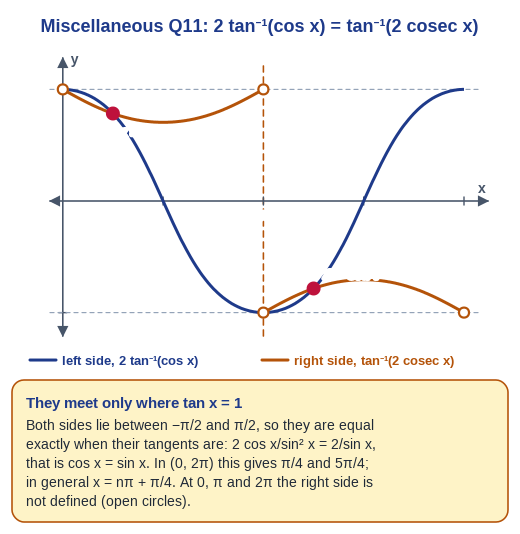
Step 1 (where the two sides live). cosec x needs sin x ≠ 0, so |cos x| < 1. Then tan⁻¹(cos x) lies in (−π/4, π/4), and the left side 2 tan⁻¹(cos x) lies in (−π/2, π/2). The right side is a value of tan⁻¹, so it also lies in (−π/2, π/2).
Step 2 (take tan of both sides). On (−π/2, π/2) tangent is one-one, so the two sides are equal exactly when their tangents are equal. Use tan 2α = 2 tan α/(1 − tan² α) with tan α = cos x:
2 cos x/(1 − cos² x) = 2 cosec x
2 cos x/sin² x = 2/sin x
cos x = sin x (multiplying by sin² x/2, as sin x ≠ 0)
Step 3. Dividing by cos x gives tan x = 1.
Answer: x = nπ + π/4, n ∈ Z, as in the answer key. In (0, 2π) the solutions are π/4 and 5π/4.
12. “tan⁻¹((1 − x)/(1 + x)) = (1/2) tan⁻¹ x, (x > 0)”
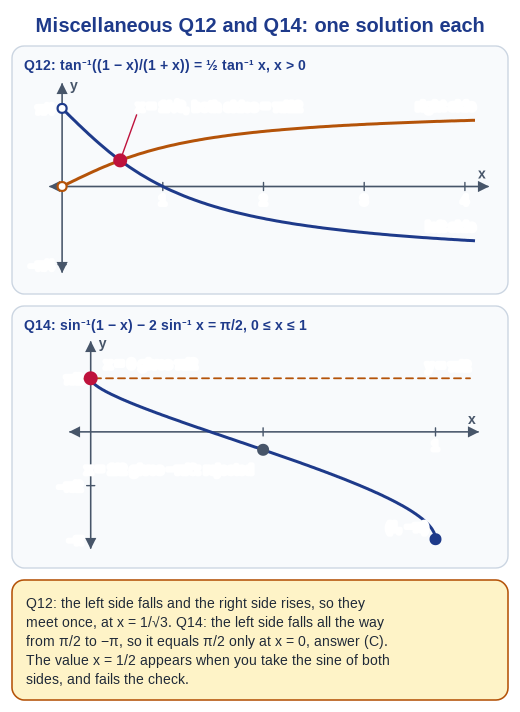
Let θ = tan⁻¹ x, with θ in (0, π/2) since x > 0. Then
(1 − x)/(1 + x) = (1 − tan θ)/(1 + tan θ) = tan(π/4 − θ)
and π/4 − θ lies in (−π/4, π/4), so the left side is π/4 − θ. The equation becomes π/4 − θ = θ/2, so θ = π/6 and x = tan(π/6) = 1/√3.
13. “sin(tan⁻¹ x), |x| < 1 is equal to (A) x/√(1 − x²) (B) 1/√(1 − x²) (C) 1/√(1 + x²) (D) x/√(1 + x²)”
Let θ = tan⁻¹ x, in (−π/4, π/4), so cos θ > 0. From sec² θ = 1 + tan² θ = 1 + x², cos θ = 1/√(1 + x²), and sin θ = tan θ cos θ = x/√(1 + x²). Answer: (D).
14. “sin⁻¹(1 − x) − 2 sin⁻¹ x = π/2, then x is equal to (A) 0, 1/2 (B) 1, 1/2 (C) 0 (D) 1/2”
Both terms must exist: 1 − x and x must lie in [−1, 1], so 0 ≤ x ≤ 1. Let θ = sin⁻¹ x, in [0, π/2]. The equation says sin⁻¹(1 − x) = π/2 + 2θ. Taking the sine of both sides,
1 − x = sin(π/2 + 2θ) = cos 2θ = 1 − 2 sin² θ = 1 − 2x²
so 2x² − x = 0, giving x = 0 or x = 1/2. Taking the sine can bring in extra answers, so check both:
- x = 0: sin⁻¹(1) − 0 = π/2. It works.
- x = 1/2: sin⁻¹(1/2) − 2 sin⁻¹(1/2) = π/6 − π/3 = −π/6 ≠ π/2. It fails.
So x = 0 only. Answer: (C). (Option (A) is the trap of not checking.)
A note on this edition
This is the rationalised book (Revised Edition October 2022, marked Reprint 2026-27). Section 2.3 keeps only the basic results such as sin(sin⁻¹ x) = x and sin⁻¹(sin x) = x on the branch, so Exercise 2.2 Q9 and Miscellaneous Q3 to Q7 are solved above with the Class 11 formulas for sin(A + B), cos(A + B) and tan(A + B), not with identity lists from older guides. The line before Exercise 2.2 Q10 still says “Exercises 16 to 18”; it means Questions 10 to 12. On page 23 the range of the restricted secant is printed once as R − {−1, 1}; the rest of the page, and the table on page 25, give R − (−1, 1), which is correct.
Practice
-
The principal value of cos⁻¹(−√3/2) is:
Show answer
Answer: (a) 5π/6
-
tan⁻¹(tan 5π/6) equals:
Show answer
Answer: (a) −π/6
-
sin(cos⁻¹(3/5)) equals:
Show answer
Answer: (a) 4/5
-
Find the value of sec⁻¹(−√2) + cosec⁻¹(−√2).
Show answer
Answer: sec⁻¹(−√2): cos y = −1/√2 with y in [0, π], so y = 3π/4. cosec⁻¹(−√2): sin y = −1/√2 with y in [−π/2, π/2], so y = −π/4. The sum is 3π/4 − π/4 = π/2.
-
Show that tan⁻¹(1/2) + tan⁻¹(1/3) = π/4.
Show answer
Answer: Let α = tan⁻¹(1/2) and β = tan⁻¹(1/3); both lie in (0, π/4), so α + β lies in (0, π/2). tan(α + β) = (1/2 + 1/3)/(1 − 1/6) = (5/6)/(5/6) = 1. The angle in (0, π/2) with tangent 1 is π/4.
Stuck on a question?
Take a photo and Lagnever AI explains it step by step. Try it for 7 days for ₹2.
Get it on Google Play Open in browser
For parents: after the trial, the plan renews monthly by UPI or card autopay. You can cancel anytime in the app.