
Class 12 Maths Chapter 2: Inverse Trigonometric Functions Notes
This chapter in five lines
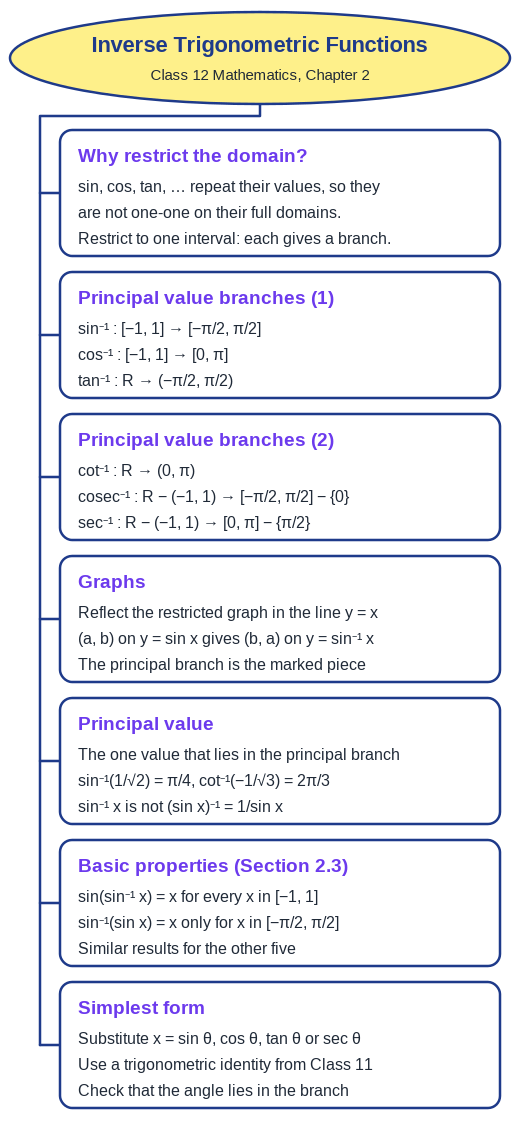
Trigonometric functions repeat their values, so they can be reversed only on intervals where they are one-one and onto. Each inverse has a principal value branch: sin⁻¹ : [−1, 1] → [−π/2, π/2], cos⁻¹ : [−1, 1] → [0, π], tan⁻¹ : R → (−π/2, π/2), cot⁻¹ : R → (0, π), and cosec⁻¹, sec⁻¹ on R − (−1, 1). The principal value is the answer inside that branch. sin(sin⁻¹ x) = x always, but sin⁻¹(sin x) = x only inside the branch.
What is this chapter about?
Chapter 1 showed that a function can be reversed only when it is one-one and onto. The six trigonometric functions are neither on their natural domains: sin x, for example, takes each value in [−1, 1] again and again. This chapter, 16 pages long, cuts each function down to one interval where it can be reversed, defines the inverse there, draws its graph, and uses a few basic properties to find values and simplify expressions. You will use these functions again in calculus, where several integrals are written with sin⁻¹ and tan⁻¹.
Why can’t we reverse sin x on all of R?
The equation sin x = 1/2 has the solutions π/6, 5π/6, −7π/6 and infinitely many more. So “the angle whose sine is 1/2” has no single answer, and sine on R has no inverse. On the interval [−π/2, π/2], though, sin x rises steadily from −1 to 1 and takes each value exactly once. Restricted to this interval, sine is one-one and onto [−1, 1], and it can be reversed.
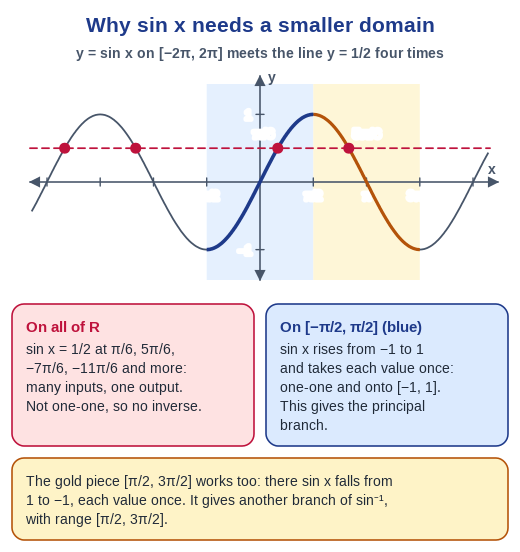
Other intervals work too, such as [π/2, 3π/2], where sine falls from 1 to −1. Each one gives a different branch of sin⁻¹. The book fixes one branch for each function, the principal value branch, and uses it whenever no branch is named.
What are the six principal value branches?
| Function | Domain | Range (principal value branch) |
|---|---|---|
| sin⁻¹ | [−1, 1] | [−π/2, π/2] |
| cos⁻¹ | [−1, 1] | [0, π] |
| cosec⁻¹ | R − (−1, 1) | [−π/2, π/2] − {0} |
| sec⁻¹ | R − (−1, 1) | [0, π] − {π/2} |
| tan⁻¹ | R | (−π/2, π/2) |
| cot⁻¹ | R | (0, π) |
The domain of each inverse is the range of the original function, and its range is the piece of the original domain that was kept. Square brackets include the end value; round brackets leave it out.
What do the graphs look like?
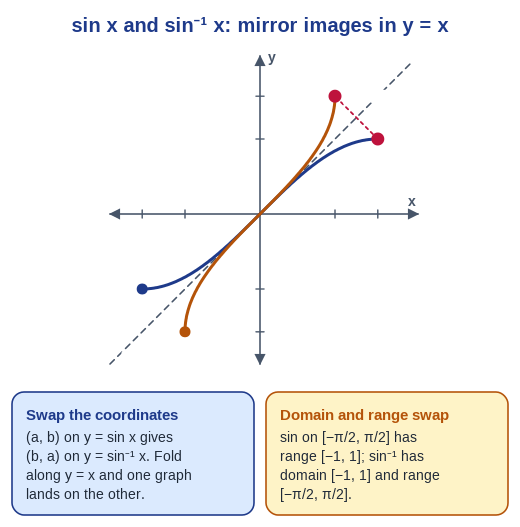
If (a, b) lies on y = sin x, then (b, a) lies on y = sin⁻¹ x. Swapping the coordinates of every point reflects the graph in the line y = x, so the graph of each inverse is the mirror image of the piece of the original graph that was kept.
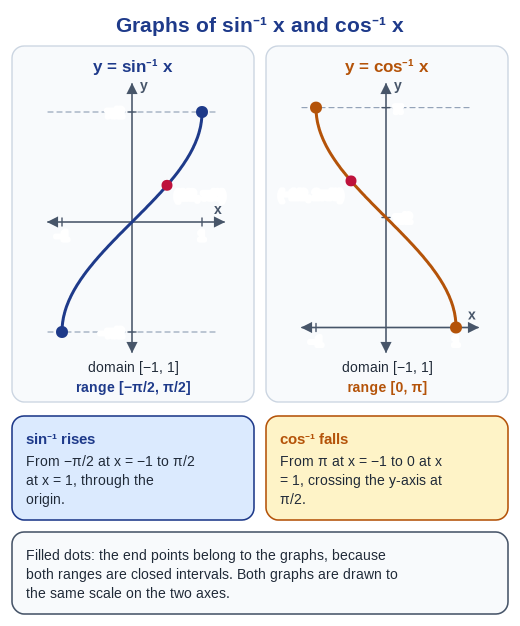
The graphs of tan⁻¹, cot⁻¹, cosec⁻¹ and sec⁻¹ are drawn on the principal values page.
What is a principal value?
The principal value of an inverse trigonometric function is its value in the principal value branch. To find it, write y = sin⁻¹ x as sin y = x and pick the y that lies in [−π/2, π/2]. For example, cos⁻¹(−√3/2) = 5π/6, because cos(5π/6) = −√3/2 and 5π/6 lies in [0, π]; and tan⁻¹(−1/√3) = −π/6, because −π/6 lies in (−π/2, π/2).
Watch the notation: sin⁻¹ x is an angle, while (sin x)⁻¹ = 1/sin x is a number. The “−1” in sin⁻¹ is not a power. More worked values: principal values of inverse trigonometric functions.
Which properties does the chapter keep?
Section 2.3 starts from the definition: y = sin⁻¹ x and x = sin y say the same thing. So sin(sin⁻¹ x) = x for every x in [−1, 1], and sin⁻¹(sin x) = x for every x in [−π/2, π/2]; similar results hold for the other five functions on their branches. The second rule needs care: sin⁻¹(sin 5π/6) is π/6, not 5π/6, because sin⁻¹ only gives angles in [−π/2, π/2].
With these rules and a substitution, expressions can be written in the simplest form. For √(1 − x²), put x = sin θ; for √(1 + x²), put x = tan θ; for √(x² − 1), put x = sec θ. Then use a Class 11 identity and check that the final angle lies in the branch. See properties of inverse trigonometric functions.
Before we move on
The rationalised book keeps Section 2.3 short: it states the basic results above and works Examples 3 to 6 with them. Older guides still print a longer list of identities, such as a formula for tan⁻¹ x + tan⁻¹ y, which this edition does not state; our solutions use the Class 11 formulas for sin(A + B), cos(A + B) and tan(A + B) instead. The line before Exercise 2.2 Q10 still says “Exercises 16 to 18”, a leftover of an older numbering; it means Questions 10 to 12. Every example and exercise is worked out in the NCERT solutions for Chapter 2.
Key terms
| Term | Meaning |
|---|---|
| Inverse trigonometric function | The inverse of sin, cos, tan, cot, sec or cosec after its domain is cut down to an interval where it is one-one and onto. sin⁻¹ x is also called arc sine of x. |
| Branch | One choice of interval for the values of an inverse function. sin⁻¹ has branches with ranges [−3π/2, −π/2], [−π/2, π/2], [π/2, 3π/2] and so on. |
| Principal value branch | The branch the book fixes for each function, such as [−π/2, π/2] for sin⁻¹. It is meant whenever no branch is named. |
| Principal value | The value of an inverse trigonometric function that lies in its principal value branch: sin⁻¹(1/2) = π/6, not 5π/6. |
| sin⁻¹ (arc sine) | Domain [−1, 1], range [−π/2, π/2]. y = sin⁻¹ x means sin y = x with y in that range. |
| cos⁻¹ (arc cosine) | Domain [−1, 1], range [0, π]. y = cos⁻¹ x means cos y = x with y in [0, π]. |
| tan⁻¹ and cot⁻¹ | Domain R for both. Ranges (−π/2, π/2) and (0, π), both open: the end values are never reached. |
| cosec⁻¹ and sec⁻¹ | Domain R − (−1, 1) for both. Ranges [−π/2, π/2] − {0} and [0, π] − {π/2}. |
| sin⁻¹ x and (sin x)⁻¹ | Different things. sin⁻¹ x is an angle; (sin x)⁻¹ is the number 1/sin x. The same holds for the other five functions. |
| Graph of an inverse | The mirror image of the kept piece of the original graph in the line y = x: (a, b) on one gives (b, a) on the other. |
| sin(sin⁻¹ x) = x | True for every x in [−1, 1], the whole domain of sin⁻¹. Similar results hold for the other functions. |
| sin⁻¹(sin x) = x | True only for x in [−π/2, π/2]. Outside it, first change x to the angle in the branch with the same sine. |
| Substitution | Putting x = sin θ, tan θ, sec θ and so on, so that an expression becomes sin⁻¹(sin φ), tan⁻¹(tan φ) or similar and simplifies to φ. |
Topics in this chapter
Practice
-
The principal value branch of cos⁻¹ is the interval:
Show answer
Answer: (a) [0, π]
-
The principal value of sin⁻¹(−√3/2) is:
Show answer
Answer: (a) −π/3
-
The domain of sec⁻¹ is:
Show answer
Answer: (a) R − (−1, 1)
-
cos⁻¹(cos 5π/3) equals:
Show answer
Answer: (a) π/3
-
sin⁻¹ x stands for:
Show answer
Answer: (a) the angle in [−π/2, π/2] whose sine is x
Questions students ask
What are the main topics of Class 12 Maths Chapter 2?
The domains and principal value branches of the six inverse trigonometric functions, their graphs, how to find principal values, and a few basic properties used to find values and write expressions in the simplest form. The chapter has Exercises 2.1 and 2.2 and a Miscellaneous Exercise.
What is the principal value branch of sin⁻¹?
The interval [−π/2, π/2]. On it, sine is one-one and onto [−1, 1], so sin⁻¹ is a function from [−1, 1] to [−π/2, π/2], and every answer of sin⁻¹ must lie in this interval.
Is sin⁻¹ x the same as 1/sin x?
No. sin⁻¹ x is the angle in [−π/2, π/2] whose sine is x, while (sin x)⁻¹ = 1/sin x = cosec x. For example, sin⁻¹(1/2) = π/6, but 1/sin(1/2) is about 2.09.
Does the 2026-27 book have formulas such as tan⁻¹ x + tan⁻¹ y?
No. Section 2.3 of the rationalised book keeps only basic results such as sin(sin⁻¹ x) = x and sin⁻¹(sin x) = x on the principal branch. Questions that join two inverse functions, such as Miscellaneous Q3 to Q7, are solved with the Class 11 formulas for sin(A + B), cos(A + B) and tan(A + B).
Stuck on a question?
Take a photo and Lagnever AI explains it step by step. Try it for 7 days for ₹2.
Get it on Google Play Open in browser
For parents: after the trial, the plan renews monthly by UPI or card autopay. You can cancel anytime in the app.