
What are the properties of inverse trigonometric functions?
Answer in short
sin(sin⁻¹ x) = x for every x in [−1, 1], but sin⁻¹(sin x) = x only for x in [−π/2, π/2]; the other five functions behave the same way on their principal branches. Outside the branch, first change the angle to one inside it. With substitutions such as x = sin θ, these rules give the simplest form.
Stuck on a question? Take a photo and Lagnever AI explains it step by step. Try it for 7 days for ₹2. Get it on Google Play
What does the book keep in Section 2.3?
If y = sin⁻¹ x, then sin y = x, and the other way round. Written as two rules:
- sin(sin⁻¹ x) = x for every x in [−1, 1];
- sin⁻¹(sin x) = x for every x in [−π/2, π/2].
For suitable values of x the same pairs hold for the other five functions. For example, cos(cos⁻¹ x) = x on [−1, 1] and cos⁻¹(cos x) = x on [0, π]; tan(tan⁻¹ x) = x for every real x and tan⁻¹(tan x) = x on (−π/2, π/2). The book says that its results hold within the principal value branches and does not go into the exact sets of x. So the habit to build for the board exam is simple: check the branch every time.
Why is sin⁻¹(sin x) not always x?
The first rule always works, because sin⁻¹ x is defined for exactly the numbers that sine can produce. The second rule can fail, because sin⁻¹ only returns angles in [−π/2, π/2]. For example, sin(5π/6) = 1/2 and sin⁻¹(1/2) = π/6, so sin⁻¹(sin 5π/6) = π/6, not 5π/6. The graph of y = sin⁻¹(sin x) is a zigzag that agrees with y = x only on the principal branch.
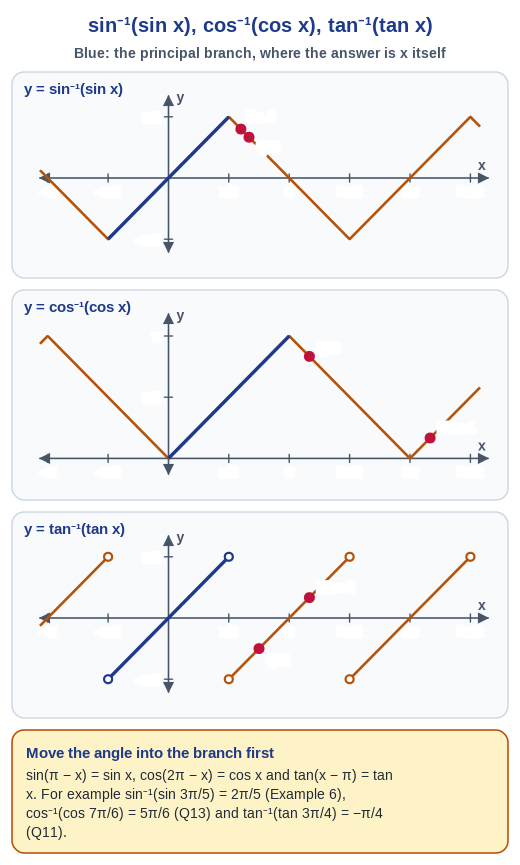
To find such a value, replace the angle by one inside the branch that has the same ratio:
- sine: sin(π − x) = sin x, and sine repeats every 2π;
- cosine: cos(2π − x) = cos x and cos(−x) = cos x;
- tangent: tan(x − π) = tan x.
For example, cos⁻¹(cos 5π/3) = π/3, because cos(5π/3) = cos(2π − 5π/3) = cos(π/3) and π/3 lies in [0, π]. And tan⁻¹(tan(−2π/3)) = π/3, because tan(−2π/3 + π) = tan(π/3) and π/3 lies in (−π/2, π/2).
How does a substitution give the simplest form?
Many questions ask you to write an expression “in the simplest form”. The plan has three steps:
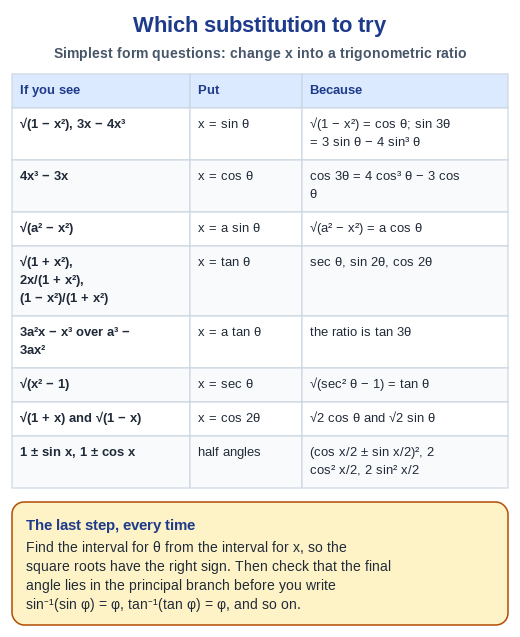
- Choose a substitution that turns the expression into a trigonometric ratio, such as x = sin θ for √(1 − x²).
- Simplify with an identity from Class 11.
- From the interval for x, find the interval for θ. Check that the final angle lies in the principal branch, then use the second rule.
Worked example 1. Simplify cos⁻¹(1 − 2x²) for 0 ≤ x ≤ 1. Put x = sin θ with θ in [0, π/2]. Then 1 − 2x² = 1 − 2 sin² θ = cos 2θ, and 2θ lies in [0, π], the branch of cos⁻¹. So cos⁻¹(1 − 2x²) = 2θ = 2 sin⁻¹ x. The condition matters: at x = −1/2 the left side is cos⁻¹(1/2) = π/3, but 2 sin⁻¹(−1/2) = −π/3.
Worked example 2. Simplify tan⁻¹(x/√(1 − x²)) for |x| < 1. Put x = sin θ with θ in (−π/2, π/2), so √(1 − x²) = cos θ, which is positive here. The fraction becomes tan θ, and θ lies in the branch of tan⁻¹, so the simplest form is θ = sin⁻¹ x.
How does a right triangle help?
For a positive x, an inverse ratio is an acute angle of a right triangle. sin⁻¹(7/25) is the angle opposite the side 7 in a triangle with hypotenuse 25; the third side is √(625 − 49) = 24. So the same angle is also tan⁻¹(7/24) and cos⁻¹(24/25). This is how one inverse function is changed into another before adding two angles with the Class 11 formulas, as in Miscellaneous Exercise Q3 to Q7.
Extra: negative inputs
These results are not listed in the rationalised book, but you can read them off the graphs. The graphs of sin⁻¹ and tan⁻¹ are symmetric about the origin, so sin⁻¹(−x) = −sin⁻¹ x and tan⁻¹(−x) = −tan⁻¹ x. For cos⁻¹ and cot⁻¹, cos⁻¹(−x) = π − cos⁻¹ x and cot⁻¹(−x) = π − cot⁻¹ x. In an exam answer, show the working with the branch, as the book does.
Read next: principal values, the chapter notes and the NCERT solutions.
Practice
-
sin⁻¹(sin 5π/6) equals:
Show answer
Answer: (a) π/6
-
For which x is sin(sin⁻¹ x) = x true?
Show answer
Answer: (a) every x in [−1, 1]
-
tan⁻¹(tan(−2π/3)) equals:
Show answer
Answer: (a) π/3
-
Write tan⁻¹(x/√(1 − x²)), |x| < 1, in the simplest form.
Show answer
Answer: Put x = sin θ with θ in (−π/2, π/2). Then √(1 − x²) = cos θ, which is positive here, so the fraction is tan θ. θ lies in the branch of tan⁻¹, so the expression is θ = sin⁻¹ x.
-
Find cos(tan⁻¹(3/4)).
Show answer
Answer: tan⁻¹(3/4) is an acute angle α with tan α = 3/4: a right triangle with sides 3 and 4 and hypotenuse 5. So cos α = 4/5.
Questions students ask
Is sin⁻¹(sin x) always equal to x?
No, only when x lies in [−π/2, π/2]. For other x, the answer is the angle in [−π/2, π/2] with the same sine: sin⁻¹(sin 5π/6) = π/6.
Is sin(sin⁻¹ x) always equal to x?
Yes, for every x where sin⁻¹ x is defined, that is, every x in [−1, 1]. For x outside [−1, 1], sin⁻¹ x does not exist at all.
Which properties of inverse trigonometric functions are in the 2026-27 book?
Section 2.3 keeps the basic pairs, such as sin(sin⁻¹ x) = x and sin⁻¹(sin x) = x, for suitable values of x, and Examples 3 to 6 use them with substitutions. The longer list of identities found in older guides is not stated in this edition.
How do I choose a substitution?
Look at the roots and fractions. √(1 − x²) suggests x = sin θ or cos θ, √(1 + x²) and 2x/(1 + x²) suggest x = tan θ, and √(x² − 1) suggests x = sec θ.
Stuck on a question?
Take a photo and Lagnever AI explains it step by step. Try it for 7 days for ₹2.
Get it on Google Play Open in browser
For parents: after the trial, the plan renews monthly by UPI or card autopay. You can cancel anytime in the app.