
How do you find the principal value of an inverse trigonometric function?
Answer in short
The principal value is the one value that lies in the function's principal value branch: [−π/2, π/2] for sin⁻¹, [0, π] for cos⁻¹, (−π/2, π/2) for tan⁻¹ and (0, π) for cot⁻¹. To find it, write y = sin⁻¹ x as sin y = x, find an angle with that sine, and pick the one inside the branch.
Stuck on a question? Take a photo and Lagnever AI explains it step by step. Try it for 7 days for ₹2. Get it on Google Play
Why does an inverse trigonometric function need a branch?
Chapter 1 showed that only a one-one and onto function can be reversed. Sine is neither on R: sin x = 1/2 at π/6, at 5π/6 and at infinitely many other angles, so “the angle whose sine is 1/2” has many answers. The way out is to keep one interval on which the function takes each value exactly once. For sine, [−π/2, π/2] does this, because sin x rises from −1 to 1 there.
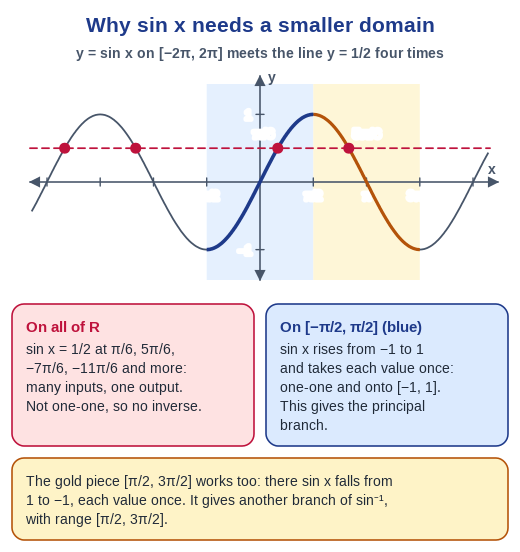
Any other such interval, such as [π/2, 3π/2], gives another branch of sin⁻¹. For each function the book fixes one branch, the principal value branch, and the value of the function in it is the principal value.
What are the six principal value branches?
| Function | Domain | Range (principal value branch) |
|---|---|---|
| sin⁻¹ | [−1, 1] | [−π/2, π/2] |
| cos⁻¹ | [−1, 1] | [0, π] |
| cosec⁻¹ | R − (−1, 1) | [−π/2, π/2] − {0} |
| sec⁻¹ | R − (−1, 1) | [0, π] − {π/2} |
| tan⁻¹ | R | (−π/2, π/2) |
| cot⁻¹ | R | (0, π) |
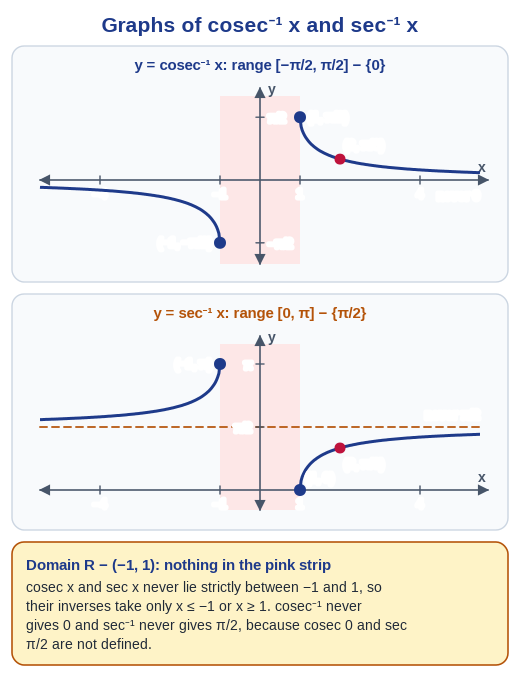
The domain of each inverse is the range of the original function: sine only produces numbers from −1 to 1, so sin⁻¹ accepts only those. Square brackets include the end value, round brackets leave it out. tan⁻¹ never equals ±π/2, because tan is not defined there; in the same way cosec⁻¹ never gives 0 and sec⁻¹ never gives π/2.
How do the graphs show the branches?
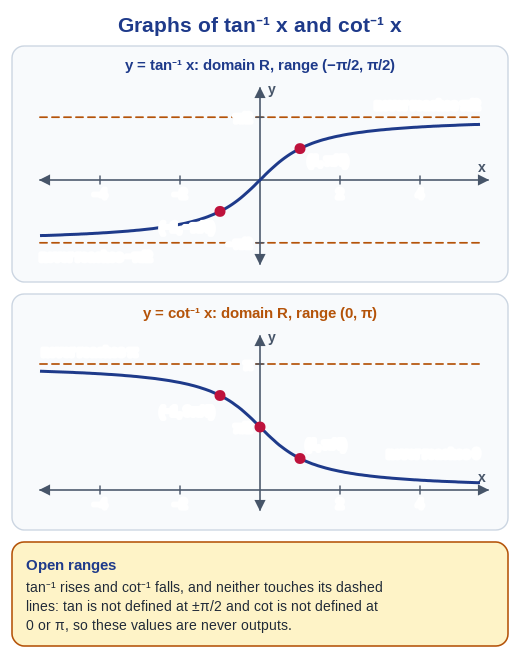
If (a, b) lies on the kept piece of y = sin x, then (b, a) lies on y = sin⁻¹ x. So each inverse graph is the mirror image of the kept piece in the line y = x. Read the range straight off the graph: it is the set of heights the curve reaches.
How do you find a principal value?
- Call the answer y. From y = cos⁻¹ x, write cos y = x.
- Find an angle with that ratio, using the standard values at 0, π/6, π/4, π/3 and π/2.
- Move it into the principal branch and check that it lies there.
Worked values:
- sin⁻¹(−√3/2). sin(π/3) = √3/2, so sin(−π/3) = −√3/2. −π/3 lies in [−π/2, π/2]: the answer is −π/3.
- cos⁻¹(−√3/2). cos(π/6) = √3/2, so cos(π − π/6) = −√3/2. 5π/6 lies in [0, π]: the answer is 5π/6, not 7π/6, which has the same cosine but lies outside [0, π].
- cot⁻¹(−1). cot(π/4) = 1, so cot(π − π/4) = −1. The answer is 3π/4, not −π/4.
- cosec⁻¹(−2/√3). cosec y = −2/√3 means sin y = −√3/2, so y = −π/3, which lies in [−π/2, π/2] − {0}.
- sec⁻¹(2). sec y = 2 means cos y = 1/2, so y = π/3.
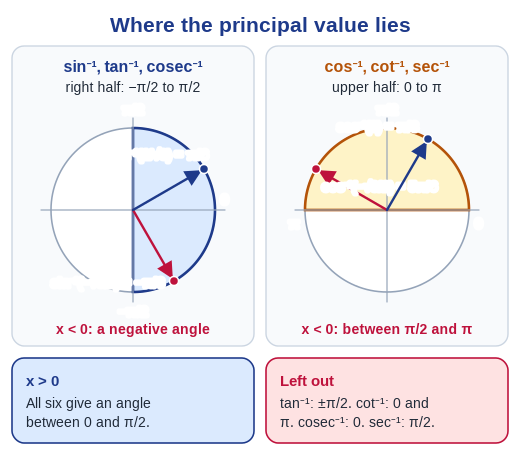
A quick check from the picture: for a positive x, all six functions give an angle between 0 and π/2. For a negative x, sin⁻¹, tan⁻¹ and cosec⁻¹ give a negative angle, while cos⁻¹, cot⁻¹ and sec⁻¹ give an angle between π/2 and π.
Is sin⁻¹ x the same as 1/sin x?
No. The “−1” in sin⁻¹ x is not a power. sin⁻¹ x is an angle, the one in [−π/2, π/2] whose sine is x. (sin x)⁻¹ means 1/sin x, which is cosec x. At x = 1/2 the two differ completely: sin⁻¹(1/2) = π/6, about 0.52, while 1/sin(1/2) is about 2.09. To avoid the mix-up, some books write arc sin x for sin⁻¹ x.
Read next: properties of inverse trigonometric functions, the chapter notes and the NCERT solutions.
Practice
-
The principal value of cot⁻¹(−1) is:
Show answer
Answer: (a) 3π/4
-
Which value can be a value of tan⁻¹ x?
Show answer
Answer: (a) −π/3
-
cosec⁻¹(−2/√3) equals:
Show answer
Answer: (a) −π/3
-
Find the principal value of sec⁻¹(−2/√3).
Show answer
Answer: Let y = sec⁻¹(−2/√3). Then cos y = −√3/2. Since cos(π/6) = √3/2, cos(π − π/6) = −√3/2, and 5π/6 lies in [0, π] − {π/2}. So the principal value is 5π/6.
-
cos(4π/3) = −1/2. Why is cos⁻¹(−1/2) not 4π/3?
Show answer
Answer: Because the principal value of cos⁻¹ must lie in [0, π], and 4π/3 does not. The angle in [0, π] with cosine −1/2 is 2π/3.
Questions students ask
What is the principal value of an inverse trigonometric function?
It is the value that lies in the function's principal value branch, for example in [−π/2, π/2] for sin⁻¹ and in [0, π] for cos⁻¹. Whenever a question names no branch, the principal value is the answer.
Why is the range of tan⁻¹ open but the range of sin⁻¹ closed?
sin(π/2) = 1 and sin(−π/2) = −1, so sin⁻¹ reaches both ends of its range. tan x is not defined at ±π/2, so tan⁻¹ never takes these values; its graph only gets closer to the lines y = ±π/2.
Why is cos⁻¹ of a negative number more than π/2?
The range of cos⁻¹ is [0, π], and in that interval cosine is negative only between π/2 and π. So cos⁻¹ of a negative number lies there, as cos⁻¹(−√3/2) = 5π/6 does.
Why are 0 and π/2 left out of the ranges of cosec⁻¹ and sec⁻¹?
cosec 0 = 1/sin 0 and sec(π/2) = 1/cos(π/2) are not defined, so these angles can never be outputs. That is why the branches are [−π/2, π/2] − {0} and [0, π] − {π/2}.
Stuck on a question?
Take a photo and Lagnever AI explains it step by step. Try it for 7 days for ₹2.
Get it on Google Play Open in browser
For parents: after the trial, the plan renews monthly by UPI or card autopay. You can cancel anytime in the app.