
NCERT Solutions Class 12 Maths Chapter 3: Matrices
Answers to every question of Exercises 3.1 to 3.4 and the Miscellaneous Exercise, and to all 25 worked examples, of Chapter 3, Matrices, of Mathematics Part I, the Class 12 NCERT textbook. Page numbers follow the 2026-27 reprint (pages 34–74). The exercise questions are quoted from the book; the examples are restated in short and labelled by number and page. Every matrix below was computed again by a script with exact fractions, and every answer agrees with the book’s answer key. Short notes: Chapter 3 notes.
How the matrices are written here. A matrix is typed row by row inside square brackets: commas separate the entries of a row, and semicolons separate the rows. So [2, 4; 3, 2] is the 2 × 2 matrix with first row 2, 4 and second row 3, 2, and [1; 2; 3] is a column. The quoted questions use the same layout for the book’s matrices.
Two rules carry most of the answers: equal matrices have equal entries in every place, and the (i, k)th entry of AB is row i of A times column k of B, added up.
Examples 1 to 5: order, construction and equality (pages 37–42)
Example 1 (page 37): men and women workers in three factories as a 3 × 2 matrix. With one row per factory and the columns men, women, the matrix is [30, 25; 25, 31; 27, 26]. Its (3, 2)th entry, 26, tells how many women work in factory III.
Example 2 (page 38): which orders a matrix with 8 elements can have. An m × n matrix has mn elements, so the orders are the ordered factor pairs of 8: 1 × 8, 8 × 1, 2 × 4 and 4 × 2.
Example 3 (page 38): the 3 × 2 matrix with aij = (1/2)|i − 3j|.
a11 = (1/2)|1 − 3| = 1, a12 = (1/2)|1 − 6| = 5/2
a21 = (1/2)|2 − 3| = 1/2, a22 = (1/2)|2 − 6| = 2
a31 = (1/2)|3 − 3| = 0, a32 = (1/2)|3 − 6| = 3/2
So the matrix is [1, 5/2; 1/2, 2; 0, 3/2].
Example 4 (page 41): two equal 3 × 3 matrices with unknowns a, b, c, x, y, z. Equating matching entries gives x + 3 = 0, z + 4 = 6, 2y − 7 = 3y − 2, a − 1 = −3, 0 = 2c + 2 and b − 3 = 2b + 4. So x = −3, z = 2, y = −5, a = −2, c = −1 and b = −7.
Example 5 (pages 41–42): [2a + b, a − 2b; 5c − d, 4c + 3d] = [4, −3; 11, 24]. Equating entries:
2a + b = 4 and a − 2b = −3. Doubling the first and adding: 5a = 5, so a = 1 and b = 2.
5c − d = 11 and 4c + 3d = 24. Tripling the first and adding: 19c = 57, so c = 3 and d = 4.
Exercise 3.1 (pages 42–43)
1. “In the matrix A = [2, 5, 19, −7; 35, −2, 5/2, 12; √3, 1, −5, 17], write: (i) The order of the matrix, (ii) The number of elements, (iii) Write the elements a13, a21, a33, a24, a23.”
(i) A has 3 rows and 4 columns, so its order is 3 × 4.
(ii) It has 3 × 4 = 12 elements.
(iii) a13 is in row 1, column 3: 19. a21 = 35, a33 = −5, a24 = 12 and a23 = 5/2.
2. “If a matrix has 24 elements, what are the possible orders it can have? What, if it has 13 elements?”
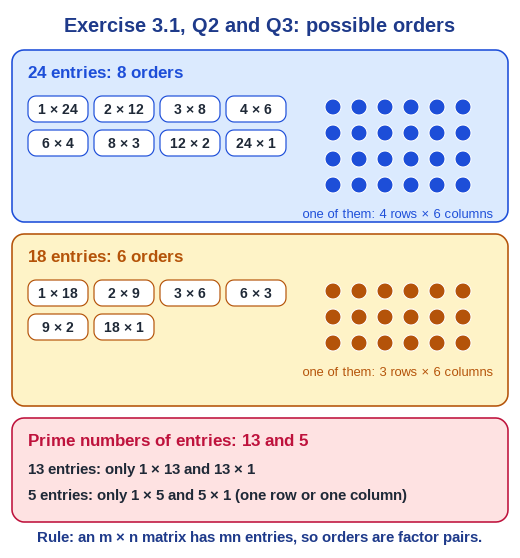
An m × n matrix has mn elements, so m × n must be an ordered factor pair. For 24: 1 × 24, 2 × 12, 3 × 8, 4 × 6, 6 × 4, 8 × 3, 12 × 2 and 24 × 1. 13 is prime, so the only orders are 1 × 13 and 13 × 1.
3. “If a matrix has 18 elements, what are the possible orders it can have? What, if it has 5 elements?”
For 18: 1 × 18, 2 × 9, 3 × 6, 6 × 3, 9 × 2 and 18 × 1. 5 is prime, so only 1 × 5 and 5 × 1.
4. “Construct a 2 × 2 matrix, A = [aij], whose elements are given by: (i) aij = (i + j)²/2 (ii) aij = i/j (iii) aij = (i + 2j)²/2”
(i) a11 = 2²/2 = 2, a12 = 3²/2 = 9/2, a21 = 9/2, a22 = 4²/2 = 8. A = [2, 9/2; 9/2, 8].
(ii) a11 = 1, a12 = 1/2, a21 = 2, a22 = 1. A = [1, 1/2; 2, 1].
(iii) a11 = 3²/2 = 9/2, a12 = 5²/2 = 25/2, a21 = 4²/2 = 8, a22 = 6²/2 = 18. A = [9/2, 25/2; 8, 18].
5. “Construct a 3 × 4 matrix, whose elements are given by: (i) aij = (1/2)|−3i + j| (ii) aij = 2i − j”
(i) Row 1 (i = 1): (1/2)|−2|, (1/2)|−1|, (1/2)|0|, (1/2)|1| = 1, 1/2, 0, 1/2. Row 2: (1/2)|−5|, (1/2)|−4|, (1/2)|−3|, (1/2)|−2| = 5/2, 2, 3/2, 1. Row 3: (1/2)|−8|, (1/2)|−7|, (1/2)|−6|, (1/2)|−5| = 4, 7/2, 3, 5/2.
A = [1, 1/2, 0, 1/2; 5/2, 2, 3/2, 1; 4, 7/2, 3, 5/2]
(ii) Row 1: 2 − 1, 2 − 2, 2 − 3, 2 − 4 = 1, 0, −1, −2. Row 2: 3, 2, 1, 0. Row 3: 5, 4, 3, 2.
A = [1, 0, −1, −2; 3, 2, 1, 0; 5, 4, 3, 2]
6. “Find the values of x, y and z from the following equations: (i) [4, 3; x, 5] = [y, z; 1, 5] (ii) [x + y, 2; 5 + z, xy] = [6, 2; 5, 8] (iii) [x + y + z; x + z; y + z] = [9; 5; 7]”
(i) Equating entries: 4 = y, 3 = z, x = 1. x = 1, y = 4, z = 3.
(ii) x + y = 6, 5 + z = 5 and xy = 8. So z = 0, and x and y are two numbers with sum 6 and product 8, the roots of t² − 6t + 8 = 0, which are 2 and 4. x = 4, y = 2, z = 0, or x = 2, y = 4, z = 0.
(iii) x + y + z = 9, x + z = 5 and y + z = 7. Subtracting the second from the first gives y = 4; then z = 3 and x = 2. x = 2, y = 4, z = 3.
7. “Find the value of a, b, c and d from the equation: [a − b, 2a + c; 2a − b, 3c + d] = [−1, 5; 0, 13]”
a − b = −1 and 2a − b = 0. Subtracting, a = 1, so b = 2. Then 2a + c = 5 gives c = 3, and 3c + d = 13 gives d = 4. a = 1, b = 2, c = 3, d = 4.
8. “A = [aij]m × n is a square matrix, if (A) m < n (B) m > n (C) m = n (D) None of these”
A square matrix has as many rows as columns. Answer: (C).
9. “Which of the given values of x and y make the following pair of matrices equal [3x + 7, 5; y + 1, 2 − 3x], [0, y − 2; 8, 4] (A) x = −1/3, y = 7 (B) Not possible to find (C) y = 7, x = −2/3 (D) x = −1/3, y = −2/3”
Equating entries: 3x + 7 = 0 gives x = −7/3, but 2 − 3x = 4 gives x = −2/3. One unknown cannot take two values, so the matrices can never be equal (y = 7 from both 5 = y − 2 and y + 1 = 8 does not help). Answer: (B).
10. “The number of all possible matrices of order 3 × 3 with each entry 0 or 1 is: (A) 27 (B) 18 (C) 81 (D) 512”
A 3 × 3 matrix has 9 entries, and each can be filled in 2 ways, independently. So there are 2⁹ = 512 matrices. Answer: (D).
Examples 6 to 11: addition and multiplication by a scalar (pages 44–50)
Example 6 (page 44): A + B for A = [√3, 1, −1; 2, 3, 0] and B = [2, √5, 1; −2, 3, 1/2]. Both are 2 × 3, so add entry by entry: A + B = [2 + √3, 1 + √5, 0; 0, 6, 1/2].
Example 7 (page 46): 2A − B for A = [1, 2, 3; 2, 3, 1] and B = [3, −1, 3; −1, 0, 2]. 2A = [2, 4, 6; 4, 6, 2], so 2A − B = [2 − 3, 4 + 1, 6 − 3; 4 + 1, 6 − 0, 2 − 2] = [−1, 5, 3; 5, 6, 0].
Example 8 (pages 47–48): X with 2A + 3X = 5B, for A = [8, 0; 4, −2; 3, 6] and B = [2, −2; 4, 2; −5, 1]. Subtract 2A from both sides: 3X = 5B − 2A. Here 5B = [10, −10; 20, 10; −25, 5] and 2A = [16, 0; 8, −4; 6, 12], so 5B − 2A = [−6, −10; 12, 14; −31, −7], and
X = (1/3)(5B − 2A) = [−2, −10/3; 4, 14/3; −31/3, −7/3]
Example 9 (page 48): X and Y with X + Y = [5, 2; 0, 9] and X − Y = [3, 6; 0, −1]. Adding the two equations, 2X = [8, 8; 0, 8], so X = [4, 4; 0, 4]. Subtracting them, 2Y = [2, −4; 0, 10], so Y = [1, −2; 0, 5].
Example 10 (pages 48–49): 2[x, 5; 7, y − 3] + [3, −4; 1, 2] = [7, 6; 15, 14]. The left side is [2x + 3, 6; 15, 2y − 4]. Equating entries (equal matrices have equal entries), 2x + 3 = 7 and 2y − 4 = 14, so x = 2 and y = 9.
Example 11 (pages 49–50): rice sales of two farmers. A (September) = [10000, 20000, 30000; 50000, 30000, 10000] and B (October) = [5000, 10000, 6000; 20000, 10000, 10000], in rupees, with rows Ramkishan, Gurcharan Singh and columns Basmati, Permal, Naura.
- (i) Combined sales: A + B = [15000, 30000, 36000; 70000, 40000, 20000].
- (ii) Decrease from September to October: A − B = [5000, 10000, 24000; 30000, 20000, 0].
- (iii) Profit at 2% of October sales: 0.02B = [100, 200, 120; 400, 200, 200]. So Ramkishan earns ₹100, ₹200 and ₹120, and Gurcharan Singh ₹400, ₹200 and ₹200, on Basmati, Permal and Naura.
Examples 12 to 19: multiplication of matrices (pages 52–58)
Example 12 (page 52): AB for A = [6, 9; 2, 3] and B = [2, 6, 0; 7, 9, 8]. A has 2 columns and B has 2 rows, so AB is defined and is 2 × 3:
AB = [6 × 2 + 9 × 7, 6 × 6 + 9 × 9, 6 × 0 + 9 × 8; 2 × 2 + 3 × 7, 2 × 6 + 3 × 9, 2 × 0 + 3 × 8] = [75, 117, 72; 25, 39, 24]
BA does not exist: B has 3 columns, while A has only 2 rows.
Example 13 (page 53): AB and BA for A = [1, −2, 3; −4, 2, 5] and B = [2, 3; 4, 5; 2, 1]. A is 2 × 3 and B is 3 × 2, so AB is 2 × 2 and BA is 3 × 3:
AB = [2 − 8 + 6, 3 − 10 + 3; −8 + 8 + 10, −12 + 10 + 5] = [0, −4; 10, 3]
BA = [2 − 12, −4 + 6, 6 + 15; 4 − 20, −8 + 10, 12 + 25; 2 − 4, −4 + 2, 6 + 5] = [−10, 2, 21; −16, 2, 37; −2, −2, 11]
Their orders differ, so AB ≠ BA.
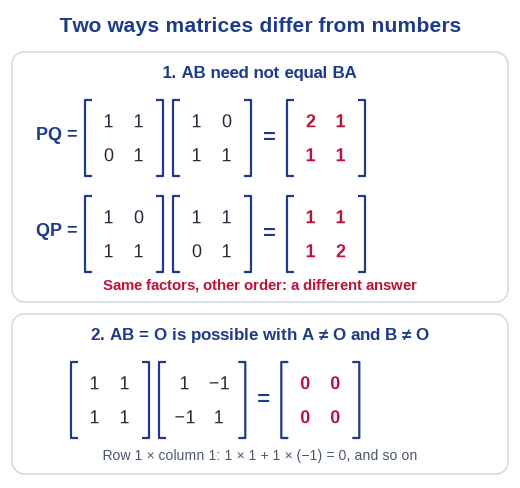
Example 14 (page 53): A = [1, 0; 0, −1] and B = [0, 1; 1, 0]. AB = [0, 1; −1, 0] but BA = [0, −1; 1, 0]: both are 2 × 2, yet AB ≠ BA. Matrix multiplication is not commutative.
Example 15 (page 54): AB for A = [0, −1; 0, 2] and B = [3, 5; 0, 0]. AB = [0 × 3 + (−1) × 0, 0 × 5 + (−1) × 0; 0 × 3 + 2 × 0, 0 × 5 + 2 × 0] = [0, 0; 0, 0], although neither A nor B is a zero matrix.
Example 16 (pages 54–55): (AB)C = A(BC) for A = [1, 1, −1; 2, 0, 3; 3, −1, 2], B = [1, 3; 0, 2; −1, 4] and C = [1, 2, 3, −4; 2, 0, −2, 1].
AB = [1 + 0 + 1, 3 + 2 − 4; 2 + 0 − 3, 6 + 0 + 12; 3 + 0 − 2, 9 − 2 + 8] = [2, 1; −1, 18; 1, 15]
(AB)C = [2 + 2, 4 + 0, 6 − 2, −8 + 1; −1 + 36, −2 + 0, −3 − 36, 4 + 18; 1 + 30, 2 + 0, 3 − 30, −4 + 15] = [4, 4, 4, −7; 35, −2, −39, 22; 31, 2, −27, 11]
BC = [1 + 6, 2 + 0, 3 − 6, −4 + 3; 0 + 4, 0, 0 − 4, 0 + 2; −1 + 8, −2 + 0, −3 − 8, 4 + 4] = [7, 2, −3, −1; 4, 0, −4, 2; 7, −2, −11, 8]
A(BC) = [7 + 4 − 7, 2 + 0 + 2, −3 − 4 + 11, −1 + 2 − 8; 14 + 0 + 21, 4 + 0 − 6, −6 + 0 − 33, −2 + 0 + 24; 21 − 4 + 14, 6 + 0 − 4, −9 + 4 − 22, −3 − 2 + 16] = [4, 4, 4, −7; 35, −2, −39, 22; 31, 2, −27, 11]
The two results are equal, so (AB)C = A(BC).
Example 17 (page 56): (A + B)C = AC + BC for A = [0, 6, 7; −6, 0, 8; 7, −8, 0], B = [0, 1, 1; 1, 0, 2; 1, 2, 0] and C = [2; −2; 3].
A + B = [0, 7, 8; −5, 0, 10; 8, −6, 0], so (A + B)C = [0 − 14 + 24; −10 + 0 + 30; 16 + 12 + 0] = [10; 20; 28]
AC = [0 − 12 + 21; −12 + 0 + 24; 14 + 16 + 0] = [9; 12; 30] and BC = [0 − 2 + 3; 2 + 0 + 6; 2 − 4 + 0] = [1; 8; −2]
AC + BC = [10; 20; 28] = (A + B)C.
Example 18 (pages 56–57): A³ − 23A − 40I = O for A = [1, 2, 3; 3, −2, 1; 4, 2, 1].
A² = [1 + 6 + 12, 2 − 4 + 6, 3 + 2 + 3; 3 − 6 + 4, 6 + 4 + 2, 9 − 2 + 1; 4 + 6 + 4, 8 − 4 + 2, 12 + 2 + 1] = [19, 4, 8; 1, 12, 8; 14, 6, 15]
A³ = A·A² = [19 + 2 + 42, 4 + 24 + 18, 8 + 16 + 45; 57 − 2 + 14, 12 − 24 + 6, 24 − 16 + 15; 76 + 2 + 14, 16 + 24 + 6, 32 + 16 + 15] = [63, 46, 69; 69, −6, 23; 92, 46, 63]
23A = [23, 46, 69; 69, −46, 23; 92, 46, 23], and 40I has 40 on the diagonal. Then A³ − 23A − 40I = [63 − 23 − 40, 0, 0; 0, −6 + 46 − 40, 0; 0, 0, 63 − 23 − 40] = O.
Example 19 (pages 57–58): an election campaign’s spending. The cost per contact in paise is A = [40; 100; 50] (telephone, house call, letter), and the contacts in cities X and Y are B = [1000, 500, 5000; 3000, 1000, 10000]. Then
BA = [40000 + 50000 + 250000; 120000 + 100000 + 500000] = [340000; 720000]
So the group spent 340000 paise = ₹3400 in X and 720000 paise = ₹7200 in Y.
Exercise 3.2 (pages 58–61)
1. “Let A = [2, 4; 3, 2], B = [1, 3; −2, 5], C = [−2, 5; 3, 4]. Find each of the following: (i) A + B (ii) A − B (iii) 3A − C (iv) AB (v) BA”
(i) A + B = [2 + 1, 4 + 3; 3 − 2, 2 + 5] = [3, 7; 1, 7]
(ii) A − B = [2 − 1, 4 − 3; 3 + 2, 2 − 5] = [1, 1; 5, −3]
(iii) 3A − C = [6 + 2, 12 − 5; 9 − 3, 6 − 4] = [8, 7; 6, 2]
(iv) AB = [2 × 1 + 4 × (−2), 2 × 3 + 4 × 5; 3 × 1 + 2 × (−2), 3 × 3 + 2 × 5] = [2 − 8, 6 + 20; 3 − 4, 9 + 10] = [−6, 26; −1, 19]
(v) BA = [1 × 2 + 3 × 3, 1 × 4 + 3 × 2; −2 × 2 + 5 × 3, −2 × 4 + 5 × 2] = [2 + 9, 4 + 6; −4 + 15, −8 + 10] = [11, 10; 11, 2]
Parts (iv) and (v) show again that AB ≠ BA.
2. “Compute the following: (i) [a, b; −b, a] + [a, b; b, a] (ii) [a² + b², b² + c²; a² + c², a² + b²] + [2ab, 2bc; −2ac, −2ab] (iii) [−1, 4, −6; 8, 5, 16; 2, 8, 5] + [12, 7, 6; 8, 0, 5; 3, 2, 4] (iv) [cos² x, sin² x; sin² x, cos² x] + [sin² x, cos² x; cos² x, sin² x]”
(i) [a + a, b + b; −b + b, a + a] = [2a, 2b; 0, 2a]
(ii) [a² + b² + 2ab, b² + c² + 2bc; a² + c² − 2ac, a² + b² − 2ab] = [(a + b)², (b + c)²; (a − c)², (a − b)²]
(iii) [−1 + 12, 4 + 7, −6 + 6; 8 + 8, 5 + 0, 16 + 5; 2 + 3, 8 + 2, 5 + 4] = [11, 11, 0; 16, 5, 21; 5, 10, 9]
(iv) Each entry is cos² x + sin² x = 1, so the sum is [1, 1; 1, 1].
3. “Compute the indicated products. (i) [a, b; −b, a][a, −b; b, a] (ii) [1; 2; 3][2, 3, 4] (iii) [1, −2; 2, 3][1, 2, 3; 2, 3, 1] (iv) [2, 3, 4; 3, 4, 5; 4, 5, 6][1, −3, 5; 0, 2, 4; 3, 0, 5] (v) [2, 1; 3, 2; −1, 1][1, 0, 1; −1, 2, 1] (vi) [3, −1, 3; −1, 0, 2][2, −3; 1, 0; 3, 1]”
(i) [a·a + b·b, a(−b) + b·a; −b·a + a·b, (−b)(−b) + a·a] = [a² + b², 0; 0, a² + b²]
(ii) A 3 × 1 matrix times a 1 × 3 matrix is 3 × 3; each entry is one number times another: [2, 3, 4; 4, 6, 8; 6, 9, 12]
(iii) (2 × 2)(2 × 3) gives 2 × 3: [1 − 4, 2 − 6, 3 − 2; 2 + 6, 4 + 9, 6 + 3] = [−3, −4, 1; 8, 13, 9]
(iv) Row 1: 2 + 0 + 12, −6 + 6 + 0, 10 + 12 + 20 = 14, 0, 42. Row 2: 3 + 0 + 15, −9 + 8 + 0, 15 + 16 + 25 = 18, −1, 56. Row 3: 4 + 0 + 18, −12 + 10 + 0, 20 + 20 + 30 = 22, −2, 70. [14, 0, 42; 18, −1, 56; 22, −2, 70]
(v) (3 × 2)(2 × 3) gives 3 × 3. Row 1: 2 − 1, 0 + 2, 2 + 1. Row 2: 3 − 2, 0 + 4, 3 + 2. Row 3: −1 − 1, 0 + 2, −1 + 1. [1, 2, 3; 1, 4, 5; −2, 2, 0]
(vi) (2 × 3)(3 × 2) gives 2 × 2: [6 − 1 + 9, −9 + 0 + 3; −2 + 0 + 6, 3 + 0 + 2] = [14, −6; 4, 5]
4. “If A = [1, 2, −3; 5, 0, 2; 1, −1, 1], B = [3, −1, 2; 4, 2, 5; 2, 0, 3] and C = [4, 1, 2; 0, 3, 2; 1, −2, 3], then compute (A+B) and (B − C). Also, verify that A + (B − C) = (A + B) − C.”
A + B = [4, 1, −1; 9, 2, 7; 3, −1, 4] and B − C = [−1, −2, 0; 4, −1, 3; 1, 2, 0].
A + (B − C) = [1 − 1, 2 − 2, −3 + 0; 5 + 4, 0 − 1, 2 + 3; 1 + 1, −1 + 2, 1 + 0] = [0, 0, −3; 9, −1, 5; 2, 1, 1]
(A + B) − C = [4 − 4, 1 − 1, −1 − 2; 9 − 0, 2 − 3, 7 − 2; 3 − 1, −1 + 2, 4 − 3] = [0, 0, −3; 9, −1, 5; 2, 1, 1]
The two are equal, as the associative law says.
5. “If A = [2/3, 1, 5/3; 1/3, 2/3, 4/3; 7/3, 2, 2/3] and B = [2/5, 3/5, 1; 1/5, 2/5, 4/5; 7/5, 6/5, 2/5], then compute 3A − 5B.”
3A = [2, 3, 5; 1, 2, 4; 7, 6, 2] and 5B = [2, 3, 5; 1, 2, 4; 7, 6, 2]. They are equal, so 3A − 5B = [0, 0, 0; 0, 0, 0; 0, 0, 0] = O.
6. “Simplify cos θ [cos θ, sin θ; −sin θ, cos θ] + sin θ [sin θ, −cos θ; cos θ, sin θ]”
= [cos² θ, cos θ sin θ; −sin θ cos θ, cos² θ] + [sin² θ, −sin θ cos θ; sin θ cos θ, sin² θ]
= [cos² θ + sin² θ, 0; 0, cos² θ + sin² θ] = [1, 0; 0, 1] = I
7. “Find X and Y, if (i) X + Y = [7, 0; 2, 5] and X − Y = [3, 0; 0, 3] (ii) 2X + 3Y = [2, 3; 4, 0] and 3X + 2Y = [2, −2; −1, 5]”
(i) Adding: 2X = [10, 0; 2, 8], so X = [5, 0; 1, 4]. Subtracting: 2Y = [4, 0; 2, 2], so Y = [2, 0; 1, 1].
(ii) Adding the equations: 5X + 5Y = [4, 1; 3, 5], so X + Y = (1/5)[4, 1; 3, 5]. Subtracting the first from the second: X − Y = [0, −5; −5, 5]. Then
2X = (1/5)[4, 1; 3, 5] + [0, −5; −5, 5] = (1/5)[4, −24; −22, 30], so X = [2/5, −12/5; −11/5, 3]
2Y = (1/5)[4, 1; 3, 5] − [0, −5; −5, 5] = (1/5)[4, 26; 28, −20], so Y = [2/5, 13/5; 14/5, −2]
Check: 2X + 3Y = [4/5 + 6/5, −24/5 + 39/5; −22/5 + 42/5, 6 − 6] = [2, 3; 4, 0].
8. “Find X, if Y = [3, 2; 1, 4] and 2X + Y = [1, 0; −3, 2]”
2X = [1, 0; −3, 2] − [3, 2; 1, 4] = [−2, −2; −4, −2], so X = [−1, −1; −2, −1].
9. “Find x and y, if 2[1, 3; 0, x] + [y, 0; 1, 2] = [5, 6; 1, 8]”
The left side is [2 + y, 6; 1, 2x + 2]. So 2 + y = 5 and 2x + 2 = 8: x = 3, y = 3.
10. “Solve the equation for x, y, z and t, if 2[x, z; y, t] + 3[1, −1; 0, 2] = 3[3, 5; 4, 6]”
The left side is [2x + 3, 2z − 3; 2y, 2t + 6] and the right side is [9, 15; 12, 18]. So 2x + 3 = 9, 2z − 3 = 15, 2y = 12 and 2t + 6 = 18: x = 3, y = 6, z = 9, t = 6.
11. “If x[2; 3] + y[−1; 1] = [10; 5], find the values of x and y.”
[2x − y; 3x + y] = [10; 5], so 2x − y = 10 and 3x + y = 5. Adding, 5x = 15: x = 3, y = −4.
12. “Given 3[x, y; z, w] = [x, 6; −1, 2w] + [4, x + y; z + w, 3], find the values of x, y, z and w.”
[3x, 3y; 3z, 3w] = [x + 4, 6 + x + y; −1 + z + w, 2w + 3]. Entry by entry:
- 3x = x + 4, so x = 2;
- 3w = 2w + 3, so w = 3;
- 3y = 6 + x + y = 8 + y, so y = 4;
- 3z = −1 + z + w = z + 2, so z = 1.
x = 2, y = 4, z = 1, w = 3.
13. “If F(x) = [cos x, −sin x, 0; sin x, cos x, 0; 0, 0, 1], show that F(x) F(y) = F(x + y).”
F(x)F(y) = [cos x cos y − sin x sin y, −cos x sin y − sin x cos y, 0; sin x cos y + cos x sin y, −sin x sin y + cos x cos y, 0; 0, 0, 1]
By the addition formulas, cos x cos y − sin x sin y = cos(x + y) and sin x cos y + cos x sin y = sin(x + y). So
F(x)F(y) = [cos(x + y), −sin(x + y), 0; sin(x + y), cos(x + y), 0; 0, 0, 1] = F(x + y)
14. “Show that (i) [5, −1; 6, 7][2, 1; 3, 4] ≠ [2, 1; 3, 4][5, −1; 6, 7] (ii) [1, 2, 3; 0, 1, 0; 1, 1, 0][−1, 1, 0; 0, −1, 1; 2, 3, 4] ≠ [−1, 1, 0; 0, −1, 1; 2, 3, 4][1, 2, 3; 0, 1, 0; 1, 1, 0]”
(i) Left: [10 − 3, 5 − 4; 12 + 21, 6 + 28] = [7, 1; 33, 34]. Right: [10 + 6, −2 + 7; 15 + 24, −3 + 28] = [16, 5; 39, 25]. Already the first entries differ, so the products are not equal.
(ii) Left: [−1 + 0 + 6, 1 − 2 + 9, 0 + 2 + 12; 0 + 0 + 0, 0 − 1 + 0, 0 + 1 + 0; −1 + 0 + 0, 1 − 1 + 0, 0 + 1 + 0] = [5, 8, 14; 0, −1, 1; −1, 0, 1].
Right: [−1 + 0 + 1, −2 + 1 + 1, −3 + 0 + 0; 0 + 0 + 1, 0 − 1 + 1, 0 + 0 + 0; 2 + 0 + 4, 4 + 3 + 4, 6 + 0 + 0] = [−1, −1, −3; 1, 0, 0; 6, 11, 6].
They differ, so the two products are not equal.
15. “Find A² − 5A + 6I, if A = [2, 0, 1; 2, 1, 3; 1, −1, 0]”
A² = [4 + 0 + 1, 0 + 0 − 1, 2 + 0 + 0; 4 + 2 + 3, 0 + 1 − 3, 2 + 3 + 0; 2 − 2 + 0, 0 − 1 + 0, 1 − 3 + 0] = [5, −1, 2; 9, −2, 5; 0, −1, −2]
5A = [10, 0, 5; 10, 5, 15; 5, −5, 0] and 6I has 6 on the diagonal. So
A² − 5A + 6I = [5 − 10 + 6, −1 − 0, 2 − 5; 9 − 10, −2 − 5 + 6, 5 − 15; 0 − 5, −1 + 5, −2 − 0 + 6] = [1, −1, −3; −1, −1, −10; −5, 4, 4]
16. “If A = [1, 0, 2; 0, 2, 1; 2, 0, 3], prove that A³ − 6A² + 7A + 2I = 0”
A² = [1 + 0 + 4, 0, 2 + 0 + 6; 0 + 0 + 2, 4, 0 + 2 + 3; 2 + 0 + 6, 0, 4 + 0 + 9] = [5, 0, 8; 2, 4, 5; 8, 0, 13]
A³ = A²·A = [5 + 0 + 16, 0, 10 + 0 + 24; 2 + 0 + 10, 8, 4 + 4 + 15; 8 + 0 + 26, 0, 16 + 0 + 39] = [21, 0, 34; 12, 8, 23; 34, 0, 55]
Now combine entry by entry, A³ − 6A² + 7A + 2I:
- row 1: 21 − 30 + 7 + 2 = 0, 0 − 0 + 0 = 0, 34 − 48 + 14 = 0;
- row 2: 12 − 12 + 0 = 0, 8 − 24 + 14 + 2 = 0, 23 − 30 + 7 = 0;
- row 3: 34 − 48 + 14 = 0, 0, 55 − 78 + 21 + 2 = 0.
Every entry is 0, so A³ − 6A² + 7A + 2I is the zero matrix.
17. “If A = [3, −2; 4, −2] and I = [1, 0; 0, 1], find k so that A² = kA − 2I”
A² = [9 − 8, −6 + 4; 12 − 8, −8 + 4] = [1, −2; 4, −4], and kA − 2I = [3k − 2, −2k; 4k, −2k − 2]. Equating the (1, 2) entries, −2 = −2k, so k = 1; the other entries agree too (3 − 2 = 1, 4 = 4, −2 − 2 = −4). k = 1.
18. “If A = [0, −tan(α/2); tan(α/2), 0] and I is the identity matrix of order 2, show that I + A = (I − A) [cos α, −sin α; sin α, cos α]”
Step 1. Write t = tan(α/2) to keep the work short. Then I + A = [1, −t; t, 1] and I − A = [1, t; −t, 1].
Step 2. The half-angle formulas give cos α = (1 − t²)/(1 + t²) and sin α = 2t/(1 + t²).
Step 3. Multiply out the right side:
(I − A)[cos α, −sin α; sin α, cos α] = [cos α + t sin α, −sin α + t cos α; −t cos α + sin α, t sin α + cos α]
Step 4. Put in the formulas from Step 2:
- cos α + t sin α = (1 − t² + 2t²)/(1 + t²) = (1 + t²)/(1 + t²) = 1
- −sin α + t cos α = (−2t + t − t³)/(1 + t²) = −t(1 + t²)/(1 + t²) = −t
- −t cos α + sin α = (−t + t³ + 2t)/(1 + t²) = t(1 + t²)/(1 + t²) = t
- t sin α + cos α = 1, the same as the first entry.
So the right side is [1, −t; t, 1] = I + A.
19. “A trust fund has ₹30,000 that must be invested in two different types of bonds. The first bond pays 5% interest per year, and the second bond pays 7% interest per year. Using matrix multiplication, determine how to divide ₹30,000 among the two types of bonds. If the trust fund must obtain an annual total interest of: (a) ₹1800 (b) ₹2000”
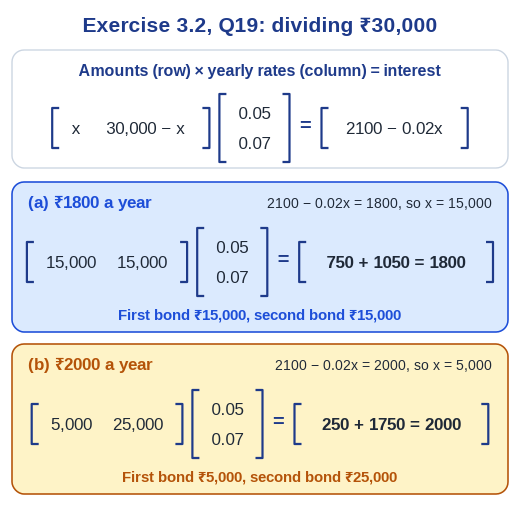
Put ₹x in the first bond and ₹(30000 − x) in the second. The yearly interest is
[x, 30000 − x][0.05; 0.07] = [0.05x + 0.07(30000 − x)] = [2100 − 0.02x]
(a) 2100 − 0.02x = 1800 gives 0.02x = 300, so x = 15000. ₹15,000 in each bond.
(b) 2100 − 0.02x = 2000 gives 0.02x = 100, so x = 5000. ₹5,000 in the first bond and ₹25,000 in the second.
20. “The bookshop of a particular school has 10 dozen chemistry books, 8 dozen physics books, 10 dozen economics books. Their selling prices are ₹80, ₹60 and ₹40 each respectively. Find the total amount the bookshop will receive from selling all the books using matrix algebra.”
The numbers of books are 120, 96 and 120. So the amount is
[120, 96, 120][80; 60; 40] = [9600 + 5760 + 4800] = [20160]
The bookshop receives ₹20,160.
The book then says: “Assume X, Y, Z, W and P are matrices of order 2 × n, 3 × k, 2 × p, n × 3 and p × k, respectively. Choose the correct answer in Exercises 21 and 22.”
21. “The restriction on n, k and p so that PY + WY will be defined are: (A) k = 3, p = n (B) k is arbitrary, p = 2 (C) p is arbitrary, k = 3 (D) k = 2, p = 3”
A product XY is defined only when the number of columns of the first matrix equals the number of rows of the second.
- PY is (p × k)(3 × k): it needs k = 3, and then PY is p × 3.
- WY is (n × 3)(3 × k): always defined, and it is n × k = n × 3.
- Two matrices can be added only if they have the same order, so p × 3 = n × 3, that is, p = n.
Answer: (A).
22. “If n = p, then the order of the matrix 7X − 5Z is: (A) p × 2 (B) 2 × n (C) n × 3 (D) p × n”
X is 2 × n and Z is 2 × p = 2 × n, so 7X − 5Z is defined and is 2 × n. Answer: (B).
Examples 20 to 22: transpose, symmetric and skew symmetric (pages 61–66)
Three words used from here on. The transpose A′ of a matrix A is the matrix you get by writing each row of A as a column. A square matrix is symmetric if A′ = A (the entries match across the main diagonal), and skew symmetric if A′ = −A (they match with opposite signs, so the diagonal entries are 0).
Example 20 (pages 61–62): transpose rules for A = [3, √3, 2; 4, 2, 0] and B = [2, −1, 2; 1, 2, 4].
- (i) A′ = [3, 4; √3, 2; 2, 0], and turning its rows back into columns gives (A′)′ = [3, √3, 2; 4, 2, 0] = A.
- (ii) A + B = [5, √3 − 1, 4; 5, 4, 4], so (A + B)′ = [5, 5; √3 − 1, 4; 4, 4]. Also A′ + B′ = [3, 4; √3, 2; 2, 0] + [2, 1; −1, 2; 2, 4] = [5, 5; √3 − 1, 4; 4, 4]. They are equal.
- (iii) kB = [2k, −k, 2k; k, 2k, 4k], so (kB)′ = [2k, k; −k, 2k; 2k, 4k] = k[2, 1; −1, 2; 2, 4] = kB′.
Example 21 (page 63): (AB)′ = B′A′ for A = [−2; 4; 5] and B = [1, 3, −6]. AB = [−2, −6, 12; 4, 12, −24; 5, 15, −30], so (AB)′ = [−2, 4, 5; −6, 12, 15; 12, −24, −30]. Also B′A′ = [1; 3; −6][−2, 4, 5] = [−2, 4, 5; −6, 12, 15; 12, −24, −30], the same.
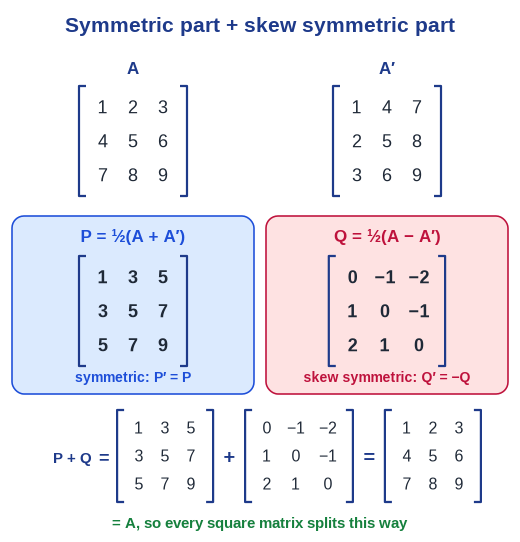
Example 22 (pages 65–66): B = [2, −2, −4; −1, 3, 4; 1, −2, −3] as a symmetric plus a skew symmetric matrix. B′ = [2, −1, 1; −2, 3, −2; −4, 4, −3].
P = (1/2)(B + B′) = (1/2)[4, −3, −3; −3, 6, 2; −3, 2, −6] = [2, −3/2, −3/2; −3/2, 3, 1; −3/2, 1, −3], and P′ = P.
Q = (1/2)(B − B′) = (1/2)[0, −1, −5; 1, 0, 6; 5, −6, 0] = [0, −1/2, −5/2; 1/2, 0, 3; 5/2, −3, 0], and Q′ = −Q.
P + Q = [2, −2, −4; −1, 3, 4; 1, −2, −3] = B.
Exercise 3.3 (pages 66–68)
1. “Find the transpose of each of the following matrices: (i) [5; 1/2; −1] (ii) [1, −1; 2, 3] (iii) [−1, 5, 6; √3, 5, 6; 2, 3, −1]”
Write each row as a column:
(i) [5, 1/2, −1], a 1 × 3 row matrix.
(ii) [1, 2; −1, 3]
(iii) [−1, √3, 2; 5, 5, 3; 6, 6, −1]
2. “If A = [−1, 2, 3; 5, 7, 9; −2, 1, 1] and B = [−4, 1, −5; 1, 2, 0; 1, 3, 1], then verify that (i) (A + B)′ = A′ + B′, (ii) (A − B)′ = A′ − B′”
A′ = [−1, 5, −2; 2, 7, 1; 3, 9, 1] and B′ = [−4, 1, 1; 1, 2, 3; −5, 0, 1].
(i) A + B = [−5, 3, −2; 6, 9, 9; −1, 4, 2], so (A + B)′ = [−5, 6, −1; 3, 9, 4; −2, 9, 2]. A′ + B′ = [−5, 6, −1; 3, 9, 4; −2, 9, 2]. Equal.
(ii) A − B = [3, 1, 8; 4, 5, 9; −3, −2, 0], so (A − B)′ = [3, 4, −3; 1, 5, −2; 8, 9, 0]. A′ − B′ = [3, 4, −3; 1, 5, −2; 8, 9, 0]. Equal.
3. “If A′ = [3, 4; −1, 2; 0, 1] and B = [−1, 2, 1; 1, 2, 3], then verify that (i) (A + B)′ = A′ + B′ (ii) (A − B)′ = A′ − B′”
A = (A′)′ = [3, −1, 0; 4, 2, 1] and B′ = [−1, 1; 2, 2; 1, 3].
(i) A + B = [2, 1, 1; 5, 4, 4], so (A + B)′ = [2, 5; 1, 4; 1, 4]. A′ + B′ = [3 − 1, 4 + 1; −1 + 2, 2 + 2; 0 + 1, 1 + 3] = [2, 5; 1, 4; 1, 4]. Equal.
(ii) A − B = [4, −3, −1; 3, 0, −2], so (A − B)′ = [4, 3; −3, 0; −1, −2]. A′ − B′ = [3 + 1, 4 − 1; −1 − 2, 2 − 2; 0 − 1, 1 − 3] = [4, 3; −3, 0; −1, −2]. Equal.
4. “If A′ = [−2, 3; 1, 2] and B = [−1, 0; 1, 2], then find (A + 2B)′”
A = (A′)′ = [−2, 1; 3, 2] and 2B = [−2, 0; 2, 4], so A + 2B = [−4, 1; 5, 6] and (A + 2B)′ = [−4, 5; 1, 6]. (Or: (A + 2B)′ = A′ + 2B′ = [−2, 3; 1, 2] + [−2, 2; 0, 4], the same.)
5. “For the matrices A and B, verify that (AB)′ = B′A′, where (i) A = [1; −4; 3], B = [−1, 2, 1] (ii) A = [0; 1; 2], B = [1, 5, 7]”
(i) AB = [−1, 2, 1; 4, −8, −4; −3, 6, 3], so (AB)′ = [−1, 4, −3; 2, −8, 6; 1, −4, 3]. B′A′ = [−1; 2; 1][1, −4, 3] = [−1, 4, −3; 2, −8, 6; 1, −4, 3]. Equal.
(ii) AB = [0, 0, 0; 1, 5, 7; 2, 10, 14], so (AB)′ = [0, 1, 2; 0, 5, 10; 0, 7, 14]. B′A′ = [1; 5; 7][0, 1, 2] = [0, 1, 2; 0, 5, 10; 0, 7, 14]. Equal.
6. “If (i) A = [cos α, sin α; −sin α, cos α], then verify that A′ A = I (ii) If A = [sin α, cos α; −cos α, sin α], then verify that A′ A = I”
(i) A′ = [cos α, −sin α; sin α, cos α], so A′A = [cos² α + sin² α, cos α sin α − sin α cos α; sin α cos α − cos α sin α, sin² α + cos² α] = [1, 0; 0, 1] = I.
(ii) A′ = [sin α, −cos α; cos α, sin α], so A′A = [sin² α + cos² α, sin α cos α − cos α sin α; cos α sin α − sin α cos α, cos² α + sin² α] = [1, 0; 0, 1] = I.
7. “(i) Show that the matrix A = [1, −1, 5; −1, 2, 1; 5, 1, 3] is a symmetric matrix. (ii) Show that the matrix A = [0, 1, −1; −1, 0, 1; 1, −1, 0] is a skew symmetric matrix.”
(i) A′ = [1, −1, 5; −1, 2, 1; 5, 1, 3] = A, so A is symmetric: a12 = a21 = −1, a13 = a31 = 5 and a23 = a32 = 1.
(ii) A′ = [0, −1, 1; 1, 0, −1; −1, 1, 0] = −A, so A is skew symmetric. Its diagonal entries are all 0, as they must be.
8. “For the matrix A = [1, 5; 6, 7], verify that (i) (A + A′) is a symmetric matrix (ii) (A − A′) is a skew symmetric matrix”
A′ = [1, 6; 5, 7].
(i) A + A′ = [2, 11; 11, 14]. Its transpose is itself, so it is symmetric.
(ii) A − A′ = [0, −1; 1, 0]. Its transpose is [0, 1; −1, 0] = −(A − A′), so it is skew symmetric.
9. “Find (1/2)(A + A′) and (1/2)(A − A′), when A = [0, a, b; −a, 0, c; −b, −c, 0]”
A′ = [0, −a, −b; a, 0, −c; b, c, 0] = −A, so A is skew symmetric. Then A + A′ = O and A − A′ = 2A:
(1/2)(A + A′) = [0, 0, 0; 0, 0, 0; 0, 0, 0] and (1/2)(A − A′) = A = [0, a, b; −a, 0, c; −b, −c, 0].
10. “Express the following matrices as the sum of a symmetric and a skew symmetric matrix: (i) [3, 5; 1, −1] (ii) [6, −2, 2; −2, 3, −1; 2, −1, 3] (iii) [3, 3, −1; −2, −2, 1; −4, −5, 2] (iv) [1, 5; −1, 2]”
In each part, P = (1/2)(A + A′) is symmetric, Q = (1/2)(A − A′) is skew symmetric, and A = P + Q.
(i) A′ = [3, 1; 5, −1]. P = (1/2)[6, 6; 6, −2] = [3, 3; 3, −1] and Q = (1/2)[0, 4; −4, 0] = [0, 2; −2, 0]. A = [3, 3; 3, −1] + [0, 2; −2, 0].
(ii) A′ = A: the matrix is already symmetric. P = A and Q = O. A = [6, −2, 2; −2, 3, −1; 2, −1, 3] + [0, 0, 0; 0, 0, 0; 0, 0, 0].
(iii) A′ = [3, −2, −4; 3, −2, −5; −1, 1, 2].
A + A′ = [6, 1, −5; 1, −4, −4; −5, −4, 4], so P = [3, 1/2, −5/2; 1/2, −2, −2; −5/2, −2, 2]
A − A′ = [0, 5, 3; −5, 0, 6; −3, −6, 0], so Q = [0, 5/2, 3/2; −5/2, 0, 3; −3/2, −3, 0]
A = [3, 1/2, −5/2; 1/2, −2, −2; −5/2, −2, 2] + [0, 5/2, 3/2; −5/2, 0, 3; −3/2, −3, 0].
(iv) A′ = [1, −1; 5, 2]. P = (1/2)[2, 4; 4, 4] = [1, 2; 2, 2] and Q = (1/2)[0, 6; −6, 0] = [0, 3; −3, 0]. A = [1, 2; 2, 2] + [0, 3; −3, 0].
The book then asks: “Choose the correct answer in the Exercises 11 and 12.”
11. “If A, B are symmetric matrices of same order, then AB − BA is a (A) Skew symmetric matrix (B) Symmetric matrix (C) Zero matrix (D) Identity matrix”
(AB − BA)′ = (AB)′ − (BA)′ = B′A′ − A′B′ = BA − AB = −(AB − BA), using A′ = A and B′ = B. Answer: (A). (It is the zero matrix only when A and B commute, that is, when AB = BA, so (C) is not true in general.)
12. “If A = [cos α, −sin α; sin α, cos α], and A + A′ = I, then the value of α is (A) π/6 (B) π/3 (C) π (D) 3π/2”
A′ = [cos α, sin α; −sin α, cos α], so A + A′ = [2 cos α, 0; 0, 2 cos α]. This equals I when 2 cos α = 1, that is cos α = 1/2, and among the options only α = π/3 gives this. Answer: (B).
Exercise 3.4 (page 69)
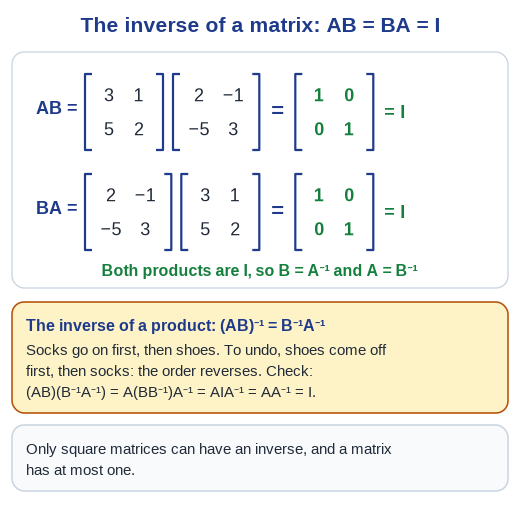
Section 3.7 defines the inverse: B is the inverse of a square matrix A when AB = BA = I. The book’s own example is A = [2, 3; 1, 2] and B = [2, −3; −1, 2], whose products in both orders are I. It then proves that an inverse is unique (Theorem 3) and that (AB)⁻¹ = B⁻¹A⁻¹ (Theorem 4).
1. “Matrices A and B will be inverse of each other only if (A) AB = BA (B) AB = BA = 0 (C) AB = 0, BA = I (D) AB = BA = I”
By the definition, both products must be the identity matrix. AB = BA alone is not enough: every square matrix A commutes with itself, but A·A is usually not I. Products equal to O are the opposite of what is needed. Answer: (D).
Miscellaneous Examples 23 to 25 (pages 70–72)
Example 23 (page 70): if A = [cos θ, sin θ; −sin θ, cos θ], then Aⁿ = [cos nθ, sin nθ; −sin nθ, cos nθ] for every natural number n. Use mathematical induction. For n = 1 it is A itself. Suppose it holds for n = k. Then
Ak + 1 = A·Ak = [cos θ cos kθ − sin θ sin kθ, cos θ sin kθ + sin θ cos kθ; −sin θ cos kθ − cos θ sin kθ, −sin θ sin kθ + cos θ cos kθ]
= [cos(k + 1)θ, sin(k + 1)θ; −sin(k + 1)θ, cos(k + 1)θ]
by the addition formulas. So it holds for n = k + 1, and hence for all n.
Example 24 (pages 70–71): for symmetric A and B of the same order, AB is symmetric if and only if AB = BA. Since A′ = A and B′ = B, (AB)′ = B′A′ = BA. If AB is symmetric, (AB)′ = AB, so BA = AB. Conversely, if AB = BA, then (AB)′ = BA = AB, so AB is symmetric.
Example 25 (pages 71–72): D with CD − AB = O, for A = [2, −1; 3, 4], B = [5, 2; 7, 4] and C = [2, 5; 3, 8]. All three are 2 × 2, so D must be 2 × 2; let D = [a, b; c, d]. AB = [10 − 7, 4 − 4; 15 + 28, 6 + 16] = [3, 0; 43, 22], and CD = [2a + 5c, 2b + 5d; 3a + 8c, 3b + 8d]. Equating CD to AB:
- First columns: 2a + 5c = 3 and 3a + 8c = 43. Take 3 × (first) − 2 × (second): 15c − 16c = 9 − 86, so −c = −77 and c = 77. Then 2a = 3 − 385 = −382, so a = −191.
- Second columns: 2b + 5d = 0 and 3b + 8d = 22. Take 3 × (first) − 2 × (second): −d = −44, so d = 44. Then 2b = −220, so b = −110.
So D = [−191, −110; 77, 44]. Check: CD = [−382 + 385, −220 + 220; −573 + 616, −330 + 352] = [3, 0; 43, 22] = AB.
Miscellaneous Exercise on Chapter 3 (pages 72–73)
1. “If A and B are symmetric matrices, prove that AB − BA is a skew symmetric matrix.”
A′ = A and B′ = B. Then (AB − BA)′ = (AB)′ − (BA)′ = B′A′ − A′B′ = BA − AB = −(AB − BA). So AB − BA is skew symmetric. (This is the reasoning of Exercise 3.3 Q11.)
2. “Show that the matrix B′AB is symmetric or skew symmetric according as A is symmetric or skew symmetric.”
Using (XYZ)′ = Z′Y′X′ and (B′)′ = B: (B′AB)′ = B′A′(B′)′ = B′A′B.
- If A is symmetric, A′ = A, so (B′AB)′ = B′AB: B′AB is symmetric.
- If A is skew symmetric, A′ = −A, so (B′AB)′ = −B′AB: B′AB is skew symmetric.
3. “Find the values of x, y, z if the matrix A = [0, 2y, z; x, y, −z; x, −y, z] satisfy the equation A′A = I.”
A′ = [0, x, x; 2y, y, −y; z, −z, z], so
A′A = [0 + x² + x², 0 + xy − xy, 0 − xz + xz; 0 + xy − xy, 4y² + y² + y², 2yz − yz − yz; 0 − xz + xz, 2yz − yz − yz, z² + z² + z²] = [2x², 0, 0; 0, 6y², 0; 0, 0, 3z²]
For this to be I: 2x² = 1, 6y² = 1 and 3z² = 1. So x = ±1/√2, y = ±1/√6, z = ±1/√3.
4. “For what values of x : [1, 2, 1][1, 2, 0; 2, 0, 1; 1, 0, 2][0; 2; x] = O?”
[1, 2, 1][1, 2, 0; 2, 0, 1; 1, 0, 2] = [1 + 4 + 1, 2 + 0 + 0, 0 + 2 + 2] = [6, 2, 4]. Then [6, 2, 4][0; 2; x] = [0 + 4 + 4x] = [4 + 4x]. This is O when 4 + 4x = 0: x = −1.
5. “If A = [3, 1; −1, 2], show that A² − 5A + 7I = 0.”
A² = [9 − 1, 3 + 2; −3 − 2, −1 + 4] = [8, 5; −5, 3]. Then A² − 5A + 7I = [8 − 15 + 7, 5 − 5 + 0; −5 + 5 + 0, 3 − 10 + 7] = [0, 0; 0, 0], the zero matrix.
6. “Find x, if [x, −5, −1][1, 0, 2; 0, 2, 1; 2, 0, 3][x; 4; 1] = O”
[x, −5, −1][1, 0, 2; 0, 2, 1; 2, 0, 3] = [x + 0 − 2, 0 − 10 + 0, 2x − 5 − 3] = [x − 2, −10, 2x − 8]. Then [x − 2, −10, 2x − 8][x; 4; 1] = [x² − 2x − 40 + 2x − 8] = [x² − 48]. So x² = 48 and x = ±4√3.
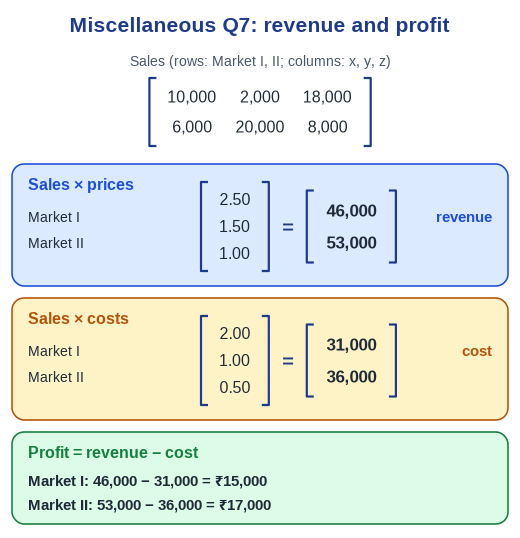
7. “A manufacturer produces three products x, y, z which he sells in two markets. Annual sales are indicated below:” (the book’s table, written out: Market I sells 10,000, 2,000 and 18,000 of the three products; Market II sells 6,000, 20,000 and 8,000) “(a) If unit sale prices of x, y and z are ₹2.50, ₹1.50 and ₹1.00, respectively, find the total revenue in each market with the help of matrix algebra. (b) If the unit costs of the above three commodities are ₹2.00, ₹1.00 and 50 paise respectively. Find the gross profit.”
(a) Revenue = [10000, 2000, 18000; 6000, 20000, 8000][2.50; 1.50; 1.00] = [25000 + 3000 + 18000; 15000 + 30000 + 8000] = [46000; 53000]. Market I: ₹46,000; Market II: ₹53,000.
(b) Cost = [10000, 2000, 18000; 6000, 20000, 8000][2.00; 1.00; 0.50] = [20000 + 2000 + 9000; 12000 + 20000 + 4000] = [31000; 36000]. Profit = revenue − cost = [46000 − 31000; 53000 − 36000] = [15000; 17000]. Gross profit: ₹15,000 in Market I and ₹17,000 in Market II (₹32,000 in all).
8. “Find the matrix X so that X [1, 2, 3; 4, 5, 6] = [−7, −8, −9; 2, 4, 6]”
The given matrix is 2 × 3 and the product is 2 × 3, so X is 2 × 2. Let X = [a, b; c, d]. Then X[1, 2, 3; 4, 5, 6] = [a + 4b, 2a + 5b, 3a + 6b; c + 4d, 2c + 5d, 3c + 6d].
- Row 1: a + 4b = −7 and 2a + 5b = −8 give b = −2 and a = 1; check 3a + 6b = 3 − 12 = −9.
- Row 2: c + 4d = 2 and 2c + 5d = 4 give d = 0 and c = 2; check 3c + 6d = 6.
X = [1, −2; 2, 0]
The book then says: “Choose the correct answer in the following questions:”
9. “If A = [α, β; γ, −α] is such that A² = I, then (A) 1 + α² + βγ = 0 (B) 1 − α² + βγ = 0 (C) 1 − α² − βγ = 0 (D) 1 + α² − βγ = 0”
A² = [α² + βγ, αβ − αβ; γα − αγ, γβ + α²] = [α² + βγ, 0; 0, α² + βγ]. This is I when α² + βγ = 1, that is 1 − α² − βγ = 0. Answer: (C).
10. “If the matrix A is both symmetric and skew symmetric, then (A) A is a diagonal matrix (B) A is a zero matrix (C) A is a square matrix (D) None of these”
A′ = A and A′ = −A give A = −A, so 2A = O and A = O. (A is also square and diagonal, but (B) is the full answer.) Answer: (B).
11. “If A is square matrix such that A² = A, then (I + A)³ − 7 A is equal to (A) A (B) I − A (C) I (D) 3A”
I and A commute (IA = AI = A), so (I + A)³ expands as with numbers: I + 3A + 3A² + A³. With A² = A, also A³ = A²·A = A·A = A. So (I + A)³ = I + 3A + 3A + A = I + 7A, and (I + A)³ − 7A = I. Answer: (C).
A note on this edition
This is the rationalised book (Revised Edition October 2022, marked Reprint 2026-27). Chapter 3 ends with invertible matrices; elementary row and column operations, and finding an inverse with them, are not in this edition, so Exercise 3.4 has a single question. Chapter 4, Determinants, finds inverses with the adjoint. One printing slip: in Example 22 (page 66) the top right entry of Q′ is printed as 5/3; it should be 5/2, as Q on page 65 shows.
Practice
-
If A = [1, 0; 2, 1], then A² equals:
Show answer
Answer: (b) [1, 0; 4, 1]
-
A is a 3 × 4 matrix, and both A′B and BA′ are defined. The order of B is:
Show answer
Answer: (c) 3 × 4
-
The matrix [0, 5; −5, 0] is:
Show answer
Answer: (b) skew symmetric
-
If A = [2, −1; 1, 0], show that A² − 2A + I = O.
Show answer
Answer: A² = [4 − 1, −2 + 0; 2 + 0, −1 + 0] = [3, −2; 2, −1]. Then A² − 2A + I = [3 − 4 + 1, −2 + 2 + 0; 2 − 2 + 0, −1 − 0 + 1] = [0, 0; 0, 0] = O.
-
Find x and y if [x, 2; 3, y][1; 1] = [5; 7].
Show answer
Answer: The product is [x + 2; 3 + y]. Equating entries, x + 2 = 5 and 3 + y = 7, so x = 3 and y = 4.
Stuck on a question?
Take a photo and Lagnever AI explains it step by step. Try it for 7 days for ₹2.
Get it on Google Play Open in browser
For parents: after the trial, the plan renews monthly by UPI or card autopay. You can cancel anytime in the app.