
Class 12 Maths Chapter 3: Matrices Notes
This chapter in five lines
A matrix is a rectangular array of numbers in rows and columns; an m × n matrix has m rows and n columns. Matrices of the same order are added entry by entry. AB is defined only when A has as many columns as B has rows, and AB need not equal BA. The transpose A′ turns rows into columns: A is symmetric if A′ = A and skew symmetric if A′ = −A. B is the inverse of A if AB = BA = I.
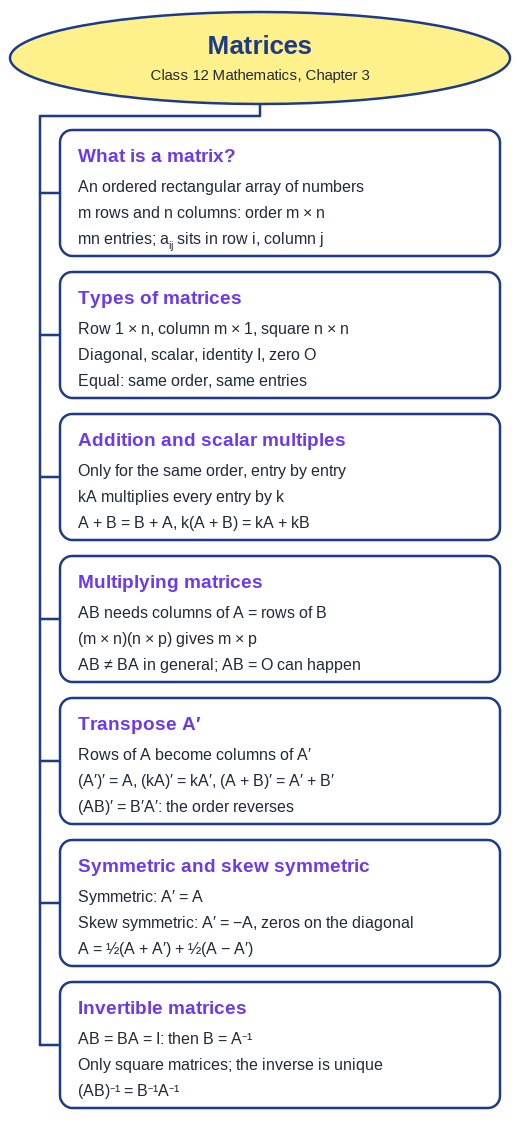
How the matrices are written here. A matrix is typed row by row inside square brackets: commas separate the entries of a row, and semicolons separate the rows. So [2, 5; 7, 1] is the 2 × 2 matrix with first row 2, 5 and second row 7, 1, and [4; 9] is a column with two entries. The diagrams show the same matrices in the usual layout.
What is this chapter about?
A matrix keeps many numbers in neat rows and columns, so that a whole table can be handled as one object. A shop’s stock list, the marks of a class in five subjects, or the coefficients of a set of equations can all be written as matrices. This chapter names the types of matrices and shows how to add them, multiply them by numbers and multiply them together. It then brings in the transpose, symmetric and skew symmetric matrices, and the inverse of a matrix. Chapter 4, Determinants, builds directly on it.
What is the order of a matrix?
A matrix with m rows and n columns has order m × n, read “m by n”, and holds mn entries. The entry in row i and column j is the (i, j)th element, written aij, so a whole matrix can be written A = [aij]m × n. For example, the runs and wickets of three players in a school match, one row per player, form the 3 × 2 matrix [45, 1; 32, 3; 18, 2]. Here a32 = 2 is the third player’s wickets.
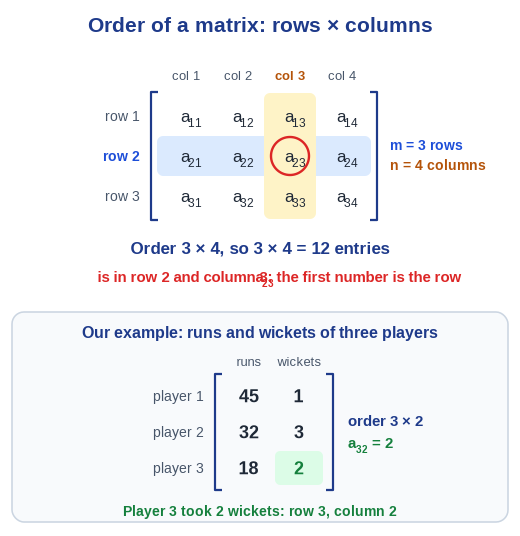
Since an m × n matrix has mn entries, the possible orders for a given number of entries are its factor pairs. A matrix with 6 entries can be 1 × 6, 2 × 3, 3 × 2 or 6 × 1.
Which types of matrices does the chapter name?
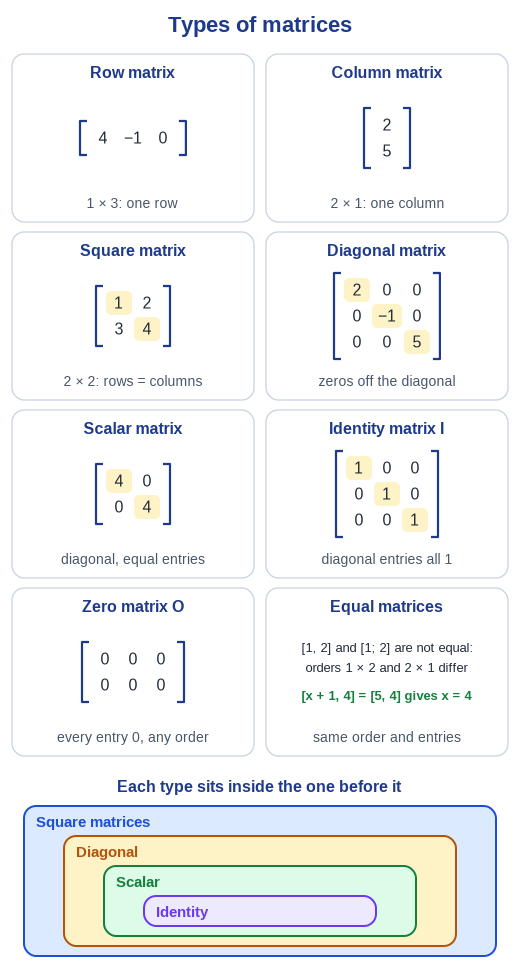
- Row matrix: one row, order 1 × n, such as [4, −1, 0].
- Column matrix: one column, order m × 1, such as [2; 5].
- Square matrix: as many rows as columns. Its entries a11, a22, … form the diagonal.
- Diagonal matrix: a square matrix whose entries off the diagonal are all 0.
- Scalar matrix: a diagonal matrix with all diagonal entries equal, such as [4, 0; 0, 4].
- Identity matrix I: a diagonal matrix with every diagonal entry 1, such as I2 = [1, 0; 0, 1].
- Zero matrix O: every entry is 0; it can have any order.
Two matrices are equal when they have the same order and every entry of one equals the matching entry of the other. Equating entries is how unknowns are found: [x + 1, 4; 3, y] = [5, 4; 3, −2] gives x = 4 and y = −2. More examples: types of matrices.
How are matrices added and multiplied?
Matrices of the same order are added or subtracted entry by entry, and a number k multiplies every entry: kA = [k aij]. Addition is commutative and associative, O is its identity and −A = (−1)A undoes A. Also k(A + B) = kA + kB and (k + l)A = kA + lA.
The product AB is defined only when the number of columns of A equals the number of rows of B. If A is m × n and B is n × p, then AB is m × p, and its (i, k)th entry is row i of A times column k of B: multiply the matching entries and add. Two students buy notebooks at ₹40 and pens at ₹10, the first 3 notebooks and 2 pens, the second 1 notebook and 4 pens. Then [3, 2; 1, 4][40; 10] = [3 × 40 + 2 × 10; 1 × 40 + 4 × 10] = [140; 80] gives their bills, ₹140 and ₹80.
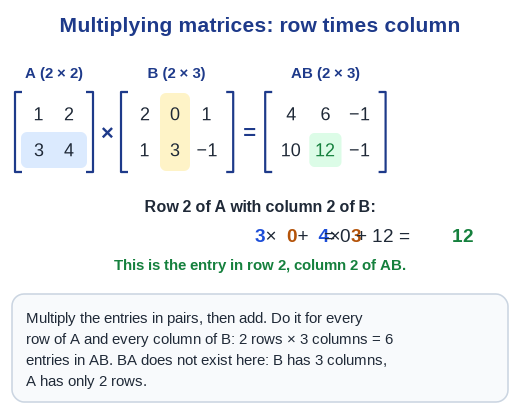
Multiplication is associative, A(BC) = (AB)C, and distributive, A(B + C) = AB + AC, and IA = AI = A. But it is not commutative: AB and BA may both exist and still differ, and AB can be O when neither A nor B is O. See operations on matrices.
What are transpose, symmetric and skew symmetric matrices?
The transpose A′ (also written AT) turns the rows of A into columns, so an m × n matrix becomes n × m. It follows four rules: (A′)′ = A, (kA)′ = kA′, (A + B)′ = A′ + B′ and (AB)′ = B′A′, with the order reversed in the last one.
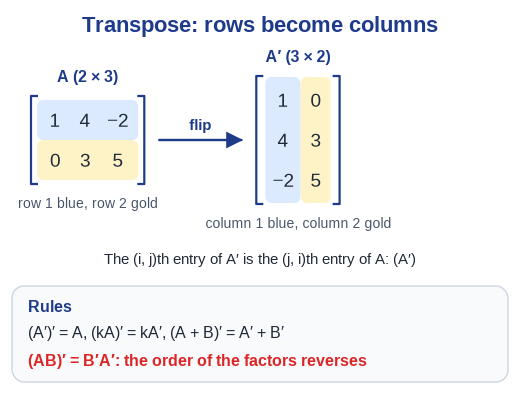
A square matrix is symmetric if A′ = A, which means aij = aji: entries mirror each other across the diagonal. It is skew symmetric if A′ = −A, and then every diagonal entry is 0. For any square matrix, A + A′ is symmetric and A − A′ is skew symmetric, so A = (1/2)(A + A′) + (1/2)(A − A′) splits A into a symmetric part and a skew symmetric part. Worked examples: symmetric and skew symmetric matrices.
What is an invertible matrix?
A square matrix A is invertible if there is a square matrix B of the same order with AB = BA = I. Such a B is the inverse of A, written A⁻¹, and A is the inverse of B. For example, [3, 1; 5, 2] and [2, −1; −5, 3] are inverses of each other, because both products are I. A rectangular matrix has no inverse, an inverse is unique when it exists, and (AB)⁻¹ = B⁻¹A⁻¹ for invertible A and B of the same order. Chapter 4 shows how to find an inverse with the adjoint.
Before we move on
This is the rationalised book (marked Reprint 2026-27). It has Exercises 3.1 to 3.4 and a Miscellaneous Exercise, and Exercise 3.4 has a single question. Elementary row and column operations, and finding an inverse with them, are not part of this edition, although older guides still teach them. Every example and exercise is worked out in the NCERT solutions for Chapter 3.
Key terms
| Term | Meaning |
|---|---|
| Matrix | Numbers or functions set out in rows and columns, in a fixed order, inside square brackets. Its numbers are called elements or entries. Matrices are named with capital letters. |
| Order m × n | A matrix with m rows and n columns has order m × n, read “m by n”, and has mn entries. |
| (i, j)th element | The entry in row i and column j. In [2, 5; 7, 1] the (2, 1)th element is 7. |
| Row matrix and column matrix | A row matrix has one row (order 1 × n); a column matrix has one column (order m × 1). |
| Square matrix | A matrix with as many rows as columns. Its entries from top left to bottom right form the diagonal. |
| Diagonal matrix | A square matrix whose entries off the diagonal are all zero, such as [2, 0; 0, −5]. |
| Scalar matrix | A diagonal matrix whose diagonal entries are all equal, such as [4, 0; 0, 4]. |
| Identity matrix I | A diagonal matrix with every diagonal entry 1. IA = AI = A for every square matrix A of the same order. |
| Zero matrix O | A matrix, of any order, with every entry 0. A + O = A. |
| Equal matrices | Two matrices of the same order whose matching entries are all equal. |
| Matrix product AB | Defined when A has as many columns as B has rows. Each entry of AB is a row of A times a column of B, added up. |
| Transpose A′ | The matrix made by writing the rows of A as columns. An m × n matrix has an n × m transpose. Also written with a T on top. |
| Symmetric and skew symmetric | A square matrix is symmetric if A′ = A, and skew symmetric if A′ = −A. A skew symmetric matrix has zeros on its diagonal. |
| Inverse A⁻¹ | A square matrix B of the same order with AB = BA = I. A matrix that has an inverse is called invertible. |
Topics in this chapter
Practice
-
A matrix has 6 entries. Which order is not possible?
Show answer
Answer: (c) 4 × 2
-
A has order 2 × 3 and B has order 3 × 4. The order of AB is:
Show answer
Answer: (b) 2 × 4
-
Which of these matrices is skew symmetric?
Show answer
Answer: (d) [0, 3; −3, 0]
-
For matrices A and B for which AB is defined, (AB)′ equals:
Show answer
Answer: (a) B′A′
-
[1, 2; 3, 4] + [0, −2; 1, 1] equals:
Show answer
Answer: (b) [1, 0; 4, 5]
Questions students ask
What are the main topics of Class 12 Maths Chapter 3?
The order and types of matrices, equality, addition, multiplication by a number and multiplication of matrices with their properties, the transpose, symmetric and skew symmetric matrices, and invertible matrices. The chapter has Exercises 3.1 to 3.4 and a Miscellaneous Exercise.
Why is matrix multiplication not commutative?
AB uses the rows of A and the columns of B, while BA uses the rows of B and the columns of A, so the two products add up different numbers. Sometimes BA is not even defined. For example, [1, 1; 0, 1][1, 0; 1, 1] = [2, 1; 1, 1], but the other order gives [1, 1; 1, 2].
Is a scalar matrix the same as an identity matrix?
Not always. A scalar matrix has equal numbers on the diagonal and zeros elsewhere, such as [4, 0; 0, 4]. It is the identity matrix only when that number is 1. So every identity matrix is scalar, but [4, 0; 0, 4] is scalar and not the identity.
Does the 2026-27 book teach elementary row operations?
No. The rationalised Chapter 3 ends with invertible matrices: the definition, the uniqueness of the inverse and (AB)⁻¹ = B⁻¹A⁻¹. Elementary row and column operations are not in this edition. Chapter 4, Determinants, shows how to find an inverse with the adjoint.
Stuck on a question?
Take a photo and Lagnever AI explains it step by step. Try it for 7 days for ₹2.
Get it on Google Play Open in browser
For parents: after the trial, the plan renews monthly by UPI or card autopay. You can cancel anytime in the app.