
What are the types of matrices?
Answer in short
A matrix is a rectangular array of numbers in rows and columns; an m × n matrix has m rows, n columns and mn entries. By shape it is a row, column or square matrix. Special square matrices are diagonal, scalar and identity matrices. A zero matrix has only zeros. Equal matrices have the same order and entries.
Stuck on a question? Take a photo and Lagnever AI explains it step by step. Try it for 7 days for ₹2. Get it on Google Play
How the matrices are written here. A matrix is typed row by row inside square brackets: commas separate the entries of a row, and semicolons separate the rows. So [2, 5; 7, 1] has first row 2, 5 and second row 7, 1, and [4; 9] is a single column.
What is a matrix?
A matrix sets out numbers or functions in rows and columns, in a fixed order, as a rectangle. The numbers are its elements or entries, and a capital letter names the whole matrix. The horizontal lines of entries are rows; the vertical lines are columns.
Suppose three players in a school cricket match score 45, 32 and 18 runs and take 1, 3 and 2 wickets. Write one row per player and one column per skill:
A = [45, 1; 32, 3; 18, 2]
The first column holds the runs and the second holds the wickets. Order matters: swapping two entries changes what the matrix says. That is why a matrix is called an ordered array.
What is the order of a matrix?
A matrix with m rows and n columns has order m × n, read “m by n”. The matrix A above is 3 × 2. An m × n matrix has m rows of n entries, so it holds mn entries.
The entry in row i and column j is the (i, j)th element, written aij. In A, a12 = 1 (the first player’s wickets) and a31 = 18 (the third player’s runs). The whole matrix can be written A = [aij]m × n, where i runs from 1 to m and j from 1 to n.
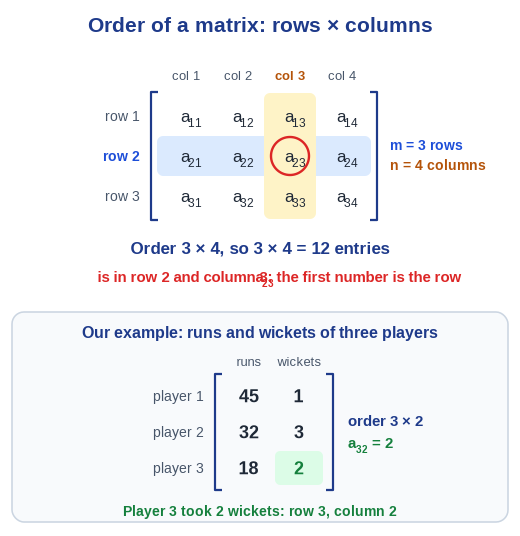
Because the number of entries is mn, the possible orders for a given number of entries are its factor pairs. With 12 entries, a matrix can be 1 × 12, 2 × 6, 3 × 4, 4 × 3, 6 × 2 or 12 × 1. With a prime number of entries, such as 7, only 1 × 7 and 7 × 1 are possible.
A matrix can also be built from a rule. If aij = i + 2j for a 2 × 2 matrix, then a11 = 3, a12 = 5, a21 = 4 and a22 = 6, so the matrix is [3, 5; 4, 6].
Which types depend only on the shape?
- A row matrix has one row: [4, −1, 0] is 1 × 3.
- A column matrix has one column: [2; 5] is 2 × 1. A point (x, y) can be written as [x; y] or [x, y].
- A square matrix has as many rows as columns; an n × n matrix is called a square matrix of order n. In a square matrix the entries a11, a22, …, ann form its diagonal, running from top left to bottom right.
Which square matrices are special?
- A diagonal matrix has 0 in every place off the diagonal: [2, 0, 0; 0, −1, 0; 0, 0, 5]. The diagonal entries can be anything, even 0.
- A scalar matrix is a diagonal matrix whose diagonal entries are all equal: [4, 0; 0, 4].
- An identity matrix is a diagonal matrix with every diagonal entry 1, written In, or just I when the order is clear: I2 = [1, 0; 0, 1] and I3 = [1, 0, 0; 0, 1, 0; 0, 0, 1].
So these types sit inside one another: every identity matrix is scalar (with the equal entry 1), every scalar matrix is diagonal, and every diagonal matrix is square.
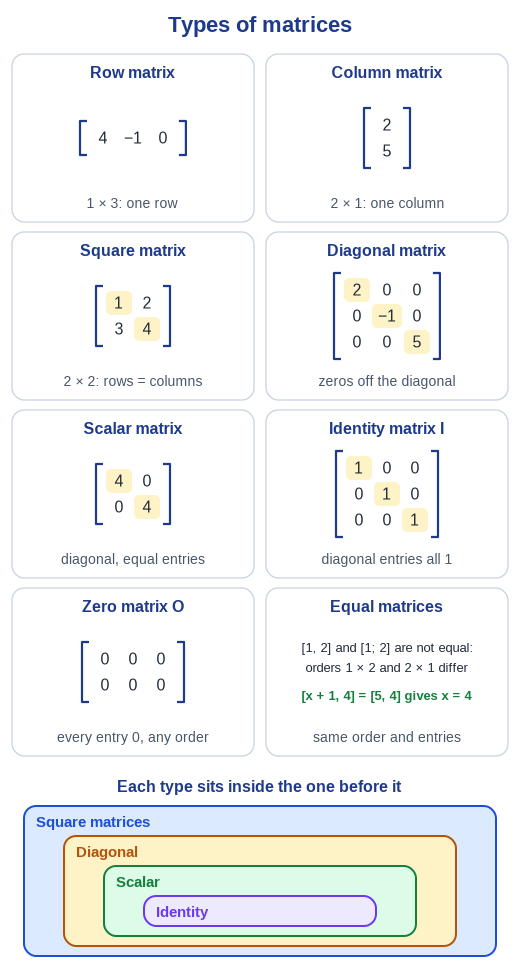
A zero matrix, written O, has every entry 0. Unlike the identity, it can have any order: [0, 0, 0; 0, 0, 0] is a 2 × 3 zero matrix.
When are two matrices equal?
Matrices A = [aij] and B = [bij] count as equal when both of these hold:
- they have the same order, and
- aij = bij for every i and j.
So [1, 2; 0, 1] and [2, 1; 0, 1] are not equal, although they use the same numbers. Equality turns one matrix equation into several ordinary equations, one per entry. From [x + 1, 4; 3, y] = [5, 4; 3, −2]:
x + 1 = 5, so x = 4
y = −2
If an entry gives two different values for the same unknown, the matrices can never be equal.
Read next: operations on matrices, the chapter notes and the NCERT solutions.
Practice
-
The order of [3, 0, −1; 2, 5, 4] is:
Show answer
Answer: (b) 2 × 3
-
Which matrix is a scalar matrix?
Show answer
Answer: (a) [5, 0; 0, 5]
-
A matrix has 7 entries. Its possible orders are:
Show answer
Answer: (a) 1 × 7 and 7 × 1
-
Construct the 2 × 2 matrix whose (i, j)th entry is i + 2j.
Show answer
Answer: a₁₁ = 1 + 2 = 3, a₁₂ = 1 + 4 = 5, a₂₁ = 2 + 2 = 4, a₂₂ = 2 + 4 = 6. So the matrix is [3, 5; 4, 6].
-
Find x and y if [x + 3, 2; 1, 2y] = [7, 2; 1, −6].
Show answer
Answer: The matrices have the same order, so matching entries are equal: x + 3 = 7 gives x = 4, and 2y = −6 gives y = −3.
Questions students ask
What is the difference between a row matrix and a column matrix?
A row matrix has only one row, so its order is 1 × n, like [4, −1, 0]. A column matrix has only one column, so its order is m × 1, like [2; 5]. A point (x, y) can be written either way, as [x, y] or [x; y].
Is every diagonal matrix a scalar matrix?
No. A diagonal matrix only needs zeros off the diagonal; its diagonal entries can differ, as in [2, 0; 0, −5]. It is a scalar matrix only when all its diagonal entries are equal.
Can a zero matrix be rectangular?
Yes. A zero matrix is any matrix whose entries are all 0, so [0, 0, 0; 0, 0, 0] is a 2 × 3 zero matrix. Its order is understood from the context. The identity matrix, by contrast, must be square.
How many entries does an m × n matrix have?
mn entries: m rows with n entries each. So a 3 × 4 matrix has 12 entries, and a matrix with 12 entries can have any order whose two numbers multiply to 12.
Stuck on a question?
Take a photo and Lagnever AI explains it step by step. Try it for 7 days for ₹2.
Get it on Google Play Open in browser
For parents: after the trial, the plan renews monthly by UPI or card autopay. You can cancel anytime in the app.