
What are symmetric and skew symmetric matrices?
Answer in short
The transpose A′ turns the rows of A into columns. A square matrix is symmetric if A′ = A, so entries mirror across the diagonal, and skew symmetric if A′ = −A, so mirrored entries are opposite and the diagonal is all zeros. Every square matrix is a symmetric matrix plus a skew symmetric one.
Stuck on a question? Take a photo and Lagnever AI explains it step by step. Try it for 7 days for ₹2. Get it on Google Play
How the matrices are written here. A matrix is typed row by row: commas separate the entries of a row and semicolons separate the rows, so [1, 4, −2; 0, 3, 5] has rows 1, 4, −2 and 0, 3, 5.
What is the transpose of a matrix?
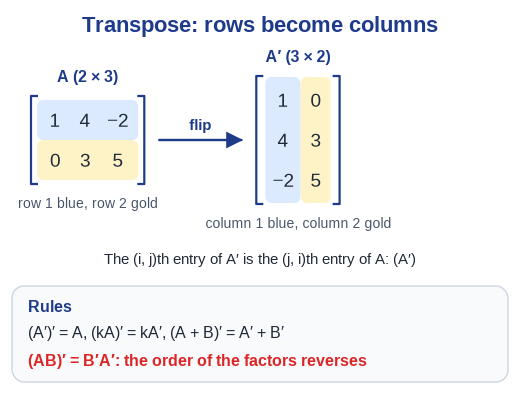
The transpose of A is the matrix made by writing the rows of A as columns, in order. It is written A′ or AT. If A = [aij] is m × n, then A′ = [aji] is n × m. For example:
A = [1, 4, −2; 0, 3, 5] (2 × 3) gives A′ = [1, 0; 4, 3; −2, 5] (3 × 2)
The first row 1, 4, −2 has become the first column, and the second row the second column.
Which rules does the transpose follow?
For matrices of suitable orders and any number k:
- (A′)′ = A: flipping twice gives back A.
- (kA)′ = kA′.
- (A + B)′ = A′ + B′.
- (AB)′ = B′A′: the order of the factors reverses.
The fourth rule is the one to watch. Take A = [1, 2; 0, 1] and B = [1, 0; 3, 1]. Then AB = [7, 2; 3, 1], so (AB)′ = [7, 3; 2, 1]. Now B′A′ = [1, 3; 0, 1][1, 0; 2, 1] = [7, 3; 2, 1], the same, while A′B′ = [1, 0; 2, 1][1, 3; 0, 1] = [1, 3; 2, 7], which is different.
What is a symmetric matrix?
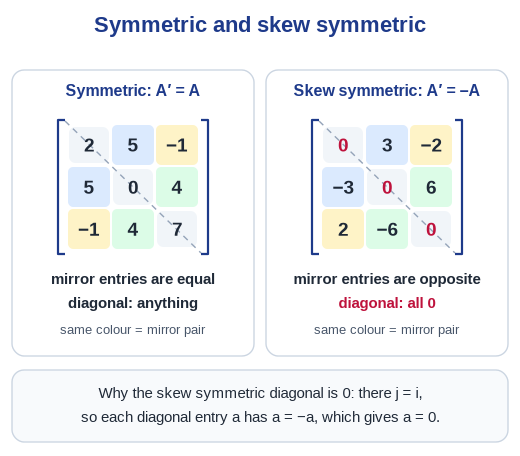
A square matrix A is symmetric if A′ = A, which means aij = aji for all i and j. Fold the matrix along its diagonal and each entry lands on an equal entry:
[2, 5, −1; 5, 0, 4; −1, 4, 7]
Here a12 = a21 = 5, a13 = a31 = −1 and a23 = a32 = 4. The diagonal entries can be anything. A distance chart between three cities is a natural symmetric matrix, since the distance from A to B equals the distance from B to A.
What is a skew symmetric matrix?
A square matrix A is skew symmetric if A′ = −A, which means aji = −aij for all i and j. Mirrored entries are negatives of each other:
[0, 3, −2; −3, 0, 6; 2, −6, 0]
Every diagonal entry of a skew symmetric matrix is 0. Putting j = i gives aii = −aii, so 2aii = 0 and aii = 0.
Why is A + A′ symmetric and A − A′ skew symmetric?
Use the transpose rules. For a square matrix A:
(A + A′)′ = A′ + (A′)′ = A′ + A = A + A′, so A + A′ is symmetric.
(A − A′)′ = A′ − (A′)′ = A′ − A = −(A − A′), so A − A′ is skew symmetric.
How do you split a square matrix into the two kinds?
Halve each and add:
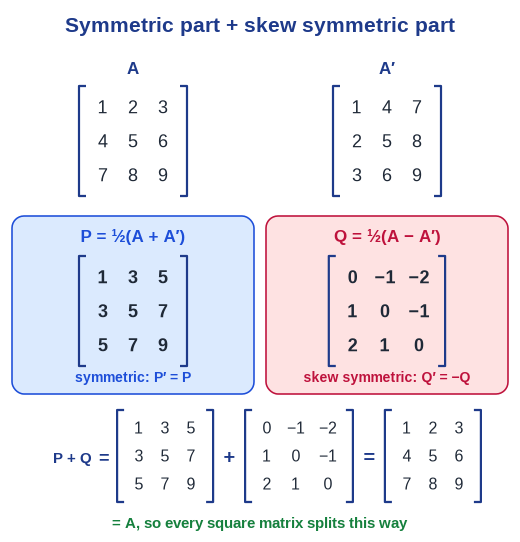
A = (1/2)(A + A′) + (1/2)(A − A′)
The first part, P, is symmetric and the second, Q, is skew symmetric, because a number times a symmetric matrix stays symmetric, and the same holds for skew symmetric ones. For A = [1, 2, 3; 4, 5, 6; 7, 8, 9], A′ = [1, 4, 7; 2, 5, 8; 3, 6, 9], so
P = (1/2)(A + A′) = [1, 3, 5; 3, 5, 7; 5, 7, 9]
Q = (1/2)(A − A′) = [0, −1, −2; 1, 0, −1; 2, 1, 0]
Check: P′ = P, Q′ = −Q and P + Q = A.
Read next: operations on matrices, the chapter notes and the NCERT solutions.
Practice
-
The transpose of [1, 2, 3; 4, 5, 6] is:
Show answer
Answer: (a) [1, 4; 2, 5; 3, 6]
-
For which value of x is [2, x; 5, 3] symmetric?
Show answer
Answer: (c) 5
-
A matrix that is both symmetric and skew symmetric must be:
Show answer
Answer: (b) a zero matrix
-
Fill in the blanks so that [0, 4, ...; ..., 0, −1; 3, ..., ...] is skew symmetric.
Show answer
Answer: Skew symmetric means the (j, i)th entry is minus the (i, j)th entry and the diagonal is 0. So the (1, 3)th entry is −3, the (2, 1)th is −4, the (3, 2)th is 1 and the (3, 3)th is 0: [0, 4, −3; −4, 0, −1; 3, 1, 0].
-
Split A = [4, 1; 7, 2] into a symmetric part and a skew symmetric part.
Show answer
Answer: A′ = [4, 7; 1, 2]. P = (1/2)(A + A′) = (1/2)[8, 8; 8, 4] = [4, 4; 4, 2], which is symmetric. Q = (1/2)(A − A′) = (1/2)[0, −6; 6, 0] = [0, −3; 3, 0], which is skew symmetric. P + Q = [4, 1; 7, 2] = A.
Questions students ask
What is the transpose of a matrix?
It is the matrix you get by writing the rows of A as columns, in the same order. If A is m × n, its transpose A′ is n × m, and the (i, j)th entry of A′ is the (j, i)th entry of A.
Why are the diagonal entries of a skew symmetric matrix zero?
Skew symmetric means the (j, i)th entry equals minus the (i, j)th entry for all i and j. On the diagonal i = j, so each diagonal entry equals its own negative: a = −a gives 2a = 0, so a = 0.
Why is (AB)′ = B′A′ and not A′B′?
The (i, k)th entry of (AB)′ is the (k, i)th entry of AB, which is row k of A times column i of B. That is the same as row i of B′ times column k of A′, the (i, k)th entry of B′A′. With A = [1, 2; 0, 1] and B = [1, 0; 3, 1], (AB)′ = B′A′ = [7, 3; 2, 1], but A′B′ = [1, 3; 2, 7].
Can every square matrix be split into symmetric and skew symmetric parts?
Yes: A = (1/2)(A + A′) + (1/2)(A − A′). The first part is symmetric and the second is skew symmetric, because A + A′ is symmetric and A − A′ is skew symmetric.
Stuck on a question?
Take a photo and Lagnever AI explains it step by step. Try it for 7 days for ₹2.
Get it on Google Play Open in browser
For parents: after the trial, the plan renews monthly by UPI or card autopay. You can cancel anytime in the app.