
NCERT Solutions Class 12 Maths Chapter 4: Determinants
Answers to every question of Exercises 4.1 to 4.5 and the Miscellaneous Exercise, and to all 19 worked examples, of Chapter 4, Determinants, of Mathematics Part I, the Class 12 NCERT textbook. Page numbers follow the 2026-27 reprint (pages 76–103). The exercise questions are quoted from the book; the examples are restated in short and labelled by number and page. Every determinant, adjoint, inverse and solution below was computed again by a script with exact fractions, and every answer agrees with the book’s answer key. Short notes: Chapter 4 notes.
How matrices and determinants are written here. A matrix is typed row by row inside square brackets: commas separate the entries of a row, and semicolons separate the rows. So [2, 4; −5, −1] is the 2 × 2 matrix with first row 2, 4 and second row −5, −1, and [5; 1] is a column. A determinant is typed the same way between two upright bars: |2, 4; −5, −1| is the determinant of that matrix. The quoted questions use the same layout.
Three formulas carry most of the answers:
- |a, b; c, d| = ad − bc.
- A determinant of order 3 is expanded along any row or column: each entry times its cofactor, added up. The cofactor is Aij = (−1)i + j Mij, where the minor Mij is the determinant left after deleting row i and column j.
- adj A is the transpose of the matrix of cofactors, and A⁻¹ = (1/|A|) adj A when |A| ≠ 0.
Examples 1 to 5: evaluating determinants (pages 77–81)
Example 1 (page 77): the value of |2, 4; −1, 2|. 2 × 2 − 4 × (−1) = 4 + 4 = 8.
Example 2 (page 77): the value of |x, x + 1; x − 1, x|. x · x − (x + 1)(x − 1) = x² − (x² − 1) = 1.
Example 3 (page 80): Δ = |1, 2, 4; −1, 3, 0; 4, 1, 0|. The third column has two zeros, so expand along it: Δ = 4 × |−1, 3; 4, 1| − 0 + 0 = 4(−1 − 12) = −52.
Example 4 (pages 80–81): Δ = |0, sin α, −cos α; −sin α, 0, sin β; cos α, −sin β, 0|. Along the first row:
Δ = 0 − sin α (0 − sin β cos α) − cos α (sin α sin β − 0) = sin α sin β cos α − cos α sin α sin β = 0.
Example 5 (page 81): x for which |3, x; x, 1| = |3, 2; 4, 1|. 3 − x² = 3 − 8, so x² = 8 and x = ±2√2.
Exercise 4.1 (pages 81–82)
“Evaluate the determinants in Exercises 1 and 2.”
1. “|2, 4; −5, −1|”
2 × (−1) − 4 × (−5) = −2 + 20 = 18.
2. “(i) |cos θ, −sin θ; sin θ, cos θ| (ii) |x² − x + 1, x − 1; x + 1, x + 1|”
(i) cos θ · cos θ − (−sin θ)(sin θ) = cos² θ + sin² θ = 1.
(ii) (x² − x + 1)(x + 1) − (x − 1)(x + 1) = (x³ + 1) − (x² − 1) = x³ − x² + 2. Here (x + 1)(x² − x + 1) = x³ + 1 is the sum-of-cubes identity.
3. “If A = [1, 2; 4, 2], then show that | 2A | = 4 | A |”
|A| = 1 × 2 − 2 × 4 = 2 − 8 = −6, so 4|A| = −24.
2A = [2, 4; 8, 4], so |2A| = 2 × 4 − 4 × 8 = 8 − 32 = −24.
Both sides are −24, so |2A| = 4|A|. (Each of the two rows gives a factor 2, and 2² = 4.)
4. “If A = [1, 0, 1; 0, 1, 2; 0, 0, 4], then show that | 3 A | = 27 | A |”
Expand along the first column, which has two zeros: |A| = 1 × |1, 2; 0, 4| = 1 × (4 − 0) = 4, so 27|A| = 108.
3A = [3, 0, 3; 0, 3, 6; 0, 0, 12], so |3A| = 3 × |3, 6; 0, 12| = 3 × (36 − 0) = 108.
Both sides are 108, so |3A| = 27|A|. (Three rows, each giving a factor 3: 3³ = 27.)
5. “Evaluate the determinants (i) |3, −1, −2; 0, 0, −1; 3, −5, 0| (ii) |3, −4, 5; 1, 1, −2; 2, 3, 1| (iii) |0, 1, 2; −1, 0, −3; −2, 3, 0| (iv) |2, −1, −2; 0, 2, −1; 3, −5, 0|”
(i) The second row has two zeros, so expand along it. Only a23 = −1 counts, with the sign (−1)2 + 3 = −1:
Δ = (−1) × (−1) × |3, −1; 3, −5| = 1 × (−15 + 3) = −12.
(ii) Along the first row: Δ = 3(1 + 6) − (−4)(1 + 4) + 5(3 − 2) = 21 + 20 + 5 = 46.
(iii) Along the first row: Δ = 0 − 1(0 − 6) + 2(−3 − 0) = 6 − 6 = 0.
(iv) Along the first row: Δ = 2(0 − 5) − (−1)(0 + 3) + (−2)(0 − 6) = −10 + 3 + 12 = 5.
6. “If A = [1, 1, −2; 2, 1, −3; 5, 4, −9], find | A |”
Along the first row: |A| = 1(−9 + 12) − 1(−18 + 15) + (−2)(8 − 5) = 3 + 3 − 6 = 0.
7. “Find values of x, if (i) |2, 4; 5, 1| = |2x, 4; 6, x| (ii) |2, 3; 4, 5| = |x, 3; 2x, 5|”
(i) 2 − 20 = 2x² − 24, so 2x² = 6, x² = 3 and x = ±√3.
(ii) 10 − 12 = 5x − 6x, so −2 = −x and x = 2.
8. “If |x, 2; 18, x| = |6, 2; 18, 6|, then x is equal to (A) 6 (B) ± 6 (C) − 6 (D) 0”
x² − 36 = 36 − 36 = 0, so x² = 36 and x = ±6. Answer: (B).
Examples 6 and 7: area of a triangle (pages 82–83)
The area of the triangle with vertices (x1, y1), (x2, y2), (x3, y3) is Δ = (1/2)|x1, y1, 1; x2, y2, 1; x3, y3, 1|, taken positive.
Example 6 (pages 82–83): the triangle with vertices (3, 8), (−4, 2) and (5, 1). Δ = (1/2)[3(2 − 1) − 8(−4 − 5) + 1(−4 − 10)] = (1/2)(3 + 72 − 14) = 61/2 sq. units.
Example 7 (page 83): the line through A(1, 3) and B(0, 0), and k if D(k, 0) makes triangle ABD of area 3 sq. units. A point P(x, y) lies on AB exactly when the triangle ABP has area 0: |x, y, 1; 1, 3, 1; 0, 0, 1| = 0. Along the first row, x(3 − 0) − y(1 − 0) + 1(0 − 0) = 3x − y = 0, so the line is y = 3x.
For D: |1, 3, 1; 0, 0, 1; k, 0, 1| = 1(0 − 0) − 3(0 − k) + 1(0 − 0) = 3k. The area is 3, and the determinant can have either sign, so (1/2)(3k) = ±3 and k = ±2.
Exercise 4.2 (page 83)
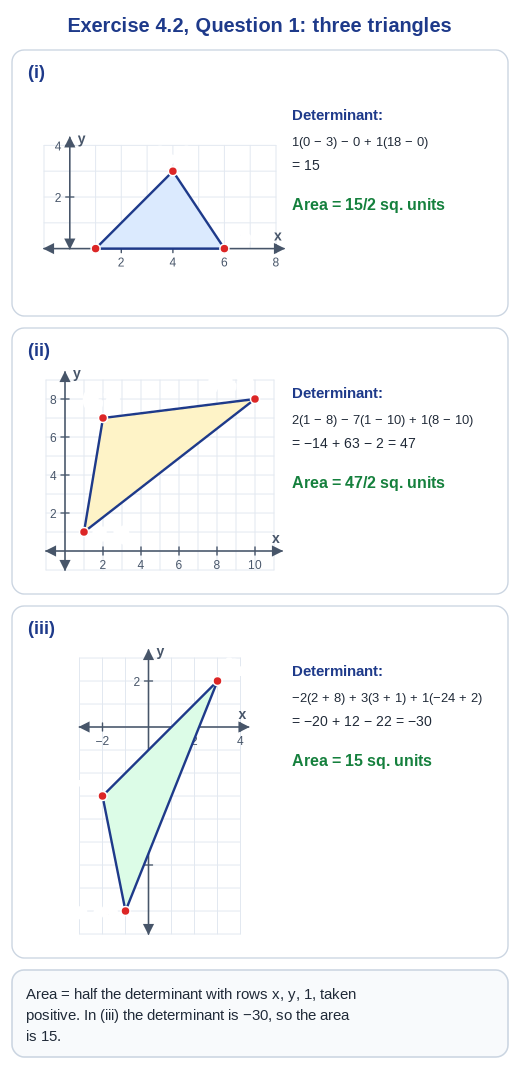
1. “Find area of the triangle with vertices at the point given in each of the following : (i) (1, 0), (6, 0), (4, 3) (ii) (2, 7), (1, 1), (10, 8) (iii) (−2, −3), (3, 2), (−1, −8)”
(i) |1, 0, 1; 6, 0, 1; 4, 3, 1| = 1(0 − 3) − 0(6 − 4) + 1(18 − 0) = −3 + 18 = 15. Area = (1/2)(15) = 15/2 sq. units.
(ii) |2, 7, 1; 1, 1, 1; 10, 8, 1| = 2(1 − 8) − 7(1 − 10) + 1(8 − 10) = −14 + 63 − 2 = 47. Area = 47/2 sq. units.
(iii) |−2, −3, 1; 3, 2, 1; −1, −8, 1| = −2(2 + 8) − (−3)(3 + 1) + 1(−24 + 2) = −20 + 12 − 22 = −30. Area is positive, so it is (1/2)(30) = 15 sq. units.
2. “Show that points A (a, b + c), B (b, c + a), C (c, a + b) are collinear.”
Collinear means all three points lie on one straight line. Such points make a flat triangle, so its area is 0. So we show that the area determinant is 0. Along the first row:
|a, b + c, 1; b, c + a, 1; c, a + b, 1| = a[(c + a) − (a + b)] − (b + c)(b − c) + 1[b(a + b) − c(c + a)]
= a(c − b) − (b² − c²) + (ab + b² − c² − ac)
= ac − ab − b² + c² + ab + b² − c² − ac = 0.
The area is (1/2)(0) = 0, so A, B and C are collinear.
3. “Find values of k if area of triangle is 4 sq. units and vertices are (i) (k, 0), (4, 0), (0, 2) (ii) (−2, 0), (0, 4), (0, k)”
The area is given, so the determinant may be +8 or −8.
(i) |k, 0, 1; 4, 0, 1; 0, 2, 1| = k(0 − 2) − 0 + 1(8 − 0) = 8 − 2k. From (1/2)(8 − 2k) = ±4: 8 − 2k = 8 gives k = 0, and 8 − 2k = −8 gives k = 8. So k = 0 or 8.
(ii) |−2, 0, 1; 0, 4, 1; 0, k, 1| = −2(4 − k) − 0 + 1(0 − 0) = 2k − 8. From 2k − 8 = ±8: k = 8 or 0.
4. “(i) Find equation of line joining (1, 2) and (3, 6) using determinants. (ii) Find equation of line joining (3, 1) and (9, 3) using determinants.”
A point (x, y) is on the line when it makes a triangle of area 0 with the two given points.
(i) |x, y, 1; 1, 2, 1; 3, 6, 1| = x(2 − 6) − y(1 − 3) + 1(6 − 6) = −4x + 2y = 0, so y = 2x.
(ii) |x, y, 1; 3, 1, 1; 9, 3, 1| = x(1 − 3) − y(3 − 9) + 1(9 − 9) = −2x + 6y = 0, so x − 3y = 0.
5. “If area of triangle is 35 sq units with vertices (2, − 6), (5, 4) and (k, 4). Then k is (A) 12 (B) −2 (C) −12, −2 (D) 12, −2”
|2, −6, 1; 5, 4, 1; k, 4, 1| = 2(4 − 4) − (−6)(5 − k) + 1(20 − 4k) = 30 − 6k + 20 − 4k = 50 − 10k.
(1/2)(50 − 10k) = ±35, so 50 − 10k = 70 gives k = −2, and 50 − 10k = −70 gives k = 12. Answer: (D).
Examples 8 to 11: minors and cofactors (pages 84–86)
Example 8 (page 84): the minor of 6 in |1, 2, 3; 4, 5, 6; 7, 8, 9|. 6 sits in row 2, column 3. Deleting them leaves M23 = |1, 2; 7, 8| = 8 − 14 = −6.
Example 9 (page 84): minors and cofactors of |1, −2; 4, 3|. M11 = 3, M12 = 4, M21 = −2, M22 = 1. With the signs (−1)i + j: A11 = 3, A12 = −4, A21 = 2, A22 = 1.
Example 10 (page 85): minors and cofactors of a11 and a21 in a general determinant of order 3. M11 = |a22, a23; a32, a33| = a22a33 − a23a32, and A11 = M11. M21 = |a12, a13; a32, a33| = a12a33 − a13a32, and A21 = −M21 = −a12a33 + a13a32.
Example 11 (page 86): minors and cofactors of |2, −3, 5; 6, 0, 4; 1, 5, −7|, and a check that a11A31 + a12A32 + a13A33 = 0.
M11 = 0 − 20 = −20, M12 = −42 − 4 = −46, M13 = 30 − 0 = 30
M21 = 21 − 25 = −4, M22 = −14 − 5 = −19, M23 = 10 + 3 = 13
M31 = −12 − 0 = −12, M32 = 8 − 30 = −22, M33 = 0 + 18 = 18
A11 = −20, A12 = 46, A13 = 30, A21 = 4, A22 = −19, A23 = −13, A31 = −12, A32 = 22, A33 = 18
Check: 2(−12) + (−3)(22) + 5(18) = −24 − 66 + 90 = 0. Entries of one row times the cofactors of another row always add up to 0.
Exercise 4.3 (page 87)
“Write Minors and Cofactors of the elements of following determinants:”
1. “(i) |2, −4; 0, 3| (ii) |a, c; b, d|”
In a determinant of order 2, the minor of an entry is the single entry left after deleting its row and column.
(i) M11 = 3, M12 = 0, M21 = −4, M22 = 2. Cofactors: A11 = 3, A12 = −0 = 0, A21 = −(−4) = 4, A22 = 2.
(ii) M11 = d, M12 = b, M21 = c, M22 = a. Cofactors: A11 = d, A12 = −b, A21 = −c, A22 = a.
2. “(i) |1, 0, 0; 0, 1, 0; 0, 0, 1| (ii) |1, 0, 4; 3, 5, −1; 0, 1, 2|”
(i) M11 = |1, 0; 0, 1| = 1, M12 = |0, 0; 0, 1| = 0, M13 = |0, 1; 0, 0| = 0
M21 = |0, 0; 0, 1| = 0, M22 = |1, 0; 0, 1| = 1, M23 = |1, 0; 0, 0| = 0
M31 = |0, 0; 1, 0| = 0, M32 = |1, 0; 0, 0| = 0, M33 = |1, 0; 0, 1| = 1
Changing the sign of a 0 changes nothing, so the cofactors are the same: A11 = 1, A12 = 0, A13 = 0, A21 = 0, A22 = 1, A23 = 0, A31 = 0, A32 = 0, A33 = 1.
(ii) M11 = |5, −1; 1, 2| = 10 + 1 = 11, M12 = |3, −1; 0, 2| = 6 − 0 = 6, M13 = |3, 5; 0, 1| = 3 − 0 = 3
M21 = |0, 4; 1, 2| = 0 − 4 = −4, M22 = |1, 4; 0, 2| = 2 − 0 = 2, M23 = |1, 0; 0, 1| = 1 − 0 = 1
M31 = |0, 4; 5, −1| = 0 − 20 = −20, M32 = |1, 4; 3, −1| = −1 − 12 = −13, M33 = |1, 0; 3, 5| = 5 − 0 = 5
A11 = 11, A12 = −6, A13 = 3, A21 = 4, A22 = 2, A23 = −1, A31 = −20, A32 = 13, A33 = 5.
3. “Using Cofactors of elements of second row, evaluate ∆ = |5, 3, 8; 2, 0, 1; 1, 2, 3|.”
A21 = −|3, 8; 2, 3| = −(9 − 16) = 7
A22 = |5, 8; 1, 3| = 15 − 8 = 7
A23 = −|5, 3; 1, 2| = −(10 − 3) = −7
Δ = a21A21 + a22A22 + a23A23 = 2(7) + 0(7) + 1(−7) = 7.
4. “Using Cofactors of elements of third column, evaluate ∆ = |1, x, yz; 1, y, zx; 1, z, xy|.”
A13 = |1, y; 1, z| = z − y
A23 = −|1, x; 1, z| = −(z − x) = x − z
A33 = |1, x; 1, y| = y − x
Δ = yz(z − y) + zx(x − z) + xy(y − x) = yz² − y²z + x²z − xz² + xy² − x²y.
Collect by powers of x: Δ = x²(z − y) − x(z² − y²) + yz(z − y) = (z − y)[x² − x(z + y) + yz] = (z − y)(x − y)(x − z).
Since (z − y)(x − z) = (y − z)(z − x), Δ = (x − y)(y − z)(z − x).
5. “If ∆ = |a11, a12, a13; a21, a22, a23; a31, a32, a33| and Aij is Cofactors of aij, then value of ∆ is given by (A) a11 A31 + a12 A32 + a13 A33 (B) a11 A11 + a12 A21 + a13 A31 (C) a21 A11 + a22 A12 + a23 A13 (D) a11 A11 + a21 A21 + a31 A31”
Rule: Δ = (entries of one row or one column) × (their own cofactors), added up.
- (A) uses row 1 entries with row 3 cofactors. Wrong pairing, so it gives 0.
- (B) uses row 1 entries with column 1 cofactors. This mixes a row with a column.
- (C) uses row 2 entries with row 1 cofactors. Wrong pairing, so it gives 0.
- (D) uses column 1 entries a11, a21, a31 with their own cofactors A11, A21, A31. This is expansion along column 1.
Answer: (D).
Examples 12 to 15: adjoint and inverse (pages 88–92)
Example 12 (page 88): adj A for A = [2, 3; 1, 4]. A11 = 4, A12 = −1, A21 = −3, A22 = 2. Writing the cofactors of each row as a column: adj A = [4, −3; −1, 2].
Example 13 (pages 90–91): for A = [1, 3, 3; 1, 4, 3; 1, 3, 4], check A(adj A) = |A| I and find A⁻¹. |A| = 1(16 − 9) − 3(4 − 3) + 3(3 − 4) = 7 − 3 − 3 = 1. The cofactors are A11 = 7, A12 = −1, A13 = −1, A21 = −3, A22 = 1, A23 = 0, A31 = −3, A32 = 0, A33 = 1, so adj A = [7, −3, −3; −1, 1, 0; −1, 0, 1].
A(adj A) = [7 − 3 − 3, −3 + 3 + 0, −3 + 0 + 3; 7 − 4 − 3, −3 + 4 + 0, −3 + 0 + 3; 7 − 3 − 4, −3 + 3 + 0, −3 + 0 + 4] = [1, 0, 0; 0, 1, 0; 0, 0, 1] = 1 · I = |A| I.
A⁻¹ = (1/1) adj A = [7, −3, −3; −1, 1, 0; −1, 0, 1].
Example 14 (page 91): for A = [2, 3; 1, −4] and B = [1, −2; −1, 3], check (AB)⁻¹ = B⁻¹A⁻¹. AB = [2 − 3, −4 + 9; 1 + 4, −2 − 12] = [−1, 5; 5, −14], with |AB| = 14 − 25 = −11. So (AB)⁻¹ = (−1/11)[−14, −5; −5, −1] = (1/11)[14, 5; 5, 1].
|A| = −8 − 3 = −11 and |B| = 3 − 2 = 1, so A⁻¹ = (−1/11)[−4, −3; −1, 2] and B⁻¹ = [3, 2; 1, 1].
B⁻¹A⁻¹ = (−1/11)[−12 − 2, −9 + 4; −4 − 1, −3 + 2] = (−1/11)[−14, −5; −5, −1] = (1/11)[14, 5; 5, 1], the same matrix.
Example 15 (page 92): A = [2, 3; 1, 2] satisfies A² − 4A + I = O; find A⁻¹ from this. A² = [4 + 3, 6 + 6; 2 + 2, 3 + 4] = [7, 12; 4, 7]. Then A² − 4A + I = [7 − 8 + 1, 12 − 12 + 0; 4 − 4 + 0, 7 − 8 + 1] = O.
|A| = 4 − 3 = 1 ≠ 0, so A⁻¹ exists. Multiply A² − 4A + I = O by A⁻¹: A − 4I + A⁻¹ = O, so A⁻¹ = 4I − A = [4 − 2, 0 − 3; 0 − 1, 4 − 2] = [2, −3; −1, 2].
Exercise 4.4 (pages 92–93)
“Find adjoint of each of the matrices in Exercises 1 and 2.”
1. “[1, 2; 3, 4]”
A11 = 4, A12 = −3, A21 = −2, A22 = 1. The adjoint is the transpose of the cofactor matrix [4, −3; −2, 1]:
adj A = [4, −2; −3, 1]. (Shortcut for order 2: swap the diagonal entries and change the signs of the other two.)
2. “[1, −1, 2; 2, 3, 5; −2, 0, 1]”
A11 = (3)(1) − (5)(0) = 3, A12 = −[(2)(1) − (5)(−2)] = −12, A13 = (2)(0) − (3)(−2) = 6
A21 = −[(−1)(1) − (2)(0)] = 1, A22 = (1)(1) − (2)(−2) = 5, A23 = −[(1)(0) − (−1)(−2)] = 2
A31 = (−1)(5) − (2)(3) = −11, A32 = −[(1)(5) − (2)(2)] = −1, A33 = (1)(3) − (−1)(2) = 5
The cofactor matrix is [3, −12, 6; 1, 5, 2; −11, −1, 5]. Its transpose is adj A = [3, 1, −11; −12, 5, −1; 6, 2, 5].
“Verify A (adj A) = (adj A) A = |A| I in Exercises 3 and 4”
3. “[2, 3; −4, −6]”
|A| = 2(−6) − 3(−4) = −12 + 12 = 0, so |A| I = [0, 0; 0, 0].
adj A = [−6, −3; 4, 2].
A(adj A) = [−12 + 12, −6 + 6; 24 − 24, 12 − 12] = [0, 0; 0, 0].
(adj A)A = [−12 + 12, −18 + 18; 8 − 8, 12 − 12] = [0, 0; 0, 0].
All three are the zero matrix, so A(adj A) = (adj A)A = |A| I.
4. “[1, −1, 2; 3, 0, −2; 1, 0, 3]”
Along the second column, which has two zeros: |A| = (−1) × A12, and A12 = −[(3)(3) − (−2)(1)] = −11, so |A| = 11 and |A| I = [11, 0, 0; 0, 11, 0; 0, 0, 11].
A11 = (0)(3) − (−2)(0) = 0, A12 = −11, A13 = (3)(0) − (0)(1) = 0
A21 = −[(−1)(3) − (2)(0)] = 3, A22 = (1)(3) − (2)(1) = 1, A23 = −[(1)(0) − (−1)(1)] = −1
A31 = (−1)(−2) − (2)(0) = 2, A32 = −[(1)(−2) − (2)(3)] = 8, A33 = (1)(0) − (−1)(3) = 3
adj A = [0, 3, 2; −11, 1, 8; 0, −1, 3].
A(adj A) = [0 + 11 + 0, 3 − 1 − 2, 2 − 8 + 6; 0 + 0 + 0, 9 + 0 + 2, 6 + 0 − 6; 0 + 0 + 0, 3 + 0 − 3, 2 + 0 + 9] = [11, 0, 0; 0, 11, 0; 0, 0, 11].
(adj A)A = [0 + 9 + 2, 0 + 0 + 0, 0 − 6 + 6; −11 + 3 + 8, 11 + 0 + 0, −22 − 2 + 24; 0 − 3 + 3, 0 + 0 + 0, 0 + 2 + 9] = [11, 0, 0; 0, 11, 0; 0, 0, 11].
Both products equal 11 I, so A(adj A) = (adj A)A = |A| I.
“Find the inverse of each of the matrices (if it exists) given in Exercises 5 to 11.”
5. “[2, −2; 4, 3]”
|A| = 6 + 8 = 14 ≠ 0, so the inverse exists. adj A = [3, 2; −4, 2].
A⁻¹ = (1/14)[3, 2; −4, 2].
6. “[−1, 5; −3, 2]”
|A| = −2 + 15 = 13 ≠ 0. adj A = [2, −5; 3, −1].
A⁻¹ = (1/13)[2, −5; 3, −1].
7. “[1, 2, 3; 0, 2, 4; 0, 0, 5]”
Along the first column: |A| = 1 × (10 − 0) = 10 ≠ 0.
A11 = (2)(5) − (4)(0) = 10, A12 = −[(0)(5) − (4)(0)] = 0, A13 = (0)(0) − (2)(0) = 0
A21 = −[(2)(5) − (3)(0)] = −10, A22 = (1)(5) − (3)(0) = 5, A23 = −[(1)(0) − (2)(0)] = 0
A31 = (2)(4) − (3)(2) = 2, A32 = −[(1)(4) − (3)(0)] = −4, A33 = (1)(2) − (2)(0) = 2
adj A = [10, −10, 2; 0, 5, −4; 0, 0, 2], so A⁻¹ = (1/10)[10, −10, 2; 0, 5, −4; 0, 0, 2].
8. “[1, 0, 0; 3, 3, 0; 5, 2, −1]”
Along the first row: |A| = 1 × (−3 − 0) = −3 ≠ 0.
A11 = (3)(−1) − (0)(2) = −3, A12 = −[(3)(−1) − (0)(5)] = 3, A13 = (3)(2) − (3)(5) = −9
A21 = −[(0)(−1) − (0)(2)] = 0, A22 = (1)(−1) − (0)(5) = −1, A23 = −[(1)(2) − (0)(5)] = −2
A31 = (0)(0) − (0)(3) = 0, A32 = −[(1)(0) − (0)(3)] = 0, A33 = (1)(3) − (0)(3) = 3
adj A = [−3, 0, 0; 3, −1, 0; −9, −2, 3], so A⁻¹ = (−1/3)[−3, 0, 0; 3, −1, 0; −9, −2, 3].
9. “[2, 1, 3; 4, −1, 0; −7, 2, 1]”
|A| = 2(−1 − 0) − 1(4 − 0) + 3(8 − 7) = −2 − 4 + 3 = −3 ≠ 0.
A11 = (−1)(1) − (0)(2) = −1, A12 = −[(4)(1) − (0)(−7)] = −4, A13 = (4)(2) − (−1)(−7) = 1
A21 = −[(1)(1) − (3)(2)] = 5, A22 = (2)(1) − (3)(−7) = 23, A23 = −[(2)(2) − (1)(−7)] = −11
A31 = (1)(0) − (3)(−1) = 3, A32 = −[(2)(0) − (3)(4)] = 12, A33 = (2)(−1) − (1)(4) = −6
adj A = [−1, 5, 3; −4, 23, 12; 1, −11, −6], so A⁻¹ = (−1/3)[−1, 5, 3; −4, 23, 12; 1, −11, −6].
10. “[1, −1, 2; 0, 2, −3; 3, −2, 4]”
|A| = 1(8 − 6) − (−1)(0 + 9) + 2(0 − 6) = 2 + 9 − 12 = −1 ≠ 0.
A11 = (2)(4) − (−3)(−2) = 2, A12 = −[(0)(4) − (−3)(3)] = −9, A13 = (0)(−2) − (2)(3) = −6
A21 = −[(−1)(4) − (2)(−2)] = 0, A22 = (1)(4) − (2)(3) = −2, A23 = −[(1)(−2) − (−1)(3)] = −1
A31 = (−1)(−3) − (2)(2) = −1, A32 = −[(1)(−3) − (2)(0)] = 3, A33 = (1)(2) − (−1)(0) = 2
adj A = [2, 0, −1; −9, −2, 3; −6, −1, 2], and A⁻¹ = (1/(−1)) adj A = [−2, 0, 1; 9, 2, −3; 6, 1, −2].
11. “[1, 0, 0; 0, cos α, sin α; 0, sin α, −cos α]”
Along the first row: |A| = 1 × (−cos² α − sin² α) = −1 ≠ 0.
A11 = −cos² α − sin² α = −1, A12 = −(0 − 0) = 0, A13 = 0 − 0 = 0
A21 = −(0 − 0) = 0, A22 = −cos α − 0 = −cos α, A23 = −(sin α − 0) = −sin α
A31 = 0 − 0 = 0, A32 = −(sin α − 0) = −sin α, A33 = cos α − 0 = cos α
adj A = [−1, 0, 0; 0, −cos α, −sin α; 0, −sin α, cos α], and A⁻¹ = (1/(−1)) adj A = [1, 0, 0; 0, cos α, sin α; 0, sin α, −cos α]. This matrix is its own inverse.
12. “Let A = [3, 7; 2, 5] and B = [6, 8; 7, 9]. Verify that (AB)⁻¹ = B⁻¹ A⁻¹.”
AB = [18 + 49, 24 + 63; 12 + 35, 16 + 45] = [67, 87; 47, 61].
|AB| = 67 × 61 − 87 × 47 = 4087 − 4089 = −2, so (AB)⁻¹ = (−1/2)[61, −87; −47, 67].
|A| = 15 − 14 = 1, so A⁻¹ = [5, −7; −2, 3]. |B| = 54 − 56 = −2, so B⁻¹ = (−1/2)[9, −8; −7, 6].
B⁻¹A⁻¹ = (−1/2)[45 + 16, −63 − 24; −35 − 12, 49 + 18] = (−1/2)[61, −87; −47, 67].
The two results are the same, so (AB)⁻¹ = B⁻¹A⁻¹.
13. “If A = [3, 1; −1, 2], show that A² − 5A + 7I = O. Hence find A⁻¹.”
A² = [9 − 1, 3 + 2; −3 − 2, −1 + 4] = [8, 5; −5, 3].
A² − 5A + 7I = [8 − 15 + 7, 5 − 5 + 0; −5 + 5 + 0, 3 − 10 + 7] = [0, 0; 0, 0] = O.
|A| = 6 + 1 = 7 ≠ 0, so A⁻¹ exists. Multiplying A² − 5A + 7I = O by A⁻¹ gives A − 5I + 7A⁻¹ = O, so 7A⁻¹ = 5I − A = [5 − 3, 0 − 1; 0 + 1, 5 − 2] = [2, −1; 1, 3].
A⁻¹ = (1/7)[2, −1; 1, 3].
14. “For the matrix A = [3, 2; 1, 1], find the numbers a and b such that A² + aA + bI = O.”
A² = [9 + 2, 6 + 2; 3 + 1, 2 + 1] = [11, 8; 4, 3].
A² + aA + bI = [11 + 3a + b, 8 + 2a; 4 + a, 3 + a + b]. Each entry must be 0.
From 4 + a = 0, a = −4; then 8 + 2a = 0 holds too. From 3 + a + b = 0, b = 1; then 11 + 3a + b = 11 − 12 + 1 = 0 holds too.
a = −4 and b = 1.
15. “For the matrix A = [1, 1, 1; 1, 2, −3; 2, −1, 3] Show that A³ − 6A² + 5A + 11 I = O. Hence, find A⁻¹.”
A² = [1 + 1 + 2, 1 + 2 − 1, 1 − 3 + 3; 1 + 2 − 6, 1 + 4 + 3, 1 − 6 − 9; 2 − 1 + 6, 2 − 2 − 3, 2 + 3 + 9] = [4, 2, 1; −3, 8, −14; 7, −3, 14]
A³ = A²A = [4 + 2 + 2, 4 + 4 − 1, 4 − 6 + 3; −3 + 8 − 28, −3 + 16 + 14, −3 − 24 − 42; 7 − 3 + 28, 7 − 6 − 14, 7 + 9 + 42] = [8, 7, 1; −23, 27, −69; 32, −13, 58]
A³ − 6A² + 5A + 11I, entry by entry:
row 1: 8 − 24 + 5 + 11 = 0, 7 − 12 + 5 + 0 = 0, 1 − 6 + 5 + 0 = 0
row 2: −23 + 18 + 5 + 0 = 0, 27 − 48 + 10 + 11 = 0, −69 + 84 − 15 + 0 = 0
row 3: 32 − 42 + 10 + 0 = 0, −13 + 18 − 5 + 0 = 0, 58 − 84 + 15 + 11 = 0
So A³ − 6A² + 5A + 11I = O.
|A| = 1(6 − 3) − 1(3 + 6) + 1(−1 − 4) = 3 − 9 − 5 = −11 ≠ 0, so A⁻¹ exists. Multiplying the equation by A⁻¹: A² − 6A + 5I + 11A⁻¹ = O, so A⁻¹ = (−1/11)(A² − 6A + 5I).
A² − 6A + 5I = [4 − 6 + 5, 2 − 6 + 0, 1 − 6 + 0; −3 − 6 + 0, 8 − 12 + 5, −14 + 18 + 0; 7 − 12 + 0, −3 + 6 + 0, 14 − 18 + 5] = [3, −4, −5; −9, 1, 4; −5, 3, 1]
A⁻¹ = (1/11)[−3, 4, 5; 9, −1, −4; 5, −3, −1].
16. “If A = [2, −1, 1; −1, 2, −1; 1, −1, 2] Verify that A³ − 6A² + 9A − 4I = O and hence find A⁻¹”
A² = [4 + 1 + 1, −2 − 2 − 1, 2 + 1 + 2; −2 − 2 − 1, 1 + 4 + 1, −1 − 2 − 2; 2 + 1 + 2, −1 − 2 − 2, 1 + 1 + 4] = [6, −5, 5; −5, 6, −5; 5, −5, 6]
A³ = A²A = [12 + 5 + 5, −6 − 10 − 5, 6 + 5 + 10; −10 − 6 − 5, 5 + 12 + 5, −5 − 6 − 10; 10 + 5 + 6, −5 − 10 − 6, 5 + 5 + 12] = [22, −21, 21; −21, 22, −21; 21, −21, 22]
A³ − 6A² + 9A − 4I, entry by entry:
row 1: 22 − 36 + 18 − 4 = 0, −21 + 30 − 9 − 0 = 0, 21 − 30 + 9 − 0 = 0
row 2: −21 + 30 − 9 − 0 = 0, 22 − 36 + 18 − 4 = 0, −21 + 30 − 9 − 0 = 0
row 3: 21 − 30 + 9 − 0 = 0, −21 + 30 − 9 − 0 = 0, 22 − 36 + 18 − 4 = 0
So A³ − 6A² + 9A − 4I = O.
|A| = 2(4 − 1) − (−1)(−2 + 1) + 1(1 − 2) = 6 − 1 − 1 = 4 ≠ 0, so A⁻¹ exists. Multiplying by A⁻¹: A² − 6A + 9I − 4A⁻¹ = O, so A⁻¹ = (1/4)(A² − 6A + 9I).
A² − 6A + 9I = [6 − 12 + 9, −5 + 6 + 0, 5 − 6 + 0; −5 + 6 + 0, 6 − 12 + 9, −5 + 6 + 0; 5 − 6 + 0, −5 + 6 + 0, 6 − 12 + 9] = [3, 1, −1; 1, 3, 1; −1, 1, 3]
A⁻¹ = (1/4)[3, 1, −1; 1, 3, 1; −1, 1, 3].
17. “Let A be a nonsingular square matrix of order 3 × 3. Then |adj A| is equal to (A) |A| (B) |A|² (C) |A|³ (D) 3|A|”
Nonsingular means |A| ≠ 0.
- Start from (adj A)A = |A| I.
- Take the determinant of both sides: |adj A| × |A| = | |A| I |.
- |A| I is a diagonal matrix with the number |A| in each of its 3 diagonal places, so its determinant is |A| × |A| × |A| = |A|³.
- So |adj A| × |A| = |A|³. Divide by |A| (allowed, since |A| ≠ 0): |adj A| = |A|².
Answer: (B). (In general, for order n, |adj A| = |A|n − 1.)
18. “If A is an invertible matrix of order 2, then det (A⁻¹) is equal to (A) det (A) (B) 1/det (A) (C) 1 (D) 0”
AA⁻¹ = I, and the determinant of a product is the product of the determinants (Theorem 3). So det(A) · det(A⁻¹) = det(I) = 1, and det(A⁻¹) = 1/det(A). Answer: (B).
Examples 16 to 18: the matrix method (pages 95–97)
A system is written as AX = B, with A the matrix of coefficients, X the column of unknowns and B the column of constants. If |A| ≠ 0, the unique solution is X = A⁻¹B.
Example 16 (page 95): 2x + 5y = 1, 3x + 2y = 7. A = [2, 5; 3, 2], B = [1; 7]. |A| = 4 − 15 = −11 ≠ 0, and A⁻¹ = (−1/11)[2, −5; −3, 2]. X = (−1/11)[2 − 35; −3 + 14] = (−1/11)[−33; 11] = [3; −1]. So x = 3, y = −1.
Example 17 (pages 95–96): 3x − 2y + 3z = 8, 2x + y − z = 1, 4x − 3y + 2z = 4. A = [3, −2, 3; 2, 1, −1; 4, −3, 2], B = [8; 1; 4]. |A| = 3(2 − 3) + 2(4 + 4) + 3(−6 − 4) = −3 + 16 − 30 = −17 ≠ 0. The cofactors give adj A = [−1, −5, −1; −8, −6, 9; −10, 1, 7].
(adj A)B = [−8 − 5 − 4; −64 − 6 + 36; −80 + 1 + 28] = [−17; −34; −51], and X = (−1/17)[−17; −34; −51] = [1; 2; 3]. So x = 1, y = 2, z = 3.
Example 18 (pages 96–97): three numbers add up to 6; the second plus three times the third is 11; the first plus the third is twice the second. With the numbers x, y, z: x + y + z = 6, y + 3z = 11 and x − 2y + z = 0. A = [1, 1, 1; 0, 1, 3; 1, −2, 1], B = [6; 11; 0]. |A| = 1(1 + 6) − 1(0 − 3) + 1(0 − 1) = 9 ≠ 0, and adj A = [7, −3, 2; 3, 0, −3; −1, 3, 1].
X = (1/9)[42 − 33 + 0; 18 + 0 + 0; −6 + 33 + 0] = (1/9)[9; 18; 27] = [1; 2; 3]. The numbers are 1, 2 and 3.
Exercise 4.5 (pages 97–98)
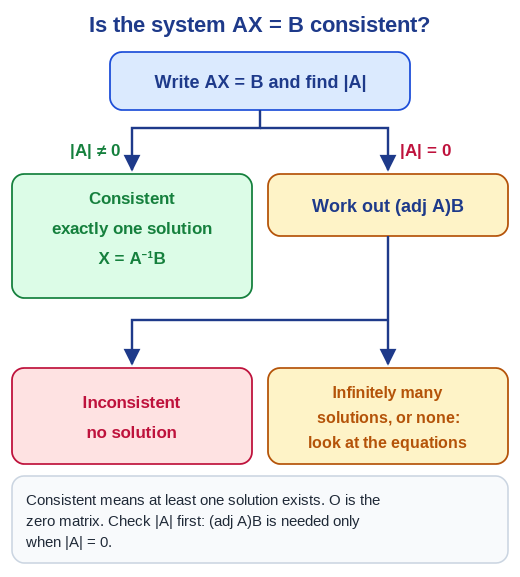
Two words used below. A system of equations is consistent if it has at least one solution, and inconsistent if it has none. A square matrix A is nonsingular if |A| ≠ 0.
“Examine the consistency of the system of equations in Exercises 1 to 6.”
1. “x + 2y = 2, 2x + 3y = 3”
A = [1, 2; 2, 3]. |A| = 3 − 4 = −1 ≠ 0, so A is nonsingular and a unique solution exists. The system is consistent.
2. “2x − y = 5, x + y = 4”
A = [2, −1; 1, 1]. |A| = 2 + 1 = 3 ≠ 0. The system is consistent.
3. “x + 3y = 5, 2x + 6y = 8”
A = [1, 3; 2, 6], B = [5; 8]. |A| = 6 − 6 = 0, so check (adj A)B.
adj A = [6, −3; −2, 1], and (adj A)B = [30 − 24; −10 + 8] = [6; −2] ≠ O.
So no solution exists: the system is inconsistent. (The lines x + 3y = 5 and x + 3y = 4 are parallel.)
4. “x + y + z = 1, 2x + 3y + 2z = 2, ax + ay + 2az = 4”
A = [1, 1, 1; 2, 3, 2; a, a, 2a]. |A| = 1(6a − 2a) − 1(4a − 2a) + 1(2a − 3a) = 4a − 2a − a = a.
Here a ≠ 0: if a were 0, the third equation would read 0 = 4. So |A| = a ≠ 0, and the system is consistent.
5. “3x − y − 2z = 2, 2y − z = −1, 3x − 5y = 3”
A = [3, −1, −2; 0, 2, −1; 3, −5, 0], B = [2; −1; 3]. |A| = 3(0 − 5) − (−1)(0 + 3) + (−2)(0 − 6) = −15 + 3 + 12 = 0, so check (adj A)B.
A11 = (2)(0) − (−1)(−5) = −5, A12 = −[(0)(0) − (−1)(3)] = −3, A13 = (0)(−5) − (2)(3) = −6
A21 = −[(−1)(0) − (−2)(−5)] = 10, A22 = (3)(0) − (−2)(3) = 6, A23 = −[(3)(−5) − (−1)(3)] = 12
A31 = (−1)(−1) − (−2)(2) = 5, A32 = −[(3)(−1) − (−2)(0)] = 3, A33 = (3)(2) − (−1)(0) = 6
adj A = [−5, 10, 5; −3, 6, 3; −6, 12, 6], and (adj A)B = [−10 − 10 + 15; −6 − 6 + 9; −12 − 12 + 18] = [−5; −3; −6] ≠ O.
The system is inconsistent.
6. “5x − y + 4z = 5, 2x + 3y + 5z = 2, 5x − 2y + 6z = −1”
A = [5, −1, 4; 2, 3, 5; 5, −2, 6]. |A| = 5(18 + 10) − (−1)(12 − 25) + 4(−4 − 15) = 140 − 13 − 76 = 51 ≠ 0. The system is consistent.
“Solve system of linear equations, using matrix method, in Exercises 7 to 14.”
7. “5x + 2y = 4, 7x + 3y = 5”
A = [5, 2; 7, 3], B = [4; 5]. |A| = 15 − 14 = 1 ≠ 0, and A⁻¹ = [3, −2; −7, 5].
X = A⁻¹B = [12 − 10; −28 + 25] = [2; −3]. So x = 2, y = −3.
8. “2x − y = −2, 3x + 4y = 3”
A = [2, −1; 3, 4], B = [−2; 3]. |A| = 8 + 3 = 11 ≠ 0, and A⁻¹ = (1/11)[4, 1; −3, 2].
X = (1/11)[−8 + 3; 6 + 6] = (1/11)[−5; 12]. So x = −5/11, y = 12/11.
9. “4x − 3y = 3, 3x − 5y = 7”
A = [4, −3; 3, −5], B = [3; 7]. |A| = −20 + 9 = −11 ≠ 0, and A⁻¹ = (−1/11)[−5, 3; −3, 4].
X = (−1/11)[−15 + 21; −9 + 28] = (−1/11)[6; 19]. So x = −6/11, y = −19/11.
10. “5x + 2y = 3, 3x + 2y = 5”
A = [5, 2; 3, 2], B = [3; 5]. |A| = 10 − 6 = 4 ≠ 0, and A⁻¹ = (1/4)[2, −2; −3, 5].
X = (1/4)[6 − 10; −9 + 25] = (1/4)[−4; 16] = [−1; 4]. So x = −1, y = 4.
11. “2x + y + z = 1, x − 2y − z = 3/2, 3y − 5z = 9”
A = [2, 1, 1; 1, −2, −1; 0, 3, −5], B = [1; 3/2; 9]. |A| = 2(10 + 3) − 1(−5 − 0) + 1(3 − 0) = 26 + 5 + 3 = 34 ≠ 0.
A11 = (−2)(−5) − (−1)(3) = 13, A12 = −[(1)(−5) − (−1)(0)] = 5, A13 = (1)(3) − (−2)(0) = 3
A21 = −[(1)(−5) − (1)(3)] = 8, A22 = (2)(−5) − (1)(0) = −10, A23 = −[(2)(3) − (1)(0)] = −6
A31 = (1)(−1) − (1)(−2) = 1, A32 = −[(2)(−1) − (1)(1)] = 3, A33 = (2)(−2) − (1)(1) = −5
adj A = [13, 8, 1; 5, −10, 3; 3, −6, −5].
X = (1/34)(adj A)B = (1/34)[13 + 12 + 9; 5 − 15 + 27; 3 − 9 − 45] = (1/34)[34; 17; −51] = [1; 1/2; −3/2].
So x = 1, y = 1/2, z = −3/2.
12. “x − y + z = 4, 2x + y − 3z = 0, x + y + z = 2”
A = [1, −1, 1; 2, 1, −3; 1, 1, 1], B = [4; 0; 2]. |A| = 1(1 + 3) − (−1)(2 + 3) + 1(2 − 1) = 4 + 5 + 1 = 10 ≠ 0.
A11 = (1)(1) − (−3)(1) = 4, A12 = −[(2)(1) − (−3)(1)] = −5, A13 = (2)(1) − (1)(1) = 1
A21 = −[(−1)(1) − (1)(1)] = 2, A22 = (1)(1) − (1)(1) = 0, A23 = −[(1)(1) − (−1)(1)] = −2
A31 = (−1)(−3) − (1)(1) = 2, A32 = −[(1)(−3) − (1)(2)] = 5, A33 = (1)(1) − (−1)(2) = 3
adj A = [4, 2, 2; −5, 0, 5; 1, −2, 3].
X = (1/10)[16 + 0 + 4; −20 + 0 + 10; 4 − 0 + 6] = (1/10)[20; −10; 10] = [2; −1; 1].
So x = 2, y = −1, z = 1.
13. “2x + 3y + 3z = 5, x − 2y + z = −4, 3x − y − 2z = 3”
A = [2, 3, 3; 1, −2, 1; 3, −1, −2], B = [5; −4; 3]. |A| = 2(4 + 1) − 3(−2 − 3) + 3(−1 + 6) = 10 + 15 + 15 = 40 ≠ 0.
A11 = (−2)(−2) − (1)(−1) = 5, A12 = −[(1)(−2) − (1)(3)] = 5, A13 = (1)(−1) − (−2)(3) = 5
A21 = −[(3)(−2) − (3)(−1)] = 3, A22 = (2)(−2) − (3)(3) = −13, A23 = −[(2)(−1) − (3)(3)] = 11
A31 = (3)(1) − (3)(−2) = 9, A32 = −[(2)(1) − (3)(1)] = 1, A33 = (2)(−2) − (3)(1) = −7
adj A = [5, 3, 9; 5, −13, 1; 5, 11, −7].
X = (1/40)[25 − 12 + 27; 25 + 52 + 3; 25 − 44 − 21] = (1/40)[40; 80; −40] = [1; 2; −1].
So x = 1, y = 2, z = −1.
14. “x − y + 2z = 7, 3x + 4y − 5z = −5, 2x − y + 3z = 12”
A = [1, −1, 2; 3, 4, −5; 2, −1, 3], B = [7; −5; 12]. |A| = 1(12 − 5) − (−1)(9 + 10) + 2(−3 − 8) = 7 + 19 − 22 = 4 ≠ 0.
A11 = (4)(3) − (−5)(−1) = 7, A12 = −[(3)(3) − (−5)(2)] = −19, A13 = (3)(−1) − (4)(2) = −11
A21 = −[(−1)(3) − (2)(−1)] = 1, A22 = (1)(3) − (2)(2) = −1, A23 = −[(1)(−1) − (−1)(2)] = −1
A31 = (−1)(−5) − (2)(4) = −3, A32 = −[(1)(−5) − (2)(3)] = 11, A33 = (1)(4) − (−1)(3) = 7
adj A = [7, 1, −3; −19, −1, 11; −11, −1, 7].
X = (1/4)[49 − 5 − 36; −133 + 5 + 132; −77 + 5 + 84] = (1/4)[8; 4; 12] = [2; 1; 3].
So x = 2, y = 1, z = 3.
15. “If A = [2, −3, 5; 3, 2, −4; 1, 1, −2], find A⁻¹. Using A⁻¹ solve the system of equations 2x − 3y + 5z = 11, 3x + 2y − 4z = −5, x + y − 2z = −3”
|A| = 2(−4 + 4) − (−3)(−6 + 4) + 5(3 − 2) = 0 − 6 + 5 = −1 ≠ 0.
A11 = (2)(−2) − (−4)(1) = 0, A12 = −[(3)(−2) − (−4)(1)] = 2, A13 = (3)(1) − (2)(1) = 1
A21 = −[(−3)(−2) − (5)(1)] = −1, A22 = (2)(−2) − (5)(1) = −9, A23 = −[(2)(1) − (−3)(1)] = −5
A31 = (−3)(−4) − (5)(2) = 2, A32 = −[(2)(−4) − (5)(3)] = 23, A33 = (2)(2) − (−3)(3) = 13
adj A = [0, −1, 2; 2, −9, 23; 1, −5, 13], and A⁻¹ = (1/(−1)) adj A = [0, 1, −2; −2, 9, −23; −1, 5, −13].
The system is AX = B with this A and B = [11; −5; −3], so X = A⁻¹B = [0 − 5 + 6; −22 − 45 + 69; −11 − 25 + 39] = [1; 2; 3].
So x = 1, y = 2, z = 3.
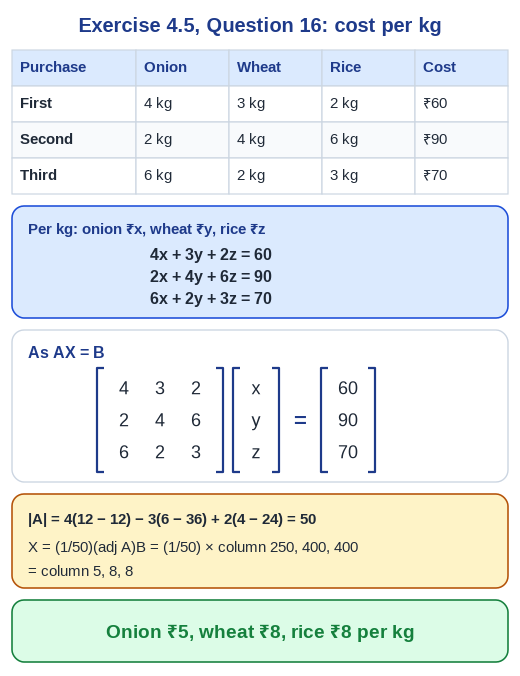
16. “The cost of 4 kg onion, 3 kg wheat and 2 kg rice is ₹ 60. The cost of 2 kg onion, 4 kg wheat and 6 kg rice is ₹ 90. The cost of 6 kg onion 2 kg wheat and 3 kg rice is ₹ 70. Find cost of each item per kg by matrix method.”
Let onion, wheat and rice cost ₹x, ₹y and ₹z per kg. Then 4x + 3y + 2z = 60, 2x + 4y + 6z = 90 and 6x + 2y + 3z = 70.
A = [4, 3, 2; 2, 4, 6; 6, 2, 3], B = [60; 90; 70]. |A| = 4(12 − 12) − 3(6 − 36) + 2(4 − 24) = 0 + 90 − 40 = 50 ≠ 0.
A11 = (4)(3) − (6)(2) = 0, A12 = −[(2)(3) − (6)(6)] = 30, A13 = (2)(2) − (4)(6) = −20
A21 = −[(3)(3) − (2)(2)] = −5, A22 = (4)(3) − (2)(6) = 0, A23 = −[(4)(2) − (3)(6)] = 10
A31 = (3)(6) − (2)(4) = 10, A32 = −[(4)(6) − (2)(2)] = −20, A33 = (4)(4) − (3)(2) = 10
adj A = [0, −5, 10; 30, 0, −20; −20, 10, 10].
X = (1/50)[0 − 450 + 700; 1800 + 0 − 1400; −1200 + 900 + 700] = (1/50)[250; 400; 400] = [5; 8; 8].
Onion costs ₹5 per kg, wheat ₹8 per kg and rice ₹8 per kg. Check: 20 + 24 + 16 = 60, 10 + 32 + 48 = 90 and 30 + 16 + 24 = 70.
Miscellaneous Example 19 (pages 98–99)
Example 19: use the product [1, −1, 2; 0, 2, −3; 3, −2, 4][−2, 0, 1; 9, 2, −3; 6, 1, −2] to solve x − y + 2z = 1, 2y − 3z = 1, 3x − 2y + 4z = 2. The product is
[−2 − 9 + 12, 0 − 2 + 2, 1 + 3 − 4; 0 + 18 − 18, 0 + 4 − 3, 0 − 6 + 6; −6 − 18 + 24, 0 − 4 + 4, 3 + 6 − 8] = [1, 0, 0; 0, 1, 0; 0, 0, 1] = I.
So the second matrix is the inverse of the first, which is the coefficient matrix A of the system. With B = [1; 1; 2]:
X = A⁻¹B = [−2 + 0 + 2; 9 + 2 − 6; 6 + 1 − 4] = [0; 5; 3]. So x = 0, y = 5, z = 3.
Miscellaneous Exercise on Chapter 4 (pages 99–100)
1. “Prove that the determinant |x, sin θ, cos θ; −sin θ, −x, 1; cos θ, 1, x| is independent of θ.”
Along the first row:
Δ = x(−x² − 1) − sin θ(−x sin θ − cos θ) + cos θ(−sin θ + x cos θ)
= −x³ − x + x sin² θ + sin θ cos θ − sin θ cos θ + x cos² θ
= −x³ − x + x(sin² θ + cos² θ) = −x³ − x + x = −x³.
Δ = −x³, which has no θ in it, so the determinant is independent of θ.
2. “Evaluate |cos α cos β, cos α sin β, −sin α; −sin β, cos β, 0; sin α cos β, sin α sin β, cos α|.”
Expand along the third column, which has a zero: Δ = (−sin α)A13 + 0 + (cos α)A33.
A13 = |−sin β, cos β; sin α cos β, sin α sin β| = −sin α sin² β − sin α cos² β = −sin α
A33 = |cos α cos β, cos α sin β; −sin β, cos β| = cos α cos² β + cos α sin² β = cos α
Δ = (−sin α)(−sin α) + (cos α)(cos α) = sin² α + cos² α = 1.
3. “If A⁻¹ = [3, −1, 1; −15, 6, −5; 5, −2, 2] and B = [1, 2, −2; −1, 3, 0; 0, −2, 1], find (AB)⁻¹”
(AB)⁻¹ = B⁻¹A⁻¹, so find B⁻¹ first. |B| = 1(3 − 0) − 2(−1 − 0) + (−2)(2 − 0) = 3 + 2 − 4 = 1 ≠ 0.
B11 = (3)(1) − (0)(−2) = 3, B12 = −[(−1)(1) − (0)(0)] = 1, B13 = (−1)(−2) − (3)(0) = 2
B21 = −[(2)(1) − (−2)(−2)] = 2, B22 = (1)(1) − (−2)(0) = 1, B23 = −[(1)(−2) − (2)(0)] = 2
B31 = (2)(0) − (−2)(3) = 6, B32 = −[(1)(0) − (−2)(−1)] = 2, B33 = (1)(3) − (2)(−1) = 5
adj B = [3, 2, 6; 1, 1, 2; 2, 2, 5], and since |B| = 1, B⁻¹ = [3, 2, 6; 1, 1, 2; 2, 2, 5].
B⁻¹A⁻¹ = [9 − 30 + 30, −3 + 12 − 12, 3 − 10 + 12; 3 − 15 + 10, −1 + 6 − 4, 1 − 5 + 4; 6 − 30 + 25, −2 + 12 − 10, 2 − 10 + 10]
(AB)⁻¹ = [9, −3, 5; −2, 1, 0; 1, 0, 2].
4. “Let A = [1, −2, 1; −2, 3, 1; 1, 1, 5]. Verify that (i) [adj A]⁻¹ = adj (A⁻¹) (ii) (A⁻¹)⁻¹ = A”
|A| = 1(15 − 1) − (−2)(−10 − 1) + 1(−2 − 3) = 14 − 22 − 5 = −13 ≠ 0.
A11 = (3)(5) − (1)(1) = 14, A12 = −[(−2)(5) − (1)(1)] = 11, A13 = (−2)(1) − (3)(1) = −5
A21 = −[(−2)(5) − (1)(1)] = 11, A22 = (1)(5) − (1)(1) = 4, A23 = −[(1)(1) − (−2)(1)] = −3
A31 = (−2)(1) − (1)(3) = −5, A32 = −[(1)(1) − (1)(−2)] = −3, A33 = (1)(3) − (−2)(−2) = −1
adj A = [14, 11, −5; 11, 4, −3; −5, −3, −1], and A⁻¹ = (−1/13)[14, 11, −5; 11, 4, −3; −5, −3, −1] = (1/13)[−14, −11, 5; −11, −4, 3; 5, 3, 1].
(i) Left side. Write C = adj A. |C| = 14(−4 − 9) − 11(−11 − 15) + (−5)(−33 + 20) = −182 + 286 + 65 = 169. Its cofactors:
C11 = (4)(−1) − (−3)(−3) = −13, C12 = −[(11)(−1) − (−3)(−5)] = 26, C13 = (11)(−3) − (4)(−5) = −13
C21 = −[(11)(−1) − (−5)(−3)] = 26, C22 = (14)(−1) − (−5)(−5) = −39, C23 = −[(14)(−3) − (11)(−5)] = −13
C31 = (11)(−3) − (−5)(4) = −13, C32 = −[(14)(−3) − (−5)(11)] = −13, C33 = (14)(4) − (11)(11) = −65
So [adj A]⁻¹ = (1/169)[−13, 26, −13; 26, −39, −13; −13, −13, −65] = (1/13)[−1, 2, −1; 2, −3, −1; −1, −1, −5].
Right side. A⁻¹ = (1/13)D with D = [−14, −11, 5; −11, −4, 3; 5, 3, 1]. Every cofactor of A⁻¹ is a determinant of order 2, so it carries the factor (1/13)² = 1/169 times the matching cofactor of D:
D11 = (−4)(1) − (3)(3) = −13, D12 = −[(−11)(1) − (3)(5)] = 26, D13 = (−11)(3) − (−4)(5) = −13
D21 = −[(−11)(1) − (5)(3)] = 26, D22 = (−14)(1) − (5)(5) = −39, D23 = −[(−14)(3) − (−11)(5)] = −13
D31 = (−11)(3) − (5)(−4) = −13, D32 = −[(−14)(3) − (5)(−11)] = −13, D33 = (−14)(−4) − (−11)(−11) = −65
So adj(A⁻¹) = (1/169)[−13, 26, −13; 26, −39, −13; −13, −13, −65] = (1/13)[−1, 2, −1; 2, −3, −1; −1, −1, −5].
Both sides are the same matrix, so [adj A]⁻¹ = adj(A⁻¹).
(ii) (A⁻¹)⁻¹ = (1/|A⁻¹|) adj(A⁻¹). Since |A| |A⁻¹| = |I| = 1, |A⁻¹| = 1/(−13) = −1/13. So
(A⁻¹)⁻¹ = (−13) × (1/13)[−1, 2, −1; 2, −3, −1; −1, −1, −5] = [1, −2, 1; −2, 3, 1; 1, 1, 5] = A.
So (A⁻¹)⁻¹ = A.
5. “Evaluate |x, y, x + y; y, x + y, x; x + y, x, y|”
Along the first row:
Δ = x[(x + y)y − x²] − y[y² − x(x + y)] + (x + y)[xy − (x + y)²]
= x(xy + y² − x²) − y(y² − x² − xy) + (x + y)(−x² − xy − y²)
= (x²y + xy² − x³) + (−y³ + x²y + xy²) − (x + y)(x² + xy + y²)
= 2x²y + 2xy² − x³ − y³ − (x³ + 2x²y + 2xy² + y³)
= −2x³ − 2y³ = −2(x³ + y³).
6. “Evaluate |1, x, y; 1, x + y, y; 1, x, x + y|”
Along the first column:
Δ = 1[(x + y)(x + y) − xy] − 1[x(x + y) − xy] + 1[xy − y(x + y)]
= (x² + xy + y²) − x² + (−y²) = xy.
7. “Solve the system of equations 2/x + 3/y + 10/z = 4, 4/x − 6/y + 5/z = 1, 6/x + 9/y − 20/z = 2”
Put u = 1/x, v = 1/y and w = 1/z. The system becomes linear: 2u + 3v + 10w = 4, 4u − 6v + 5w = 1, 6u + 9v − 20w = 2.
A = [2, 3, 10; 4, −6, 5; 6, 9, −20], B = [4; 1; 2]. |A| = 2(120 − 45) − 3(−80 − 30) + 10(36 + 36) = 150 + 330 + 720 = 1200 ≠ 0.
A11 = (−6)(−20) − (5)(9) = 75, A12 = −[(4)(−20) − (5)(6)] = 110, A13 = (4)(9) − (−6)(6) = 72
A21 = −[(3)(−20) − (10)(9)] = 150, A22 = (2)(−20) − (10)(6) = −100, A23 = −[(2)(9) − (3)(6)] = 0
A31 = (3)(5) − (10)(−6) = 75, A32 = −[(2)(5) − (10)(4)] = 30, A33 = (2)(−6) − (3)(4) = −24
adj A = [75, 150, 75; 110, −100, 30; 72, 0, −24].
[u; v; w] = (1/1200)[300 + 150 + 150; 440 − 100 + 60; 288 + 0 − 48] = (1/1200)[600; 400; 240] = [1/2; 1/3; 1/5].
So 1/x = 1/2, 1/y = 1/3 and 1/z = 1/5: x = 2, y = 3, z = 5.
8. “If x, y, z are nonzero real numbers, then the inverse of matrix A = [x, 0, 0; 0, y, 0; 0, 0, z] is (A) [x⁻¹, 0, 0; 0, y⁻¹, 0; 0, 0, z⁻¹] (B) xyz [x⁻¹, 0, 0; 0, y⁻¹, 0; 0, 0, z⁻¹] (C) (1/xyz) [x, 0, 0; 0, y, 0; 0, 0, z] (D) (1/xyz) [1, 0, 0; 0, 1, 0; 0, 0, 1]”
|A| = x(yz − 0) = xyz ≠ 0. The cofactors off the diagonal are all 0, and A11 = yz, A22 = xz, A33 = xy, so adj A = [yz, 0, 0; 0, xz, 0; 0, 0, xy].
A⁻¹ = (1/xyz)[yz, 0, 0; 0, xz, 0; 0, 0, xy] = [1/x, 0, 0; 0, 1/y, 0; 0, 0, 1/z] = [x⁻¹, 0, 0; 0, y⁻¹, 0; 0, 0, z⁻¹]. Answer: (A).
9. “Let A = [1, sin θ, 1; −sin θ, 1, sin θ; −1, −sin θ, 1], where 0 ≤ θ ≤ 2π. Then (A) Det (A) = 0 (B) Det (A) ∈ (2, ∞) (C) Det (A) ∈ (2, 4) (D) Det (A) ∈ [2, 4]”
Along the first row:
Det(A) = 1(1 + sin² θ) − sin θ(−sin θ + sin θ) + 1(sin² θ + 1) = 2 + 2 sin² θ.
For 0 ≤ θ ≤ 2π, sin² θ takes every value from 0 to 1, both included. So Det(A) runs from 2 to 4, both included: Det(A) ∈ [2, 4]. Answer: (D).
A note on this edition
This is the rationalised book (marked Reprint 2026-27). The section on properties of determinants is not in this edition, so every determinant above is found by expanding along a row or a column. Some printed lines are left over from the older book and can be ignored:
- The chapter introduction and the summary still mention “properties of determinants”, although that section is gone.
- On page 85, the Remark points to “Example 21”; it means Example 10 on the same page.
- In the Miscellaneous Exercise (pages 99–100), the headings “Using properties of determinants in Exercises 11 to 15, prove that:” and “Choose the correct answer in Exercise 17 to 19.” carry old question numbers. The exercise now has 9 questions, and Questions 8 and 9 are the multiple-choice ones.
- In Exercise 4.5, Question 4, the book’s answer “Consistent” needs a ≠ 0, which the third equation already forces.
Practice
-
The value of |5, 2; 3, 4| is:
Show answer
Answer: (b) 14
-
The area of the triangle with vertices (0, 0), (4, 0) and (0, 6) is:
Show answer
Answer: (c) 12 sq. units
-
If A is a 3 × 3 matrix with |A| = 5, then |adj A| equals:
Show answer
Answer: (d) 25
-
Find the inverse of A = [4, 7; 1, 2].
Show answer
Answer: |A| = 4 × 2 − 7 × 1 = 1 ≠ 0, so A⁻¹ exists. For a 2 × 2 matrix, adj A swaps the diagonal entries and changes the signs of the other two: adj A = [2, −7; −1, 4]. So A⁻¹ = (1/1) adj A = [2, −7; −1, 4].
-
Solve x + y = 5, 2x − y = 1 by the matrix method.
Show answer
Answer: A = [1, 1; 2, −1], B = [5; 1]. |A| = −1 − 2 = −3 ≠ 0. adj A = [−1, −1; −2, 1]. X = A⁻¹B = (−1/3)[−5 − 1; −10 + 1] = (−1/3)[−6; −9] = [2; 3]. So x = 2 and y = 3.
Stuck on a question?
Take a photo and Lagnever AI explains it step by step. Try it for 7 days for ₹2.
Get it on Google Play Open in browser
For parents: after the trial, the plan renews monthly by UPI or card autopay. You can cancel anytime in the app.